
City Government
Homeless Housing on Public Land at East 12th Street
On August 2 residents will be relocated to a portion of the same East 12th Street remainder parcel and will stay on-site until the program opens. Residents have been offered priority, first placement in the program. Others will receive temporary housing in other programs.

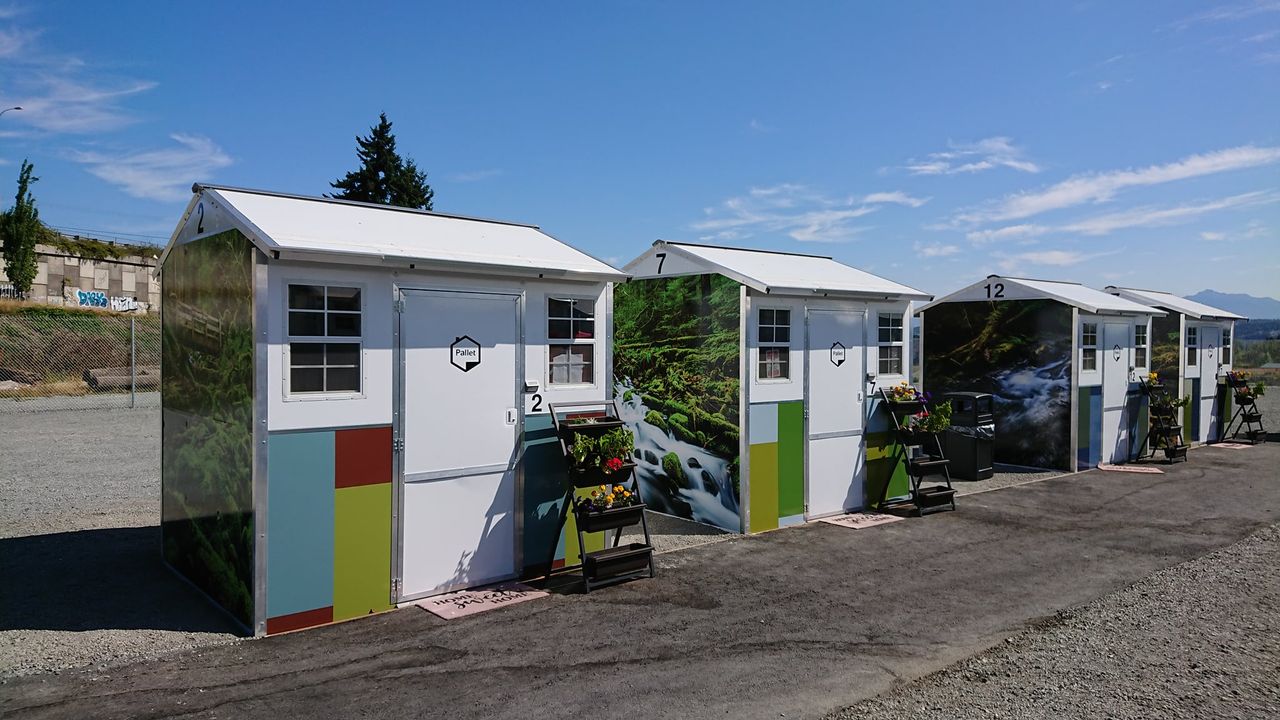
The following are Oakland Council President Nikki Fortunato Bas’s recent answers to questions about building homeless housing at a city-owned parcel at East 12th Street and Second Avenue. The answers have been edited for clarity and brevity.


Nikki Fortunato Bas
What is this project?
Informed by the experiences of our unsheltered neighbors and by homeless advocates, (Nikki Bas’s) District 2 team has been working closely with city departments and Housing Consortium of the East Bay (HCEB) to develop a large-scale homelessness intervention on the city-owned parcel at East 12th Street and 2nd Avenue. The project would:
- Provide temporary housing and comprehensive, trauma-informed/harm reduction services, serving high-needs District 2 unhoused residents, providing them permanent housing.
- Provide “tiny home” PalletShelter structures for up to 65 homeless residents and support services including healthcare and housing navigation.
- On the same parcel, a co-governed program supported by provider Tiny Logic will house 14 residents in PalletShelters.
What is the project timeline?
We expect construction to begin on this project on August 4 and for individuals to move into the Pallet Shelters as early as this fall.
How will individuals be selected or approached for participation in the program?
The city has been coordinating outreach to encampments in the immediate geographic area, prioritizing larger encampments near Lake Merritt and East 12th Street.
Where will the current residents living on the East 12th remainder parcel move when construction begins this week?
On August 2 residents will be relocated to a portion of the same East 12th Street remainder parcel and will stay on-site until the program opens. Residents have been offered priority, first placement in the program. Others will receive temporary housing in other programs.
How are you incorporating wrap-around services into the program?
Staff from HCEB will employ trauma-informed and harm-reduction wrap-around services and care, working closely with each resident to provide case management that fits their individual needs.
How will safety and privacy be maintained for residents and the surrounding community?
HCEB will hire security professionals to secure the site daily, and the adjacent co-governed program supported will have residents providing their own security. The site will also be secured by a keypad for entry/exit, a 6-foot fence to provide privacy, and ample lighting.
What are the “Community Agreements” for the program and residents?
The service provider, HCEB, will draft Community Agreements to ensure that safety, restorative justice, well-being and community-building are prioritized at the site. Residents will provide input and agree to these terms and will be asked to leave if rules are violated.
What is the best way for neighbors to support the program?
Our project will feature a “Community Council,” a group of stakeholders, including housed residents, nearby business owners, advocates, faith leaders and others, to provide ongoing guidance, community participation, and support. Email lsalaverry@oaklandca.gov to get involved.
Is there a plan for site beautification?
Bas’s office is working with potential partners, students and teachers at nearby schools and community groups, on murals and beautification efforts. Email lsalaverry@oaklandca.gov information.
What plans are there for noise, dust/debris mitigation during construction?
Site preparation/construction will consist of grading the parcel; this process will be minimally invasive and short. Assembly of PalletShelters will also be relatively simple. Each structure can be set up within 45 minutes, not requiring heavy equipment.
What are the future plans for this parcel, previously slated for development of the LakeHouse Commons Project?
The Lakehouse Commons Project, approved in 2016, is a mixed-use housing project by developers UrbanCore and the East Bay Asian Local Development Corporation (EBALDC). The group has missed several construction deadlines and has received six separate extensions or updates. The most recent extension means that – if they are able to confirm their financing – the project would not begin for at least one year. A city staff update will be available in August.
The Oakland Post’s coverage of local news in Alameda County is supported by the Ethnic Media Sustainability Initiative, a program created by California Black Media and Ethnic Media Services to support community newspapers across California.






Activism
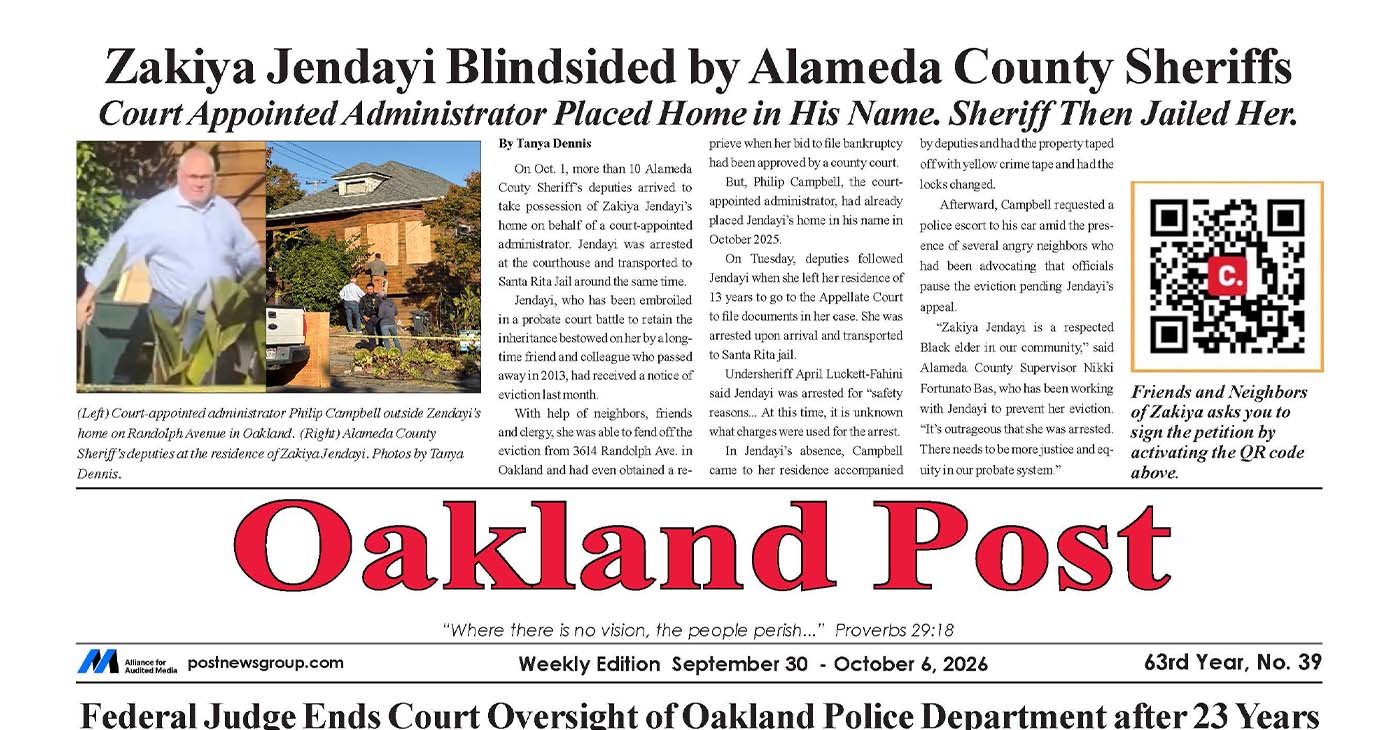
Oakland Post: Week of September 30 – October 6, 2026
The printed Weekly Edition of the Oakland Post: Week of September 30 – October 6, 2026

To enlarge your view of this issue, use the slider, magnifying glass icon or full page icon in the lower right corner of the browser window.

Activism
Oakland Post: Week of September 23 – 29, 2026
The printed Weekly Edition of the Oakland Post: Week of September 23 – 29, 2026

To enlarge your view of this issue, use the slider, magnifying glass icon or full page icon in the lower right corner of the browser window.
Activism
Oakland Post: Week of September 16 – 22, 2026
The printed Weekly Edition of the Oakland Post: Week of September 16 – 22, 2026

To enlarge your view of this issue, use the slider, magnifying glass icon or full page icon in the lower right corner of the browser window.



Listening as a Lifeline: A Doula’s Witness to Black Maternal Health

New Protections for Ticket Buyers: Gov. Newsom Signs Assemblymember Isaac Bryan’s Bill

‘We Don’t Talk Trash — We Pick Up Trash!’

Zakiya Jendayi Arrested, Locked Out of Home by Sheriff’s Deputies

Oakland Post: Week of September 30 – October 6, 2026

Asm. Corey Jackson Announces Launch of 24-Hour Childcare in His District

IN MEMORIAM: The Rev. Leon “Sonny” Clark, Longtime Orange County Pastor and Community Leader, Dies at 72

Poll: Becerra Widens His Lead Over Hilton; Californians Split on Wealth Tax

From Historic Memories to New Possibilities: Oakland Celebrates Coliseum 60

County Office of Education Says OUSD Finances Are Getting Healthier, Materially Stronger

LIVE FREE Sunday Dinner Brings Faith, Fellowship and Civic Conversation to Oakland

Remembering Chauncey Bailey as Student Journalists Face Threats to Truth-Telling

BLACspace Cooperative Invites Bay Area to Experience Oakland’s Black Cultural Ecosystem Through a BLAC Map Tour + Party

In Wake of Death on Doorstep, Williams Chapel Baptist Church Calls for Better Care, Funding for Unhoused

Oakland Centenarian Nuna McKee Honored!

Standoff for Justice: Our Homes Are Worth Fighting For

Oakland Post: Week of August 26 – September 1, 2026

Frontier Airlines’ Return to Oakland Airport Brings Flights, Jobs and Opportunity

Gubernatorial Candidate Steve Hilton Blasts California New Tire Rules; Newsom Hits Back

Chef Sharon Lee Blends Culinary Excellence, Education and Empowerment

Jackie Wright Champions Bay Area Stories, Filmmakers and Cultural Institutions

Misnamed ‘Parent’ PAC Seeks to Influence Oakland School Board Elections

Oakland Coliseum Project Opens Door for Small Businesses to Build Bigger

Big City Mayors Ask for “Yes” Vote on Housing Bond Measure; Conservatives Say “No”

Gov. Newsom’s Latest Appointees Include Sacramento Advocate for Formerly Incarcerated Students; State’s New Tech Chief

Longtime BWOPA Member Brendalyn Goodall Appointed to California Workforce Development Board

Gov. Newsom Signs Law Shielding Immigration Aid Workers From Doxing Threats

Secretary of State Shirley N. Weber Urges Californians to Vote Early as Voter ID Battle Intensifies

Oakland Post: Week of September 2 – 8, 2026

IN MEMORIAM: Dolly Parton Dead at 80 — How She Built a Legacy of Love and Earned Her Place in Black Culture

The Conversation With Al McFarlane 6/23/26

Media Monday 6/22/26

LIVE! ASK ALMA! — TUES. 6.23.26 7PM EST

Car Buying Secrets: 4 Hidden Checks Before You Sign!

Is This 550 HP Charger Worth YOUR Money? AutoNetwork Review

Celebrating Juneteenth – Frederick Douglass on education and resistance

LIVE! — ASK ALMA! — TUES. 6.19.26 7PM EST

Hyundai Ioniq 5 Parking, Safety, and 360 View #shorts

2025 Ioniq 5 New Wiper & Powerful Performance! #shorts

Electric SUV Range: Is 259 Miles Enough? #shorts

EV Charging: How Fast Can You Charge an Electric Vehicle? #shorts

Biometric Cooling… Messaging Seats…Come on! 2025 Infiniti QX80 Autograph 4WD

Charged Up: Witness the Magic of a Fully Electric Car! #shorts

Range Rover Sport PHEV Included…: See What’s Inside This Luxury SUV! #shorts

Invisible Hood View: Perfect Parking with X-Ray Vision! #shorts
-
 Community3 weeks ago
Misnamed ‘Parent’ PAC Seeks to Influence Oakland School Board Elections
-
 Activism4 weeks ago
Oakland Post: Week of September 2 – 8, 2026
-

 Community3 weeks ago
Richmond Tiny House Village Farm & Garden Set to Open Gates on Sept. 26
-

 Activism3 weeks ago
Oakland Post: Week of September 9 – 15, 2026
-

 Black History3 weeks ago
Latest Massacre in Haiti Reveals Cruelty U.S. Deportations
-

 Black History3 weeks ago
OPINION: Nolan Wells’ Death One of Several Signifying Racial Terror Lives on in U.S. South
-

 Community3 weeks ago
Democratic Clubs Interview Candidates for Oakland School Board
-

 Business2 weeks ago
Mayor Lee Announces $1 Million Kaiser Permanente Grant for Pilot Program to Address Homelessness, Clean Up Public Spaces throughout Oakland
