
Bay Area
Holistic Health Practices Aimed at Preventing Cancer

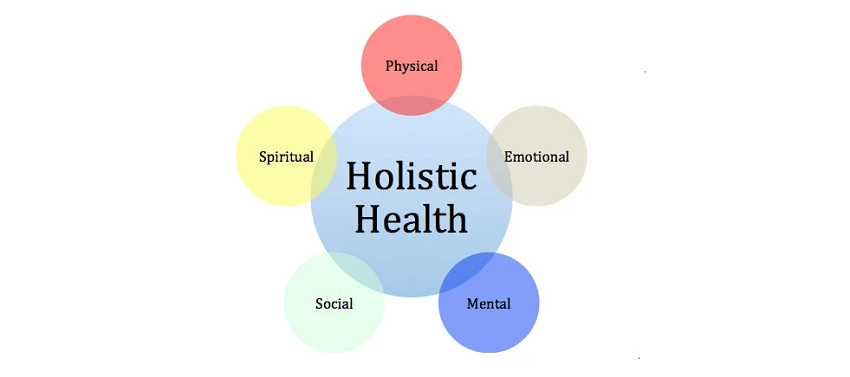
The term holistic health has been bandied about for many years with many people preferring to call it Alternative Health, which suggests something other than what holistic truly means.
With traditional, allopathic medicine dividing the body into parts or “specialties” like heart, bones, etc., some people prefer the description, ‘Alternative,’ which gives an innocuous meaning and usually refers to chiropractic, massage or acupuncture. It does not provide the actual truth about how bodies function holistically.
It doesn’t take into consideration that the body is an electrical system that communicates with all of its parts. The real explanation of holistic is the balance of mind, body and spirit with the attributes all working together.
Assuming our systems don’t operate as a whole can be likened to the fact that the same medicine can be administered to millions of people knowing full well that all of us have different metabolisms and DNA. It makes no sense.
In the last few centuries, we’ve been trained to be cut off from our natural environment — The Earth — our feelings and how much we’re connected to nature’s calming attributes. We’ve not accepted the idea that an imbalance in the emotions or our spirit has as strong a voice as physical pain or that disease can manifest from an anxious mind or unhappiness. We tend to block these things out of our consciousness, yet, our minds greatly influence disease.
Recognizing the need to eat purely grown food from the earth, Max Gerson was the first to test how foods reacted in the body, coming to the conclusion that a vegetarian diet was the most healing. His daughter Charlotte, who now runs his cancer clinic in Mexico says, “Emotions play a significant role in the cause of cancer. If someone comes to us to heal their cancer, I make sure both the husband and wife come together. There’s always one who gets the cancer and one who causes it. If they won’t agree to counseling, I refuse to take them as patients.”
Futurist Jacque Fresco of the Venus Project designs his ecological cities by studying the human body. Understanding that we need clean water and air and the calming trees and plants that nature provides, his cities are purposely created to enhance the symbiotic relationship between man and the earth.
Nature has everything we need to heal ourselves. If we buy organically grown foods without pesticides and become educated about the healing attributes of the herbs and plants that nature provides us, we will begin to treat our bodies directly from the earth, instead of using drugs that target only specific areas often causing devastating, long term side effects.
The fact that we have lost respect and spiritual connection to the earth has caused the environmental catastrophes we are now experiencing. It’s difficult to avoid cancer and disease because the earth itself has cancer. Restoring the idea that we must have this important balance of mind, body and spirit is necessary not only for own healing, it’s important for the survival of our planet.
Lexie Ross is a civil rights and peace activist who began her career as a journalist in Georgia in 1981. Ross’ passion for finding natural, pain-free cures for cancer led her to pioneer the first articles in Atlanta about the dangers of aspartame, fluoride, pesticides, vaccines, electronic pollution and other toxic additives used in our foods and cosmetics. She also produced her own Health Frontiers Radio Show. She teaches the necessity of eating organically grown greens and vegetables cultivated in enzyme-rich, organic soil, along with the benefits of taking vitamins and herbs. She has written a handbook, The Hidden Truths About Preventing Cancer.



Activism
Oakland Post: Week of September 23 – 29, 2026
The printed Weekly Edition of the Oakland Post: Week of September 23 – 29, 2026


To enlarge your view of this issue, use the slider, magnifying glass icon or full page icon in the lower right corner of the browser window.

Activism
Oakland Post: Week of September 16 – 22, 2026
The printed Weekly Edition of the Oakland Post: Week of September 16 – 22, 2026

To enlarge your view of this issue, use the slider, magnifying glass icon or full page icon in the lower right corner of the browser window.
Activism
Oakland Post: Week of September 9 – 15, 2026
The printed Weekly Edition of the Oakland Post: Week of September 9 – 15, 2026
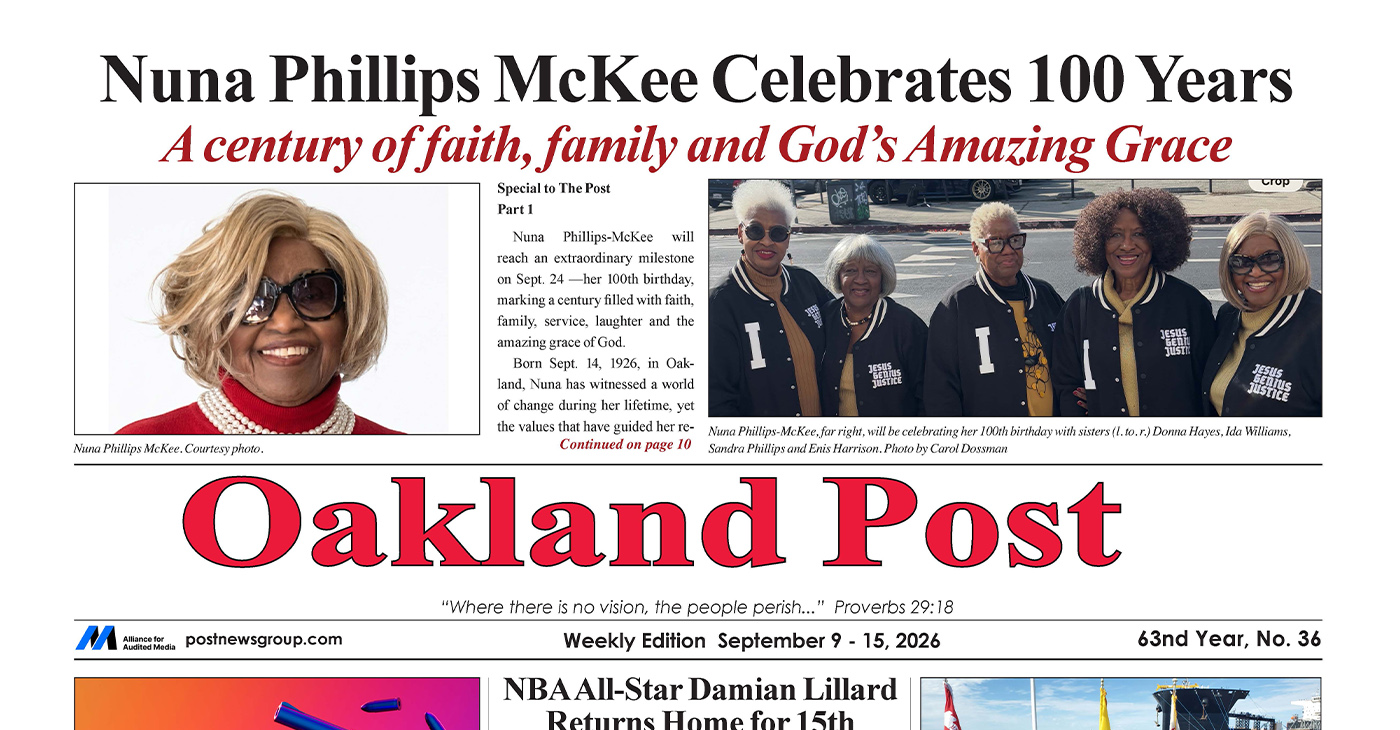
To enlarge your view of this issue, use the slider, magnifying glass icon or full page icon in the lower right corner of the browser window.


Asm. Corey Jackson Announces Launch of 24-Hour Childcare in His District

IN MEMORIAM: The Rev. Leon “Sonny” Clark, Longtime Orange County Pastor and Community Leader, Dies at 72

Poll: Becerra Widens His Lead Over Hilton; Californians Split on Wealth Tax

From Historic Memories to New Possibilities: Oakland Celebrates Coliseum 60

County Office of Education Says OUSD Finances Are Getting Healthier, Materially Stronger

LIVE FREE Sunday Dinner Brings Faith, Fellowship and Civic Conversation to Oakland

Remembering Chauncey Bailey as Student Journalists Face Threats to Truth-Telling

BLACspace Cooperative Invites Bay Area to Experience Oakland’s Black Cultural Ecosystem Through a BLAC Map Tour + Party

In Wake of Death on Doorstep, Williams Chapel Baptist Church Calls for Better Care, Funding for Unhoused

Oakland Centenarian Nuna McKee Honored!

Caribbean Nations Produce Action Plan Calling for UK Reparations Over Slavery

Oakland Post: Week of September 23 – 29, 2026

Doulas Are Helping Black California Moms Navigate Pregnancy–Even as High Mortality Rates Persist

Newsom Signs Addictive Social Media Law to Protect Kids

On Your November Ballot: Prop 38 Would Allocate $8.4 Billion to Immunology and Immunotherapy Funding

Standoff for Justice: Our Homes Are Worth Fighting For

Oakland Post: Week of August 26 – September 1, 2026

Frontier Airlines’ Return to Oakland Airport Brings Flights, Jobs and Opportunity

Gubernatorial Candidate Steve Hilton Blasts California New Tire Rules; Newsom Hits Back

Chef Sharon Lee Blends Culinary Excellence, Education and Empowerment

Jackie Wright Champions Bay Area Stories, Filmmakers and Cultural Institutions

Big City Mayors Ask for “Yes” Vote on Housing Bond Measure; Conservatives Say “No”

Oakland Coliseum Project Opens Door for Small Businesses to Build Bigger

Gov. Newsom’s Latest Appointees Include Sacramento Advocate for Formerly Incarcerated Students; State’s New Tech Chief

Misnamed ‘Parent’ PAC Seeks to Influence Oakland School Board Elections

Longtime BWOPA Member Brendalyn Goodall Appointed to California Workforce Development Board

Gov. Newsom Signs Law Shielding Immigration Aid Workers From Doxing Threats

Secretary of State Shirley N. Weber Urges Californians to Vote Early as Voter ID Battle Intensifies

From Palestine to Oakland: Seeds for Liberation Examines Shared Struggles for Freedom

IN MEMORIAM: Dolly Parton Dead at 80 — How She Built a Legacy of Love and Earned Her Place in Black Culture

The Conversation With Al McFarlane 6/23/26

Media Monday 6/22/26

LIVE! ASK ALMA! — TUES. 6.23.26 7PM EST

Car Buying Secrets: 4 Hidden Checks Before You Sign!

Is This 550 HP Charger Worth YOUR Money? AutoNetwork Review

Celebrating Juneteenth – Frederick Douglass on education and resistance

LIVE! — ASK ALMA! — TUES. 6.19.26 7PM EST

Hyundai Ioniq 5 Parking, Safety, and 360 View #shorts

2025 Ioniq 5 New Wiper & Powerful Performance! #shorts

Electric SUV Range: Is 259 Miles Enough? #shorts

EV Charging: How Fast Can You Charge an Electric Vehicle? #shorts

Biometric Cooling… Messaging Seats…Come on! 2025 Infiniti QX80 Autograph 4WD

Charged Up: Witness the Magic of a Fully Electric Car! #shorts

Range Rover Sport PHEV Included…: See What’s Inside This Luxury SUV! #shorts

Invisible Hood View: Perfect Parking with X-Ray Vision! #shorts
-
 Community2 weeks ago
Misnamed ‘Parent’ PAC Seeks to Influence Oakland School Board Elections
-

 Activism3 weeks ago
Oakland Post: Week of September 2 – 8, 2026
-

 Community2 weeks ago
Richmond Tiny House Village Farm & Garden Set to Open Gates on Sept. 26
-

 Black History2 weeks ago
Latest Massacre in Haiti Reveals Cruelty U.S. Deportations
-

 Activism2 weeks ago
Oakland Post: Week of September 9 – 15, 2026
-

 Black History2 weeks ago
OPINION: Nolan Wells’ Death One of Several Signifying Racial Terror Lives on in U.S. South
-

 Community2 weeks ago
Democratic Clubs Interview Candidates for Oakland School Board
-
 Featured2 weeks ago
‘Ready to See These Bills Become Law’: Sen. Weber’s Package of 15 Bills Advance to Gov. Newsom’s Desk
