
Activism
Healing Domestic Violence: “It has to be Heart Stuff’
Black people must learn to “leverage our allies in support of our goals,” even if those allies aren’t Black. She explained that others could and are willing to give resources, but she is an advocate for Black people setting their own agenda.


Charlene Muhammad | Special to the Oakland Post
Wilhelmenia “Mina” Wilson, executive director of Healthy Black Families, Inc., in Berkeley grew in a nuclear family in the Bay Area.
Her parents met in college and were each other’s first love. Still, there was trauma.
As Ms. Wilson grew older, she went through her own traumatic experiences. As a young woman, she, too, became a victim to domestic violence.
“The only way I was able to save myself was to remove myself. And not only did I leave the environment, but he knew where I worked. I left my job. I left and created a new life for myself,” she said. “And in removing myself, what I had to do also was stay by myself until I could heal myself. And that took some years.”
To overcome her trauma, Wilson employed some of the techniques she now shares with others as the executive director of Healthy Black Families, Inc.
“I had to learn myself. I had to unpack my trauma. I had to learn to love myself again. And then that allowed me to navigate relationships in a different way,” she said. “So, I’m not really talking from what I think. I’m really talking from what I know, from my own personal experience, and I’d love to try this and see if it works successfully at a macro level as it did for me on a micro one.”

In an interview with Post News Group, Ms. Wilson provided her views on the root causes of domestic violence and proposed several viable solutions.
“When you subject people to lack of human dignity, when people don’t have their basic needs met, that begets a lot of different types of negative behaviors,” she said.
She attributed the causes of domestic violence to how the capitalist system sometimes devalues Black people, and Black women in particular — both of which, from her view, are rooted in slavery. Black women were a commodity, and Black men were vulnerable because they could not protect Black women and were slaughtered when they attempted to, she said.
Fast forward to 2022 and the “same type of socioeconomic structure exists today as it did then. Black poverty is high. Black unemployment is high. Black folks still are fewer as far as home ownership,” she added.
With that month-to-month struggle for sustenance paired with the lack of options to support people’s needs, “people tend to implode upon each other,” Wilson said.
She said when she thinks about solutions to domestic violence, she thinks about how to detach from the system that wants to manipulate and capitalize on Black people, how to gain deeper knowledge of self and how to create new pathways of life and livelihood.
Some solutions she offered included: tackling poverty and the socioeconomic structure by creating an economy within the Black community and buying Black; supporting underfunded grassroots organizations that are grounded in the community; establishing programs and vocational training for children and the community; getting into agriculture and urban farming; and building infrastructure and offering support services.
Related to the solution on economics, she said Black people must learn to “leverage our allies in support of our goals,” even if those allies aren’t Black. She explained that others could and are willing to give resources, but she is an advocate for Black people setting their own agenda.
Wilson especially noted the importance of mastering self, bringing up Biblical figures like Jesus as examples.
“They had done self-mastery, and they had learned universal law. And they knew how to walk in the world so they could be creative energies,” she said.
She recalled a course she took offered by Dr. Ishmael Tetteh, a spiritual teacher from Ghana, on “soul processing.” Students were asked to make a timeline of their entire lives. Tetteh labeled the painful parts of their lives as “cud,” which is partly digested food that a cow continues to chew on.
“Those painful experiences are like cud in our spirit, and we continue to chew on them. And he said, the goal of this life soul processing is to break apart those cud patches and then redefine them in a way that serves you,” Wilson said.
She said as Black people in America, “all of us have trauma” that need to be unpacked.
Another solution she proposed was creating spaces that are culturally authentic where Black people can heal together. But she said the first step is unpacking the pain that fuels the violence.
“Oftentimes that means you have to move people away from each other so that they can do their own healing,” she said, because “it’s hard to heal with people who have harmed you.”
Necessary infrastructure for her includes safe houses and community-based intervention.
“If it’s a mom and kids, where do we put them while we work out the situation, and with the man who’s doing it, how do we get them into a situation where they can do some anger management rather than criminalize everything?” she questioned.
When Wilson experienced domestic violence, a woman she had been close to helped her out.
“She talked to me, and she was the person who made space for my healing. She let me stay with her for a while. And so, fast forward, years go by, I get my act together. And I think about her, and I go back to her and I’m like, ‘I don’t know how to thank you for what you did for me,’” Wilson recalled.
“And she was like, ‘Girl, what you don’t get is that it’s not even about me.’ She’s like, ‘The only reason that I am here to do this for you is because there was some woman who did it for me.’ And she said, ‘So you don’t owe me anything.’” She said, “‘What you owe is you got to step up and do it for someone else when you see a need.’”
Wilson says she lives her life trying to hold true to that advice.
“And I think we have to proceed with that kind of heart in order to really heal people. It can’t just be tactical stuff. It has to be human stuff. It has to be heart stuff,” she said.





Activism
Oakland Post: Week of March 18 – 24, 2026
The printed Weekly Edition of the Oakland Post: Week of March 18 – 24, 2026
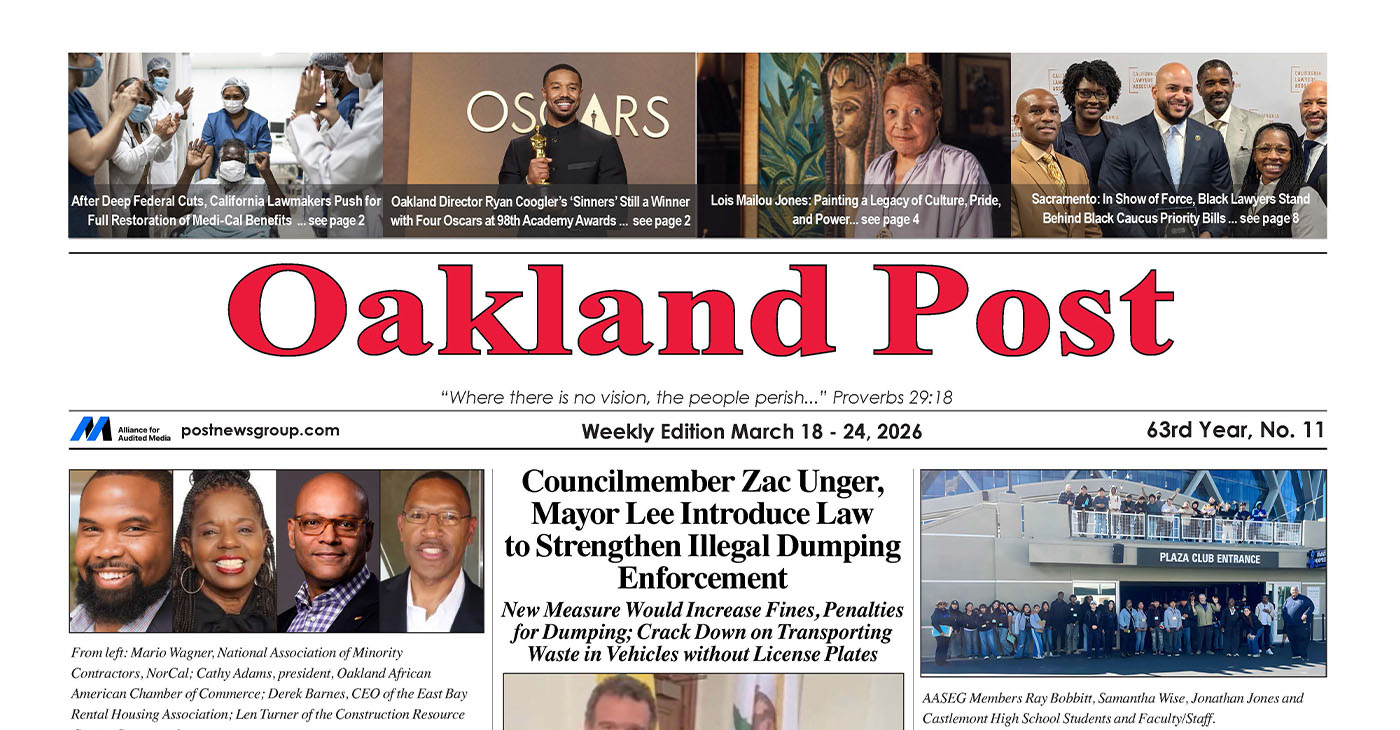
To enlarge your view of this issue, use the slider, magnifying glass icon or full page icon in the lower right corner of the browser window.
Activism
Oakland Post: Week of March 11 -17, 2026
The printed Weekly Edition of the Oakland Post: Week of March 11 – 17, 2026
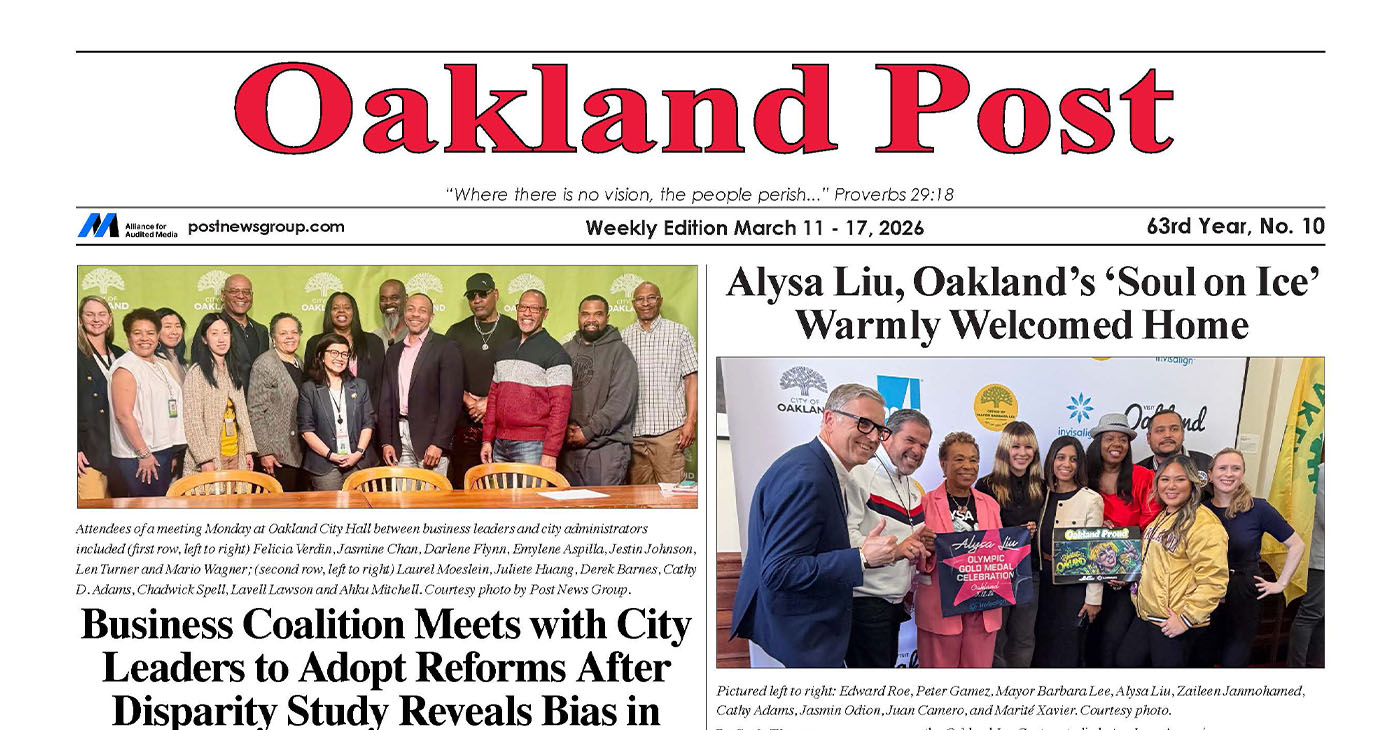
To enlarge your view of this issue, use the slider, magnifying glass icon or full page icon in the lower right corner of the browser window.
Activism
Oakland Post: Week of March 4 – 10, 2026
The printed Weekly Edition of the Oakland Post: Week of March 4 – 10, 2026
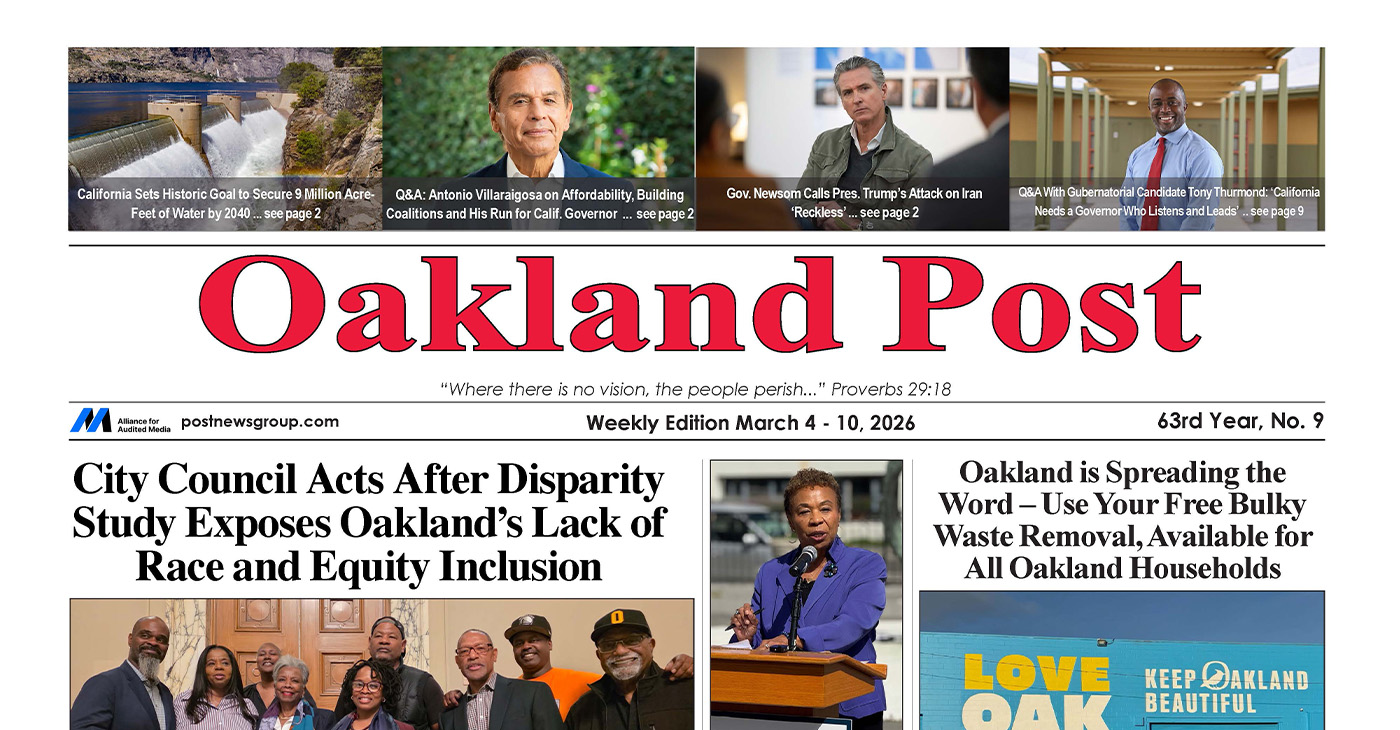
To enlarge your view of this issue, use the slider, magnifying glass icon or full page icon in the lower right corner of the browser window.

WORK FROM HOME
Home-based business with potential monthly income of $10K+ per month. A proven training system and website provided to maximize business effectiveness. Perfect job to earn side and primary income. Contact Lynne for more details: Lynne4npusa@gmail.com 800-334-0540


Black Artists in America, Installation Three Wraps at the Dixon Gallery and Gardens

Grief, Advocacy, and Education: A Counselor Reflects on Black Maternal Health

Future of Florida’s Black History Museum in Limbo

New Research Shows the Many Benefits of Early Learning

South Hampton K-8 Students Among Top 10 Finalists for Samsung’s ‘Solve for Tomorrow’ Competition

Cuba: No Negotiation with US on the President or Political System

Brooklyn Academy of Music Names Jamaican-Born Tamara McCaw as President

Trinidad & Tobego – U.S. Launches WhatsApp Channel for American Citizens in the Country

Oakland Post: Week of March 18 – 24, 2026

AI Innovation vs. Ethics and Environmental Impact

AI, Web3, and Digital Reparations

What If You Owned Your AI Agent?

Season 7, Episode 3 – January Reporter’s Roundtable 📱

Season 7, Episode 3 – January Reporter’s Roundtable

AI, Media, and Power | Part 2, Real-World Impacts and Tradeoffs

Oakland Post: Week of February 11 – 17, 2026

Reflecting on Black History Milestones in Birmingham AL

CITY OF SAN LEANDRO STATE OF CALIFORNIA PUBLIC WORKS DEPARTMENT ENGINEERING DIVISION NOTICE TO BIDDERS FOR ANNUAL STREET OVERLAY/REHABILITATION 2019-21 – PHASE III

Oakland Post: Week of February 18 – 24, 2026

PRESS ROOM: NBA Hall of Fame Nominee Terry Cummings Joins 100 Black Men of DeKalb County to Launch Victory & Values Initiative

Oakland Post: Week of February 25 – March 3, 2026

Trump’s MAGA Allies are Creating Executive Order Plan to Steal the 2026 Midterms

U.S. manufacturing rebounds – how foundry services are adapting to rising demand

OP-ED: One Hundred Years of Black Workers Telling the Truth

Advancements in solar technology that are changing the way we power the world

Chase Oakland Community Center Hosts Alley-Oop Accelerator Building Community and Opportunity for Bay Area Entrepreneurs

Poll Shows Support for Policies That Help Families Afford Child Care

Oakland Post: Week of March 4 – 10, 2026

PRESS ROOM: Civil Rights TV Launches in Selma as the World’s First 24/7 Civil Rights Television Network

Ghana Mourns a Son of the African World

Hyundai Ioniq 5 Parking, Safety, and 360 View #shorts

2025 Ioniq 5 New Wiper & Powerful Performance! #shorts

Electric SUV Range: Is 259 Miles Enough? #shorts

EV Charging: How Fast Can You Charge an Electric Vehicle? #shorts

Biometric Cooling… Messaging Seats…Come on! 2025 Infiniti QX80 Autograph 4WD

Charged Up: Witness the Magic of a Fully Electric Car! #shorts

Range Rover Sport PHEV Included…: See What’s Inside This Luxury SUV! #shorts

Invisible Hood View: Perfect Parking with X-Ray Vision! #shorts

AI Is Reshaping Black Healthcare: Promise, Peril, and the Push for Improved Results in California

ESSAY: Technology and Medicine, a Primary Care Point of View

Sanctuary Cities

The RESISTANCE – FREEDOM NOW

STATE OF THE PEOPLE: Freddie

ECONOMIC BOYCOTT DAY!!!!!

I told You So

-
 #NNPA BlackPress4 weeks ago
Poll Shows Support for Policies That Help Families Afford Child Care
-
 Activism3 weeks ago
Oakland Post: Week of March 4 – 10, 2026
-

 #NNPA BlackPress3 weeks ago
Woman’s Search for Family’s Roots Leads to Ancestor John T. Ward – A Successful Entrepreneur and Conductor on the Underground Railroad
-

 #NNPA BlackPress4 weeks ago
OP-ED: NNPA Launches 2026 “Leadership Matters” Video Series
-

 #NNPA BlackPress3 weeks ago
Advocates Raise Alarm Over ICE Operation, MOU and Detention Risks in Baltimore County
-

 #NNPA BlackPress3 weeks ago
COMMENTARY: Women of Color Shape Our Past and Future
-

 #NNPA BlackPress3 weeks ago
Pete Buttigieg to Join Mayor Randall Woodfin for Community Town Hall in Birmingham
-
 Activism2 weeks ago
Oakland Post: Week of March 11 -17, 2026
