
Bay Area
Governor Newsom Taps Diverse Group for COVID-19 Recovery Task Force

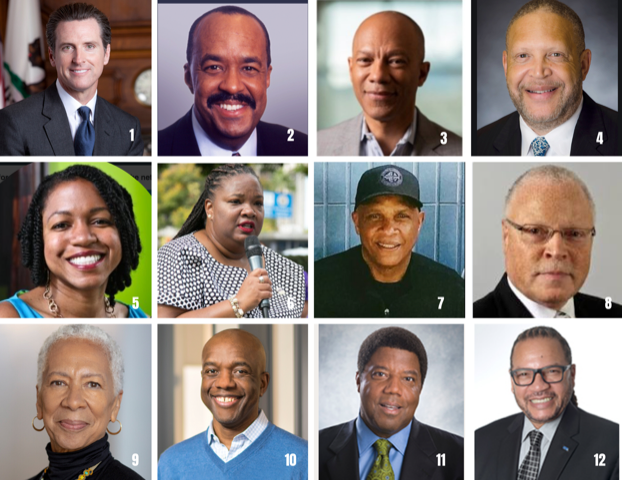
Angela Blackwell, founder and president of Oakland’s PolicyLink, has been named to Gov. Gavin Newsom’s COVID-19 task force.
“It’s been like tons, or gallons, of alcohol was thrown on the open wounds of inequality and racism in this country,” said Blackwell. “And as we think about how to recover, we’re going to have to think about how to make sure that we don’t go back to where we were before.”
Blackwell is the founder and president of the non-profit PolicyLink, a research institute and social action organization that advances racial and economic equity, according to the group’s website.
“It was unacceptable then and it will be unacceptable going forward,” Blackwell continued, pointing out the “painful” economic and health disparities the COVID-19 pandemic has laid bare across the United States and here in California.
She was speaking on April 17 during Newsom’s daily COVID-19 press conference in Sacramento when he appointed Blackwell and 79 other prominent Californians to the state Task Force on Business and Jobs Recovery.
The governor said he is charging the diverse group of social, political and economic leaders to analyze every sector of the state economy and put together a road map to economic recovery. Newsom says he expects the task force to come up with “short-term, medium-term and long-term ideas” to put California on track to once again attain the level of economic prosperity the state had reached before the pandemic: 21 consecutive months of job growth; a $20 billion budget surplus in 2019; and 20 billion more stacked away in the state reserves.

“I have asked and tasked some of the best and brightest minds that we could source — a disproportionate number, almost exclusively, reside right here in the state of California – some of the most well-known business leaders in the world. The great social justice lawyers reside here in the state of California. Tribal leaders. Health care leaders. Small business leaders.”
Tom Steyer, the billionaire businessman, civic leader, and former U.S. presidential candidate will co-chair the task force along with Newsom’s Chief of Staff Ann O’Leary.
Other African-American task force members include Gregory A. Adams, chairman and CEO, Kaiser Foundation Health Plan, Inc., and hospitals; Willie Adams, president, International Longshore and Warehouse Union; E. Toby Boyd, president, California Teachers Association; Stacy Brown-Philpot: CEO, TaskRabbit; Dr. Robert Ross, president and CEO, The California Endowment; among others.
The impact of the global Coronavirus pandemic in California has been deep and far-reaching, hitting the finances, health, and way of life of people across class, race, and geographical lines, but especially so among African Americans and other people of color.
At press time, the coronavirus had claimed the lives of more than 1,000 Californians, and more than 28,000 more across the state had been infected by the deadly virus – with the largest concentration, more than 11,000 people, diagnosed in Los Angeles County alone.
Based on racial data the state has collected so far on mortality rates, a disproportionate number of Black Californians have died from COVID-19: About 12% in a state where African Americans account for 6% of the total population of nearly 40 million people.
About 95 people died of COVID-19 on April 16, the deadliest day since the onset of the pandemic, and a day before the governor announced his economic recovery task force appointments.
Last week, the governor also announced that the state is officially in a “pandemic-induced recession.”
“This pandemic has forced millions of Californians out of jobs – with the most vulnerable hit the hardest,” he said. “We will use a gradual, science-based and data-driven framework to guide our re-opening timing while planning our economic recovery.”
More than 3.1 million Californians have filed for unemployment insurance since March 12, and the state unemployment rate has spiked to 5.3% from under 3% just two months ago. Before the onset of the pandemic, about 2,500 people applied weekly, on average, for unemployment insurance. Over the last few weeks, that weekly average has jumped to more than 200,000.
“This is an amazing moment despite all the suffering,” Blackwell said. “The silver lining could be to finally understand that we cannot go forward as a nation divided as we have been between haves and have-nots.”
Other members the governor appointed to the task force are California Assembly Speaker Anthony Rendon (D-Los Angeles), Senate Minority Leader Shannon Grove (R-Bakersfield), Assembly Minority Leader Marie Waldron (R-Escondido), former Federal Reserve Chair Janet Yellen, Walt Disney Company Executive Chairman Bob Iger, former head of the Small Business Administration Aida Álvarez and dozens of other Californians from sectors, including business, labor, health care, academia and philanthropy.
Gov. Newsom also appointed the state’s four living former governors as honorary members on the task force. They are Hon. Jerry Brown, Hon. Arnold Schwarzenegger, Hon. Gray Davis and Hon. Pete Wilson.
“We need to demonstrate for the nation that it is possible to have a recovery that is transformative, imaginative and radical,” Blackwell emphasized.








Activism
Oakland Post: Week of September 23 – 29, 2026
The printed Weekly Edition of the Oakland Post: Week of September 23 – 29, 2026


To enlarge your view of this issue, use the slider, magnifying glass icon or full page icon in the lower right corner of the browser window.

Activism
Oakland Post: Week of September 16 – 22, 2026
The printed Weekly Edition of the Oakland Post: Week of September 16 – 22, 2026

To enlarge your view of this issue, use the slider, magnifying glass icon or full page icon in the lower right corner of the browser window.
Activism
Oakland Post: Week of September 9 – 15, 2026
The printed Weekly Edition of the Oakland Post: Week of September 9 – 15, 2026

To enlarge your view of this issue, use the slider, magnifying glass icon or full page icon in the lower right corner of the browser window.



Asm. Corey Jackson Announces Launch of 24-Hour Childcare in His District

IN MEMORIAM: The Rev. Leon “Sonny” Clark, Longtime Orange County Pastor and Community Leader, Dies at 72

Poll: Becerra Widens His Lead Over Hilton; Californians Split on Wealth Tax

From Historic Memories to New Possibilities: Oakland Celebrates Coliseum 60

County Office of Education Says OUSD Finances Are Getting Healthier, Materially Stronger

LIVE FREE Sunday Dinner Brings Faith, Fellowship and Civic Conversation to Oakland

Remembering Chauncey Bailey as Student Journalists Face Threats to Truth-Telling

BLACspace Cooperative Invites Bay Area to Experience Oakland’s Black Cultural Ecosystem Through a BLAC Map Tour + Party

In Wake of Death on Doorstep, Williams Chapel Baptist Church Calls for Better Care, Funding for Unhoused

Oakland Centenarian Nuna McKee Honored!

Caribbean Nations Produce Action Plan Calling for UK Reparations Over Slavery

Oakland Post: Week of September 23 – 29, 2026

Doulas Are Helping Black California Moms Navigate Pregnancy–Even as High Mortality Rates Persist

Newsom Signs Addictive Social Media Law to Protect Kids

On Your November Ballot: Prop 38 Would Allocate $8.4 Billion to Immunology and Immunotherapy Funding

Less Affluent School Districts, Including Sacramento City, Face Threat of State Takeover

ESSAY: California Can Close Its Colorectal Cancer Gap

California Hispanic Chambers of Commerce Unveils: ‘Powering the Future’ Theme for 47th Annual Statewide Convention

Four Candidates, Including Incumbent Barbara Lee, Qualify for Oakland Mayor’s Race

Oakland Post: Week of August 12 – 18, 2026

From Blueprint to Breakthrough: Tackling Affordable Housing in Oakland

Oakland Observes Black August with Block Parties, Film Showings, Workshops

COMMENTARY: Why Local School Tax Measure G1 Will Not Be on the November Ballot

Standoff for Justice: Our Homes Are Worth Fighting For

Returning to Its Roots, the Oakland Black-Eyed Pea Festival Partners with the Freedom Farmers Market Sept. 12

Oakland Post: Week of August 26 – September 1, 2026

NPRC Scores First Advocacy Victory: David Shaw Finally Gets His Wish to ‘Go Home’

Frontier Airlines’ Return to Oakland Airport Brings Flights, Jobs and Opportunity

Gubernatorial Candidate Steve Hilton Blasts California New Tire Rules; Newsom Hits Back

Chef Sharon Lee Blends Culinary Excellence, Education and Empowerment

The Conversation With Al McFarlane 6/23/26

Media Monday 6/22/26

LIVE! ASK ALMA! — TUES. 6.23.26 7PM EST

Car Buying Secrets: 4 Hidden Checks Before You Sign!

Is This 550 HP Charger Worth YOUR Money? AutoNetwork Review

Celebrating Juneteenth – Frederick Douglass on education and resistance

LIVE! — ASK ALMA! — TUES. 6.19.26 7PM EST

Hyundai Ioniq 5 Parking, Safety, and 360 View #shorts

2025 Ioniq 5 New Wiper & Powerful Performance! #shorts

Electric SUV Range: Is 259 Miles Enough? #shorts

EV Charging: How Fast Can You Charge an Electric Vehicle? #shorts

Biometric Cooling… Messaging Seats…Come on! 2025 Infiniti QX80 Autograph 4WD

Charged Up: Witness the Magic of a Fully Electric Car! #shorts

Range Rover Sport PHEV Included…: See What’s Inside This Luxury SUV! #shorts

Invisible Hood View: Perfect Parking with X-Ray Vision! #shorts
-
 Commentary4 weeks ago
Standoff for Justice: Our Homes Are Worth Fighting For
-
 Activism4 weeks ago
Oakland Post: Week of August 26 – September 1, 2026
-
 Business4 weeks ago
Frontier Airlines’ Return to Oakland Airport Brings Flights, Jobs and Opportunity
-
 Business4 weeks ago
Gubernatorial Candidate Steve Hilton Blasts California New Tire Rules; Newsom Hits Back
-
 Business4 weeks ago
Chef Sharon Lee Blends Culinary Excellence, Education and Empowerment
-

 Community4 weeks ago
Big City Mayors Ask for “Yes” Vote on Housing Bond Measure; Conservatives Say “No”
-

 Black History4 weeks ago
Jackie Wright Champions Bay Area Stories, Filmmakers and Cultural Institutions
-

 Education4 weeks ago
Gov. Newsom’s Latest Appointees Include Sacramento Advocate for Formerly Incarcerated Students; State’s New Tech Chief
