
Bay Area
Former Marin City Black Panther Party Members Reminisce on Beginnings at Panel Discussion
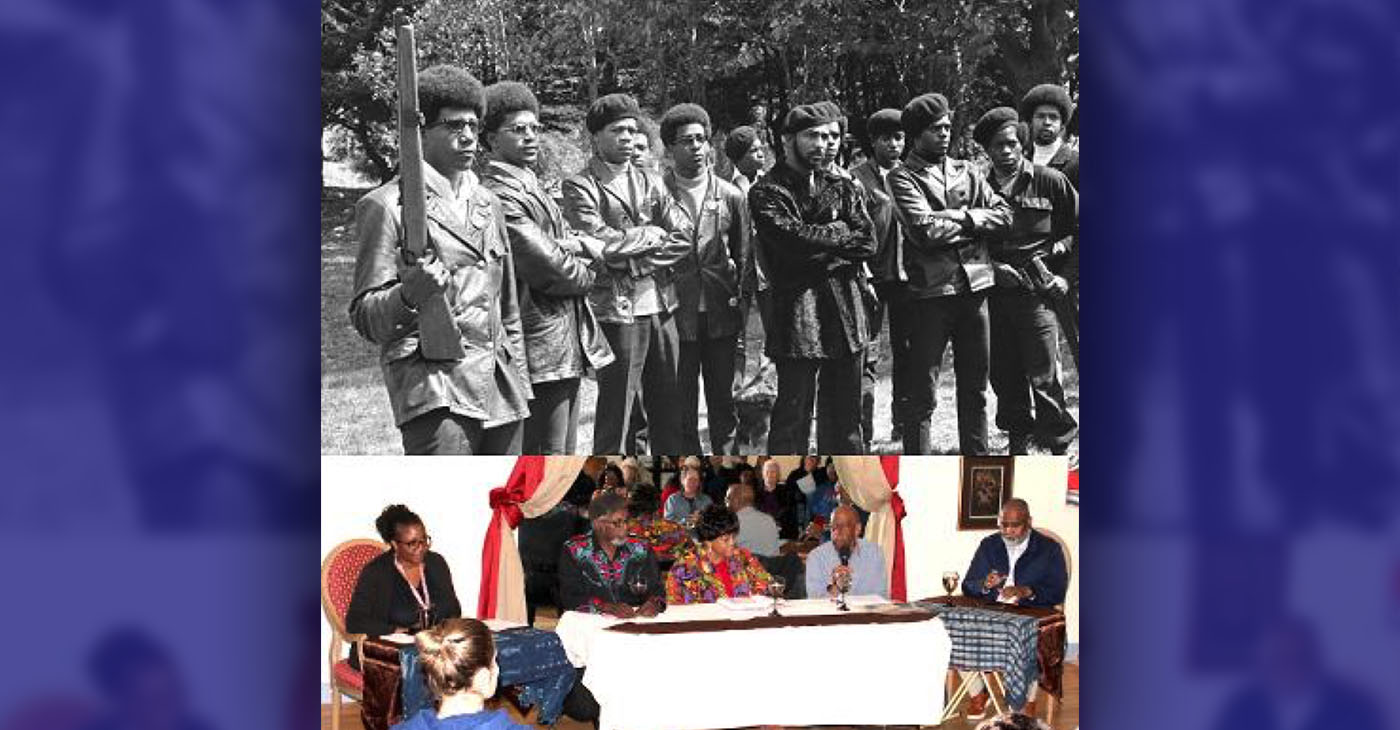
Marin City community members Charles Huff, Terri Green, and Walter Turner, who are also former members of the Black Panther Party, spoke of their experiences at a panel discussion held at the Marin City Arts Gallery on Feb. 16.

By Godfrey Lee
Marin City community members Charles Huff, Terri Green, and Walter Turner, who are also former members of the Black Panther Party, spoke of their experiences at a panel discussion held at the Marin City Arts Gallery on Feb. 16.
The moderators were Rashida Skaar, librarian at the Marin County Free Library and Rev. Rondall Leggett, pastor of First Missionary Baptist Church. Skaar asked the panel what led them to join the Black Panther Party.
Charles Huff said that The Black Panther Party (BPP) for Self Defense was created because Black people were getting being beaten up [by police]. He also felt lost and needed to belong to something. So, Huff became involved with the Party in order to survive, hung out at Eldridge Cleaver’s house, and saw a lot of meetings with people that mattered, who cared about the Black community, and about what happened to him.
Blacks have that tradition of struggle, Huff said: “We were always fighting, struggling, and about the love of ourselves, community, and children.”
So, when Huff saw Huey Newton protecting himself from the police, he decided to join the Party. He felt stronger knowing that “the adversary of the powers” thought it was necessary to threaten and infiltrate the Party, which meant that the Party was making a difference.
Terry Green’s parents came to the Bay Area to work in the shipyards to make a better place for the family. They taught him “that we were children of God, and can ‘do all things through Christ who strengthens us.’” They also encouraged him to be strong, courageous, to think for themselves, stand up for what is right, and not to believe everything taught by the powers that be.
Green was raised to “love our neighbors as our selves.” Black people, wherever they came from, it was all about sharing with one another: cooking food, distributing clothes and food. They didn’t want their people sick, and wanted their kids educated. “We all have to take care of one another. If we are going to survive, all of us have to work together in our community,” Green said.
Like the Black Panther Party, the Marin City community can also investigate the issues that affect it, such as the need for full employment, housing, and improved services, Green said. “We have to wake up and look around. Why is it that other youth have nice recreation centers and Marin City still has a building from WW2? And when Marin City needs new facilities, they think something is wrong with us,” Green said.
Green’s family also taught her how to shoot a gun for self-defense. “You had to arm yourself and do what is necessary to survive,” she said.
Walter Turner saw the Black Panther Party as a ‘vanguard,’ a group of people leading the way in new developments or ideas. Turner did not have time to think of motivation while involved with the Party, “because when you woke up in the morning, you worked hard until you stop.” Turner considered himself part of that vanguard and built upon it.
“The Black Panther Party vanguard is still true today, and we still got to struggle to get what we need,” said Walter.







Activism
Oakland Post: Week of March 18 – 24, 2026
The printed Weekly Edition of the Oakland Post: Week of March 18 – 24, 2026

To enlarge your view of this issue, use the slider, magnifying glass icon or full page icon in the lower right corner of the browser window.
Activism
Oakland Post: Week of March 11 -17, 2026
The printed Weekly Edition of the Oakland Post: Week of March 11 – 17, 2026
To enlarge your view of this issue, use the slider, magnifying glass icon or full page icon in the lower right corner of the browser window.
Activism
Oakland Post: Week of March 4 – 10, 2026
The printed Weekly Edition of the Oakland Post: Week of March 4 – 10, 2026

To enlarge your view of this issue, use the slider, magnifying glass icon or full page icon in the lower right corner of the browser window.


WORK FROM HOME
Home-based business with potential monthly income of $10K+ per month. A proven training system and website provided to maximize business effectiveness. Perfect job to earn side and primary income. Contact Lynne for more details: Lynne4npusa@gmail.com 800-334-0540


Black Artists in America, Installation Three Wraps at the Dixon Gallery and Gardens

Grief, Advocacy, and Education: A Counselor Reflects on Black Maternal Health

Future of Florida’s Black History Museum in Limbo

New Research Shows the Many Benefits of Early Learning

South Hampton K-8 Students Among Top 10 Finalists for Samsung’s ‘Solve for Tomorrow’ Competition

Cuba: No Negotiation with US on the President or Political System

Brooklyn Academy of Music Names Jamaican-Born Tamara McCaw as President

Trinidad & Tobego – U.S. Launches WhatsApp Channel for American Citizens in the Country

Oakland Post: Week of March 18 – 24, 2026

AI Innovation vs. Ethics and Environmental Impact

AI, Web3, and Digital Reparations

What If You Owned Your AI Agent?

Season 7, Episode 3 – January Reporter’s Roundtable 📱

Season 7, Episode 3 – January Reporter’s Roundtable

AI, Media, and Power | Part 2, Real-World Impacts and Tradeoffs

Oakland Post: Week of February 11 – 17, 2026

Reflecting on Black History Milestones in Birmingham AL

CITY OF SAN LEANDRO STATE OF CALIFORNIA PUBLIC WORKS DEPARTMENT ENGINEERING DIVISION NOTICE TO BIDDERS FOR ANNUAL STREET OVERLAY/REHABILITATION 2019-21 – PHASE III

Oakland Post: Week of February 18 – 24, 2026

PRESS ROOM: NBA Hall of Fame Nominee Terry Cummings Joins 100 Black Men of DeKalb County to Launch Victory & Values Initiative

Oakland Post: Week of February 25 – March 3, 2026

Trump’s MAGA Allies are Creating Executive Order Plan to Steal the 2026 Midterms

U.S. manufacturing rebounds – how foundry services are adapting to rising demand

OP-ED: One Hundred Years of Black Workers Telling the Truth

Advancements in solar technology that are changing the way we power the world

Chase Oakland Community Center Hosts Alley-Oop Accelerator Building Community and Opportunity for Bay Area Entrepreneurs

Poll Shows Support for Policies That Help Families Afford Child Care

Oakland Post: Week of March 4 – 10, 2026

PRESS ROOM: Civil Rights TV Launches in Selma as the World’s First 24/7 Civil Rights Television Network

Ghana Mourns a Son of the African World

Hyundai Ioniq 5 Parking, Safety, and 360 View #shorts

2025 Ioniq 5 New Wiper & Powerful Performance! #shorts

Electric SUV Range: Is 259 Miles Enough? #shorts

EV Charging: How Fast Can You Charge an Electric Vehicle? #shorts

Biometric Cooling… Messaging Seats…Come on! 2025 Infiniti QX80 Autograph 4WD

Charged Up: Witness the Magic of a Fully Electric Car! #shorts

Range Rover Sport PHEV Included…: See What’s Inside This Luxury SUV! #shorts

Invisible Hood View: Perfect Parking with X-Ray Vision! #shorts

AI Is Reshaping Black Healthcare: Promise, Peril, and the Push for Improved Results in California

ESSAY: Technology and Medicine, a Primary Care Point of View

Sanctuary Cities

The RESISTANCE – FREEDOM NOW

STATE OF THE PEOPLE: Freddie

ECONOMIC BOYCOTT DAY!!!!!

I told You So
-
 #NNPA BlackPress4 weeks ago
Poll Shows Support for Policies That Help Families Afford Child Care
-
 Activism4 weeks ago
Oakland Post: Week of March 4 – 10, 2026
-

 #NNPA BlackPress3 weeks ago
Woman’s Search for Family’s Roots Leads to Ancestor John T. Ward – A Successful Entrepreneur and Conductor on the Underground Railroad
-

 #NNPA BlackPress4 weeks ago
OP-ED: NNPA Launches 2026 “Leadership Matters” Video Series
-

 #NNPA BlackPress3 weeks ago
Advocates Raise Alarm Over ICE Operation, MOU and Detention Risks in Baltimore County
-

 #NNPA BlackPress3 weeks ago
COMMENTARY: Women of Color Shape Our Past and Future
-

 #NNPA BlackPress3 weeks ago
Pete Buttigieg to Join Mayor Randall Woodfin for Community Town Hall in Birmingham
-

 Activism2 weeks ago
Oakland Post: Week of March 11 -17, 2026
