
Bay Area
Final Environmental Impact Report Released for Possible New A’s Stadium Ballpark
“Releasing the final Environmental Impact Report (FEIR) is a major milestone on our path to build a new waterfront ballpark district that will create up to 18 acres of beautiful public parks, more affordable housing, and good jobs for Oaklanders,” Mayor Schaaf said in a statement. “The 3,500-page document is thorough and exhaustive, and it ensures that the project is environmentally safe and sustainable,” said Oakland Mayor Libby Schaaf.


Draft Report not amended to address community concerns, short timeline means minimal public input
By Keith Burbank, Bay City News and the Post News Group staff
Oakland officials have released a final environmental impact report for the A’s proposed new stadium and development at Howard Terminal, a process with a short timeline over the holidays allowing only for minimal public comment.
The report is required by the California Environmental Quality Act and analyzes potential effects of the project on the surrounding environment.
The timing of the release of the port was of concern to many. It was released on Friday, a week before Christmas, and goes to the Planning Commission mid-January, a small window of time during a busy time of year for the public to read and comment on the report.
Further, the final report does not include any significant changes to the draft version, which means it was not amended to consider more than 400 comments made on the draft version. However, city staff did respond to each comment.
Oakland Mayor Libby Schaaf, a strong supporter of Oakland A’s owner John Fisher’s stadium deal, was enthusiastic about the report.
“Releasing the final Environmental Impact Report (FEIR) is a major milestone on our path to build a new waterfront ballpark district that will create up to 18 acres of beautiful public parks, more affordable housing, and good jobs for Oaklanders,” Mayor Schaaf said in a statement. “The 3,500-page document is thorough and exhaustive, and it ensures that the project is environmentally safe and sustainable,” Schaaf said.
The mayor said the report’s timing keeps the city on track to bring about the final vote to the city council in 2022, bringing the city “one step close to keeping our beloved A’s rooted in Oakland.”
Others were less enthusiastic. The East Oakland Stadium Alliance and port business leaders are raising concerns and urging caution.
“During the Draft EIR (Environmental Impact Report) phase, our coalition and others submitted detailed comments regarding the need for the city to revise and recirculate the Draft EIR, which was inadequate on numerous fronts, but it appears the city has chosen to ignore these requests and refused to re-circulate,” Mike Jacob, Vice President and General Counsel of the Pacific Merchant Shipping Association in a press release from the East Oakland Stadium Alliance.
Jacob also said that the timing of the report, released just before the holidays, reads like the city playing “hard-ball” with the community. “Port stakeholders are working around the clock to keep goods moving during an unprecedented supply chain crisis and community advocates are focusing on issues like feeding and housing those in need,” he said.
Jacobs also decried the city’s lack of progress on Seaport Compatibility Measures or a Community Benefits Agreement, despite the challenges he says the project presents for the maritime and West Oakland communities. “Until these items are presented to the public for review, in addition to a thoroughly vetted financial plan, the City and County cannot in good faith make judgments about whether this project is worth the numerous costs to our taxpayers and community,” he said.
“We ultimately anticipate the FEIR will confirm what we already know: the A’s and the City are simply not interested in funding the significant investments necessary to prevent this project’s disruption to the Port of Oakland’s supply chain or address its significant negative impacts to West Oakland and the environment.”
A’s president Dave Kaval also called the release of the report a milestone, one that is three years in the making. But the team needs a decision from the elected officials in Oakland as soon as possible, he said.
Keeping the pressure on Oakland, the A’s are also still considering moving the team to Las Vegas, paving paths for the team in both cities. He said there is momentum on both paths.
Kaval said the A’s are in the final stages of selecting a potential site in Las Vegas, which he thinks will be announced in the next month or so.
City officials will recommend to the Oakland Planning Commission that it certify the report and send it to the city council for approval.
City officials and the A’s are now negotiating the final agreements. The Planning Commission will take up the city’s recommendation on Jan. 19, and the city council may vote on the report in February, which, if approved, would complete the environmental review process.
This article is by Keith Burbank, Bay City News, and the Post News Group staff.





Activism
Oakland Post: Week of March 11 -17, 2026
The printed Weekly Edition of the Oakland Post: Week of March 11 – 17, 2026
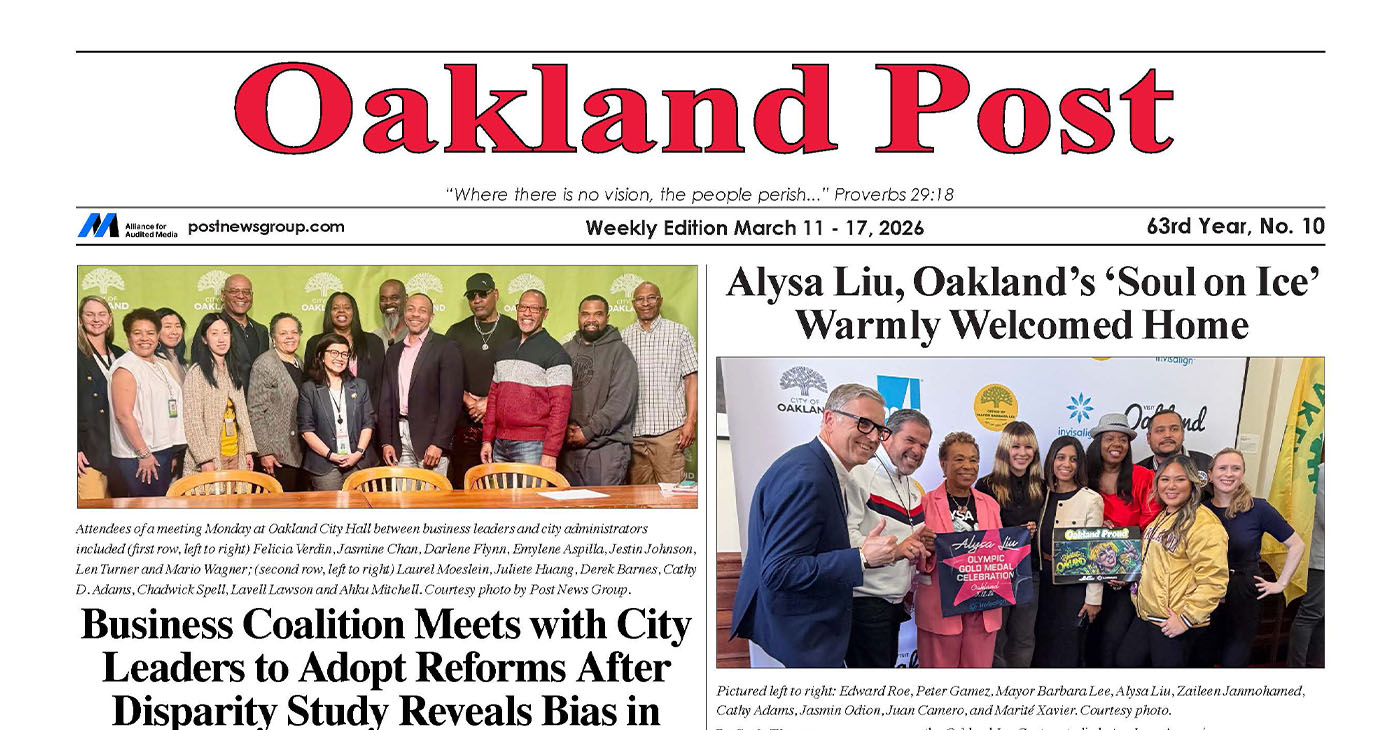
To enlarge your view of this issue, use the slider, magnifying glass icon or full page icon in the lower right corner of the browser window.
Activism
Oakland Post: Week of March 4 – 10, 2026
The printed Weekly Edition of the Oakland Post: Week of March 4 – 10, 2026

To enlarge your view of this issue, use the slider, magnifying glass icon or full page icon in the lower right corner of the browser window.
Activism
Oakland Post: Week of February 25 – March 3, 2026
The printed Weekly Edition of the Oakland Post: Week of – February 25 – March 3, 2026

To enlarge your view of this issue, use the slider, magnifying glass icon or full page icon in the lower right corner of the browser window.


WORK FROM HOME
Home-based business with potential monthly income of $10K+ per month. A proven training system and website provided to maximize business effectiveness. Perfect job to earn side and primary income. Contact Lynne for more details: Lynne4npusa@gmail.com 800-334-0540


Financial Wellness and Mental Health: Managing Money Stress in College

Oakland Post: Week of March 11 -17, 2026

Women & Wealth: Tips for Navigating Your Lifelong Financial Journey

COMMENTARY: Women of Color Shape Our Past and Future

Woman’s Search for Family’s Roots Leads to Ancestor John T. Ward – A Successful Entrepreneur and Conductor on the Underground Railroad

Advocates Raise Alarm Over ICE Operation, MOU and Detention Risks in Baltimore County

Pete Buttigieg to Join Mayor Randall Woodfin for Community Town Hall in Birmingham

WATCH: Week One – NNPA’s “Leadership Matters” Video Series

Oakland Post: Week of March 4 – 10, 2026

OP-ED: NNPA Launches 2026 “Leadership Matters” Video Series

PRESS ROOM: PMG and Cranbrook Horizons-Upward Bound Launch Journey Fellowship Cohort 2

Los Angeles Summit Brings Together Leaders to Tackle Poverty and Affordability

Civil Rights TV Launches 24/7 Network Focused on Black History, Education and Equity

REVIEW: The Ultimate Hot Girl Summer Getaway: Sunseeker Resort Florida

COMMENTARY: How You Stop a Prescription Medicine is as Important as How You Start

Book Review: Books on Black History and Black Life for Kids

Community Celebrates Turner Group Construction Company as Collins Drive Becomes Turner Group Drive

Discrimination in City Contracts

California Launches Study on Mileage Tax to Potentially Replace Gas Tax as Republicans Push Back

COMMENTARY: The Biases We Don’t See — Preventing AI-Driven Inequality in Health Care

Black History Events in the East Bay

Post Newspaper Invites NNPA to Join Nationwide Probate Reform Initiative

Art of the African Diaspora Celebrates Legacy and Community at Richmond Art Center

New Bill, the RIDER Safety Act, Would Support Transit Ambassadors and Safety on Public Transit

COMMENTARY: The National Protest Must Be Accompanied with Our Votes

Oakland Post: Week of February 4 – 10, 2026

Oakland Post: Week of February 11 – 17, 2026

Dorothy Lee Bolden: Uniting Domestic Workers

After Don Lemon’s Arrest, Black Officials Raise Concerns About Independent Black Media

Reflecting on Black History Milestones in Birmingham AL

Hyundai Ioniq 5 Parking, Safety, and 360 View #shorts

2025 Ioniq 5 New Wiper & Powerful Performance! #shorts

Electric SUV Range: Is 259 Miles Enough? #shorts

EV Charging: How Fast Can You Charge an Electric Vehicle? #shorts

Biometric Cooling… Messaging Seats…Come on! 2025 Infiniti QX80 Autograph 4WD

Charged Up: Witness the Magic of a Fully Electric Car! #shorts

Range Rover Sport PHEV Included…: See What’s Inside This Luxury SUV! #shorts

Invisible Hood View: Perfect Parking with X-Ray Vision! #shorts

AI Is Reshaping Black Healthcare: Promise, Peril, and the Push for Improved Results in California

ESSAY: Technology and Medicine, a Primary Care Point of View

Sanctuary Cities

The RESISTANCE – FREEDOM NOW

STATE OF THE PEOPLE: Freddie

ECONOMIC BOYCOTT DAY!!!!!

I told You So
-
 #NNPA BlackPress3 weeks ago
Reflecting on Black History Milestones in Birmingham AL
-

 #NNPA BlackPress3 weeks ago
PRESS ROOM: NBA Hall of Fame Nominee Terry Cummings Joins 100 Black Men of DeKalb County to Launch Victory & Values Initiative
-

 #NNPA BlackPress4 weeks ago
U.S. manufacturing rebounds – how foundry services are adapting to rising demand
-

 #NNPA BlackPress4 weeks ago
OP-ED: One Hundred Years of Black Workers Telling the Truth
-

 Activism3 weeks ago
Oakland Post: Week of February 25 – March 3, 2026
-

 #NNPA BlackPress4 weeks ago
Advancements in solar technology that are changing the way we power the world
-

 #NNPA BlackPress3 weeks ago
Trump’s MAGA Allies are Creating Executive Order Plan to Steal the 2026 Midterms
-

 #NNPA BlackPress4 weeks ago
PRESS ROOM: Civil Rights TV Launches in Selma as the World’s First 24/7 Civil Rights Television Network
