
Activism
Faith Communities Vow to Continue Sanctuary Despite Trump’s Removal of Protections for Churches and Schools
Rabbi Dev Noily of Oakland’s Kehilla Community Synagogue said “the Torah teaches that ‘…when an immigrant comes to live with you in your land, you should not wrong them. You should treat the immigrant who lives with you as one of your citizens. And you should love them as yourself: for you were immigrants in the land of Egypt.’”

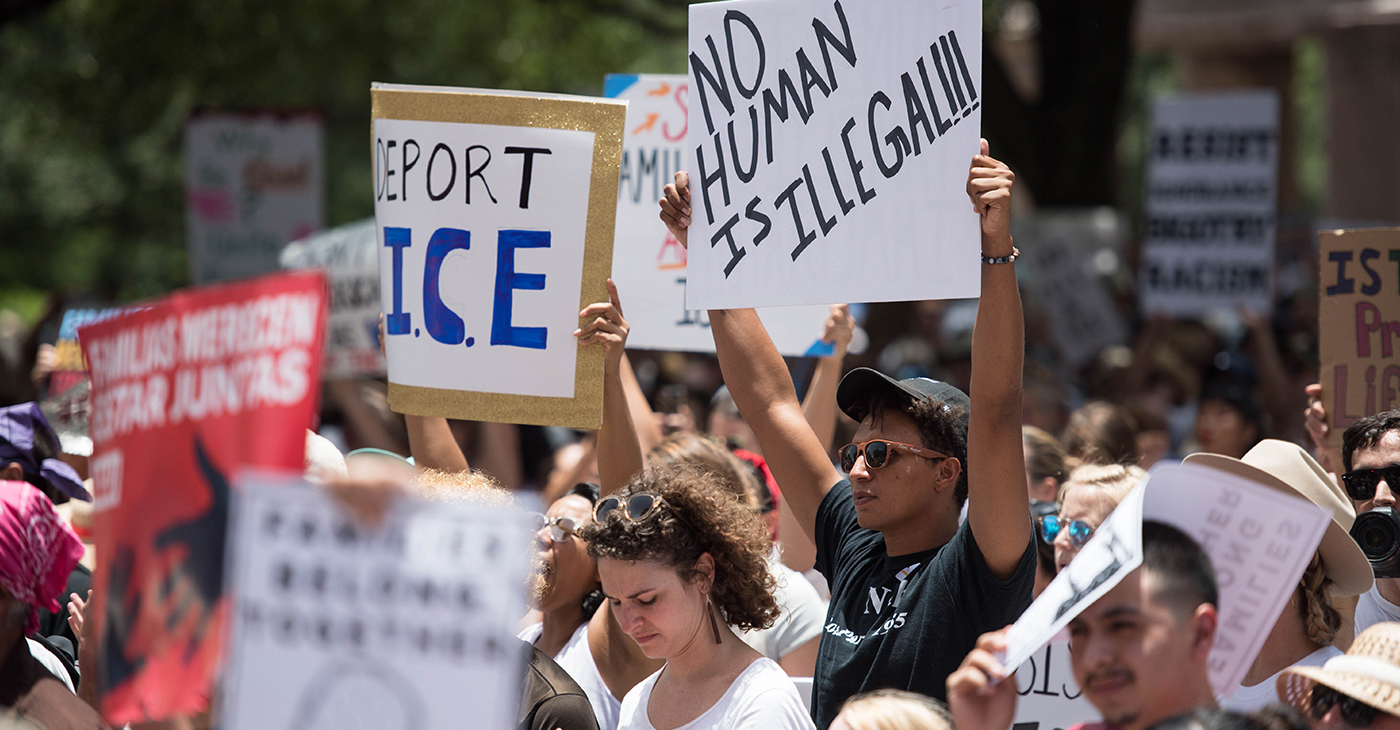
CA State leaders also rebuke Trump’s immigration policies
By Post Staff
Since the Trump administration’s cancellation of the 2011 “sensitive areas” memo, faith communities associated with the Interfaith Movement for Human Integrity are affirming their commitment to sanctuary, which means continuing to welcome immigrants and offering solidarity, support, and services regardless of immigration status.
The “Sensitive Locations Memo,” introduced during the Obama administration in 2011, advised immigration enforcement officers to avoid making arrests in places like schools and houses of worship.
In addition, California state officials and leaders of county offices of education and school districts also quickly rebuked the Trump administration’s policies allowing immigration enforcement near or in schools.
“Schools must be safe spaces, not sites of fear,” said Alex Traverso, director of communications of the State Board of Education. “Every child deserves to learn without intimidation, and California will do all we can to protect our students.”
The directive issued Tuesday by Department of Homeland Security acting Secretary Benjamine Huffman reverses the 2011 memo, restricting Immigration and Customs Enforcement (ICE) and Customs and Border Protection (CBP) agencies from detaining immigrants near locations like schools, childcare centers, playgrounds, hospitals, and churches.
“This action empowers the brave men and women in CBP and ICE to enforce our immigration laws and catch criminal aliens — including murderers and rapists — who have illegally come into our country. Criminals will no longer be able to hide in America’s schools and churches to avoid arrest,” the Department of Homeland Security said in a statement Tuesday.

Under California law, school officials are not required to allow immigration agents to enter schools without a judicial warrant, according to recent guidance issued by California Attorney General Rob Bonta.
“It is disappointing, but unfortunately unsurprising that President Trump, in his first days in office, is focusing his time and energy on making his inhumane and irresponsible mass deportation agenda a reality,” Bonta said.
David Goldberg, president of the California Teachers Association, said, “We have a professional and moral responsibility to keep our students safe if ICE comes to our communities. We will always come together in our union to ensure every public school is a safe space and to uphold the constitutionally protected right of all students to access a public education.”
Despite the repeal of the 2011 memo, faith communities remain steadfast in their solidarity, according to Rev. Deborah Lee, executive director of the Interfaith Movement for Human Integrity.
“We strongly condemn the harmful executive actions that have spread fear and perpetuated misleading narratives criminalizing and demonizing immigrants to justify mass arrests,” Lee said.
“The truth is sanctuary policies keep communities safer and immigrants being targeted, including those who are legal permanent residents … are essential members of our families and communities,” she said.
The history of sanctuary spans critical movements, from the Underground Railroad and the abolition of slavery to providing refuge for Central American migrants fleeing violence and supporting mixed-status families facing deportation in the past two decades, the statement of the Interfaith Movement said.
“Our faiths compel us to prevent harm and honor the sanctity of families, communities, and human life,” said Rev. Dr. Tovis Page, co-minister of the Unitarian Universalists of San Mateo and program director of the Peninsula Solidarity Cohort. “This is especially critical today, as immigrant communities endure mass arrests, racial targeting, and the spread of fear and animus.”
Rabbi Dev Noily of Oakland’s Kehilla Community Synagogue said “the Torah teaches that ‘…when an immigrant comes to live with you in your land, you should not wrong them. You should treat the immigrant who lives with you as one of your citizens. And you should love them as yourself: for you were immigrants in the land of Egypt.’”
“Our sacred texts value the dignity and well-being of every person. It is immoral that these policies of mass detention and mass deportation are enriching the pockets of for-profit detention centers whose stocks are soaring, while immigrant families who feed this nation, provide care and keep this nation running will suffer immensely,” said Sister Joan O’Donnell from the Sisters of Mercy Western Region.
For more information contact, contact the Interfaith Movement for Human Integrity at office@im4humanintegrity.org or https://www.im4humanintegrity.org








Activism
Oakland Post: Week of September 16 – 22, 2026
The printed Weekly Edition of the Oakland Post: Week of September 16 – 22, 2026
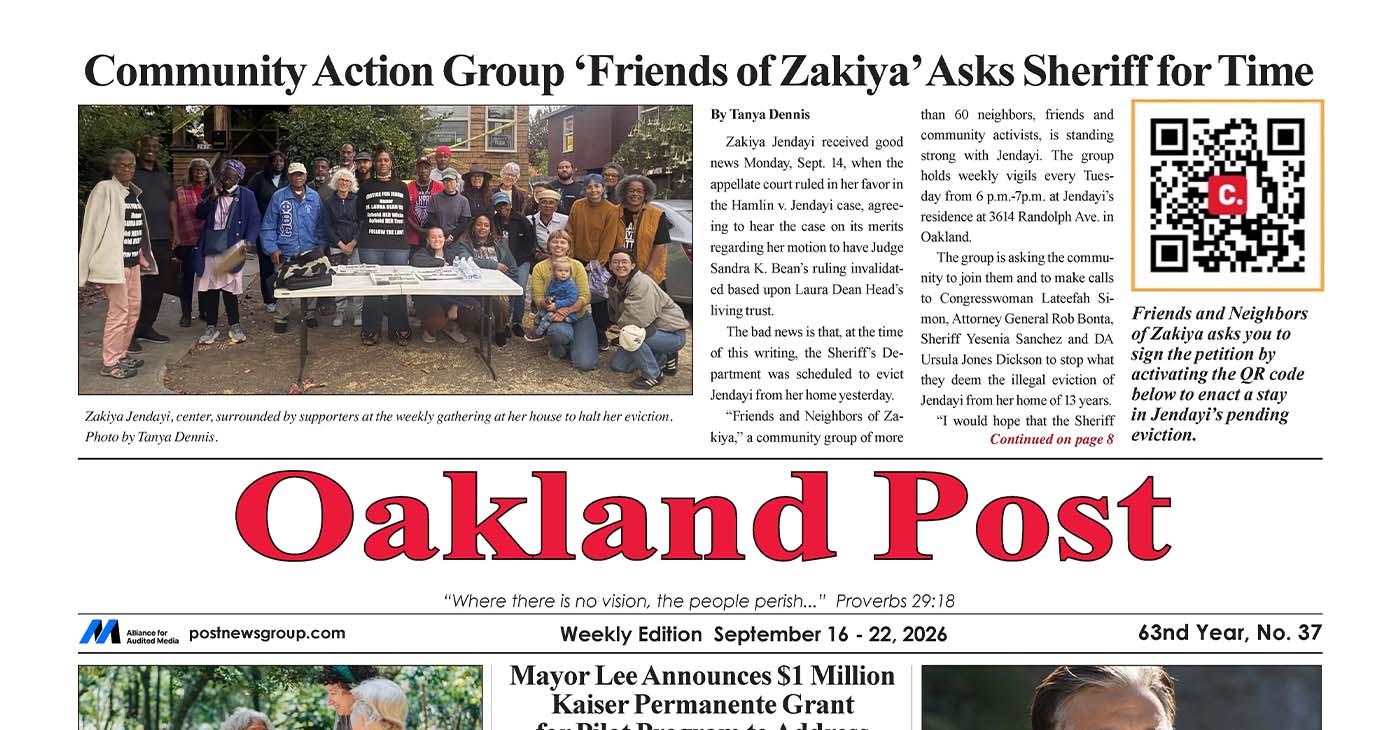
To enlarge your view of this issue, use the slider, magnifying glass icon or full page icon in the lower right corner of the browser window.
Activism
Oakland Post: Week of September 9 – 15, 2026
The printed Weekly Edition of the Oakland Post: Week of September 9 – 15, 2026

To enlarge your view of this issue, use the slider, magnifying glass icon or full page icon in the lower right corner of the browser window.
Activism
Oakland Post: Week of September 2 – 8, 2026
The printed Weekly Edition of the Oakland Post: Week of September 2 – 8, 2026
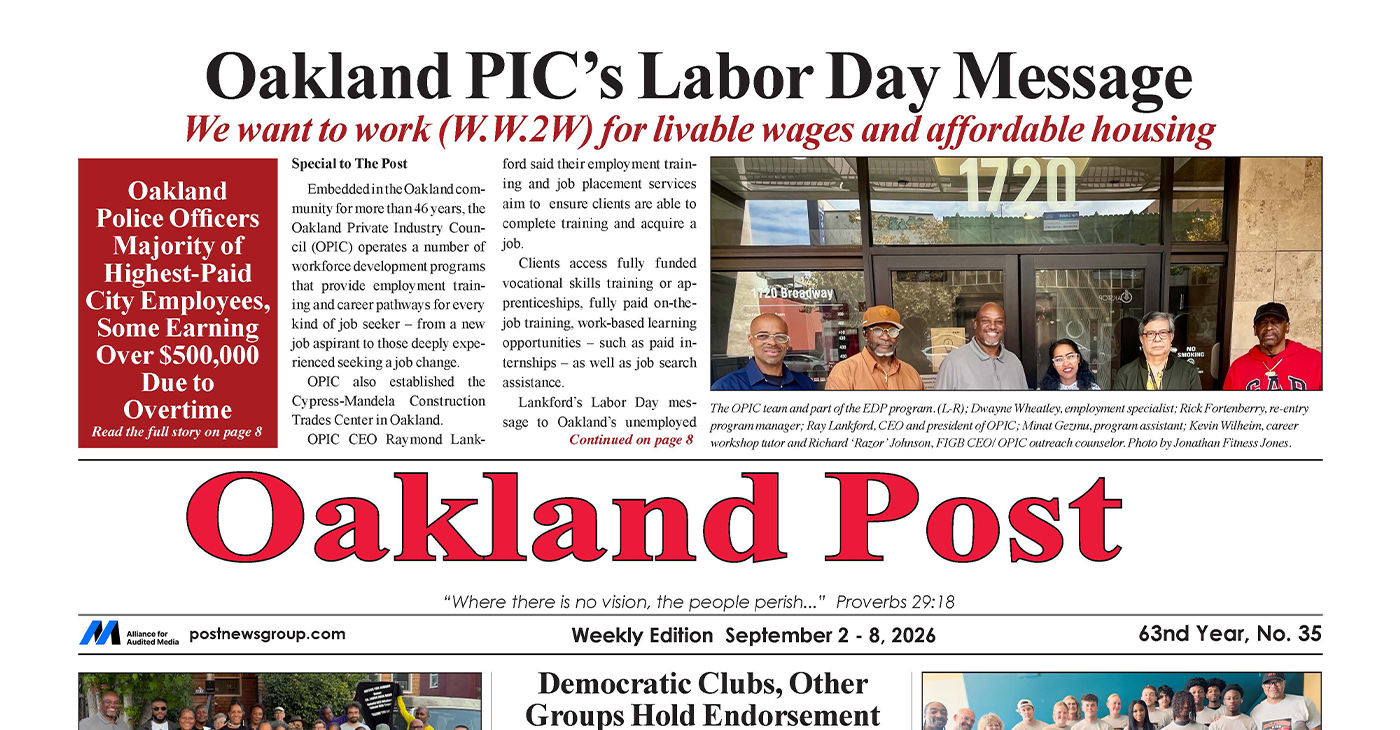
To enlarge your view of this issue, use the slider, magnifying glass icon or full page icon in the lower right corner of the browser window.



Doulas Are Helping Black California Moms Navigate Pregnancy–Even as High Mortality Rates Persist

Newsom Signs Addictive Social Media Law to Protect Kids

On Your November Ballot: Prop 38 Would Allocate $8.4 Billion to Immunology and Immunotherapy Funding

Ask California: Golden State Releases New AI Chatbot

Asm. Isaac Bryan’s Bill Banning California Police From ICE Side Jobs Reaches Newsom’s Desk

Assemblymember LaShae Sharp-Collins’s Bill Would Pause Law Enforcement’s Use of Shock Gloves Pending Study

BOOK REVIEW: ‘Laws of Solomon’ Reveals Tender Heart of Former Child Soldier

OPINION: The New American Fear – From 9-11 to AI

Passing for White, Fighting for Black America: The Courage of Walter White

Oakland People’s Arms Embargo Coalition Demands End to Military Shipments Thru Oakland

Barbara Lee Mourns Gloria Steinem, Remembers a Friendship Rooted in Equality

Event Preview: ‘Fashion v. Fascism’ – A Runway Revolution Is Coming to the Bay Area

Two Looming Threats Every Alameda County Elder Should Know About

Oakland Mayor Reads to Children at Bookout Block Party at Marcus Books Store

Tradition Comes to the Streets in 11th Annual Black-Eyed Pea Festival at the Freedom Farmers Market

Less Affluent School Districts, Including Sacramento City, Face Threat of State Takeover

ESSAY: California Can Close Its Colorectal Cancer Gap

California Hispanic Chambers of Commerce Unveils: ‘Powering the Future’ Theme for 47th Annual Statewide Convention

Four Candidates, Including Incumbent Barbara Lee, Qualify for Oakland Mayor’s Race

Oakland Post: Week of August 12 – 18, 2026

From Blueprint to Breakthrough: Tackling Affordable Housing in Oakland

Oakland Observes Black August with Block Parties, Film Showings, Workshops

COMMENTARY: Why Local School Tax Measure G1 Will Not Be on the November Ballot

Standoff for Justice: Our Homes Are Worth Fighting For

Returning to Its Roots, the Oakland Black-Eyed Pea Festival Partners with the Freedom Farmers Market Sept. 12

Oakland Post: Week of August 26 – September 1, 2026

NPRC Scores First Advocacy Victory: David Shaw Finally Gets His Wish to ‘Go Home’

Frontier Airlines’ Return to Oakland Airport Brings Flights, Jobs and Opportunity

Gubernatorial Candidate Steve Hilton Blasts California New Tire Rules; Newsom Hits Back

Chef Sharon Lee Blends Culinary Excellence, Education and Empowerment

The Conversation With Al McFarlane 6/23/26

Media Monday 6/22/26

LIVE! ASK ALMA! — TUES. 6.23.26 7PM EST

Car Buying Secrets: 4 Hidden Checks Before You Sign!

Is This 550 HP Charger Worth YOUR Money? AutoNetwork Review

Celebrating Juneteenth – Frederick Douglass on education and resistance

LIVE! — ASK ALMA! — TUES. 6.19.26 7PM EST

Hyundai Ioniq 5 Parking, Safety, and 360 View #shorts

2025 Ioniq 5 New Wiper & Powerful Performance! #shorts

Electric SUV Range: Is 259 Miles Enough? #shorts

EV Charging: How Fast Can You Charge an Electric Vehicle? #shorts

Biometric Cooling… Messaging Seats…Come on! 2025 Infiniti QX80 Autograph 4WD

Charged Up: Witness the Magic of a Fully Electric Car! #shorts

Range Rover Sport PHEV Included…: See What’s Inside This Luxury SUV! #shorts

Invisible Hood View: Perfect Parking with X-Ray Vision! #shorts
-
 Commentary4 weeks ago
Standoff for Justice: Our Homes Are Worth Fighting For
-
 Activism4 weeks ago
Oakland Post: Week of August 26 – September 1, 2026
-
 Business4 weeks ago
Frontier Airlines’ Return to Oakland Airport Brings Flights, Jobs and Opportunity
-
 Business4 weeks ago
Gubernatorial Candidate Steve Hilton Blasts California New Tire Rules; Newsom Hits Back
-
 Business4 weeks ago
Chef Sharon Lee Blends Culinary Excellence, Education and Empowerment
-

 Community4 weeks ago
Big City Mayors Ask for “Yes” Vote on Housing Bond Measure; Conservatives Say “No”
-
 Black History4 weeks ago
Jackie Wright Champions Bay Area Stories, Filmmakers and Cultural Institutions
-

 Education4 weeks ago
Gov. Newsom’s Latest Appointees Include Sacramento Advocate for Formerly Incarcerated Students; State’s New Tech Chief
