
Politics
Exclusive: Dean Smith’s Pardon Letter for Wilmington Ten Revealed


Former University of North Carolina basketball coach Dean Smith
by Cash Michaels
Special to the NNPA from The Carolinian Newspaper
This week, as the world mourns the passing of legendary UNC Tar Heel Head Basketball Coach Dean Smith, he is being remembered as a trailblazer not only for his championship winning hardwood strategy, but also for standing strong for social justice, and against racial discrimination.
“He pushed forward the Civil Rights movement, recruiting the first black scholarship athlete to North Carolina and helping to integrate a restaurant and a neighborhood in Chapel Hill,” said Pres. Barack Obama of Smith in tribute.
But while many know of how Coach Smith recruited Charlie Scott as the first African-American to play Atlantic Coast Conference basketball in the ‘60’s, and how he supported former Chapel Hill Mayor Howard Lee when the black man tried against all odds to purchase a home in an all-white Chapel Hill neighborhood, it has never been revealed, until now, that Dean Smith also tried to use his considerable influence with then Gov. James B. Hunt in 1977 to secure pardons for ten wrongly convicted civil rights activists known as “the Wilmington Ten.”
In July 2013, while doing research for the documentary, “Pardons of Innocence: The Wilmington Ten” at the NC Archives, a Carolinian reporter discovered a previously unknown missive from Coach Smith to Gov. Hunt. Dated July 25, 1977 on “University of North Carolina” letterhead from Smith’s “Basketball Office,” a copy of the extraordinary letter was made for possible use in the film. However it was never used in the production, so the letter copy was held until this week, after Smith, at age 83, died at his home in Chapel Hill Saturday evening.
When Gov. Hunt first took office in 1977, the Wilmington Ten – nine young black males and one white female led by the fiery Rev. Benjamin Chavis – had already been tried, convicted and sentenced to a combined 282 years in prison in 1972. Defense attorneys were unsuccessful appealing those convictions to state courts, and an appeal to the US Fourth Circuit Court of Appeals was pending.
Upon taking office, Hunt indicated that he wanted to review the historic case, and once all of the state appeals ran out, he would step in if needed.
It was during this time that letters from literally all over the country and the world began pouring in to Gov. Hunt’s office, both pro and con.
One of them was from Dean Smith.
Addressed to “The Honorable James B. Hunt, Jr. – Governor,” Coach Smith wrote:
“Lee Upperman, our former basketball manager and now one of the attorneys for the Wilmington 10, has allowed me to read the Petition for Pardon of these ten people,” Coach Smith wrote to Hunt. “Without knowing the full details, other than what I have carefully examined in the Petition for Pardon, I would still urge you as a citizen to truly pardon these ten who have already served what many would consider a just sentence for what they had been determined guilty.”
Smith continued, “Apparently there is no chance for a new trial and for them to serve the number of years given them in a rather strange way, would seem to be excessive.”
Coach Smith concluded his letter to the governor with, “As a citizen who supported you for Governor in the November election, I would urge you to pardon the Wilmington 10 if you do have that right.”
“Most sincerely, Dean E. Smith.” The coach signed it simply “Dean.”
But the letter didn’t finish there.
In what apparently was Dean Smith’s handwriting, he adds a postscript:
“Bob Seymour has provided me with some additional material on these 10 people which would lead one to believe injustice was done.”
Smith then initialed the handwritten notation.
The significance of Smith’s July 1977 letter is the fact that he marked the envelope “PERSONAL & CONFIDENTIAL” meaning that he wanted his request to be seen, and considered, only by the governor, and not be made public.
Given the raging national and worldwide controversy about the Wilmington Ten case, and how they were falsely convicted for the arson destruction of a white-owned grocery store in Wilmington during the height of racial tensions there in February 1971, Smith would have found himself in the crossfire between civil rights and law enforcement groups who were bitterly divided.
While African-Americans and white liberals would have welcomed someone of Coach Smith’s stature and high profile in support of their worldwide movement to free the “freedom fighters” Wilmington Ten, Smith would have been instantly vilified by members of the NC judiciary, North Carolina’s business community, and even conservative US Sen. Jesse Helms – all of whom who considered the Ten to be dangerous radicals – and wrote numerous letters to Gov. Hunt opposing freeing them.
His controversial involvement would have undoubtedly put an unwanted cloud over his basketball program at UNC if word ever leaked at that time, and his judgement on race would have once again been questioned.
Because of a recent change in policy, letters sent to the Governor’s Office of Executive Clemency in the past ten years to be considered during pardons cases are no longer considered public record, in an effort to protect those who communicate with the governor, who has the sole discretion in issuing pardons.
In the State Archives, an unsigned drafted letter dated Sept. 1, 1977 apparently from Gov. James Hunt, responds to Coach Smith, thanking him for his missive, and telling Smith that until all of the state courts considering appeals in the case have decided, he will abide by a policy of not stepping in.
“If, at some time in the future, we consider any action for any of the individuals involved, we will give your thoughts due consideration,” wrote Hunt to Coach Smith. “ I thank you for sharing your ideas with me on this case.”
History shows that a few months later, on January 23, 1978, Gov. Hunt went on statewide television, and announced that he would not pardon the Wilmington Ten, but would reduce their harsh sentences. However in December 1980, after all of them had been released from prison, the US Fourth Circuit Court of Appeals in Virginia overturned the Wilmington Ten’s convictions citing “gross prosecutorial misconduct,” and ordered North Carolina to either drop the charges, or conduct a new trial.
The state did nothing for 32 years, thus leaving the Ten in legal limbo. Not until the National Newspaper Publishers Association, led by the Wilmington Journal, defense attorneys Irving Joyner and James Ferguson, and the NCNAACP, mounted a successful national campaign in 2012 to secure ten pardons of innocence from then Gov. Beverly Perdue, were they finally legally exonerated.
Calling the Ten victims of “naked racism” and “political prisoners,” Gov. Perdue said she granted the pardons of innocence because she couldn’t find any evidence of their guilt, but did agree with the US Fourth Circuit Court of Appeals that prosecutors in the case indeed broke the law in framing the ten activists.
Dean Smith was right in 1977 when he wrote, “…injustice was done.”
This week was the first time anyone associated with the Wilmington Ten case were told or shown anything about Coach Smith’s bid to gain their freedom.
After reading the letter, Rev. Dr. Benjamin Chavis, now president of the National Newspaper Publishers Association, said in an exclusive statement to The Carolinian and Wilmington Journal newspapers, “Dean Smith was a bold leader who stood for racial equality when it was not the popular thing to do. Smith’s courage made him more than one of the greatest basketball coaches in the world. He triumphed off the court as well and won progress for all humanity. Long live the legacy and spirit of Dean Smith.”
Another Wilmington Ten member, Wayne Moore, also paid tribute to the great coach and leader.
“I have known for a long time that Dean Smith was not only a champion as a coach, but that he was also a champion for social justice,” Moore, who now lives in Michigan, wrote. “Being the first coach to grant a scholarship to a black player at UNC at a point where Jim Crow and Civil Rights were clashing on the doorsteps of justice, took a great deal of courage. There were immediate calls for him to be fired, but he stood his ground and went on to become one of the greatest coaches in the history of basketball.”
“Still, his greatest legacy might rightfully be the passion he openly displayed for racial justice and equality. The fact that this letter is written on UNC stationery is a testimony in and of itself to his bold approach he often took.”
Attorney Irving Joyner, professor of law at North Carolina Central University School of Law in Durham, and one of the defense attorneys for the Wilmington Ten, wrote, “I have always been an admirer of the courage that Dean Smith exhibited in his coaching and community affairs.”
“His decision to bring Charlie Scott from New York to desegregate the UNC-Chapel Hill basketball team changed the complexion of NCAA basketball at a time that he was not forced to it. At the time, Dean Smith knew that desegregating that basketball team and the campus was the right thing to do. For him, it was a matter of principle,” Prof. Irving wrote.
“Likewise, I treasure and appreciate his championing of the early efforts to pardon the Wilmington 10 in 1977 and since that time because he personally knew that it was the right thing to do,” Joyner continued. “I deeply regret that Governor Jim Hunt did not accept his advice. Those and other equally courageous acts endeared Smith to his community, his school, and to the many people who were engaged in the struggle for equal rights and racial justice.”
Prof. Joyner concluded, “We pray that these lessons of racial harmony and racial justice will serve as an inspiration, and guide to others who find themselves in positions of power and influence.”





Activism
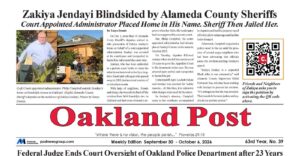
Oakland Post: Week of September 30 – October 6, 2026
The printed Weekly Edition of the Oakland Post: Week of September 30 – October 6, 2026
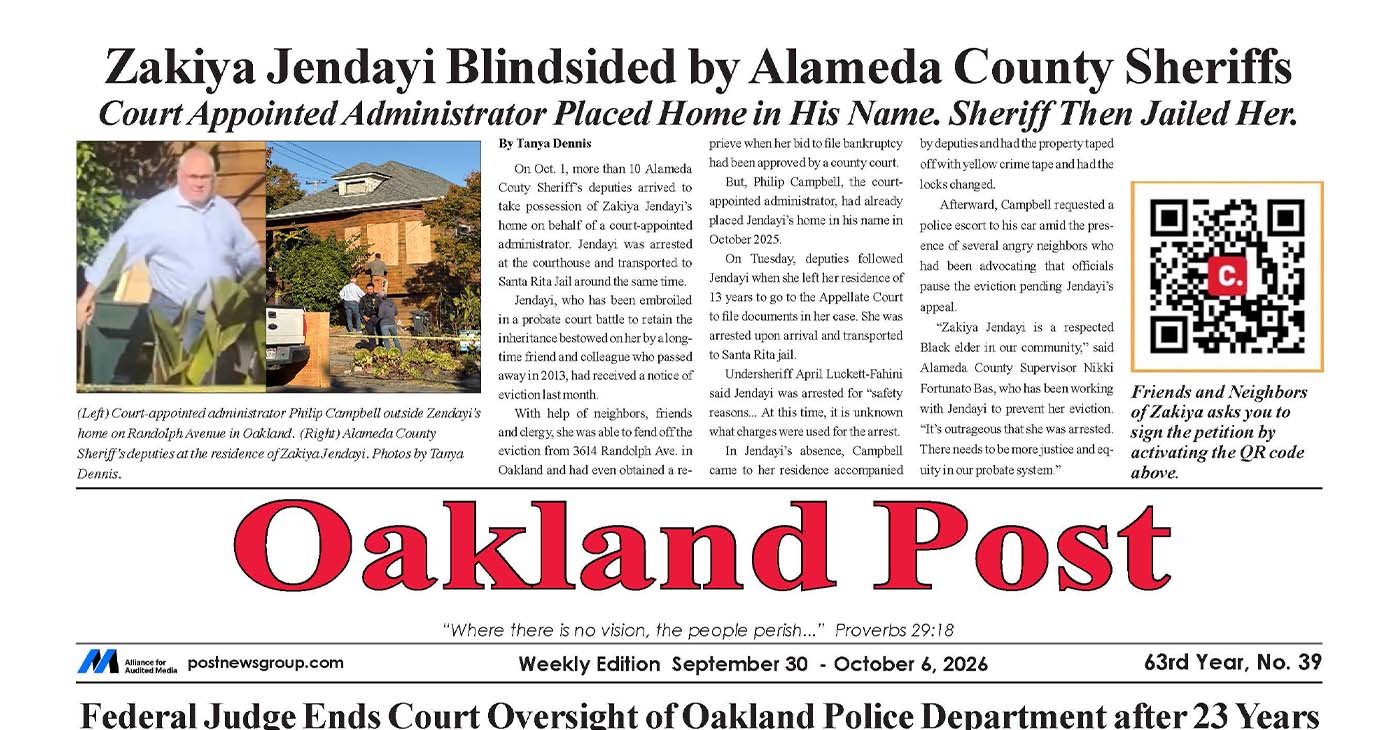
To enlarge your view of this issue, use the slider, magnifying glass icon or full page icon in the lower right corner of the browser window.
Economy
Poll: Becerra Widens His Lead Over Hilton; Californians Split on Wealth Tax
A new Public Policy Institute of California poll shows Democrat Xavier Becerra leads Republican Steve Hilton by 22 points in California’s governor’s race, with 60% of likely voters supporting Becerra compared to 38% for Hilton. The September survey also reveals Californians are closely divided on a proposed one-time tax on billionaires, with 52% of likely voters in favor of Proposition 40. Affordability issues are a major factor for voters. Read more to learn about the poll’s additional findings on voter sentiment.


Democrat Xavier Becerra holds a 22-point lead over Republican Steve Hilton in California’s governor’s race, while voters remain closely divided over a proposed one-time tax on billionaires, according to a new Public Policy Institute of California poll.
The September PPIC survey found that 60% of likely voters support Becerra, compared with 38% for Hilton. His lead is actually narrower than it was in July, when he led Hilton 61% to 36%.
Becerra leads among independent voters, with 57% supporting him compared with 38% for Hilton. Party loyalty remains strong, with 93% of Democratic likely voters backing Becerra and 92% of Republicans supporting Hilton.
Hilton leads in the Central Valley, where 52% of likely voters support him compared with 46% for Becerra.

Affordability remains a major factor: 65% of likely voters say candidates’ plans to address cost-of-living issues are “very important” to their vote.
“Affordability continues to be top of mind for Californians when considering their choice for governor,” said Mark Baldassare, PPIC Statewide Survey director and Miller Chair in Public Policy.
The poll also found a narrow split over Proposition 40, a proposed one-time tax of up to 5% on taxpayers with assets exceeding $1 billion. Fifty-two percent of likely voters said they would vote yes, while 46% said they would vote no.
Support for the wealth tax varies sharply by party. Seventy-two percent of Democrats favor Proposition 40, compared with 46% of independents and 21% of Republicans.
Two competing measures also drew majority support. Fifty-one percent back Proposition 41, while 54% support Proposition 42, both of which could affect the wealth-tax proposal.
The findings come as Californians express broader frustration with the state’s political direction. Seventy-one percent of likely voters expect bad economic times in California over the next year.
“Californians are clearly grumpy and aren’t enamored with any particular political party or movement,” Baldassare said.
The survey interviewed 1,745 California adults, including 1,103 likely voters, from Sept. 4-10. The margin of error for likely voters is plus or minus 3.8 percentage points.

Community
LIVE FREE Sunday Dinner Brings Faith, Fellowship and Civic Conversation to Oakland
Approximately 50 members and guests gathered at Imani Community Church for a LIVE FREE Sunday Dinner, sharing a meal with Pastor Michael McBride. The event, hosted by Imani Community Church Pastor Jeremy McCants, focused on faith, community preparedness, and civic participation. Participants discussed “sacred resistance” and how communities can collectively respond to challenges, including practical suggestions for emergencies. The conversation also touched upon the importance of civic engagement and voting in the upcoming election. Read more to learn about the specific actions discussed.
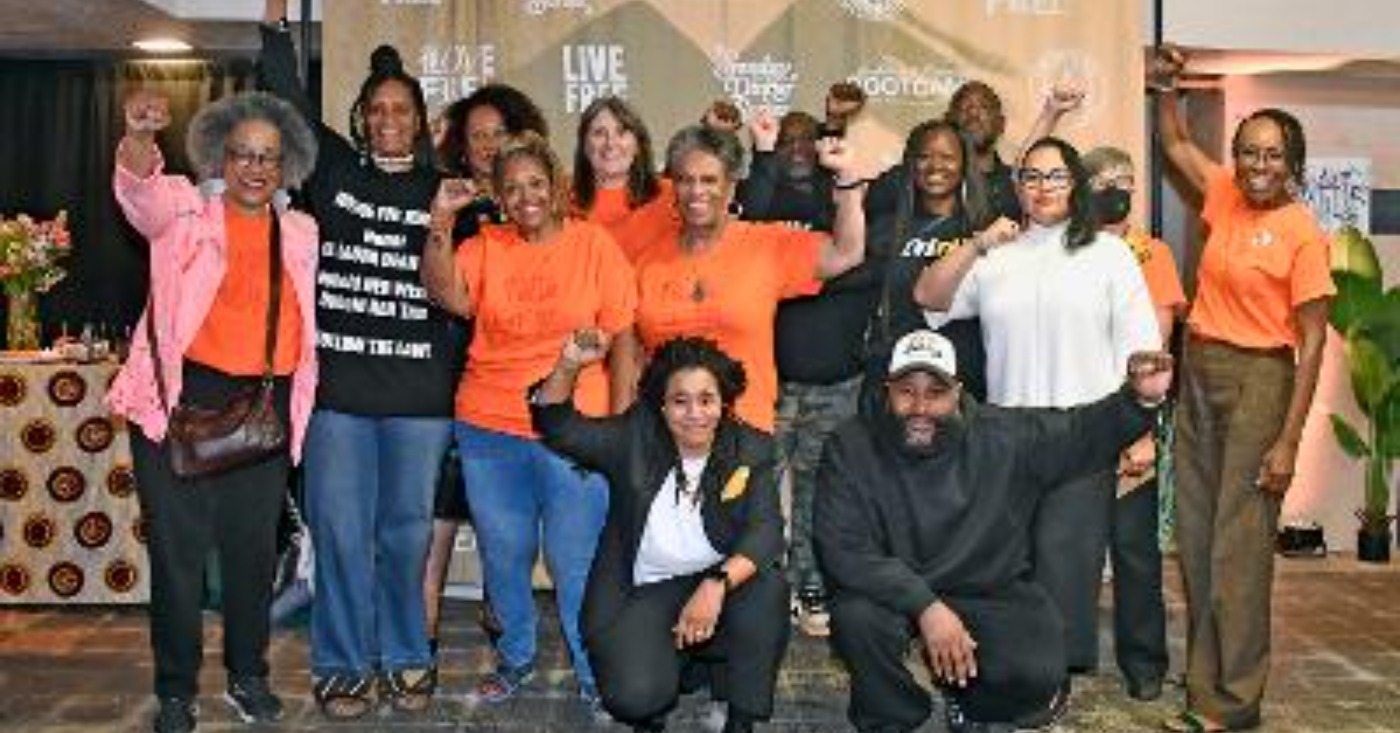
Pastor Michael McBride joins Imani Community Church Members for Food, Faith and Conversation about Community Action
Approximately 50 members and guests of Imani Community Church gathered Sunday afternoon for a LIVE FREE Sunday Dinner, sharing a meal with Pastor Michael McBride while discussing faith, community preparedness and civic participation.
Hosted by Imani Community Church Pastor Jeremy McCants, the Sept. 20 gathering was part of LIVE FREE’s Sunday Dinner initiative, which draws upon the tradition of families, neighbors and faith communities gathering around the Sunday dinner table to break bread and discuss issues affecting their lives.
McBride is founder of LIVE FREE and lead pastor of The Way Christian Center on University Avenue in Berkeley. His Bay Area ministry has deep roots. The congregation traces its history to a church planted by McBride’s grandmother in 1969. McBride returned to the Bay Area in 2005 and became its fourth pastor.
His ministry later expanded into community organizing and national advocacy. McBride founded LIVE FREE in 2011 following organizing work in Oakland and has been involved in efforts addressing gun violence, mass incarceration and civic engagement.
At Imani, the Sunday dinner concept was simple: sit down together, eat together and talk.
McBride recalled a time when Sunday dinner provided families and neighbors an opportunity to discuss what was happening in their communities. LIVE FREE has adapted that tradition into gatherings where faith communities and neighbors can meet, communicate, and consider how to respond collectively to current challenges.
Much of Sunday’s conversation centered on what McBride described as “sacred resistance,” bringing faith into discussions about how communities respond during difficult and uncertain times.
Participants considered a fundamental question: How do we make sense of what is happening around us, and how do we move forward?
The conversation was grounded in faith and prayer, but participants also discussed action and preparation. Attendees talked about not assuming that institutions and everyday systems will always function as expected.
Practical suggestions included keeping basic food staples such as rice and beans available during emergencies. Participants cited the water crisis in Flint, Michigan, as an example as they discussed communities that have experienced disruptions to essential services.
The broader message was one of preparedness and connection: neighbors should know and support one another before a crisis occurs.
The conversation also turned to civic participation and the upcoming election.
McBride’s message was brief: “Vote. We must vote.”
Participants were encouraged to register to vote, verify that their registration is current, and learn what will appear on their ballots. The discussion included researching candidates and ballot measures, voting early, and making a voting plan.
An Oct. 3 workshop was announced as another opportunity for community members to learn more about candidates, volunteer phone banking, ballot measures, and issues before voters.
For Imani’s Social Justice Team, the gathering provided another opportunity to share information with the congregation and surrounding community regarding Imani member Zakiya Jendayi, fighting for her home, and how the community can support her by attending a vigil at her Oakland home every Tuesday from 6-7 p.m. at 3614 Randolph Ave. 94610.


Listening as a Lifeline: A Doula’s Witness to Black Maternal Health

New Protections for Ticket Buyers: Gov. Newsom Signs Assemblymember Isaac Bryan’s Bill

‘We Don’t Talk Trash — We Pick Up Trash!’

Zakiya Jendayi Arrested, Locked Out of Home by Sheriff’s Deputies

Oakland Post: Week of September 30 – October 6, 2026

Asm. Corey Jackson Announces Launch of 24-Hour Childcare in His District

IN MEMORIAM: The Rev. Leon “Sonny” Clark, Longtime Orange County Pastor and Community Leader, Dies at 72

Poll: Becerra Widens His Lead Over Hilton; Californians Split on Wealth Tax

From Historic Memories to New Possibilities: Oakland Celebrates Coliseum 60

County Office of Education Says OUSD Finances Are Getting Healthier, Materially Stronger

LIVE FREE Sunday Dinner Brings Faith, Fellowship and Civic Conversation to Oakland

Remembering Chauncey Bailey as Student Journalists Face Threats to Truth-Telling

BLACspace Cooperative Invites Bay Area to Experience Oakland’s Black Cultural Ecosystem Through a BLAC Map Tour + Party

In Wake of Death on Doorstep, Williams Chapel Baptist Church Calls for Better Care, Funding for Unhoused

Oakland Centenarian Nuna McKee Honored!

Standoff for Justice: Our Homes Are Worth Fighting For

Oakland Post: Week of August 26 – September 1, 2026

Frontier Airlines’ Return to Oakland Airport Brings Flights, Jobs and Opportunity

Gubernatorial Candidate Steve Hilton Blasts California New Tire Rules; Newsom Hits Back

Chef Sharon Lee Blends Culinary Excellence, Education and Empowerment

Jackie Wright Champions Bay Area Stories, Filmmakers and Cultural Institutions

Misnamed ‘Parent’ PAC Seeks to Influence Oakland School Board Elections

Oakland Coliseum Project Opens Door for Small Businesses to Build Bigger

Big City Mayors Ask for “Yes” Vote on Housing Bond Measure; Conservatives Say “No”

Gov. Newsom’s Latest Appointees Include Sacramento Advocate for Formerly Incarcerated Students; State’s New Tech Chief

Longtime BWOPA Member Brendalyn Goodall Appointed to California Workforce Development Board

Gov. Newsom Signs Law Shielding Immigration Aid Workers From Doxing Threats

Secretary of State Shirley N. Weber Urges Californians to Vote Early as Voter ID Battle Intensifies

Oakland Post: Week of September 2 – 8, 2026

IN MEMORIAM: Dolly Parton Dead at 80 — How She Built a Legacy of Love and Earned Her Place in Black Culture

The Conversation With Al McFarlane 6/23/26

Media Monday 6/22/26

LIVE! ASK ALMA! — TUES. 6.23.26 7PM EST

Car Buying Secrets: 4 Hidden Checks Before You Sign!

Is This 550 HP Charger Worth YOUR Money? AutoNetwork Review

Celebrating Juneteenth – Frederick Douglass on education and resistance

LIVE! — ASK ALMA! — TUES. 6.19.26 7PM EST

Hyundai Ioniq 5 Parking, Safety, and 360 View #shorts

2025 Ioniq 5 New Wiper & Powerful Performance! #shorts

Electric SUV Range: Is 259 Miles Enough? #shorts

EV Charging: How Fast Can You Charge an Electric Vehicle? #shorts

Biometric Cooling… Messaging Seats…Come on! 2025 Infiniti QX80 Autograph 4WD

Charged Up: Witness the Magic of a Fully Electric Car! #shorts

Range Rover Sport PHEV Included…: See What’s Inside This Luxury SUV! #shorts

Invisible Hood View: Perfect Parking with X-Ray Vision! #shorts
-
 Community3 weeks ago
Misnamed ‘Parent’ PAC Seeks to Influence Oakland School Board Elections
-
 Activism4 weeks ago
Oakland Post: Week of September 2 – 8, 2026
-

 Community3 weeks ago
Richmond Tiny House Village Farm & Garden Set to Open Gates on Sept. 26
-

 Activism3 weeks ago
Oakland Post: Week of September 9 – 15, 2026
-

 Black History3 weeks ago
Latest Massacre in Haiti Reveals Cruelty U.S. Deportations
-

 Black History3 weeks ago
OPINION: Nolan Wells’ Death One of Several Signifying Racial Terror Lives on in U.S. South
-

 Community3 weeks ago
Democratic Clubs Interview Candidates for Oakland School Board
-

 Business2 weeks ago
Mayor Lee Announces $1 Million Kaiser Permanente Grant for Pilot Program to Address Homelessness, Clean Up Public Spaces throughout Oakland
Politics
Exclusive: Dean Smith’s Pardon Letter for Wilmington Ten Revealed
Former University of North Carolina basketball coach Dean Smith
by Cash Michaels
Special to the NNPA from The Carolinian Newspaper
This week, as the world mourns the passing of legendary UNC Tar Heel Head Basketball Coach Dean Smith, he is being remembered as a trailblazer not only for his championship winning hardwood strategy, but also for standing strong for social justice, and against racial discrimination.
“He pushed forward the Civil Rights movement, recruiting the first black scholarship athlete to North Carolina and helping to integrate a restaurant and a neighborhood in Chapel Hill,” said Pres. Barack Obama of Smith in tribute.
But while many know of how Coach Smith recruited Charlie Scott as the first African-American to play Atlantic Coast Conference basketball in the ‘60’s, and how he supported former Chapel Hill Mayor Howard Lee when the black man tried against all odds to purchase a home in an all-white Chapel Hill neighborhood, it has never been revealed, until now, that Dean Smith also tried to use his considerable influence with then Gov. James B. Hunt in 1977 to secure pardons for ten wrongly convicted civil rights activists known as “the Wilmington Ten.”
In July 2013, while doing research for the documentary, “Pardons of Innocence: The Wilmington Ten” at the NC Archives, a Carolinian reporter discovered a previously unknown missive from Coach Smith to Gov. Hunt. Dated July 25, 1977 on “University of North Carolina” letterhead from Smith’s “Basketball Office,” a copy of the extraordinary letter was made for possible use in the film. However it was never used in the production, so the letter copy was held until this week, after Smith, at age 83, died at his home in Chapel Hill Saturday evening.
When Gov. Hunt first took office in 1977, the Wilmington Ten – nine young black males and one white female led by the fiery Rev. Benjamin Chavis – had already been tried, convicted and sentenced to a combined 282 years in prison in 1972. Defense attorneys were unsuccessful appealing those convictions to state courts, and an appeal to the US Fourth Circuit Court of Appeals was pending.
Upon taking office, Hunt indicated that he wanted to review the historic case, and once all of the state appeals ran out, he would step in if needed.
It was during this time that letters from literally all over the country and the world began pouring in to Gov. Hunt’s office, both pro and con.
One of them was from Dean Smith.
Addressed to “The Honorable James B. Hunt, Jr. – Governor,” Coach Smith wrote:
“Lee Upperman, our former basketball manager and now one of the attorneys for the Wilmington 10, has allowed me to read the Petition for Pardon of these ten people,” Coach Smith wrote to Hunt. “Without knowing the full details, other than what I have carefully examined in the Petition for Pardon, I would still urge you as a citizen to truly pardon these ten who have already served what many would consider a just sentence for what they had been determined guilty.”
Smith continued, “Apparently there is no chance for a new trial and for them to serve the number of years given them in a rather strange way, would seem to be excessive.”
Coach Smith concluded his letter to the governor with, “As a citizen who supported you for Governor in the November election, I would urge you to pardon the Wilmington 10 if you do have that right.”
“Most sincerely, Dean E. Smith.” The coach signed it simply “Dean.”
But the letter didn’t finish there.
In what apparently was Dean Smith’s handwriting, he adds a postscript:
“Bob Seymour has provided me with some additional material on these 10 people which would lead one to believe injustice was done.”
Smith then initialed the handwritten notation.
The significance of Smith’s July 1977 letter is the fact that he marked the envelope “PERSONAL & CONFIDENTIAL” meaning that he wanted his request to be seen, and considered, only by the governor, and not be made public.
Given the raging national and worldwide controversy about the Wilmington Ten case, and how they were falsely convicted for the arson destruction of a white-owned grocery store in Wilmington during the height of racial tensions there in February 1971, Smith would have found himself in the crossfire between civil rights and law enforcement groups who were bitterly divided.
While African-Americans and white liberals would have welcomed someone of Coach Smith’s stature and high profile in support of their worldwide movement to free the “freedom fighters” Wilmington Ten, Smith would have been instantly vilified by members of the NC judiciary, North Carolina’s business community, and even conservative US Sen. Jesse Helms – all of whom who considered the Ten to be dangerous radicals – and wrote numerous letters to Gov. Hunt opposing freeing them.
His controversial involvement would have undoubtedly put an unwanted cloud over his basketball program at UNC if word ever leaked at that time, and his judgement on race would have once again been questioned.
Because of a recent change in policy, letters sent to the Governor’s Office of Executive Clemency in the past ten years to be considered during pardons cases are no longer considered public record, in an effort to protect those who communicate with the governor, who has the sole discretion in issuing pardons.
In the State Archives, an unsigned drafted letter dated Sept. 1, 1977 apparently from Gov. James Hunt, responds to Coach Smith, thanking him for his missive, and telling Smith that until all of the state courts considering appeals in the case have decided, he will abide by a policy of not stepping in.
“If, at some time in the future, we consider any action for any of the individuals involved, we will give your thoughts due consideration,” wrote Hunt to Coach Smith. “ I thank you for sharing your ideas with me on this case.”
History shows that a few months later, on January 23, 1978, Gov. Hunt went on statewide television, and announced that he would not pardon the Wilmington Ten, but would reduce their harsh sentences. However in December 1980, after all of them had been released from prison, the US Fourth Circuit Court of Appeals in Virginia overturned the Wilmington Ten’s convictions citing “gross prosecutorial misconduct,” and ordered North Carolina to either drop the charges, or conduct a new trial.
The state did nothing for 32 years, thus leaving the Ten in legal limbo. Not until the National Newspaper Publishers Association, led by the Wilmington Journal, defense attorneys Irving Joyner and James Ferguson, and the NCNAACP, mounted a successful national campaign in 2012 to secure ten pardons of innocence from then Gov. Beverly Perdue, were they finally legally exonerated.
Calling the Ten victims of “naked racism” and “political prisoners,” Gov. Perdue said she granted the pardons of innocence because she couldn’t find any evidence of their guilt, but did agree with the US Fourth Circuit Court of Appeals that prosecutors in the case indeed broke the law in framing the ten activists.
Dean Smith was right in 1977 when he wrote, “…injustice was done.”
This week was the first time anyone associated with the Wilmington Ten case were told or shown anything about Coach Smith’s bid to gain their freedom.
After reading the letter, Rev. Dr. Benjamin Chavis, now president of the National Newspaper Publishers Association, said in an exclusive statement to The Carolinian and Wilmington Journal newspapers, “Dean Smith was a bold leader who stood for racial equality when it was not the popular thing to do. Smith’s courage made him more than one of the greatest basketball coaches in the world. He triumphed off the court as well and won progress for all humanity. Long live the legacy and spirit of Dean Smith.”
Another Wilmington Ten member, Wayne Moore, also paid tribute to the great coach and leader.
“I have known for a long time that Dean Smith was not only a champion as a coach, but that he was also a champion for social justice,” Moore, who now lives in Michigan, wrote. “Being the first coach to grant a scholarship to a black player at UNC at a point where Jim Crow and Civil Rights were clashing on the doorsteps of justice, took a great deal of courage. There were immediate calls for him to be fired, but he stood his ground and went on to become one of the greatest coaches in the history of basketball.”
“Still, his greatest legacy might rightfully be the passion he openly displayed for racial justice and equality. The fact that this letter is written on UNC stationery is a testimony in and of itself to his bold approach he often took.”
Attorney Irving Joyner, professor of law at North Carolina Central University School of Law in Durham, and one of the defense attorneys for the Wilmington Ten, wrote, “I have always been an admirer of the courage that Dean Smith exhibited in his coaching and community affairs.”
“His decision to bring Charlie Scott from New York to desegregate the UNC-Chapel Hill basketball team changed the complexion of NCAA basketball at a time that he was not forced to it. At the time, Dean Smith knew that desegregating that basketball team and the campus was the right thing to do. For him, it was a matter of principle,” Prof. Irving wrote.
“Likewise, I treasure and appreciate his championing of the early efforts to pardon the Wilmington 10 in 1977 and since that time because he personally knew that it was the right thing to do,” Joyner continued. “I deeply regret that Governor Jim Hunt did not accept his advice. Those and other equally courageous acts endeared Smith to his community, his school, and to the many people who were engaged in the struggle for equal rights and racial justice.”
Prof. Joyner concluded, “We pray that these lessons of racial harmony and racial justice will serve as an inspiration, and guide to others who find themselves in positions of power and influence.”
Activism
Oakland Post: Week of September 30 – October 6, 2026
The printed Weekly Edition of the Oakland Post: Week of September 30 – October 6, 2026
To enlarge your view of this issue, use the slider, magnifying glass icon or full page icon in the lower right corner of the browser window.
Economy
Poll: Becerra Widens His Lead Over Hilton; Californians Split on Wealth Tax
A new Public Policy Institute of California poll shows Democrat Xavier Becerra leads Republican Steve Hilton by 22 points in California’s governor’s race, with 60% of likely voters supporting Becerra compared to 38% for Hilton. The September survey also reveals Californians are closely divided on a proposed one-time tax on billionaires, with 52% of likely voters in favor of Proposition 40. Affordability issues are a major factor for voters. Read more to learn about the poll’s additional findings on voter sentiment.
Democrat Xavier Becerra holds a 22-point lead over Republican Steve Hilton in California’s governor’s race, while voters remain closely divided over a proposed one-time tax on billionaires, according to a new Public Policy Institute of California poll.
The September PPIC survey found that 60% of likely voters support Becerra, compared with 38% for Hilton. His lead is actually narrower than it was in July, when he led Hilton 61% to 36%.
Becerra leads among independent voters, with 57% supporting him compared with 38% for Hilton. Party loyalty remains strong, with 93% of Democratic likely voters backing Becerra and 92% of Republicans supporting Hilton.
Hilton leads in the Central Valley, where 52% of likely voters support him compared with 46% for Becerra.
Affordability remains a major factor: 65% of likely voters say candidates’ plans to address cost-of-living issues are “very important” to their vote.
“Affordability continues to be top of mind for Californians when considering their choice for governor,” said Mark Baldassare, PPIC Statewide Survey director and Miller Chair in Public Policy.
The poll also found a narrow split over Proposition 40, a proposed one-time tax of up to 5% on taxpayers with assets exceeding $1 billion. Fifty-two percent of likely voters said they would vote yes, while 46% said they would vote no.
Support for the wealth tax varies sharply by party. Seventy-two percent of Democrats favor Proposition 40, compared with 46% of independents and 21% of Republicans.
Two competing measures also drew majority support. Fifty-one percent back Proposition 41, while 54% support Proposition 42, both of which could affect the wealth-tax proposal.
The findings come as Californians express broader frustration with the state’s political direction. Seventy-one percent of likely voters expect bad economic times in California over the next year.
“Californians are clearly grumpy and aren’t enamored with any particular political party or movement,” Baldassare said.
The survey interviewed 1,745 California adults, including 1,103 likely voters, from Sept. 4-10. The margin of error for likely voters is plus or minus 3.8 percentage points.
Community
LIVE FREE Sunday Dinner Brings Faith, Fellowship and Civic Conversation to Oakland
Approximately 50 members and guests gathered at Imani Community Church for a LIVE FREE Sunday Dinner, sharing a meal with Pastor Michael McBride. The event, hosted by Imani Community Church Pastor Jeremy McCants, focused on faith, community preparedness, and civic participation. Participants discussed “sacred resistance” and how communities can collectively respond to challenges, including practical suggestions for emergencies. The conversation also touched upon the importance of civic engagement and voting in the upcoming election. Read more to learn about the specific actions discussed.
Pastor Michael McBride joins Imani Community Church Members for Food, Faith and Conversation about Community Action
Approximately 50 members and guests of Imani Community Church gathered Sunday afternoon for a LIVE FREE Sunday Dinner, sharing a meal with Pastor Michael McBride while discussing faith, community preparedness and civic participation.
Hosted by Imani Community Church Pastor Jeremy McCants, the Sept. 20 gathering was part of LIVE FREE’s Sunday Dinner initiative, which draws upon the tradition of families, neighbors and faith communities gathering around the Sunday dinner table to break bread and discuss issues affecting their lives.
McBride is founder of LIVE FREE and lead pastor of The Way Christian Center on University Avenue in Berkeley. His Bay Area ministry has deep roots. The congregation traces its history to a church planted by McBride’s grandmother in 1969. McBride returned to the Bay Area in 2005 and became its fourth pastor.
His ministry later expanded into community organizing and national advocacy. McBride founded LIVE FREE in 2011 following organizing work in Oakland and has been involved in efforts addressing gun violence, mass incarceration and civic engagement.

At Imani, the Sunday dinner concept was simple: sit down together, eat together and talk.
McBride recalled a time when Sunday dinner provided families and neighbors an opportunity to discuss what was happening in their communities. LIVE FREE has adapted that tradition into gatherings where faith communities and neighbors can meet, communicate, and consider how to respond collectively to current challenges.
Much of Sunday’s conversation centered on what McBride described as “sacred resistance,” bringing faith into discussions about how communities respond during difficult and uncertain times.
Participants considered a fundamental question: How do we make sense of what is happening around us, and how do we move forward?
The conversation was grounded in faith and prayer, but participants also discussed action and preparation. Attendees talked about not assuming that institutions and everyday systems will always function as expected.
Practical suggestions included keeping basic food staples such as rice and beans available during emergencies. Participants cited the water crisis in Flint, Michigan, as an example as they discussed communities that have experienced disruptions to essential services.
The broader message was one of preparedness and connection: neighbors should know and support one another before a crisis occurs.
The conversation also turned to civic participation and the upcoming election.
McBride’s message was brief: “Vote. We must vote.”
Participants were encouraged to register to vote, verify that their registration is current, and learn what will appear on their ballots. The discussion included researching candidates and ballot measures, voting early, and making a voting plan.
An Oct. 3 workshop was announced as another opportunity for community members to learn more about candidates, volunteer phone banking, ballot measures, and issues before voters.
For Imani’s Social Justice Team, the gathering provided another opportunity to share information with the congregation and surrounding community regarding Imani member Zakiya Jendayi, fighting for her home, and how the community can support her by attending a vigil at her Oakland home every Tuesday from 6-7 p.m. at 3614 Randolph Ave. 94610.
-
Community3 weeks ago
Misnamed ‘Parent’ PAC Seeks to Influence Oakland School Board Elections
-
Activism4 weeks ago
Oakland Post: Week of September 2 – 8, 2026
-
Community3 weeks ago
Richmond Tiny House Village Farm & Garden Set to Open Gates on Sept. 26
-
Activism3 weeks ago
Oakland Post: Week of September 9 – 15, 2026
-
Black History3 weeks ago
Latest Massacre in Haiti Reveals Cruelty U.S. Deportations
-
Black History3 weeks ago
OPINION: Nolan Wells’ Death One of Several Signifying Racial Terror Lives on in U.S. South
-
Community3 weeks ago
Democratic Clubs Interview Candidates for Oakland School Board
-
Business2 weeks ago
Mayor Lee Announces $1 Million Kaiser Permanente Grant for Pilot Program to Address Homelessness, Clean Up Public Spaces throughout Oakland

Leave a Reply