
Activism
Essay: Let’s Take an Honest Look at Distrust, Disparities and Discrimination in Medical Care
In medicine, we celebrate J. Marion Sims as the father of obstetrics, but until recently, we rarely mentioned that most of his medical breakthroughs were achieved through the suffering of Black women who were not adequately anesthetized as he experimented on some of the most delicate parts of their bodies. Books such as “Medical Apartheid” and “The Immortal Life of Henrietta Lacks” document the long history of Black bodies being used for scientific experimentation without any compensation or acknowledgement.

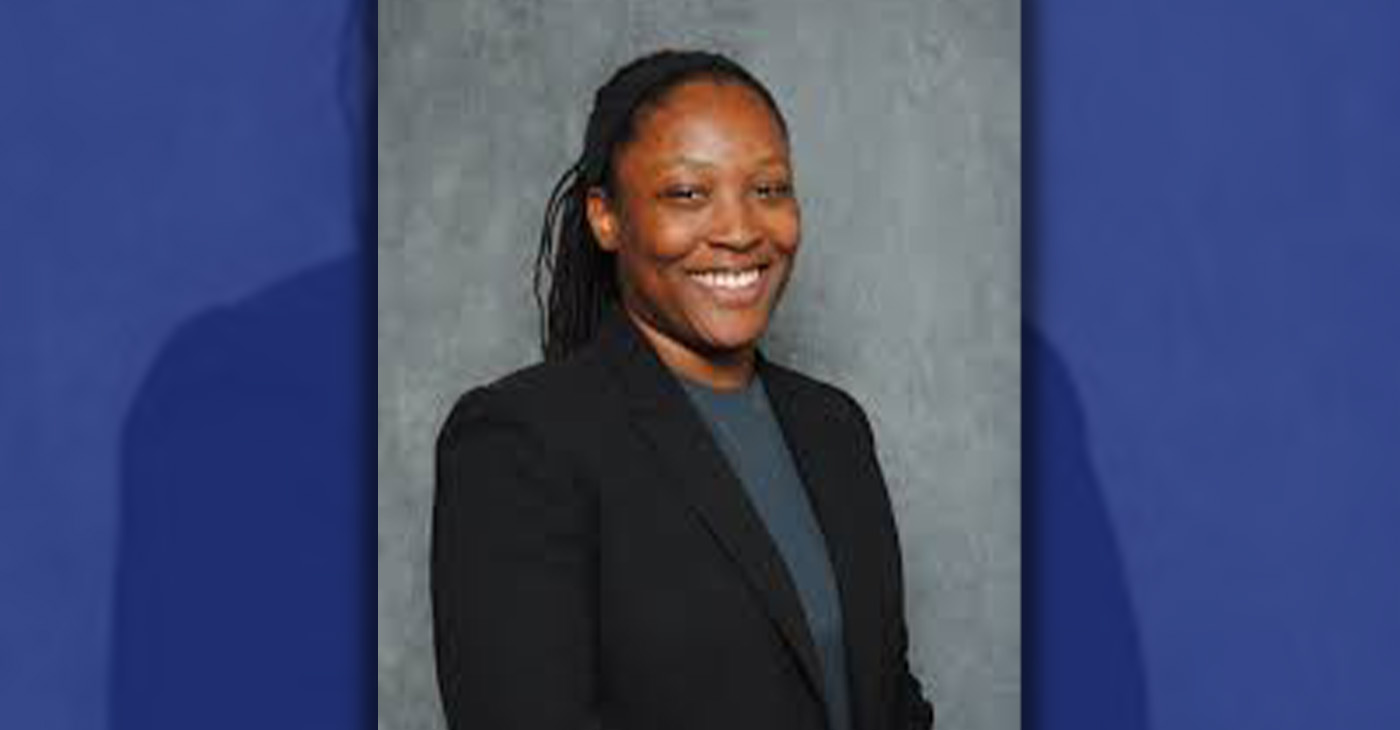
By Dr. Imani McElroy,
Special to California Black Media
As I became part of the small community of Black female surgeons, who represent less than 1% of all physicians, I embraced the responsibility with an understanding that part of my career would be dedicated to being a voice for marginalized and disenfranchised people.
Growing up in the San Francisco Bay Area, I observed the vast economic divide that contributes to health care disparities. Unstable employment and housing, food deserts, underfunded schools, and escalating living expenses all play a significant role in poor health for Black patients.
They also are a direct reflection of centuries of systemic discrimination and racism that has crippled Black Americans dating back to the era of slavery.
The same issues have followed me personally. I live with asthma, which has quietly impacted my breathing since childhood. I have been fortunate to avoid long-term hospitalization, but I have had numerous visits to urgent care and emergency departments.
I discussed my symptoms with my primary care physicians over the years, but it wasn’t until my third year living in Boston that I found a physician who attended to my symptoms and made the necessary adjustments that finally controlled my asthma. My asthma had progressed steadily for 15 years and despite being in the medical field and being able to describe the decline, my symptoms were ignored.

This is a story that is too common among Black Americans. Even fame could not protect Serena Williams when she had to demand appropriate testing and treatment for blood clots in her lungs following the birth of her first child.
I understood that my role as a health care provider extended well beyond the walls of the operating room and the hospital.
The plight of Black Americans within health care and the discrimination we face is well documented in both medical and lay literature.
In medicine, we celebrate J. Marion Sims as the father of obstetrics, but until recently, we rarely mentioned that most of his medical breakthroughs were achieved through the suffering of Black women who were not adequately anesthetized as he experimented on some of the most delicate parts of their bodies. Books such as “Medical Apartheid” and “The Immortal Life of Henrietta Lacks” document the long history of Black bodies being used for scientific experimentation without any compensation or acknowledgment.
If we are going to have an honest discussion about the root cause of medical mistrust within the Black community, the conversation cannot simply begin and end with the United States Public Health Service (USPHS) Untreated Syphilis Study at Tuskegee.
It’s essential to recognize that the generational trauma endured by the Black community contributes significantly to its skepticism towards medical institutions.
Healthcare advocacy is multifaceted. From physician-led initiatives addressing policy and resource allocation, to research that intentionally and thoughtfully addresses disparities in access and outcomes, to development of integrated multidisciplinary treatment teams for personalized care plans, there is quite possibly no more important step than educating the lay person.
Gone are the days of blind trust in a physician simply because of their title.
Furthermore, being able to empower patients to advocate for their health care needs will also allow physicians to understand how medical conditions impact their patients’ quality of life and everyday activities. Shared decision-making rests on a patient’s ability to trust the providers caring for them. The medical community owes it to Black Americans to afford them this trust.
As an advocate, I aim to bridge the gap between medical literature and lay literature. Making sure that our community has updated and accessible information that can impact their understanding of their medical conditions and improve the quality of care they receive.
As a Black woman in America, I face my own challenges, including navigating the health care system, and finding providers who look like me, understand my unique needs, and are willing to engage with me despite my medical background.
As my family members grow older and begin to interact more frequently with medical providers, I find myself in the frustrating position of having to help them advocate for themselves in a system that does not always listen.
My white coat does not shield me from the realities of being Black in America and thus I feel it is my duty to become part of the solution in addressing disparities in healthcare.
While much of the work to fix this problem falls in the hands of physicians and providers, active participation is required from both sides.
Increased representation in clinical trials will improve our understanding of risk factors and treatment responses. Attending health fairs and community outreach events will help increase medical literacy and understanding. Being persistent and truthful about symptom progression or treatment side effects is equally as important to help inform decision making.
Most of our medical knowledge is hidden behind paywalls buried in medical jargon. My goal is to help make what is happening in the medical community more accessible to our community.
About the Author
A native of the Bay Area, Dr. Imani E. McElroy is a clinical fellow of Vascular Surgery at USC Keck School of Medicine. She completed general surgery training at the Massachusetts General Hospital in Boston, MA. She has a master of Public Health from the Harvard T.H. Chan School of Public Health and received a Doctor of Medicine from the Charles R. Drew University/UCLA David Geffen School of Medicine. She earned a bachelor’s degree in Biological Sciences from the University of California Irvine.
This article is supported by the California Black Health Journalism Project, a program created by California Black Media, that addresses the top health challenges African Americans in California face. It relies on the input of community and practitioners; an awareness of historical factors, social contexts and root causes; and a strong focus on solutions as determined by policymakers, advocates and patients.











Activism
Oakland Post: Week of September 16 – 22, 2026
The printed Weekly Edition of the Oakland Post: Week of September 16 – 22, 2026

To enlarge your view of this issue, use the slider, magnifying glass icon or full page icon in the lower right corner of the browser window.
Activism
Oakland Post: Week of September 9 – 15, 2026
The printed Weekly Edition of the Oakland Post: Week of September 9 – 15, 2026
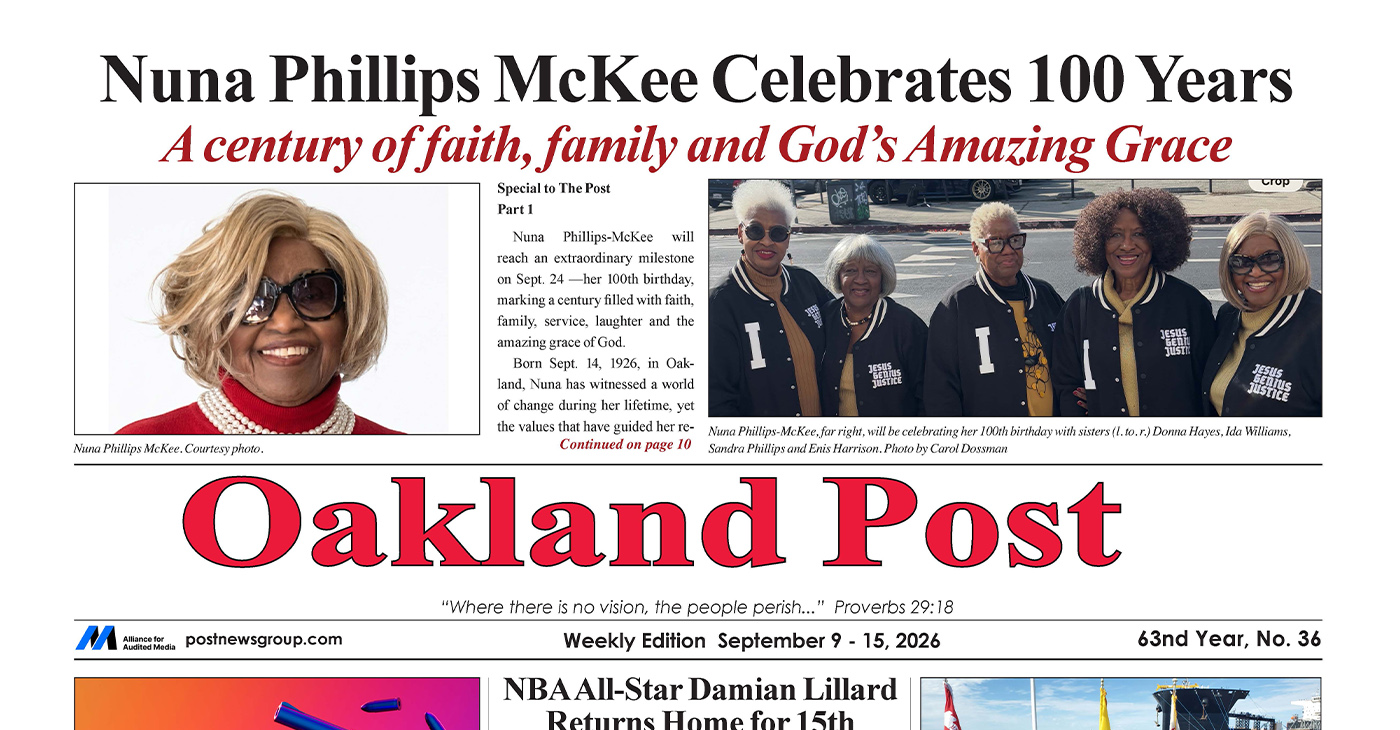
To enlarge your view of this issue, use the slider, magnifying glass icon or full page icon in the lower right corner of the browser window.
Activism
Oakland Post: Week of September 2 – 8, 2026
The printed Weekly Edition of the Oakland Post: Week of September 2 – 8, 2026
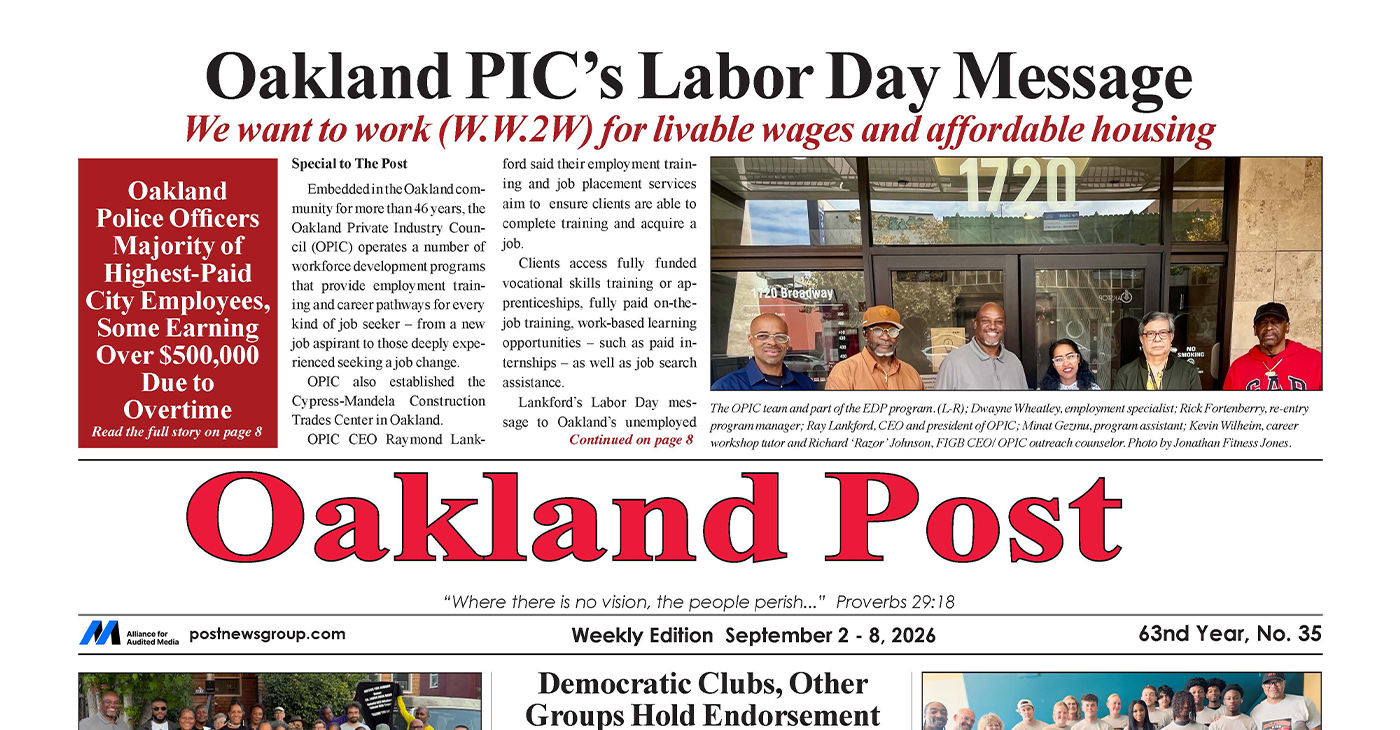
To enlarge your view of this issue, use the slider, magnifying glass icon or full page icon in the lower right corner of the browser window.



Doulas Are Helping Black California Moms Navigate Pregnancy–Even as High Mortality Rates Persist

Newsom Signs Addictive Social Media Law to Protect Kids

On Your November Ballot: Prop 38 Would Allocate $8.4 Billion to Immunology and Immunotherapy Funding

Ask California: Golden State Releases New AI Chatbot

Asm. Isaac Bryan’s Bill Banning California Police From ICE Side Jobs Reaches Newsom’s Desk

Assemblymember LaShae Sharp-Collins’s Bill Would Pause Law Enforcement’s Use of Shock Gloves Pending Study

BOOK REVIEW: ‘Laws of Solomon’ Reveals Tender Heart of Former Child Soldier

OPINION: The New American Fear – From 9-11 to AI

Passing for White, Fighting for Black America: The Courage of Walter White

Oakland People’s Arms Embargo Coalition Demands End to Military Shipments Thru Oakland

Barbara Lee Mourns Gloria Steinem, Remembers a Friendship Rooted in Equality

Event Preview: ‘Fashion v. Fascism’ – A Runway Revolution Is Coming to the Bay Area

Two Looming Threats Every Alameda County Elder Should Know About

Oakland Mayor Reads to Children at Bookout Block Party at Marcus Books Store

Tradition Comes to the Streets in 11th Annual Black-Eyed Pea Festival at the Freedom Farmers Market

Less Affluent School Districts, Including Sacramento City, Face Threat of State Takeover

ESSAY: California Can Close Its Colorectal Cancer Gap

California Hispanic Chambers of Commerce Unveils: ‘Powering the Future’ Theme for 47th Annual Statewide Convention

Four Candidates, Including Incumbent Barbara Lee, Qualify for Oakland Mayor’s Race

Oakland Post: Week of August 12 – 18, 2026

From Blueprint to Breakthrough: Tackling Affordable Housing in Oakland

Oakland Observes Black August with Block Parties, Film Showings, Workshops

COMMENTARY: Why Local School Tax Measure G1 Will Not Be on the November Ballot

Standoff for Justice: Our Homes Are Worth Fighting For

Returning to Its Roots, the Oakland Black-Eyed Pea Festival Partners with the Freedom Farmers Market Sept. 12

NPRC Scores First Advocacy Victory: David Shaw Finally Gets His Wish to ‘Go Home’

Oakland Post: Week of August 26 – September 1, 2026

Frontier Airlines’ Return to Oakland Airport Brings Flights, Jobs and Opportunity

Gubernatorial Candidate Steve Hilton Blasts California New Tire Rules; Newsom Hits Back

Chef Sharon Lee Blends Culinary Excellence, Education and Empowerment

The Conversation With Al McFarlane 6/23/26

Media Monday 6/22/26

LIVE! ASK ALMA! — TUES. 6.23.26 7PM EST

Car Buying Secrets: 4 Hidden Checks Before You Sign!

Is This 550 HP Charger Worth YOUR Money? AutoNetwork Review

Celebrating Juneteenth – Frederick Douglass on education and resistance

LIVE! — ASK ALMA! — TUES. 6.19.26 7PM EST

Hyundai Ioniq 5 Parking, Safety, and 360 View #shorts

2025 Ioniq 5 New Wiper & Powerful Performance! #shorts

Electric SUV Range: Is 259 Miles Enough? #shorts

EV Charging: How Fast Can You Charge an Electric Vehicle? #shorts

Biometric Cooling… Messaging Seats…Come on! 2025 Infiniti QX80 Autograph 4WD

Charged Up: Witness the Magic of a Fully Electric Car! #shorts

Range Rover Sport PHEV Included…: See What’s Inside This Luxury SUV! #shorts

Invisible Hood View: Perfect Parking with X-Ray Vision! #shorts
-
 Commentary4 weeks ago
Standoff for Justice: Our Homes Are Worth Fighting For
-
 Activism4 weeks ago
Oakland Post: Week of August 26 – September 1, 2026
-
 Business4 weeks ago
Frontier Airlines’ Return to Oakland Airport Brings Flights, Jobs and Opportunity
-
 Business4 weeks ago
Gubernatorial Candidate Steve Hilton Blasts California New Tire Rules; Newsom Hits Back
-
 Business4 weeks ago
Chef Sharon Lee Blends Culinary Excellence, Education and Empowerment
-

 Education4 weeks ago
Gov. Newsom’s Latest Appointees Include Sacramento Advocate for Formerly Incarcerated Students; State’s New Tech Chief
-

 Community4 weeks ago
Big City Mayors Ask for “Yes” Vote on Housing Bond Measure; Conservatives Say “No”
-

 Business4 weeks ago
Oakland Coliseum Project Opens Door for Small Businesses to Build Bigger
