
Education
End of Year Letter from OUSD Supt. Kyla Johnson-Trammell


As I wrap up my first year as superintendent, I am filled with resolve and optimism for the future.
We owe a debt of gratitude to our committed partners, participants in OUSD committees, Oakland voters who helped bring much needed investment to our schools via Measures N, G, and G1 and our existing bond, and our families.
We can not do this work alone. Here are a few of our accomplishments that show we are headed in the right direction:

- We are leading the State in our efforts to transform high school experiences through Linked Learning. Seventy-eight percent of OUSD high school students participated in pathways this year. That’s up from 53 percent just two years ago, in 2015-16. This means that the majority of our graduates are leaving the District having participated in relevant work-based learning.
- Graduation rates continue to rise across the District; we have seen improvement in each of the past three years with an increase of 5 percent total from the class of 2014 to the class of 2016. We’ve also seen meaningful gains in graduation rates among Special Education students, with more work to be done.
- We are deepening our commitment to Social Emotional Learning (SEL) practices to increase both adult and student engagement, and to foster positive interactions that help our youth express their feelings, manage their actions, and engage in learning.
- Additionally, this year, more than 300 youth were trained as Restorative Justice (RJ) peer facilitators and more than 48,000 (duplicated) students utilized RJ practices.
The explosive growth and interest in computer science at the middle and high school levels continues, building on the 1,000 percent increase in computer science course enrollment we saw between 2015 and 2017. This year, 3,750 middle and high school students were inspired in computer science courses.
We are taking steps towards bringing our Equity Policy to life. The Office of Equity has built on the nationally recognized model of African American Male Achievement to change the narrative and provide targeted support to students through the African American Female Excellence, Latino/a Student Achievement, and Asian Pacific Islander Student Achievement initiatives.
Strengthening our Student and Family Engagement efforts remains a top priority. We continue to work with families and students to understand critical information about student learning, school budgets, and District-wide initiatives. We are continuously improving the ways we encourage participation in OUSD committees and how we ask for partnership and feedback from students and families.
The first year of the Blueprint for Quality Schools process to increase quality education and address sustainability across OUSD is complete. The multi-year strategy continues next year with our first Cohort of schools and the selection of the second Cohort.
As a Sanctuary District, we continue to welcome and stand behind ALL students, no matter where they were born or the barriers they overcame to be here. We cherish the cultural richness in our District and make no exceptions when it comes to including learners with a wide variety of backgrounds and needs.
All of us can take pride in these accomplishments. Next year and going forward, we will continue to make strides to become a more sustainable and thriving District. By aligning and uniting around our District values of Joy, Integrity, Equity, Excellence, Cultural Responsiveness – and, above all – putting Students First, we will realize our vision. Together.














Community
WCCUSD Joins Statewide Organic School Food Purchasing Cooperative
Other districts involved include: Alameda USD, Albany USD, Berkeley USD, Capistrano USD, Cupertino Union SD, Hayward USD, Laguna Beach USD, Lagunitas Elementary SD, Mt. Diablo USD, North Monterey County USD, Pajaro Valley USD, San Leandro USD, San Ramon Valley USD, Santa Clara USD, Sausalito Marin City SD, Tahoe-Truckee USD and West Contra Costa USD.

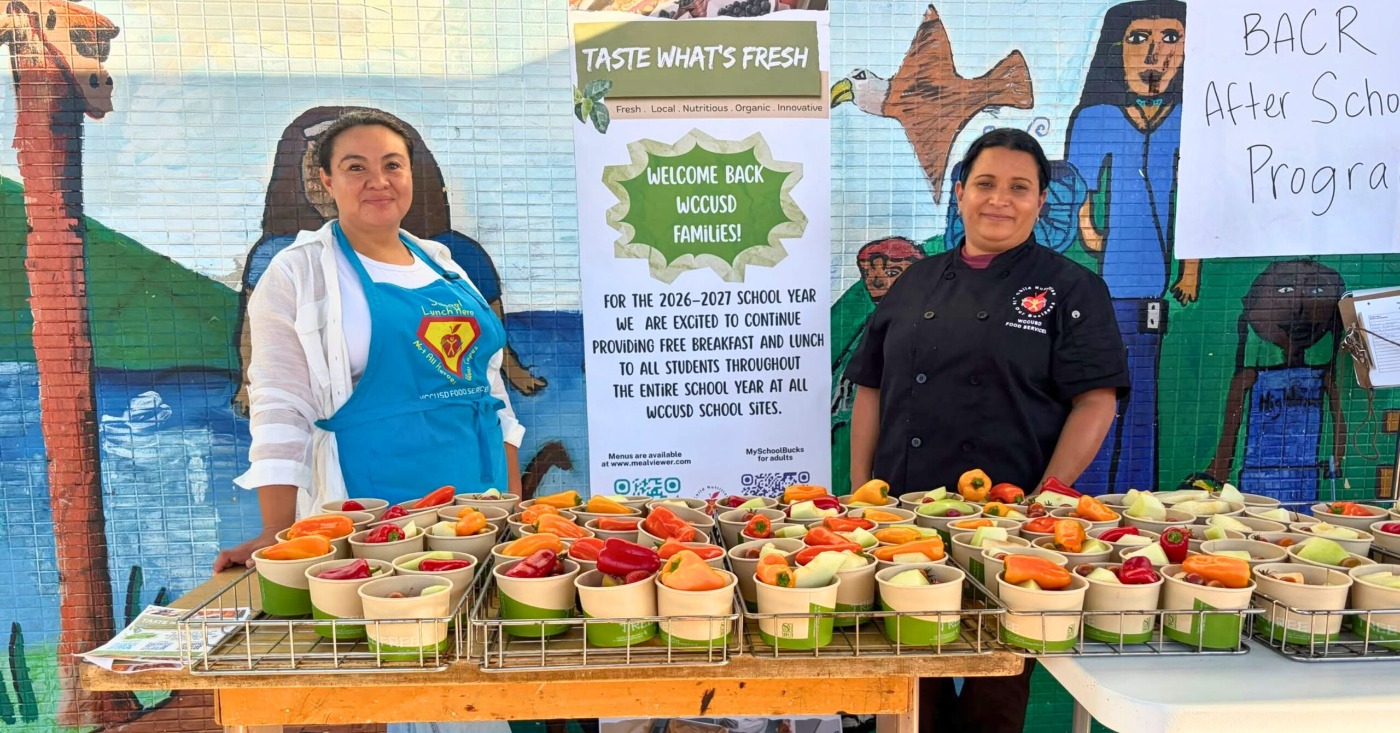

Seventeen California public school districts, including West Contra Costa Unified (WCCUSD), have joined a purchasing cooperative to pool their buying power and expand access to organic food in school meals.
The nonprofit Conscious Kitchen recently announced the launch of the Conscious Organic School Food Purchasing Cooperative. Its founding districts serve more than 300,000 students combined.
The cooperative partnered with food distributors UNFI and Sysco to expand the organic products available to participating districts. Combining schools’ purchasing demand helps distributors plan with suppliers while creating more dependable markets for organic farmers and food makers, according to Conscious Kitchen.
Other eligible California school districts can access the cooperative’s products and pricing through its existing contracts without conducting their own bids. Mt. Diablo Unified School District serves as the lead district for the cooperative’s grocery bid.
Other districts involved include: Alameda USD, Albany USD, Berkeley USD, Capistrano USD, Cupertino Union SD, Hayward USD, Laguna Beach USD, Lagunitas Elementary SD, Mt. Diablo USD, North Monterey County USD, Pajaro Valley USD, San Leandro USD, San Ramon Valley USD, Santa Clara USD, Sausalito Marin City SD, Tahoe-Truckee USD and West Contra Costa USD.
Barbara Jellison, WCCUSD’s executive director of food services, said the cooperative builds on years of work bringing fresh, organic food into school kitchens.
“The next challenge has always been how to make that possible for more districts,” Jellison said. “The Co-op gives schools a way to take what we have learned and move it to a completely different scale.”

Community
Asm. Corey Jackson Announces Launch of 24-Hour Childcare in His District
Assemblymember Corey Jackson has secured $2 million in state funding for a proposed childcare special district in Moreno Valley and Perris. This funding aims to establish a system providing 24-hour, seven-day-a-week childcare, which would be California’s first special district focused solely on childcare. The initiative seeks to address the area’s designation as a “childcare desert” and high costs for working families. The funding will cover startup, planning, and formation costs for the district. Read more about the specifics of this groundbreaking initiative.

Assemblymember Corey Jackson (D-Moreno Valley) has secured $2 million in state funding to launch a proposed childcare special district serving families in Moreno Valley and Perris, paving the way for a system designed to provide childcare 24 hours a day, seven days a week.
The Moreno Valley-Perris Childcare Special District would be the first special district in California focused specifically on childcare, according to Jackson’s office. The state funding will cover startup, planning, and formation costs and help the district meet requirements set by the Riverside Local Agency Formation Commission, or LAFCO.
The proposed district would coordinate a mixed-delivery childcare system that could include home-based and center-based care. The goal is to provide universal childcare for families who work overnight, early morning, or other nontraditional shifts.
Jackson’s office says Moreno Valley is a certified “childcare desert,” with licensed childcare spaces available for only 15% of children with working parents. Infant care in Moreno Valley averages $2,776 a month, or about 35.7% of median household income. In Perris, licensed infant care can cost more than 60% of an individual worker’s gross median earnings, according to the assemblymember’s office.

“Securing this $2 million in startup funding is a monumental victory for the working-class families of Moreno Valley and Perris who have been trapped in a childcare desert for far too long,” Jackson said.
The proposal follows Jackson’s unsuccessful effort to establish the district through Assembly Bill 2083. The legislation would have created the district as a dependent special district covering Moreno Valley, Perris and their spheres of influence, with Riverside LAFCO responsible for reviewing its formation and boundaries.
The new funding allows the district’s formation to move forward without requiring mandatory contributions from local school districts and other stakeholders, according to Jackson’s office. His spokesperson, Daniel Peeden, said Jackson hopes the district can be operating by 2028.
The proposal has faced questions from some local officials. Moreno Valley City Councilmember Ed Delgado, who is running against Jackson for the 60th Assembly District seat, said he supports affordable childcare but questioned how the proposed district would operate and how much it would ultimately cost.
“Basically, he didn’t have a plan. We didn’t see a plan,” Delgado said, adding that officials had questions about operating costs, insurance and eligibility.
“It’s going to take a lot more than $2 million to create a special district to provide affordable childcare,” Delgado said.
Delgado has suggested working with existing childcare centers to subsidize costs for local families rather than creating a new agency.
Jackson’s office says the program will lower barriers to “workforce participation” and reduce “affordability anxiety” for young families. This landmark District is poised to trigger a virtuous cycle of economic upward mobility and long-term regional prosperity in the 60th Assembly District, his office added.
Business
County Office of Education Says OUSD Finances Are Getting Healthier, Materially Stronger
The Oakland Unified School District’s recent budget submission has been deemed “materially stronger” by the Alameda County Office of Education, reflecting deliberate work by the new board and superintendent. Despite needing further cuts in the coming years, the district is progressing toward financial health, according to ACOE Superintendent Alysse Castro. This assessment counters critics who suggest a dire financial outlook for Oakland schools, acknowledging the district has made significant reductions and adopted a plan to address structural challenges. The ACOE commended the district’s efforts to get its financial house in order. Read more to learn about the details of these financial improvements.
County’s letter counters critics who offer Doomsday scenarios for Oakland schools
The Oakland Unified School District, under the leadership of a new board majority and new superintendent, recently submitted a budget to the county “that is a materially stronger submission than the district has filed in recent years, (which) reflects difficult and deliberate work,” according to a letter to the district from Supt. Alysse Castro of the Alameda County Office of Education.
While OUSD still must make more budget cuts in the next two years, the district is on the road to financial health, according to a Sept. 15 letter from Castro to the district.
Under the California Education Code, Alameda County and other county offices of education (COEs) have the legal responsibility to review, approve, conditionally approve, or disapprove local school district annual budgets and interim financial reports.
“The Alameda County Office of Education wants to acknowledge that the district has submitted a budget that shows a positive fund balance, meets the state minimum reserve for economic uncertainty in each year of the multiyear project and is accompanied by a board-adopted commitment to close the remaining structural challenges,” the letter said.
“After two decades of state receivership and significant changes in OUSD’s budgeting practices,” it is understandable that there may be “considerable confusion” in the public about the district’s current financial condition, according to the letter.
However, the district’s current fiscal position and practices are “materially” better than prior years, though they “do not yet eliminate underlying structural challenges,” the letter continued.
Castro also commended the board and staff for working to get their financial house in order.
“There are three essential parts to addressing a structural deficit: staff must identify and bring
forward hard choices; the governing board must make those choices; and staff must follow
through and implement them,” she wrote.
“All three appear to be happening in OUSD, and that represents meaningful progress,” she wrote. “The district has made significant reductions to ongoing expenditures, increased its use of available restricted resources, and adopted a plan to address the remaining gap.”
According to the County, the district already has approved budget cuts of about $30 million in the current year. Additional reductions of about $30 million will be necessary next year, and another $11 million the following year.
These cuts are necessary, the county says, because “the district is still operating at a structural
deficit, meaning spending more every year than it brings in.”
In a statement released earlier this month, the district announced it had “finished the year with $170.1 million in its General Fund and an unrestricted reserve of $32.3 million, finishing $16.4 million ahead of what the district projected in March.”
The budget reflects progress toward putting the district in a stronger financial position to better serve students and families, said district leaders, while also acknowledging the need for significant reductions across the board.
“This turnaround happened because our board was willing to make difficult decisions rather than pass them along, and because our staff did the work,” said Supt. Dr. Denise Saddler. “None of this came easily, and there is more ahead of us. What these closed books show is that the direction is right.”
In October 2025, the board directed staff to prepare budget scenarios totaling $100 million in adjustments. In December, presented with a choice between borrowing to bridge the gap and making the reductions directly, the board chose the latter, the district statement said. As part of the reduction plan, the board approved cuts to more than 400 certificated and classified positions, along with a retirement incentive that converted some layoffs into voluntary departures.
“Closing our books is not the same as finishing the work, and we are not stopping here,” said Tara Gard,deputy superintendent of Business and Operations. “We will continue with the actions in our Financial Stabilization Plan because of where they lead.”
In a statement released on social media, Oakland Education Association (OEA) President
Kampala Taiz-Rancifer strongly criticized those who allege the district is collapsing and supported members of the school board majority who are working hard to stabilize the district’s finances while minimizing disruption for schools and employees.
Jennifer Brouhard (D2) and Valarie Bachelor (D6), who are running for reelection, “are moving the district toward a ‘materially stronger’ financial position than we’ve seen in recent years—all while investing in school sites and the employees who serve Oakland students,” she wrote.
“For years, we’ve heard billionaire-backed board members say they had to make ‘tough choices’ to balance the budget,” she continued. “Those choices almost always caused disruption and instability for our schools and communities. This is a different approach: financial stability alongside investments in students, schools, and workers. All in the effort to improve student outcomes.”
“The real hard work is tuning out the rage bait, the chaos agents, the attacks on unions and workers, and ignoring the loud corporate profiteers—and staying focused on what matters: improving outcomes for students while creating stable teaching and learning conditions,” said Taiz-Rancifer.
“Let’s not go backward into the days of manufactured panic.”



Mayor Barbara Lee Holds Special State of the City Address in Deep East Oakland

Practitioners of African Traditional Spirituality Offer Ancestral Reverence Ritual Oct. 31

It’s Time to Lose Weight Before the Holidays

Trader Vic’s Returns to Its Oakland Roots

Oakland Coal Terminal Backed by Trump Would Be Bigger, Dirtier Than Promised, Says Report

Opponents Smear Effective African American Transit Director as Election Nears

Oakland Post: Week of October 14 – 20, 2026

OP-ED: The Black Church Writes AI’s Next Chapter

OP-ED: The Black Church Writes AI’s Next Chapter

WCCUSD Joins Statewide Organic School Food Purchasing Cooperative

Democrats, Community Groups Back Measure EE to Change How Oakland Is Governed

Four Tips to Help You Plan a Holiday “Staycation”

Veterans Housing Project Proposed for South Richmond
PRESS ROOM: Transformative Justice Coalition 2026 Voting Rights Champion Awards Reception ‘Yesterday Is Today: The Battle For Voting Rights

Mayor Lee Delivers 2026 State of the City Address: ‘Oakland Continues to Be on the Move’

Misnamed ‘Parent’ PAC Seeks to Influence Oakland School Board Elections

Listening as a Lifeline: A Doula’s Witness to Black Maternal Health

Poll: Becerra Widens His Lead Over Hilton; Californians Split on Wealth Tax

Oakland Post: Week of September 9 – 15, 2026

County Office of Education Says OUSD Finances Are Getting Healthier, Materially Stronger

Richmond Tiny House Village Farm & Garden Set to Open Gates on Sept. 26

Mayor Lee Announces $1 Million Kaiser Permanente Grant for Pilot Program to Address Homelessness, Clean Up Public Spaces throughout Oakland

Latest Massacre in Haiti Reveals Cruelty U.S. Deportations

Zakiya Jendayi Arrested, Locked Out of Home by Sheriff’s Deputies

OPINION: Nolan Wells’ Death One of Several Signifying Racial Terror Lives on in U.S. South

Doulas Are Helping Black California Moms Navigate Pregnancy–Even as High Mortality Rates Persist

BLACspace Cooperative Invites Bay Area to Experience Oakland’s Black Cultural Ecosystem Through a BLAC Map Tour + Party

Oakland Post: Week of September 16 – 22, 2026

Democratic Clubs Interview Candidates for Oakland School Board

Oakland People’s Arms Embargo Coalition Demands End to Military Shipments Thru Oakland

The Conversation With Al McFarlane 6/23/26

Media Monday 6/22/26

LIVE! ASK ALMA! — TUES. 6.23.26 7PM EST

Car Buying Secrets: 4 Hidden Checks Before You Sign!

Is This 550 HP Charger Worth YOUR Money? AutoNetwork Review

Celebrating Juneteenth – Frederick Douglass on education and resistance

LIVE! — ASK ALMA! — TUES. 6.19.26 7PM EST

Hyundai Ioniq 5 Parking, Safety, and 360 View #shorts

2025 Ioniq 5 New Wiper & Powerful Performance! #shorts

Electric SUV Range: Is 259 Miles Enough? #shorts

EV Charging: How Fast Can You Charge an Electric Vehicle? #shorts

Biometric Cooling… Messaging Seats…Come on! 2025 Infiniti QX80 Autograph 4WD

Charged Up: Witness the Magic of a Fully Electric Car! #shorts

Range Rover Sport PHEV Included…: See What’s Inside This Luxury SUV! #shorts

Invisible Hood View: Perfect Parking with X-Ray Vision! #shorts
-
 Black History3 weeks ago
Listening as a Lifeline: A Doula’s Witness to Black Maternal Health
-
 Economy4 weeks ago
Poll: Becerra Widens His Lead Over Hilton; Californians Split on Wealth Tax
-
 Business4 weeks ago
County Office of Education Says OUSD Finances Are Getting Healthier, Materially Stronger
-
 Lead Story3 weeks ago
Zakiya Jendayi Arrested, Locked Out of Home by Sheriff’s Deputies
-
 Black History4 weeks ago
Doulas Are Helping Black California Moms Navigate Pregnancy–Even as High Mortality Rates Persist
-
 Art4 weeks ago
BLACspace Cooperative Invites Bay Area to Experience Oakland’s Black Cultural Ecosystem Through a BLAC Map Tour + Party
-

 Business4 weeks ago
From Historic Memories to New Possibilities: Oakland Celebrates Coliseum 60
-

 Community4 weeks ago
Asm. Corey Jackson Announces Launch of 24-Hour Childcare in His District
