
Bay Area
Eerie Apocalyptic Sky in Bay Area Raises Concerns for Residents

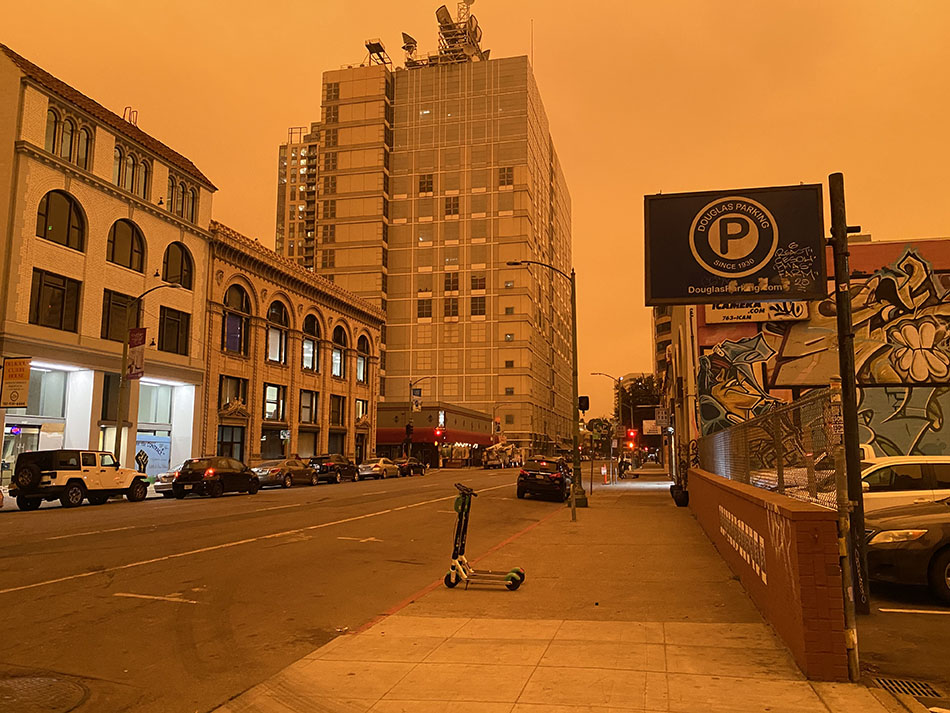
In addition to smoke from the August fires, the Bay Area branch of the National Weather Service noted on Twitter that lower temperatures and weaker winds compared to the last several days are allowing wildfire smoke suspended in the air to fall closer to the ground, contributing to the sky color change.
People all over the Bay Area woke up Wednesday morning to ominous, orange skies. Street lights stayed on long past what should have been daybreak that — under normal circumstances –would have been a clear, sunny day.
The Apocalypse has arrived in Oakland this is Lake Merritt at 10:30 a.m pic.twitter.com/QhovkvhAq7
— Michelle Dione🧜🏻♀️ (@ShelleDione) September 9, 2020
‘Surreal,’ ‘hell,’ and variants of ‘apocalypse’ were terms that peppered conversations on and off social media.
The cause, as reported by Bay City News, is smoke from the August Complex fires in Mendocino County that settled on top of a marine layer in the Bay Area Wednesday, turning the sky various shades of red and orange.
According to the San Francisco Chronicle, “ . . . [t]he ominous pallor of the skies, experts said, were a product of the plumes of smoke billowing from the historic number of wildfires burning across the state. Wind conditions overnight pushed smoke into lower elevations, filtering sunlight and producing dark tints of red, orange and gray. Still, air quality remained mostly unchanged.”
Bay Area Air Quality Management District spokesman Ralph Borrmann said the smoke is filtering out blue light, giving skies around the Bay Area a red-orange tint.
Borrmann said that while the air district extended its Spare the Air alerts through Friday, air quality is not being adversely affected by the smoke because the marine layer is, in effect, insulating low-lying areas.
Parts of the Bay Area at higher elevations may be more susceptible to poor air quality, but parts of the Bay Area that lie at or close to sea level were not being adversely affected like in previous days. Updates about air quality in the Bay Area can be found at baaqmd.gov.
This writer woke up to ash on my car and lawn and confused about the time of day and why it wasn’t lighter at dawn. By noon on Wednesday, people were still driving with their headlights on. Streetlights that turn off at dawn were still illuminated. People complained of their eyes being irritated.
This writer received a text from a friend, Ange, about “ . . . the impending apocalypse and obvious undercurrent of anxiety” followed by “ . . . seriously though . . . what is with the sky?”
Jim Tang tweeted: “If you told me that I was actually in hell right now, I would believe you.”
If you told me that I was actually in hell right now, I would believe you. Apocalyptic feel to the sky across the Bay Area right now. pic.twitter.com/iQvVbNTylD
— Jim Tang (@wxmann) September 9, 2020
Connie Guglielmo of CNET tweeted “Strange skies over the Bay Area again this morning. Ominous music optional.”
Strange skies over the Bay Area again this morning. Ominous music optional. pic.twitter.com/lkZ88q6rfe
— Connie Guglielmo (@techledes) September 9, 2020
Will Tran of KRON 4 tweeted: “[o]range, dark and ashy bc of wildfires. I was two days away from my 8th birthday when Mt. St. Helens shook the planet. I’m from Seattle-Tacoma and I remember the sky looked just like this.”
Absolutely no filter involved here. This is the morning sky over San Francisco at 8am. Orange, dark and ashy bc of wildfires. I was two days away from my 8th birthday when Mt. St. Helens shook the planet. I’m from Seattle-Tacoma and i remember the sky looked just like this. pic.twitter.com/zgOkT2Ou5f
— Will Tran (@KRON4WTran) September 9, 2020
(Mount St Helens is an active volcano in nearly 100 miles south of Seattle, Wash. It had a deadly eruption in 1980.)
News reports discussed how residents of Oakland, San Francisco, and the Bay Area were sharing images of the “apocalyptic morning light” as record heat continues to fuel local fires.
Wildfires are changing the weather of an entire region, meteorologists said. And forecasters don’t know when it will end.
“Fires create their own weather,” National Weather Service meteorologist Roger Gass explained, but usually only on a small scale, in areas close to the flames.
The smoke that upended the Bay Area on Wednesday, though, was coming from hundreds of miles away, according to reports from The East Bay Times. Most of it, Gass said, “was likely from the August Complex Fire in the Mendocino National Forest and the Bear Fire in the western Sierra. Smoke from other fires throughout California, Oregon and Washington was also mixed into the massive layer of haze,” the East Bay Times reported.
“We’re having such a large scope of dense smoke across the Bay Area and the West Coast in general, that it’s actually impacting our weather conditions,” Gass told the East Bay Times. “We’re kind of in uncharted territory right now.”
Meteorologists said that the air quality is not as bad as it appears to be, but that is not reassuring to some.
“I woke to an apocalyptic sky, orange haze elicits a sense of dusk rather than day. I’m reminded of all the dystopian books I’ve read. I also sense that we are doomed. The world descending into chaos around me” said my wife, Natalie Devora Monifa.
“I think this weather is a ‘no’” added my 19-year-old daughter, Isabella Bolden-Monifa
“Since the beginning of this pandemic, I’ve been feeling as if I was in an apocalypse. Today’s weather in the Bay Area is ‘outpicturing’ what I’ve been feeling” said another friend, Pamela Grimm.
But for my son, Benjamin Bolden-Monifa, “It’s cool.” My 17-year-old’s favorite color is orange and he wears it daily.








Activism
Oakland Post: Week of September 30 – October 6, 2026
The printed Weekly Edition of the Oakland Post: Week of September 30 – October 6, 2026

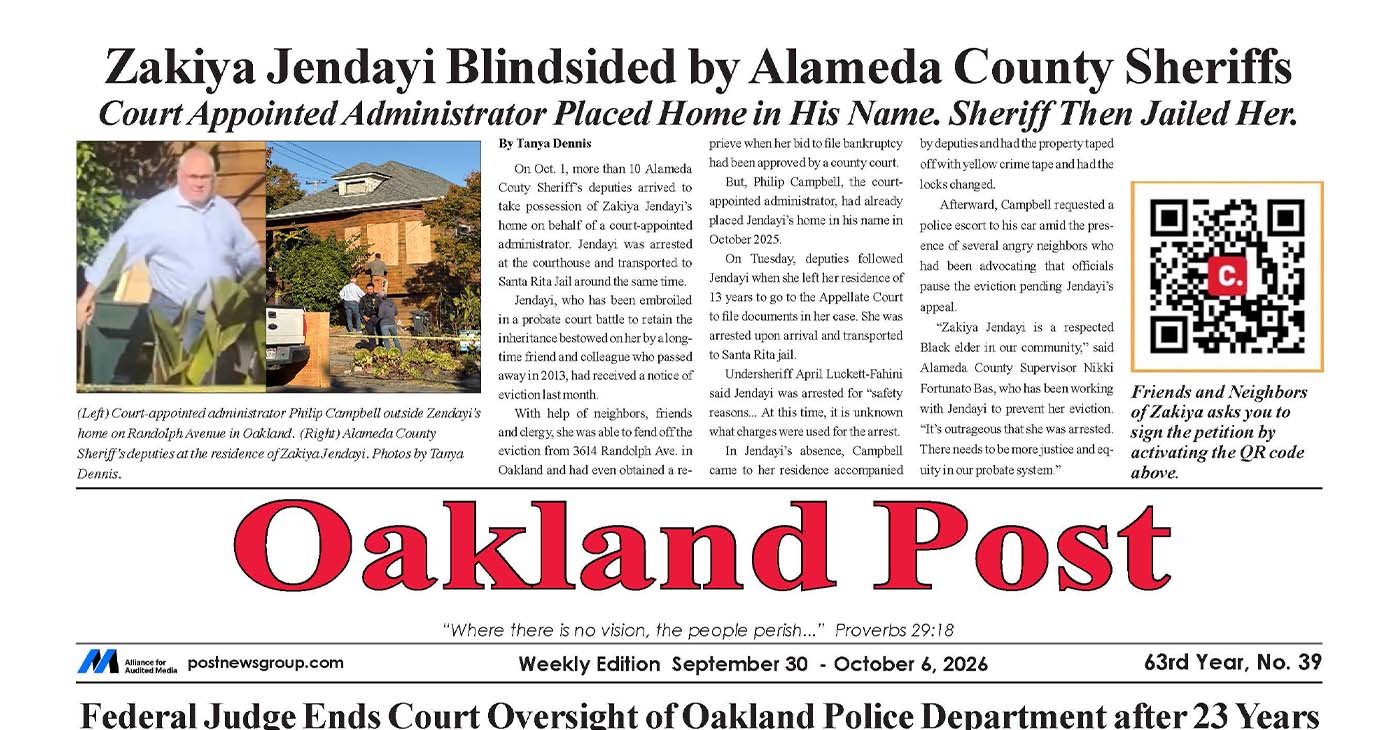
To enlarge your view of this issue, use the slider, magnifying glass icon or full page icon in the lower right corner of the browser window.


Activism
Oakland Post: Week of September 23 – 29, 2026
The printed Weekly Edition of the Oakland Post: Week of September 23 – 29, 2026

To enlarge your view of this issue, use the slider, magnifying glass icon or full page icon in the lower right corner of the browser window.
Activism
Oakland Post: Week of September 16 – 22, 2026
The printed Weekly Edition of the Oakland Post: Week of September 16 – 22, 2026

To enlarge your view of this issue, use the slider, magnifying glass icon or full page icon in the lower right corner of the browser window.



OP-ED: Proposition 44 Would Put a Price on Trust

OP-ED: Proposition 40: It’s Time to Play Chess, Not Checkers

Listening as a Lifeline: A Doula’s Witness to Black Maternal Health

New Protections for Ticket Buyers: Gov. Newsom Signs Assemblymember Isaac Bryan’s Bill

‘We Don’t Talk Trash — We Pick Up Trash!’

Zakiya Jendayi Arrested, Locked Out of Home by Sheriff’s Deputies

Oakland Post: Week of September 30 – October 6, 2026

Asm. Corey Jackson Announces Launch of 24-Hour Childcare in His District

IN MEMORIAM: The Rev. Leon “Sonny” Clark, Longtime Orange County Pastor and Community Leader, Dies at 72

Poll: Becerra Widens His Lead Over Hilton; Californians Split on Wealth Tax

From Historic Memories to New Possibilities: Oakland Celebrates Coliseum 60

County Office of Education Says OUSD Finances Are Getting Healthier, Materially Stronger

LIVE FREE Sunday Dinner Brings Faith, Fellowship and Civic Conversation to Oakland

Remembering Chauncey Bailey as Student Journalists Face Threats to Truth-Telling

BLACspace Cooperative Invites Bay Area to Experience Oakland’s Black Cultural Ecosystem Through a BLAC Map Tour + Party

Standoff for Justice: Our Homes Are Worth Fighting For

Oakland Post: Week of August 26 – September 1, 2026

Frontier Airlines’ Return to Oakland Airport Brings Flights, Jobs and Opportunity

Gubernatorial Candidate Steve Hilton Blasts California New Tire Rules; Newsom Hits Back

Chef Sharon Lee Blends Culinary Excellence, Education and Empowerment

Jackie Wright Champions Bay Area Stories, Filmmakers and Cultural Institutions

Misnamed ‘Parent’ PAC Seeks to Influence Oakland School Board Elections

Oakland Coliseum Project Opens Door for Small Businesses to Build Bigger

Big City Mayors Ask for “Yes” Vote on Housing Bond Measure; Conservatives Say “No”

Gov. Newsom’s Latest Appointees Include Sacramento Advocate for Formerly Incarcerated Students; State’s New Tech Chief

Longtime BWOPA Member Brendalyn Goodall Appointed to California Workforce Development Board

Gov. Newsom Signs Law Shielding Immigration Aid Workers From Doxing Threats

Secretary of State Shirley N. Weber Urges Californians to Vote Early as Voter ID Battle Intensifies

Oakland Post: Week of September 2 – 8, 2026

IN MEMORIAM: Dolly Parton Dead at 80 — How She Built a Legacy of Love and Earned Her Place in Black Culture

The Conversation With Al McFarlane 6/23/26

Media Monday 6/22/26

LIVE! ASK ALMA! — TUES. 6.23.26 7PM EST

Car Buying Secrets: 4 Hidden Checks Before You Sign!

Is This 550 HP Charger Worth YOUR Money? AutoNetwork Review

Celebrating Juneteenth – Frederick Douglass on education and resistance

LIVE! — ASK ALMA! — TUES. 6.19.26 7PM EST

Hyundai Ioniq 5 Parking, Safety, and 360 View #shorts

2025 Ioniq 5 New Wiper & Powerful Performance! #shorts

Electric SUV Range: Is 259 Miles Enough? #shorts

EV Charging: How Fast Can You Charge an Electric Vehicle? #shorts

Biometric Cooling… Messaging Seats…Come on! 2025 Infiniti QX80 Autograph 4WD

Charged Up: Witness the Magic of a Fully Electric Car! #shorts

Range Rover Sport PHEV Included…: See What’s Inside This Luxury SUV! #shorts

Invisible Hood View: Perfect Parking with X-Ray Vision! #shorts
-
 Community3 weeks ago
Misnamed ‘Parent’ PAC Seeks to Influence Oakland School Board Elections
-
 Activism4 weeks ago
Oakland Post: Week of September 2 – 8, 2026
-

 Activism3 weeks ago
Oakland Post: Week of September 9 – 15, 2026
-

 Community3 weeks ago
Richmond Tiny House Village Farm & Garden Set to Open Gates on Sept. 26
-

 Black History3 weeks ago
Latest Massacre in Haiti Reveals Cruelty U.S. Deportations
-

 Black History3 weeks ago
OPINION: Nolan Wells’ Death One of Several Signifying Racial Terror Lives on in U.S. South
-

 Business2 weeks ago
Mayor Lee Announces $1 Million Kaiser Permanente Grant for Pilot Program to Address Homelessness, Clean Up Public Spaces throughout Oakland
-

 Community3 weeks ago
Democratic Clubs Interview Candidates for Oakland School Board
