
Bay Area
Court Ruling Temporarily Blocks Mills College Merger with Northeastern University
Mills College began formal talks to merge with Northeastern in June. In March, the college had said “mounting financial challenges” meant it would most likely close after 2023.


Mills College in Oakland has temporarily been blocked from moving forward with its plans to merge with Northeastern University in Boston after a trustee alleged the school was withholding information about the merger.
Mills College began formal talks to merge with Northeastern in June. In March, the college had said “mounting financial challenges” meant it would most likely close after 2023.
But under the pending agreement, it would remain open as Mills College at Northeastern University and become gender-inclusive for all students. Previously, Mills College’s undergraduate program was only open to women and nonbinary students.
That agreement was halted August 5 after an Alameda County Superior Court judge issued a temporary restraining order based on a motion by Tara Singh, a former member of the school’s board of trustees, and Viji Nakka-Cammauf, a current trustee and president of the Alumnae Association of Mills College.
In the motion, Nakka-Cammauf alleges that the college has withheld financial information and planning documents, among other information, that has kept her from performing her duties as a member of the board.
College President Elizabeth Hillman said in a statement that Nakka-Cammauf was given “more than ample” information about the potential partnership and the Board of Trustees as a group was confident in the amount of information it had received.
In July, the school administration offered Nakka-Cammauf the opportunity to review hard copies of the information on campus so long as she did not bring legal counsel or financial analysts with her or make copies of the documents without the school’s approval.
Nakka-Cammauf rejected the offer and petitioned the court to require the school to provide the documents in an accessible manner, a move that Hillman called an “unfortunate side-show engineered by the AAMC and its lawyers,” but Alexa Pagonas, vice president of the Alumnae Association of Mills College Board of Governors, said it was necessary to push the college for more transparency about its financial state.
The merger has been opposed by the Save Mills College Coalition, a group of students, faculty, staff, parents and alumnae founded after the initial March announcement that Mills College would likely close in 2023.
In a statement, the group said the merger would “certainly terminate Mills’ historic mission, character, and status as an independent women’s college.”
The coalition commissioned a report by Stefano Falconi with the consulting firm Berkeley Research Group that said assets such as Mill’s endowment, alumni support, valuable land and artistic and literary collections could be used to keep the college open without a merger.
In February 2020, the Western Association of Schools and Colleges’ Senior College and University Commission reaffirmed Mills College’s accreditation and commended their “significant strides” in identifying alternative sources of revenue such as land resources.
In its report, the commission states that the college’s auditors did not identify any significant issues and that the U.S. Department of Education has rated the school as “financially sound” for the past several years.
However, the commission also identified that Mills College had been incurring operating losses from fiscal years 2011 through 2018 due to decreasing enrollment and was operating on a significant deficit in its budget for fiscal year 2020. The report also notes that the school had not met several of its key initiatives in its 2017 Financial Stabilization Plan designed to balance the budget.
Despite this, the commission reported that “If the market continues to perform well, there are sufficient reserves to support operational deficits for several years” — a point the Save Mills College Coalition stresses in its argument to remain open without the merger.
“It is deeply disappointing that the AAMC claims surprise and seeks to assign blame for financial challenges that the College, and smaller liberal arts institutions like it all across the nation, have been facing — and publicly addressing — for many years,” Hillman said in a statement.
The court’s action stops Mills College from taking any action toward potential partnerships, including the merger with Northeastern University. However, the judge also did not immediately grant access to the information Nakka-Cammauf requested, instead setting an August 16 hearing on the motion.
A Board of Trustees vote on the merger previously scheduled for August 12 has also been canceled.














Activism
Oakland Post: Week of August 5 – 11, 2026
The printed Weekly Edition of the Oakland Post: Week of August 5 – 11, 2026

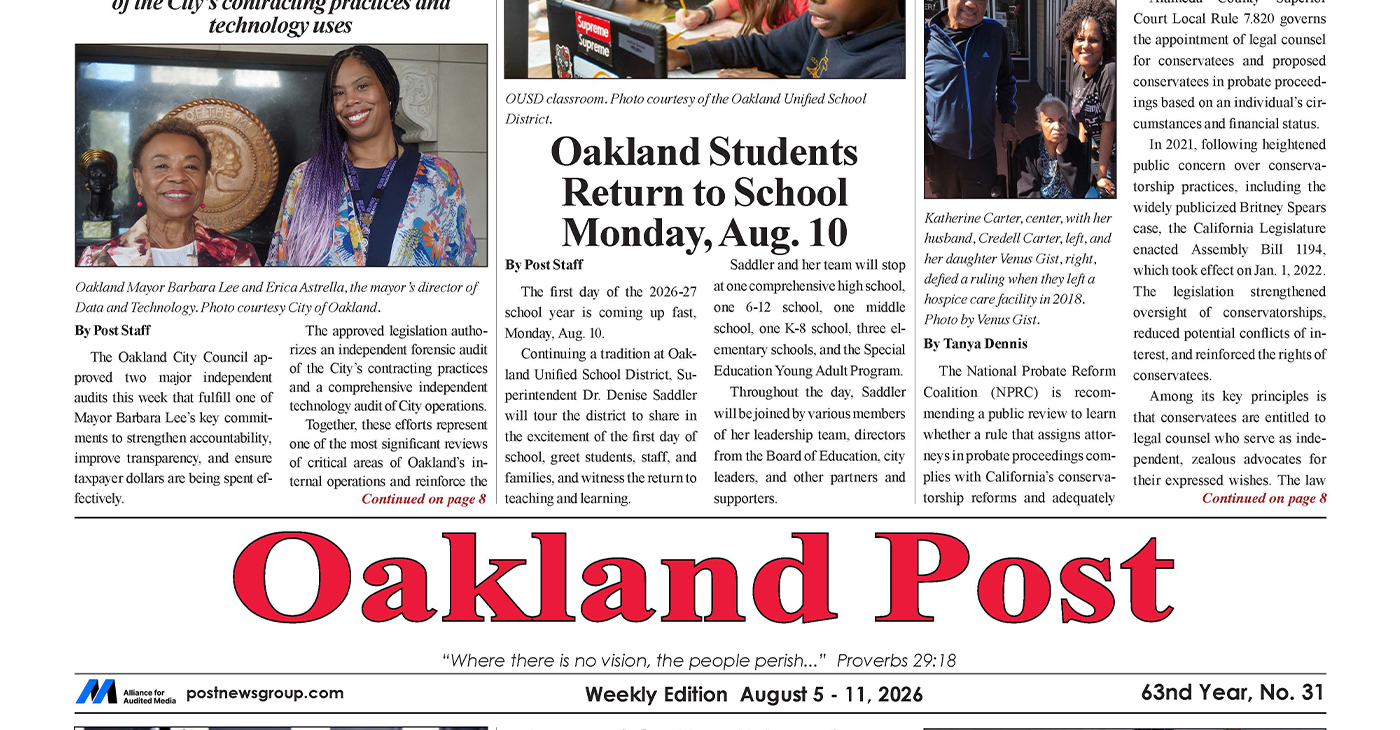
To enlarge your view of this issue, use the slider, magnifying glass icon or full page icon in the lower right corner of the browser window.

Activism
Oakland Post: Week of July 29 – August 4, 2026
The printed Weekly Edition of the Oakland Post: Week of July 29 – August 4, 2026

To enlarge your view of this issue, use the slider, magnifying glass icon or full page icon in the lower right corner of the browser window.
Activism
Oakland Post: Week of July 22 – 28, 2026
The printed Weekly Edition of the Oakland Post: Week of July 22 – 28, 2026

To enlarge your view of this issue, use the slider, magnifying glass icon or full page icon in the lower right corner of the browser window.

WORK FROM HOME
Home-based business with potential monthly income of $10K+ per month. A proven training system and website provided to maximize business effectiveness. Perfect job to earn side and primary income. Contact Lynne for more details: Lynne4npusa@gmail.com 800-334-0540


Car Wash Workers Cope with Lingering Impacts of ICE Raids

Misty Copeland Shapes Ballet’s Tomorrow

As Part of Your Back-to- School Checklist, Vaccinate

As Part of Your Back-to- School Checklist, Vaccinate

Congresswoman Simon Demands Investigation into Trump’s Abuse of Emergency Powers for Coal Export Terminal in West Oakland

OPINION: The Philippines Isn’t Foreign When Your Family Still Lives There

Asm. McKinnor’s Bill Banning Drones Above Outdoor Entertainment Events Awaits Senate Decision

California Sen. Padilla Joins Colleagues to Introduce Bill Imposing Term Limits on Supreme Court Justices

Department of Homeland Security Demands California Secretary of State Shirley N. Weber Scrub Voter Rolls

George Cook: The Inventor Who Made Fishing Smarter

Gov. Newsom Announces $109.6 Million in Funding for 278 Supportive Homes in Bakersfield, Contra Costa, Sacramento and Fresno

Rep. Kamlager Dove Demands Care, Justice for Man Shot by ICE

“The Power to See Threats Sooner”: Gov. Newsom, Safety Officials Showcase California’s Investments in Hi-Tech Wildfire Prevention

100 Black Wings’ Team Oakland Youth Athletes Heading to Taiwan for 2026 International Children’s Games

Oakland ‘Port Serves as a Powerful Engine for Good Jobs and Economic Development
Department of Homeland Security Demands California Secretary of State Shirley N. Weber Scrub Voter Rolls

Oakland Children’s Hospital Workers and Patients Rally for Pediatric Medical Care
“The Power to See Threats Sooner”: Gov. Newsom, Safety Officials Showcase California’s Investments in Hi-Tech Wildfire Prevention

New Judge Could Decide if Karmelo Anthony Gets a New Trial

Surveillance Pricing Fight: State Senate Debates Bill Banning Retailers from Using AI to Set Prices Based on a Buyer’s Profile

Alpha Kappa Alpha Sorority, Inc. Celebrates New North Atlantic Regional Director

Mount Zion MBC, Church of Jesus Christ of Latter-day Saints Partner to Bring 29,000 Meals to Alameda County
California Sen. Padilla Joins Colleagues to Introduce Bill Imposing Term Limits on Supreme Court Justices

Starting This Summer, California Car Buyers Can Get an Instant $3500 Off the Cost of Electric Vehicles

COMMENTARY: You Are Already Paying for the AI Boom

California Bill Would Let Abuse Victims Use Trauma as Legal Defense for Violent Crime

Fed Court to Decide Landmark First Amendment Case

Gov. Gavin Newsom Signs Law Streamlining Affordable Housing Rules

Oakland Celebrates $125 Million Coliseum Sale

Saving Black Mothers Starts Outside the Hospital

The Conversation With Al McFarlane 6/23/26

Media Monday 6/22/26

LIVE! ASK ALMA! — TUES. 6.23.26 7PM EST

Car Buying Secrets: 4 Hidden Checks Before You Sign!

Is This 550 HP Charger Worth YOUR Money? AutoNetwork Review

Celebrating Juneteenth – Frederick Douglass on education and resistance

LIVE! — ASK ALMA! — TUES. 6.19.26 7PM EST

Hyundai Ioniq 5 Parking, Safety, and 360 View #shorts

2025 Ioniq 5 New Wiper & Powerful Performance! #shorts

Electric SUV Range: Is 259 Miles Enough? #shorts

EV Charging: How Fast Can You Charge an Electric Vehicle? #shorts

Biometric Cooling… Messaging Seats…Come on! 2025 Infiniti QX80 Autograph 4WD

Charged Up: Witness the Magic of a Fully Electric Car! #shorts

Range Rover Sport PHEV Included…: See What’s Inside This Luxury SUV! #shorts

Invisible Hood View: Perfect Parking with X-Ray Vision! #shorts
-
 Featured4 days ago
Department of Homeland Security Demands California Secretary of State Shirley N. Weber Scrub Voter Rolls
-
 Business3 weeks ago
Oakland Children’s Hospital Workers and Patients Rally for Pediatric Medical Care
-
 Environment4 days ago
“The Power to See Threats Sooner”: Gov. Newsom, Safety Officials Showcase California’s Investments in Hi-Tech Wildfire Prevention
-
 #NNPA BlackPress2 weeks ago
New Judge Could Decide if Karmelo Anthony Gets a New Trial
-
 Business3 weeks ago
Surveillance Pricing Fight: State Senate Debates Bill Banning Retailers from Using AI to Set Prices Based on a Buyer’s Profile
-
 Black History1 week ago
Alpha Kappa Alpha Sorority, Inc. Celebrates New North Atlantic Regional Director
-
 Business3 weeks ago
Mount Zion MBC, Church of Jesus Christ of Latter-day Saints Partner to Bring 29,000 Meals to Alameda County
-
 Featured4 days ago
California Sen. Padilla Joins Colleagues to Introduce Bill Imposing Term Limits on Supreme Court Justices
