
Activism
COMMENTARY: San Jose Congressman Norman Mineta: The Reparations Hero for Asian Americans
Congressman Norman Y. Mineta will forever be known as the man who got justice for the people incarcerated by the Japanese internment during World War II. He got reparations passed in a Republican administration.

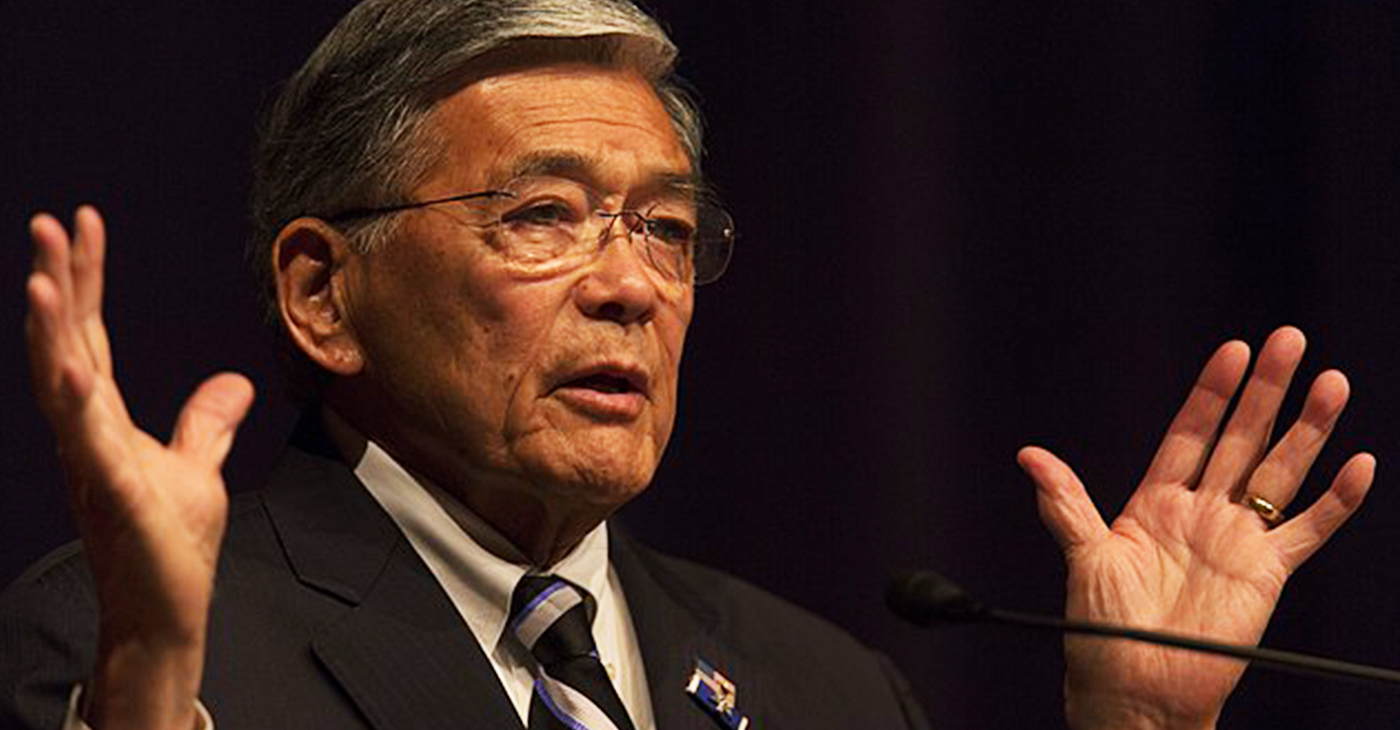
By Emil Guillermo
When the Democratic candidates began the 2020 presidential campaign, there was a buzz about reparations for African Americans.
And then, the buzz died.
I mention that because last week, former San Jose Mayor and 13th District Congressman Norman Y. Mineta passed away at age 90.
Mineta will forever be known as the man who got justice for the people incarcerated by the Japanese internment during World War II.

He got reparations passed in a Republican administration.
Think about that. Reparations, the BIPOC holy grail. After Mineta got it done in 1988 under Reagan, it’s never been replicated.
Looking back, it seems like a magic trick. But it wasn’t. It was just hard work and politicking.
That’s why we all should revere the man who died somewhat appropriately in the first week of May, the month now known as Asian American Native Hawaiian Pacific Islander Heritage Month.
Mineta was one of the first Congressional boosters to stretch what was originally a week, and then coined it Asian Pacific American Heritage Month.
His passing on May 3, 2022, is an important marker on the significance of diversity and representation at the highest levels of government, politics, and elected office.
Born in San Jose to Japanese immigrants, Mineta lived through every major moment in modern Asian American history.
For the barriers he broke, and the policies he established, he was simply the community’s father figure.
He was Mr. Asian America.
For a short-time, I got to be close to him.
In the 103rd Congress in 1993, I was Mineta’s press secretary and speechwriter.
I had been at NPR where I hosted “All Things Considered.” When I left that position, I thought as a Californian in Washington, I should at least get to know how democracy gets done from the inside. Ideally, I figured you can cross the line into the netherworld of politics once. You can even cross back from whence you came. Once. But Norm was no ordinary politician.
He was the embodiment of Asian America in public life.
He was our hopes and dreams. Our cries and sorrows. From the time he was a Cub Scout incarcerated with other Japanese Americans during World War II to the time he served in government, Norm was there for all of us.
He was our fighter and our redeemer when he co-sponsored the Civil Liberties Act of 1988, that got justice for internees. More than $1.6 billion was paid out to 82,200 Japanese Americans, according to the New York Times.
That was always the difference maker. Norm was in the fight to rectify the historical transgression that gives Asian Americans our moral authority to this day.
There were other Asian American politicians, of course. But few had the career arc of Mineta, who first served locally in 1971 as mayor of San Jose. He was the first Asian American mayor of a major U.S. city.
In 1974, he was first elected to Congress, leaving in 1995, when the divided government began to shape up with an aggressive GOP led by Newt Gingrich.
But Norm re-emerged in government with more Asian American firsts, as Commerce Secretary in the Clinton Cabinet, and then Transportation Secretary under G.W. Bush. Two administrations. Two different parties.
The Norm I knew was the 1993 Norm. The people’s Norm.
The Norm who drove a modest white Dodge Colt because he wanted an American car. I knew the guy who worked all day, then carried a huge bag of homework to read through for the next day. I knew the guy who was in the post-flow triumph of the Civil Liberties Act, always diligent, persistent, and searching for a way to make things better.
That’s what I learned about Norm the most. Remember, this was in the early ’90s. Washington was getting nastier, more divisive, and gridlocked.
But Norm had friends like the late Republican Sen. Alan Simpson. They met as Boy Scouts in Wyoming. One incarcerated at the internment camp, the other free. Later as congressmen, they stood for a kind of bipartisanship that is rare these days.
That was perhaps the most significant political lesson I learned from Mineta. Legislation is one thing, but we’re all still human beings. And the goal is to turn adversaries into friends and to have your friends stay friends. You keep the channels open. You create new alliances, like the ideal public-private partnerships.
The point is, Mineta was always seeking solutions, working together with others to make things better.
He passes as the country is bitterly divided on everything. His life should serve as a playbook on how to keep the fragile nature of our democracy whole.
Remember Norm Mineta. He was the Democrat who got reparations passed in a Republican administration.
Today, that would make him a political Superman.
Emil Guillermo is a journalist and commentator. Listen to his talk show on www.amok.com Twitter@emilamok










Activism
Oakland Post: Week of September 30 – October 6, 2026
The printed Weekly Edition of the Oakland Post: Week of September 30 – October 6, 2026
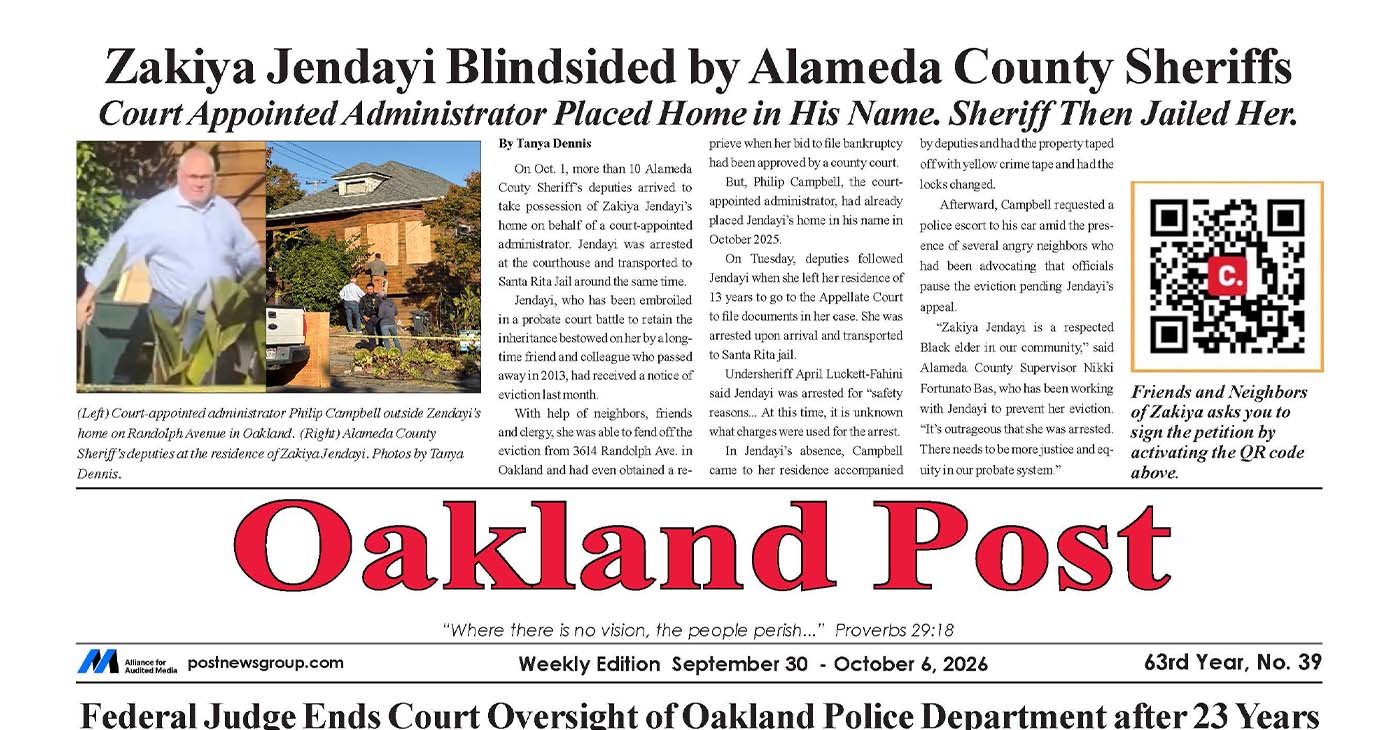
To enlarge your view of this issue, use the slider, magnifying glass icon or full page icon in the lower right corner of the browser window.
Activism
Oakland Post: Week of September 23 – 29, 2026
The printed Weekly Edition of the Oakland Post: Week of September 23 – 29, 2026

To enlarge your view of this issue, use the slider, magnifying glass icon or full page icon in the lower right corner of the browser window.
Activism
Oakland Post: Week of September 16 – 22, 2026
The printed Weekly Edition of the Oakland Post: Week of September 16 – 22, 2026

To enlarge your view of this issue, use the slider, magnifying glass icon or full page icon in the lower right corner of the browser window.


OP-ED: Proposition 44 Would Put a Price on Trust

OP-ED: Proposition 40: It’s Time to Play Chess, Not Checkers

Listening as a Lifeline: A Doula’s Witness to Black Maternal Health

New Protections for Ticket Buyers: Gov. Newsom Signs Assemblymember Isaac Bryan’s Bill

‘We Don’t Talk Trash — We Pick Up Trash!’

Zakiya Jendayi Arrested, Locked Out of Home by Sheriff’s Deputies

Oakland Post: Week of September 30 – October 6, 2026

Asm. Corey Jackson Announces Launch of 24-Hour Childcare in His District

IN MEMORIAM: The Rev. Leon “Sonny” Clark, Longtime Orange County Pastor and Community Leader, Dies at 72

Poll: Becerra Widens His Lead Over Hilton; Californians Split on Wealth Tax

From Historic Memories to New Possibilities: Oakland Celebrates Coliseum 60

County Office of Education Says OUSD Finances Are Getting Healthier, Materially Stronger

LIVE FREE Sunday Dinner Brings Faith, Fellowship and Civic Conversation to Oakland

Remembering Chauncey Bailey as Student Journalists Face Threats to Truth-Telling

BLACspace Cooperative Invites Bay Area to Experience Oakland’s Black Cultural Ecosystem Through a BLAC Map Tour + Party

Standoff for Justice: Our Homes Are Worth Fighting For

Oakland Post: Week of August 26 – September 1, 2026

Frontier Airlines’ Return to Oakland Airport Brings Flights, Jobs and Opportunity

Jackie Wright Champions Bay Area Stories, Filmmakers and Cultural Institutions

Gubernatorial Candidate Steve Hilton Blasts California New Tire Rules; Newsom Hits Back

Chef Sharon Lee Blends Culinary Excellence, Education and Empowerment

Misnamed ‘Parent’ PAC Seeks to Influence Oakland School Board Elections

Oakland Coliseum Project Opens Door for Small Businesses to Build Bigger

Big City Mayors Ask for “Yes” Vote on Housing Bond Measure; Conservatives Say “No”

Gov. Newsom’s Latest Appointees Include Sacramento Advocate for Formerly Incarcerated Students; State’s New Tech Chief

Oakland Post: Week of September 2 – 8, 2026

Longtime BWOPA Member Brendalyn Goodall Appointed to California Workforce Development Board

Gov. Newsom Signs Law Shielding Immigration Aid Workers From Doxing Threats

Secretary of State Shirley N. Weber Urges Californians to Vote Early as Voter ID Battle Intensifies

Oakland Post: Week of September 9 – 15, 2026

The Conversation With Al McFarlane 6/23/26

Media Monday 6/22/26

LIVE! ASK ALMA! — TUES. 6.23.26 7PM EST

Car Buying Secrets: 4 Hidden Checks Before You Sign!

Is This 550 HP Charger Worth YOUR Money? AutoNetwork Review

Celebrating Juneteenth – Frederick Douglass on education and resistance

LIVE! — ASK ALMA! — TUES. 6.19.26 7PM EST

Hyundai Ioniq 5 Parking, Safety, and 360 View #shorts

2025 Ioniq 5 New Wiper & Powerful Performance! #shorts

Electric SUV Range: Is 259 Miles Enough? #shorts

EV Charging: How Fast Can You Charge an Electric Vehicle? #shorts

Biometric Cooling… Messaging Seats…Come on! 2025 Infiniti QX80 Autograph 4WD

Charged Up: Witness the Magic of a Fully Electric Car! #shorts

Range Rover Sport PHEV Included…: See What’s Inside This Luxury SUV! #shorts

Invisible Hood View: Perfect Parking with X-Ray Vision! #shorts
-
 Community4 weeks ago
Misnamed ‘Parent’ PAC Seeks to Influence Oakland School Board Elections
-
 Activism4 weeks ago
Oakland Post: Week of September 9 – 15, 2026
-

 Community4 weeks ago
Richmond Tiny House Village Farm & Garden Set to Open Gates on Sept. 26
-

 Black History4 weeks ago
Latest Massacre in Haiti Reveals Cruelty U.S. Deportations
-

 Black History4 weeks ago
OPINION: Nolan Wells’ Death One of Several Signifying Racial Terror Lives on in U.S. South
-

 Business3 weeks ago
Mayor Lee Announces $1 Million Kaiser Permanente Grant for Pilot Program to Address Homelessness, Clean Up Public Spaces throughout Oakland
-
 Economy2 weeks ago
Poll: Becerra Widens His Lead Over Hilton; Californians Split on Wealth Tax
-

 Community4 weeks ago
Democratic Clubs Interview Candidates for Oakland School Board
