
Black History
COMMENTARY: Four Hundred Years and We Still Ain’t Clear:
NNPA NEWSWIRE — “…there is this misguided group of Afrodescendants, who are throwing shade at those who are not ‘American descendants of slaves’ ADOS. Their shade is an odd version of the “am I Black enough for you” game that some folks ran against President Barack Obama, and are now running against Presidential candidates Kamala Harris and Corey Booker. “

By Julianne Malveaux
According to some historians, Afrodescendents first entered these united states in 1619 off the coast of Virginia. If we believe that narrative, Afrodescendents have been in this country for 400 years. If the people who were kidnapped and brought here had to tell the story, would they tell the same one? Would they say that we came before Columbus? That some of us might have been here even longer? There were captured Africans that came from the mother continent in 1619, but also, thanks to the transatlantic slave trade, Africans here who had come from Bermuda, Jamaica, and other places.
Why is this relevant? Because there is this misguided group of Afrodescendants, who are throwing shade at those who are not “American descendants of slaves” ADOS. Their shade is an odd version of the “am I Black enough for you” game that some folks ran against President Barack Obama, and are now running against Presidential candidates Kamala Harris and Corey Booker. What is Black enough, when we, Afrodescendant people, all have enslavement in our background? Let’s make it plain. Europeans went to the African continents, kidnapped people (sometimes with African acquiescence), brought them to the Western Hemisphere, and sold us. Goods and people flowed between England (or New England, the Americas, and Africa), including sugar, tobacco, manufactured products, guns and humans. Understand that everyone in the triangle was affected and that enslaved people were freely traded between the United States and other parts of the Americas!
I am not sure what kinds of warped brains dreamed up the realities of enslavement and the ways that a minority in the South was able to control a majority. The laws that managed enslavement included laws that prevented literacy, ownership, and much else. The laws often detailed the terms of punishment if restrictive conditions were breached. A North Carolina law said, “teaching slaves to read and write, tends to excite dissatisfaction in their minds, and to produce insurrection and rebellion.” Disobeying this law was punishable by thirty-nine lashes or imprisonment for a free Black person, or a fine of two hundred dollars then, or about $5000 now. People violated the laws, of course, but the warped sensibility that prohibited the dissemination of knowledge is the basis for many sick stereotypes, such as “if you want to hide something from a Black person, put it in a book.”
Fast-forward four hundred years, or even two. Why are teachers in Louden County, Virginia, forcing fifth and sixth-grade students to simulate enslavement with an obstacle course they called “The Underground Railroad”? Why were many of these students Afrodescendents? Why are the leaders of the school silent about the discipline that was ordered on the rogue teachers who took it upon their ignorant selves to construct such an exercise? Why has David Stewart, the principal of the Madison Trust School in Louden County, sent out a vapid apology for a “culturally insensitive” exercise, and not a more strongly worded condemnation of the racism implicit in this nonsense.
We have been here at least 400 years, and still, some folks aren’t clear about the ways enslavement has shaped our nation. In Virginia, where both the governor and the Attorney General (two of the top three elected officials in the state) have admitted to masquerading in Blackface, albeit thirty-odd years ago, teachers don’t see anything wrong with subjecting Black students to a reenactment of enslavement. Oh, they said they were teaching “teamwork.” Really.
We have been here at least 400 years, and our nation is not yet clear about its flawed foundations. There would be no house at 1600 Pennsylvania Avenue, which should not be called the White House, but the House that Enslaved People Built, were it not for the labor of kidnapped people and their descendants. There would be no banking system if enslaved people were not used as collateral for European devilment. There would be no insurance industry were it not for the enslaved. But in our collective ignorance allows us, all of us, African Americans, European Americans, and others, to live in denial, pretending that there is fairness is a racist, patriarchal, predatory, capitalist society.
We have been here at least 400 years, but we still aren’t clear about the nonsense and exploitation that affects and infuses our very foundation. Our entire nation needs to go back to school to learn some history. But there is a special place in hell for teachers in Louden County, Virginia who think that enslavement is some kind of game!
Julianne Malveaux is an author and economist. Her latest book “Are We Better Off? Race, Obama and Public Policy” is available via www.amazon.com for booking, wholesale inquiries or for more info visitwww.juliannemalveaux.com









Activism
Oakland Post: Week of March 18 – 24, 2026
The printed Weekly Edition of the Oakland Post: Week of March 18 – 24, 2026

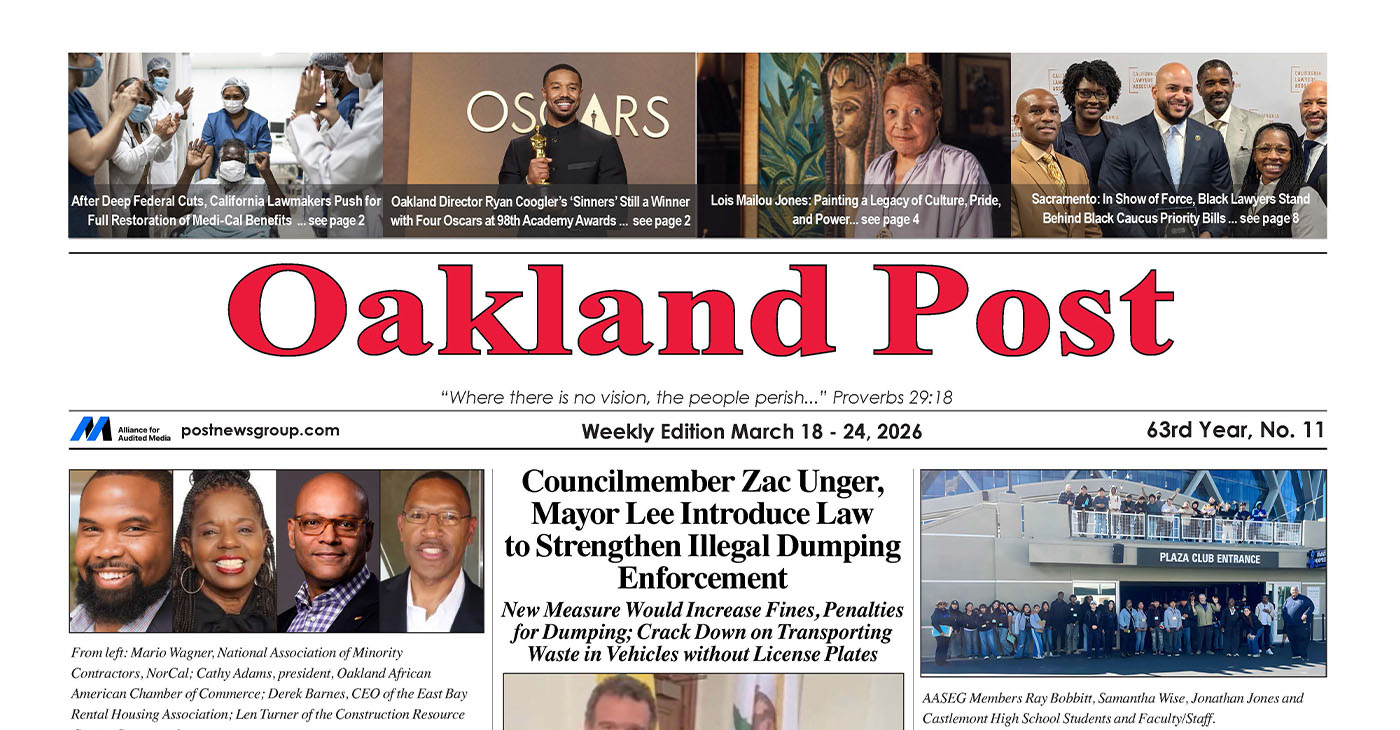
To enlarge your view of this issue, use the slider, magnifying glass icon or full page icon in the lower right corner of the browser window.

Activism
Oakland Post: Week of March 11 -17, 2026
The printed Weekly Edition of the Oakland Post: Week of March 11 – 17, 2026
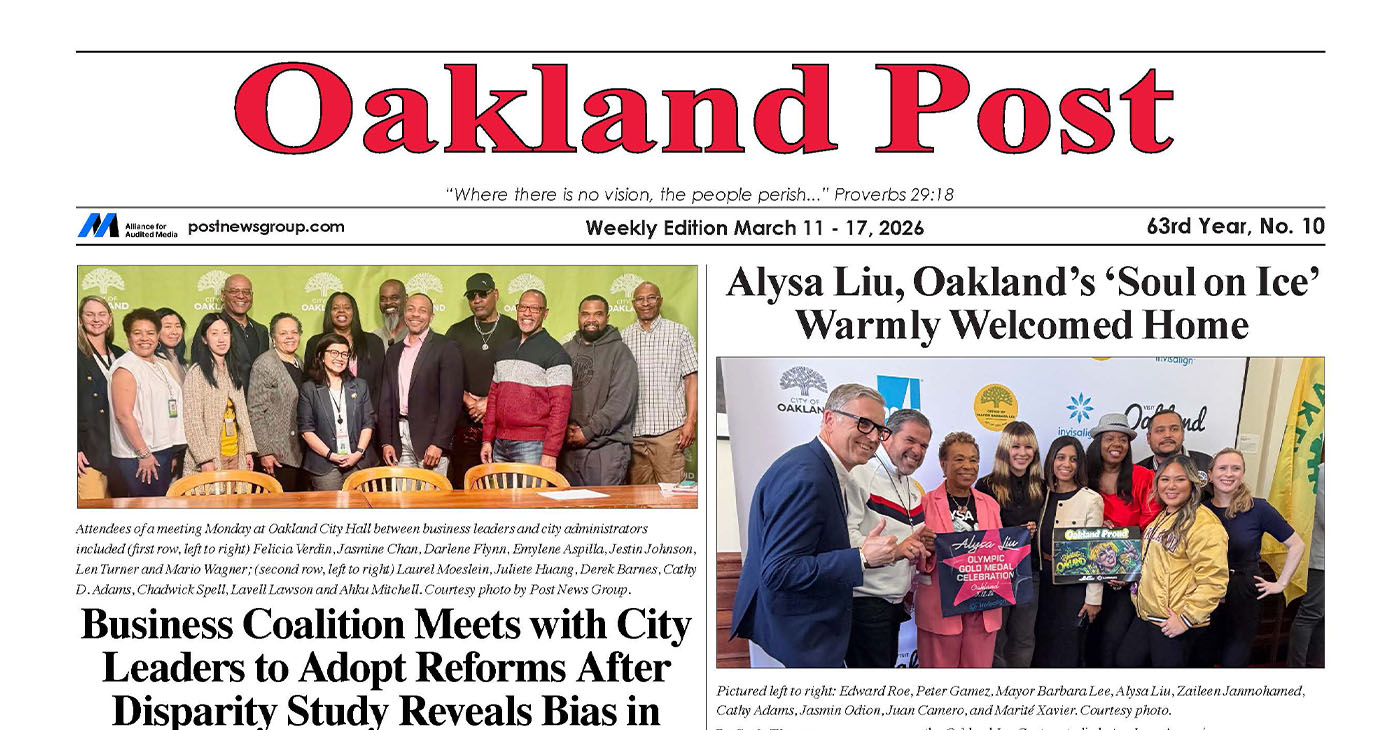
To enlarge your view of this issue, use the slider, magnifying glass icon or full page icon in the lower right corner of the browser window.
Activism
Oakland Post: Week of March 4 – 10, 2026
The printed Weekly Edition of the Oakland Post: Week of March 4 – 10, 2026
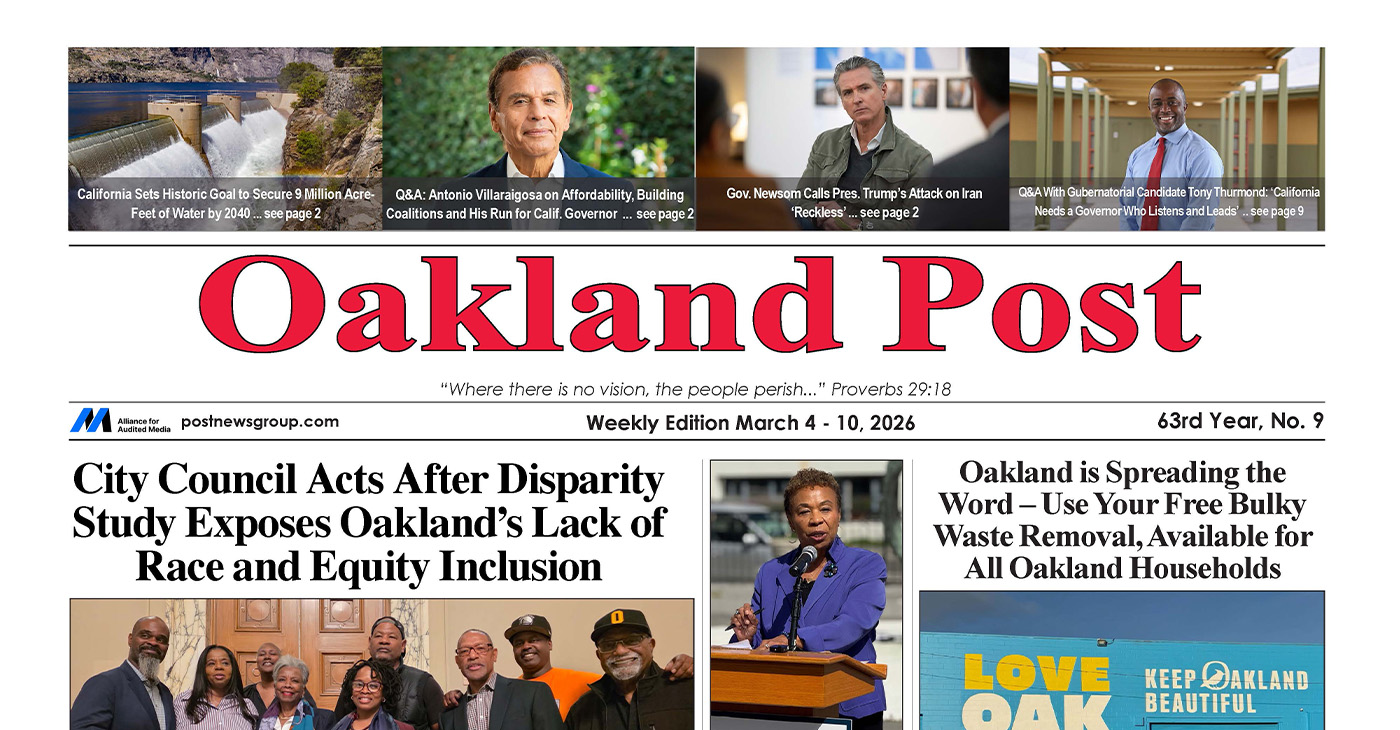
To enlarge your view of this issue, use the slider, magnifying glass icon or full page icon in the lower right corner of the browser window.
WORK FROM HOME
Home-based business with potential monthly income of $10K+ per month. A proven training system and website provided to maximize business effectiveness. Perfect job to earn side and primary income. Contact Lynne for more details: Lynne4npusa@gmail.com 800-334-0540


Black Artists in America, Installation Three Wraps at the Dixon Gallery and Gardens

Grief, Advocacy, and Education: A Counselor Reflects on Black Maternal Health

Future of Florida’s Black History Museum in Limbo

New Research Shows the Many Benefits of Early Learning

South Hampton K-8 Students Among Top 10 Finalists for Samsung’s ‘Solve for Tomorrow’ Competition

Cuba: No Negotiation with US on the President or Political System

Brooklyn Academy of Music Names Jamaican-Born Tamara McCaw as President

Trinidad & Tobego – U.S. Launches WhatsApp Channel for American Citizens in the Country

Oakland Post: Week of March 18 – 24, 2026

AI Innovation vs. Ethics and Environmental Impact

AI, Web3, and Digital Reparations

What If You Owned Your AI Agent?

Season 7, Episode 3 – January Reporter’s Roundtable 📱

Season 7, Episode 3 – January Reporter’s Roundtable

AI, Media, and Power | Part 2, Real-World Impacts and Tradeoffs

Oakland Post: Week of February 11 – 17, 2026

Reflecting on Black History Milestones in Birmingham AL

CITY OF SAN LEANDRO STATE OF CALIFORNIA PUBLIC WORKS DEPARTMENT ENGINEERING DIVISION NOTICE TO BIDDERS FOR ANNUAL STREET OVERLAY/REHABILITATION 2019-21 – PHASE III

Oakland Post: Week of February 18 – 24, 2026

PRESS ROOM: NBA Hall of Fame Nominee Terry Cummings Joins 100 Black Men of DeKalb County to Launch Victory & Values Initiative

Oakland Post: Week of February 25 – March 3, 2026

Trump’s MAGA Allies are Creating Executive Order Plan to Steal the 2026 Midterms

U.S. manufacturing rebounds – how foundry services are adapting to rising demand

OP-ED: One Hundred Years of Black Workers Telling the Truth

Advancements in solar technology that are changing the way we power the world

Chase Oakland Community Center Hosts Alley-Oop Accelerator Building Community and Opportunity for Bay Area Entrepreneurs

Poll Shows Support for Policies That Help Families Afford Child Care

Oakland Post: Week of March 4 – 10, 2026

PRESS ROOM: Civil Rights TV Launches in Selma as the World’s First 24/7 Civil Rights Television Network

Ghana Mourns a Son of the African World

Hyundai Ioniq 5 Parking, Safety, and 360 View #shorts

2025 Ioniq 5 New Wiper & Powerful Performance! #shorts

Electric SUV Range: Is 259 Miles Enough? #shorts

EV Charging: How Fast Can You Charge an Electric Vehicle? #shorts

Biometric Cooling… Messaging Seats…Come on! 2025 Infiniti QX80 Autograph 4WD

Charged Up: Witness the Magic of a Fully Electric Car! #shorts

Range Rover Sport PHEV Included…: See What’s Inside This Luxury SUV! #shorts

Invisible Hood View: Perfect Parking with X-Ray Vision! #shorts

AI Is Reshaping Black Healthcare: Promise, Peril, and the Push for Improved Results in California

ESSAY: Technology and Medicine, a Primary Care Point of View

Sanctuary Cities

The RESISTANCE – FREEDOM NOW

STATE OF THE PEOPLE: Freddie

ECONOMIC BOYCOTT DAY!!!!!

I told You So
-
 #NNPA BlackPress4 weeks ago
Poll Shows Support for Policies That Help Families Afford Child Care
-
 Activism4 weeks ago
Oakland Post: Week of March 4 – 10, 2026
-

 #NNPA BlackPress3 weeks ago
Woman’s Search for Family’s Roots Leads to Ancestor John T. Ward – A Successful Entrepreneur and Conductor on the Underground Railroad
-

 #NNPA BlackPress4 weeks ago
OP-ED: NNPA Launches 2026 “Leadership Matters” Video Series
-

 #NNPA BlackPress3 weeks ago
Advocates Raise Alarm Over ICE Operation, MOU and Detention Risks in Baltimore County
-

 #NNPA BlackPress3 weeks ago
COMMENTARY: Women of Color Shape Our Past and Future
-

 #NNPA BlackPress3 weeks ago
Pete Buttigieg to Join Mayor Randall Woodfin for Community Town Hall in Birmingham
-

 Activism2 weeks ago
Oakland Post: Week of March 11 -17, 2026

4 Comments