
City Government
City Council Declares Oakland Housing State of Emergency

The unanimous vote of the City Council to declare a housing state of emergency Tuesday night marks an historic step for Oakland, representing an unprecedented level of citywide unanimity and determination to halt the displacement that is shredding local residents’ lives and neighborhoods, according to leaders of the coalition of groups that worked with city council members to pass the ordinance.
“People are hurting…. This (housing crisis) is tearing our community apart,” said coalition leader James Vann, speaking at the meeting. “We came here with the request for a moratorium to say: stop, pause, take a breather.”
“Let’s stop this madness for a while so the council can have time … to discuss and deliberate some measures that can affect this crisis,” said Vann, one of the authors of the 90-day moratorium on rent increases above 1.7 percent and evictions without cause.
Hundreds of residents and representatives of groups that supported the ordinance lined up to speak Tuesday night, while community members packed the council chambers and galleries, filled the lobby outside the chambers and packed the hearing rooms that provided television access to the meeting.

Community members wait to enter the City Council chambers to speak on the moratorium. Photo by Tulio Ospina.

Many stayed until nearly 1 a.m. when the council unanimously approved the ordinance.
Speaker after speaker demanded that councilmembers respond to the plight of the community, to address the needs of the 60 percent of the residents who are renters and unable to pay for market rate or “workforce” housing.
A sizable contingent of landlords and their supporters also attended. A number of owners of rental units spoke against the moratorium.
“These kinds of phony ‘remedies’ do nothing to address the real supply-and-demand issues facing Oakland. It’s time our elected leaders stopped scapegoating small and medium-sized property owners and started addressing the city’s housing shortage with meaningful actions,” according to a statement sent to the Post by the East Bay Rental Housing Association.
Speaking in favor of the resolution, activist Kitty Kelly Epstein talked about the impact she believes the moratorium will have.
“I think (it) will make a big difference – it’s going to stop some evictions, it’s going to (receive) national and regional attention, and it’s going to make something happen because people in the public are going to know they have more rights than they ever knew they had.”
“You all (on the council) have seen the extent of passion on the part of the people who have come here,” Epstein said. “This movement has become united enough that I think we can move forward.”

Speakers of all backgrounds and ages spoke at the City Council meeting about their experiences with displacement. Photo by Tulio Ospina.
Coalition leader Carroll Fife emphasized the connection between the housing crisis, poverty, unemployment and other social problems.
“It’s all connected: housing, displacement, joblessness, despair,” she said.
“We want you (the council) to take action not only on this moratorium but also on the unilateral budget cuts that the mayor has made to job training that keeps children off the street, that trains them to do work,” said Fife.
She also underscored the significance of the fight against displacement.
“City workers cannot afford to live here,” she said. “Our teachers cannot afford to live here. Do something today.”
“The great migration up from the South brought people here to build this city,” she said. “We want those people to have the first dibs on living here, not Oakland being sold to the highest bidder.”
Calling on people to register to vote, Fife told the council, “If you do not do right by the people who live here, you will not sit in those seats. I guarantee that.”
Groups that came to the meeting to speak in support of the moratorium included SEIU, Black Women Organized for Political Action (BWOPA), Block by Block Organizing Network, Post Salon Community Assembly, Oakland Alliance, East Bay Housing Organizations (EBHO), Oakland Parents Together, Wellstone Democratic Club, John George Democratic Club, Causa Justa: Just Cause, Oakland Tenants Union, E12th Coalition, Qilombo, Green Party, Alliance of Californians for Community Empowerment (ACCE), OaklandWorks and the Oakland East Bay Alumnae Chapter of the of the Delta Sigma Theta Sorority, Inc.
Lynn Haines Dodd, president of the Delta Sigma Theta chapter, told the council, “What is asked today is simple – the preservation of the heart of the city. Elderly working class and professionals need places they call home. We stand with the people of Oakland. We ask that you do the same.”

Members of the Oakland East Bay Alumnae Chapter of the of the Delta Sigma Theta Sorority spoke Tuesday night in support of the housing state of emergency. Photo of Tulio Ospina.
SEIU 1021 representative Felipe Cuevas said he was a city worker and a member of the craft bargaining unit. “Most of my coworker cannot afford to pay rent or buy a house to live in Oakland,” he said.
“I have been a resident of Oakland all my life. I am 52 years old and homeless,” said Judy Tomlinson. “I stay in a shelter now. When I was little, I didn’t say that I want grow up and be homeless.
“You are forcing me out of Oakland.”
“The housing crisis has to do with greed,” said Towanda Sherry, another longtime resident. “I see kids sleeping outside my apartment door on the ground or people sleeping in cars. I see seniors riding busies all day long (with no place to go).”
Holly Fincke said, “I’m not likely to be homeless, (but) I will be way, way out there (in the suburbs). I would like you to consider the long view, the type of city we want to have. Tenant protections are the bedrock.”
Clifton Harrison said he is in a fight with his landlord over a 112 percent rent increase. “I’m a senior citizen. The unit I’m in was rented in 1988 for $800. Now it’s going for $4,000.”
A lot of the people who are being victimized are not just the low-income residents, he said. “It’s teachers, nurses, senior citizens.”

Kin Folkz (right) talks about how many LGBTQ people of color have been displaced from Oakland in recent years. Photo by Tulio Ospina.
In their statement against the moratorium to the Post, the East Bay Rental Housing Association wrote:
“(The) Oakland City Council continues to use small rental property owners as the scapegoat for the city’s housing problems. Placing a moratorium on units already under rent control restrictions defies logic and only serves to further punish small mom-and-pop property owners who provide the bulk of the affordable housing in Oakland.
“New units built after 1983 are exempt from the moratorium under current state law (Costa-Hawkins). The moratorium will therefore have zero impact on those units most affected by market pressures.
“Prohibiting responsible property owners from passing on the capital improvements will result in properties across the city falling into disrepair.”
Councilmembers Desley Brooks, Rebecca Kaplan and Council President Lynette Gibson McElhaney strongly supported the passage of the housing state of emergency.
“We have a serious, serious housing problem in our city… and a lot of what we’re doing isn’t helping people stay here,” said Brooks, who backed the motion to discuss the Protect Oakland Tenants Initiative ballot measure on the April 19 council meeting. “It’s paramount that we pass this state of emergency.”













Activism
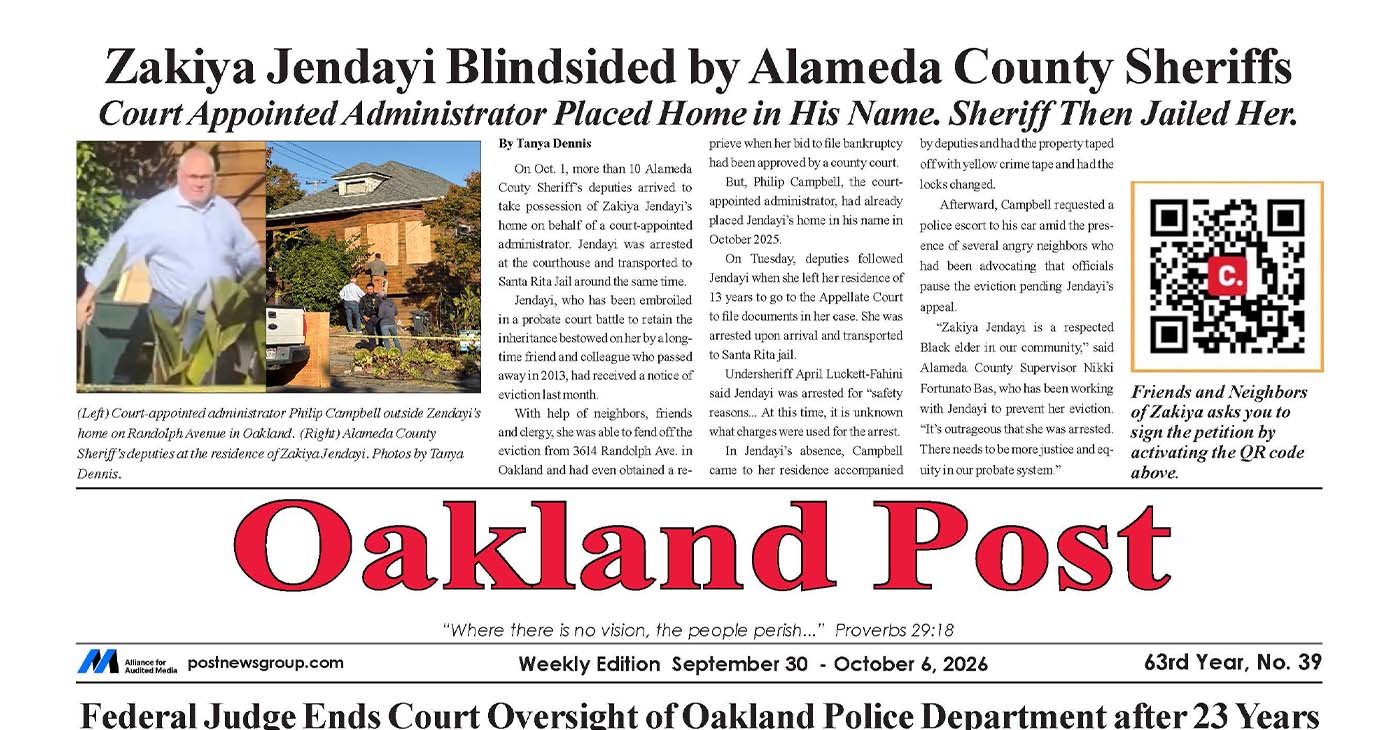
Oakland Post: Week of September 30 – October 6, 2026
The printed Weekly Edition of the Oakland Post: Week of September 30 – October 6, 2026
To enlarge your view of this issue, use the slider, magnifying glass icon or full page icon in the lower right corner of the browser window.
Activism
Oakland Post: Week of September 23 – 29, 2026
The printed Weekly Edition of the Oakland Post: Week of September 23 – 29, 2026

To enlarge your view of this issue, use the slider, magnifying glass icon or full page icon in the lower right corner of the browser window.

Activism
Oakland Post: Week of September 16 – 22, 2026
The printed Weekly Edition of the Oakland Post: Week of September 16 – 22, 2026

To enlarge your view of this issue, use the slider, magnifying glass icon or full page icon in the lower right corner of the browser window.



OP-ED: Proposition 44 Would Put a Price on Trust

OP-ED: Proposition 40: It’s Time to Play Chess, Not Checkers

Listening as a Lifeline: A Doula’s Witness to Black Maternal Health

New Protections for Ticket Buyers: Gov. Newsom Signs Assemblymember Isaac Bryan’s Bill

‘We Don’t Talk Trash — We Pick Up Trash!’

Zakiya Jendayi Arrested, Locked Out of Home by Sheriff’s Deputies

Oakland Post: Week of September 30 – October 6, 2026

Asm. Corey Jackson Announces Launch of 24-Hour Childcare in His District

IN MEMORIAM: The Rev. Leon “Sonny” Clark, Longtime Orange County Pastor and Community Leader, Dies at 72

Poll: Becerra Widens His Lead Over Hilton; Californians Split on Wealth Tax

From Historic Memories to New Possibilities: Oakland Celebrates Coliseum 60

County Office of Education Says OUSD Finances Are Getting Healthier, Materially Stronger

LIVE FREE Sunday Dinner Brings Faith, Fellowship and Civic Conversation to Oakland

Remembering Chauncey Bailey as Student Journalists Face Threats to Truth-Telling

BLACspace Cooperative Invites Bay Area to Experience Oakland’s Black Cultural Ecosystem Through a BLAC Map Tour + Party

Standoff for Justice: Our Homes Are Worth Fighting For

Oakland Post: Week of August 26 – September 1, 2026

Frontier Airlines’ Return to Oakland Airport Brings Flights, Jobs and Opportunity

Gubernatorial Candidate Steve Hilton Blasts California New Tire Rules; Newsom Hits Back

Chef Sharon Lee Blends Culinary Excellence, Education and Empowerment

Jackie Wright Champions Bay Area Stories, Filmmakers and Cultural Institutions

Misnamed ‘Parent’ PAC Seeks to Influence Oakland School Board Elections

Oakland Coliseum Project Opens Door for Small Businesses to Build Bigger

Big City Mayors Ask for “Yes” Vote on Housing Bond Measure; Conservatives Say “No”

Gov. Newsom’s Latest Appointees Include Sacramento Advocate for Formerly Incarcerated Students; State’s New Tech Chief

Longtime BWOPA Member Brendalyn Goodall Appointed to California Workforce Development Board

Gov. Newsom Signs Law Shielding Immigration Aid Workers From Doxing Threats

Oakland Post: Week of September 2 – 8, 2026

Secretary of State Shirley N. Weber Urges Californians to Vote Early as Voter ID Battle Intensifies

IN MEMORIAM: Dolly Parton Dead at 80 — How She Built a Legacy of Love and Earned Her Place in Black Culture

The Conversation With Al McFarlane 6/23/26

Media Monday 6/22/26

LIVE! ASK ALMA! — TUES. 6.23.26 7PM EST

Car Buying Secrets: 4 Hidden Checks Before You Sign!

Is This 550 HP Charger Worth YOUR Money? AutoNetwork Review

Celebrating Juneteenth – Frederick Douglass on education and resistance

LIVE! — ASK ALMA! — TUES. 6.19.26 7PM EST

Hyundai Ioniq 5 Parking, Safety, and 360 View #shorts

2025 Ioniq 5 New Wiper & Powerful Performance! #shorts

Electric SUV Range: Is 259 Miles Enough? #shorts

EV Charging: How Fast Can You Charge an Electric Vehicle? #shorts

Biometric Cooling… Messaging Seats…Come on! 2025 Infiniti QX80 Autograph 4WD

Charged Up: Witness the Magic of a Fully Electric Car! #shorts

Range Rover Sport PHEV Included…: See What’s Inside This Luxury SUV! #shorts

Invisible Hood View: Perfect Parking with X-Ray Vision! #shorts
-
 Community3 weeks ago
Misnamed ‘Parent’ PAC Seeks to Influence Oakland School Board Elections
-

 Activism3 weeks ago
Oakland Post: Week of September 9 – 15, 2026
-

 Community3 weeks ago
Richmond Tiny House Village Farm & Garden Set to Open Gates on Sept. 26
-

 Black History3 weeks ago
Latest Massacre in Haiti Reveals Cruelty U.S. Deportations
-

 Black History3 weeks ago
OPINION: Nolan Wells’ Death One of Several Signifying Racial Terror Lives on in U.S. South
-

 Business2 weeks ago
Mayor Lee Announces $1 Million Kaiser Permanente Grant for Pilot Program to Address Homelessness, Clean Up Public Spaces throughout Oakland
-

 Community3 weeks ago
Democratic Clubs Interview Candidates for Oakland School Board
-

 Uncategorized3 weeks ago
NBA All-Star Damian Lillard Returns Home for 15th Annual Backpack Giveaway
