
Activism
California State Gov and Advocacy Orgs Are Empowering Domestic Abuse Survivors on Path to Healing
In California, about 42.5% of Black women have experienced some form of IPV, compared to 34.9% of all women in the state, according to a Blue Shield of California Foundation report. This abuse can be physical, psychological, financial, sexual emotional.. Even after the abuse ends, some survivors experience physical health issues like chronic pain, stomach issues, heart disease and diabetes, as well as mental health issues like eating disorders, headaches, and insomnia. Guns and gender violence are a particularly dangerous combination for Black women.

Edward Henderson | California Black Media
California native Sheilah Kimble says she was far from home, living in Buffalo, NY, when her partner became physically and verbally abusive.
“There were several occasions when I reached out to different agencies to assist me with my situation,” remembers Kimble, who is from South Los Angeles County. “I felt nobody wanted to help. Nobody gave me advice because I was from a marginalized community. I was not aware of any resources, so I thought they were limited.”
Kimble says her 5-month-old daughter would sometimes witness the abuse and hide behind her crib, cowering in fear.
Despite the harm to her, her daughter and son, it was hard for Kimble to gain the strength to leave.
“They call that trauma-bonding. It’s unhealthy,” said Kimble.
As the violence in her home escalated, law enforcement got involved and social services threatened to take her son away.
“A social worker would come by and ask certain questions. Being in an abusive relationship, you pretty much are controlled and coached. So, I was afraid to say certain things,” Kimble continued.
Eventually, the social worker helped Kimble find a shelter and connected her with the resources she needed to get back to her family in California.
Like Kimble, victims of domestic violence (DV) or intimate partner violence (IPV) often struggle to find a way out and, often, they must consider the safety of not just themselves — but that of their children as well.
In California, about 42.5% of Black women have experienced some form of IPV, compared to 34.9% of all women in the state, according to a Blue Shield of California Foundation report. This abuse can be physical, psychological, financial, sexual emotional.. Even after the abuse ends, some survivors experience physical health issues like chronic pain, stomach issues, heart disease and diabetes, as well as mental health issues like eating disorders, headaches, and insomnia. Guns and gender violence are a particularly dangerous combination for Black women.
According to the California Black Women’s Health Project, DV is the number one health issue Black women in California face.
To address the alarming rates of DV and IPV in the state –and the disproportionate rate of incidents in African American communities — the State of California and advocacy organizations across the state are wrapping their arms around victims, providing them resources and taking a number of policy actions to address the problem.
“Domestic violence continues to disproportionately impact women, leaving many survivors trapped in cycles of abuse with limited resources to escape. This burden is not just felt in broken bodies and hearts, but in economic devastation that undermines women’s independence and security,” said First Partner Jennifer Siebel Newsom in a statement earlier this year.
In September, Gov. Gavin Newsom signed a package of eight laws to protect victims of DV. Those laws address the following issues:
- Created a new victim restitution fund for survivors of domestic abuse and other crimes
- Expanded access to restraining orders and streamlined the process of obtaining them
- Established a partnership with car manufacturers to prevent victim tracking; equipped investigators with more tools to prevent cases from being improperly classified as homicides
- Increased public awareness about financial abuse and provided resources to help victims exit violent domestic situations

Lenore A. Tate, PhD, is a Licensed Psychologist/Professional Consultant
Dr. Lenore Tate is a licensed psychologist based in the Bay Area who has been an expert in trauma-informed care for over 30 years. She believes the first step in overcoming domestic violence is recognizing that you are in an abusive relationship.
Dr. Lenore Tate is a licensed psychologist based in the Bay Area who has been an expert in trauma-informed care for over 30 years. She believes the first step in overcoming domestic violence is recognizing that you are in an abusive relationship.
“Historically, in our Black families, speaking about domestic violence has been taboo. So, to reach out for help also adds an extra layer of emotional trauma shame and remorse,” said Tate.
To recognize a domestic violence situation, Tate notes that there are at least 8 categories to consider.
“Physical abuse is obviously one,” Tate says.
“But there are also a number of other categories,” she continued, “such as intimidation, coercion, fiduciary or economic abuse, economic control, the way one abuses his or her authority, using loved ones to control the relationship, minimizing and denying and or blaming others, and of course social isolation, keeping that person away from their family. And lastly, verbal attacks.”
Across California, there are many organizations providing resources to individuals to help them escape and heal from domestic violence situations.
Christoper Negri is the Associate Director of Public Policy Strategies for the California Partnership to End Domestic Violence (The Partnership). The organization represents a vast network of service providers throughout the state.
“We exist to represent the folks who are doing this work in community. Our member programs will provide shelter, they’ll provide legal representation to survivors, they’ll provide counseling services, many different types of services and support to domestic violence survivors. We as a partnership, representing them, we provide training and technical assistance to them. We provide a voice in institutions of power.”
With the help from service providers like those represented by The Partnership, Kimble and her family have made significant progress on their road to recovery. She is now a published author, screenwriter and playwright. She also started her own non-profit committed to aiding other survivors named in honor of her son called The Arthur Lee Ducantell II Foundation.
“That’s part of my healing, to be able to share,” Kimble said. To help others. I believe in a relationship with God. And I think that He put me in that position to be able to teach batterers.”
If you or someone you know in California is experiencing domestic violence, call 1-800-799-7233, visit the California Partnership to End Domestic Violence at CPEDV.org, search this database at FindaHelpline.com for organizations serving your area, or use this map to find resources near you.










Activism
Oakland Post: Week of March 18 – 24, 2026
The printed Weekly Edition of the Oakland Post: Week of March 18 – 24, 2026
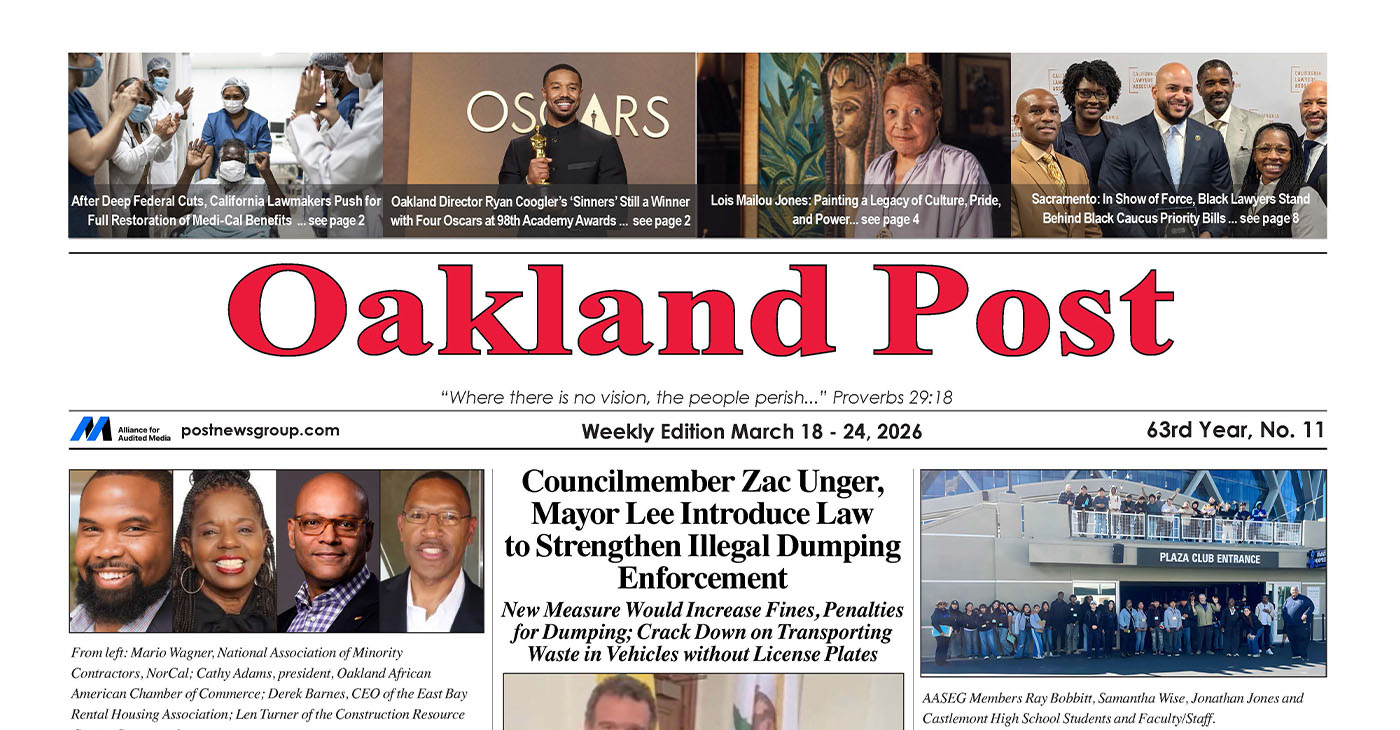
To enlarge your view of this issue, use the slider, magnifying glass icon or full page icon in the lower right corner of the browser window.
Activism
Oakland Post: Week of March 11 -17, 2026
The printed Weekly Edition of the Oakland Post: Week of March 11 – 17, 2026
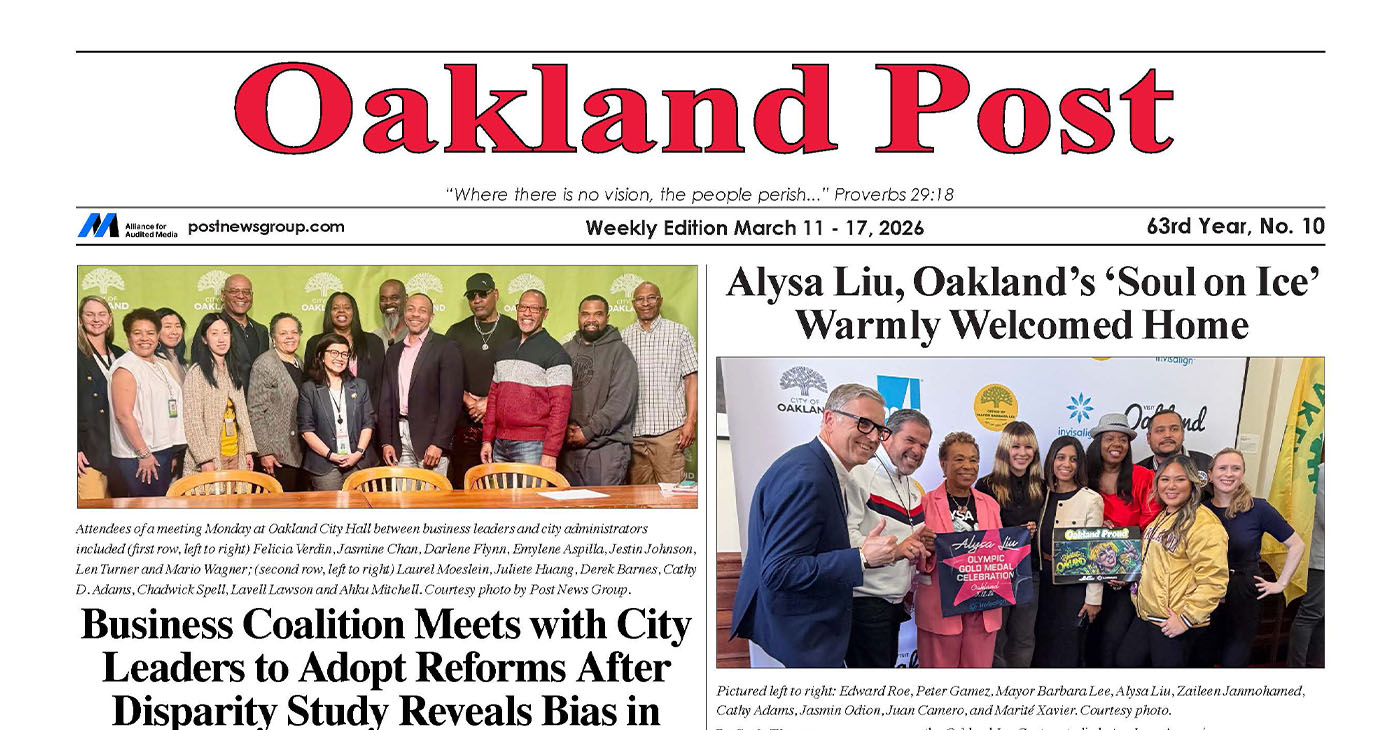
To enlarge your view of this issue, use the slider, magnifying glass icon or full page icon in the lower right corner of the browser window.
Activism
Oakland Post: Week of March 4 – 10, 2026
The printed Weekly Edition of the Oakland Post: Week of March 4 – 10, 2026
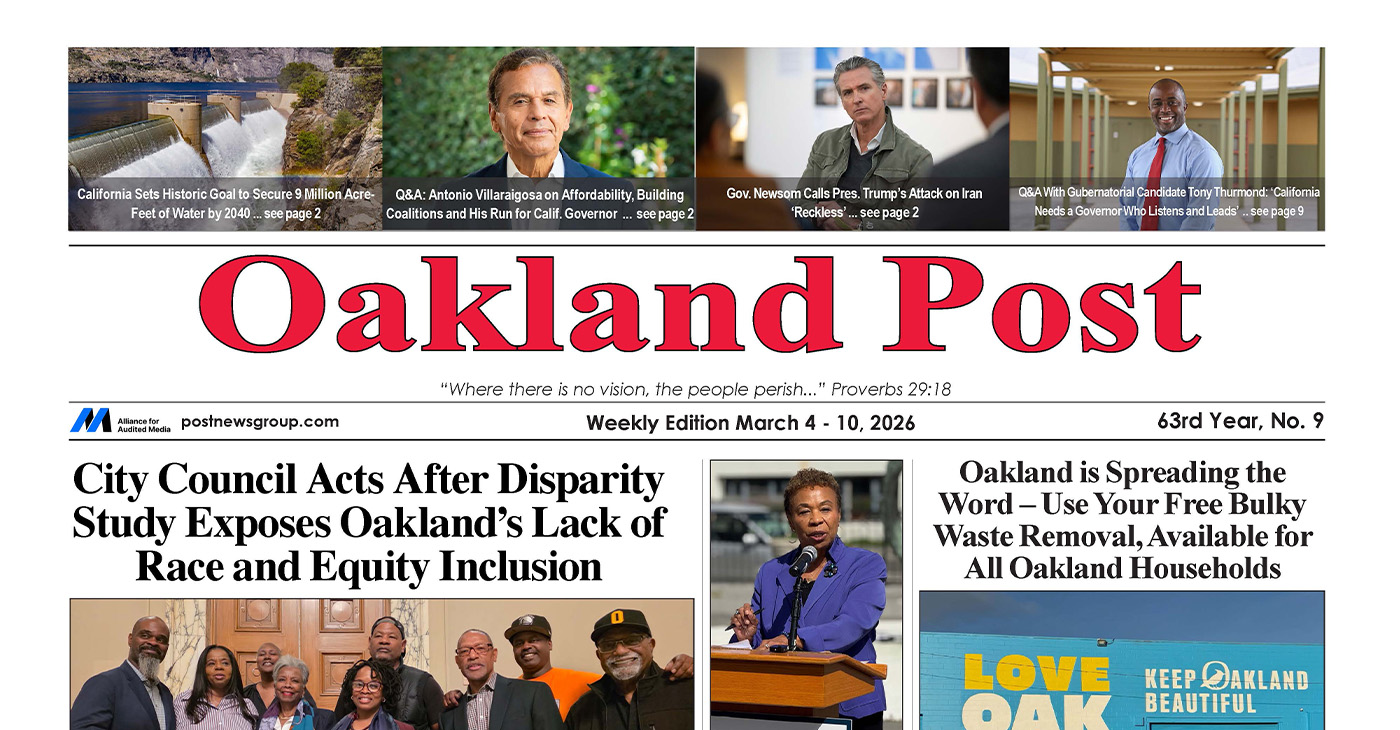
To enlarge your view of this issue, use the slider, magnifying glass icon or full page icon in the lower right corner of the browser window.

WORK FROM HOME
Home-based business with potential monthly income of $10K+ per month. A proven training system and website provided to maximize business effectiveness. Perfect job to earn side and primary income. Contact Lynne for more details: Lynne4npusa@gmail.com 800-334-0540


Black Artists in America, Installation Three Wraps at the Dixon Gallery and Gardens

Grief, Advocacy, and Education: A Counselor Reflects on Black Maternal Health

Future of Florida’s Black History Museum in Limbo

New Research Shows the Many Benefits of Early Learning

South Hampton K-8 Students Among Top 10 Finalists for Samsung’s ‘Solve for Tomorrow’ Competition

Cuba: No Negotiation with US on the President or Political System

Brooklyn Academy of Music Names Jamaican-Born Tamara McCaw as President

Trinidad & Tobego – U.S. Launches WhatsApp Channel for American Citizens in the Country

Oakland Post: Week of March 18 – 24, 2026

AI Innovation vs. Ethics and Environmental Impact

AI, Web3, and Digital Reparations

What If You Owned Your AI Agent?

Season 7, Episode 3 – January Reporter’s Roundtable 📱

Season 7, Episode 3 – January Reporter’s Roundtable

AI, Media, and Power | Part 2, Real-World Impacts and Tradeoffs

Reflecting on Black History Milestones in Birmingham AL

CITY OF SAN LEANDRO STATE OF CALIFORNIA PUBLIC WORKS DEPARTMENT ENGINEERING DIVISION NOTICE TO BIDDERS FOR ANNUAL STREET OVERLAY/REHABILITATION 2019-21 – PHASE III

Oakland Post: Week of February 18 – 24, 2026

Oakland Post: Week of February 25 – March 3, 2026

PRESS ROOM: NBA Hall of Fame Nominee Terry Cummings Joins 100 Black Men of DeKalb County to Launch Victory & Values Initiative

Trump’s MAGA Allies are Creating Executive Order Plan to Steal the 2026 Midterms

Oakland Post: Week of March 4 – 10, 2026

Chase Oakland Community Center Hosts Alley-Oop Accelerator Building Community and Opportunity for Bay Area Entrepreneurs

U.S. manufacturing rebounds – how foundry services are adapting to rising demand

Poll Shows Support for Policies That Help Families Afford Child Care

OP-ED: One Hundred Years of Black Workers Telling the Truth

Advancements in solar technology that are changing the way we power the world

Woman’s Search for Family’s Roots Leads to Ancestor John T. Ward – A Successful Entrepreneur and Conductor on the Underground Railroad

Oakland Post: Week of March 11 -17, 2026

COMMENTARY: Women of Color Shape Our Past and Future

Hyundai Ioniq 5 Parking, Safety, and 360 View #shorts

2025 Ioniq 5 New Wiper & Powerful Performance! #shorts

Electric SUV Range: Is 259 Miles Enough? #shorts

EV Charging: How Fast Can You Charge an Electric Vehicle? #shorts

Biometric Cooling… Messaging Seats…Come on! 2025 Infiniti QX80 Autograph 4WD

Charged Up: Witness the Magic of a Fully Electric Car! #shorts

Range Rover Sport PHEV Included…: See What’s Inside This Luxury SUV! #shorts

Invisible Hood View: Perfect Parking with X-Ray Vision! #shorts

AI Is Reshaping Black Healthcare: Promise, Peril, and the Push for Improved Results in California

ESSAY: Technology and Medicine, a Primary Care Point of View

Sanctuary Cities

The RESISTANCE – FREEDOM NOW

STATE OF THE PEOPLE: Freddie

ECONOMIC BOYCOTT DAY!!!!!

I told You So

-
 Activism4 weeks ago
Oakland Post: Week of March 4 – 10, 2026
-
 #NNPA BlackPress4 weeks ago
Woman’s Search for Family’s Roots Leads to Ancestor John T. Ward – A Successful Entrepreneur and Conductor on the Underground Railroad
-
 Activism3 weeks ago
Oakland Post: Week of March 11 -17, 2026
-
 #NNPA BlackPress4 weeks ago
COMMENTARY: Women of Color Shape Our Past and Future
-

 #NNPA BlackPress4 weeks ago
Advocates Raise Alarm Over ICE Operation, MOU and Detention Risks in Baltimore County
-

 Advice3 weeks ago
Financial Wellness and Mental Health: Managing Money Stress in College
-

 #NNPA BlackPress4 weeks ago
Pete Buttigieg to Join Mayor Randall Woodfin for Community Town Hall in Birmingham
-
 Activism2 weeks ago
Oakland Post: Week of March 18 – 24, 2026
