Connect with us

Bay Area

Burglary at Offices of OCCUR Longtime Community Organization

Reports from both organizations were filed with the Oakland Police Department, which is still investigating the crimes. “There was this moment of sheer disbelief,” said Alexander upon discovering the break-in. “And then a variety of emotions ranging from confusion, fear, and tremendous anger that our personal and professional spaces and property had been invaded and violated,” she said. “Why would anyone want to do this?”

Published

on

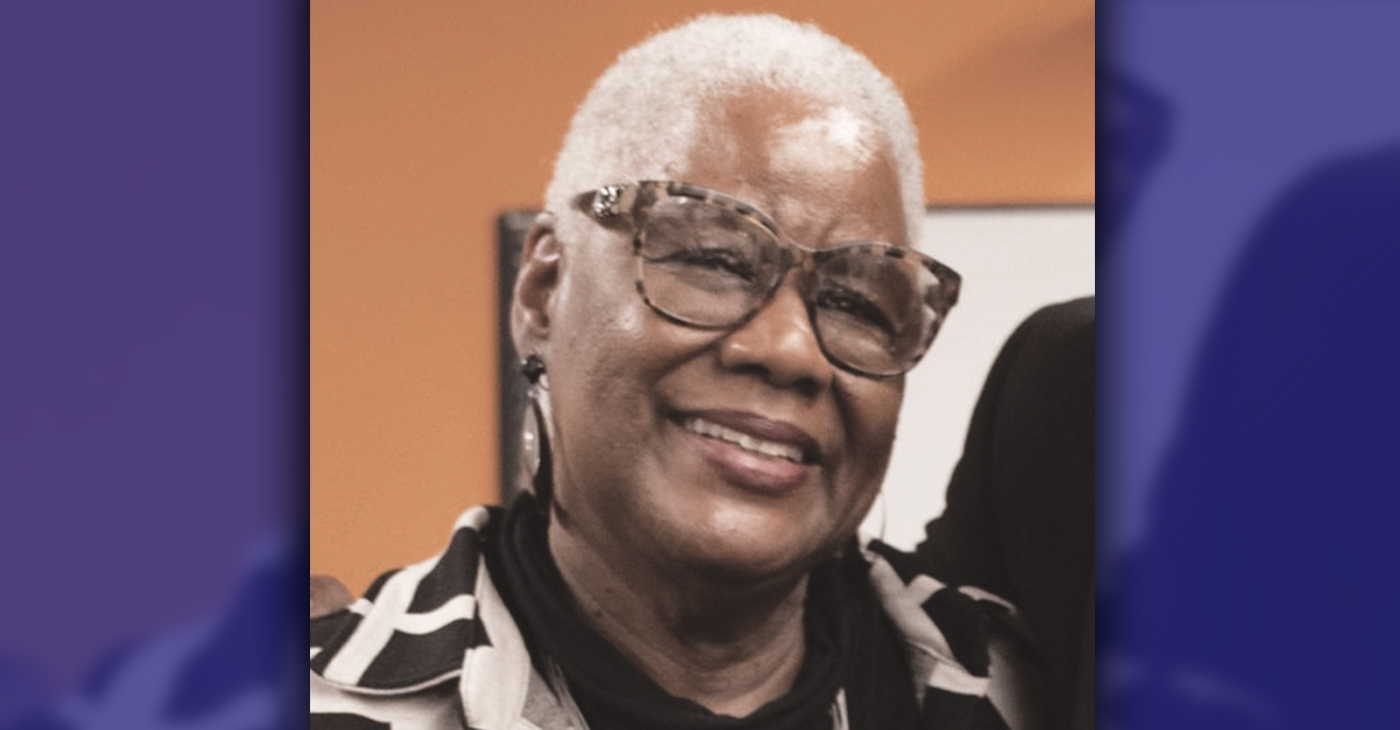
OCCUR’s Executive Director Sondra Alexander.

By Post Staff

For the first time in OCCUR’s 65 years in operation, its offices were burglarized on Wednesday March 23, 2022.

That morning Post News Group employee Brenda Hudson alerted OCCUR’s Executive Director Sondra Alexander that a burglary had taken place at the OCCUR office.

When Alexander arrived at the office, the floors, normally clutter-free, were strewn with paper. Her desk drawer and those of associates were pulled out, and their contents rifled through.

Besides OCCUR, the Post News Group offices, which are located in the same building were also burglarized and vandalized.

Reports from both organizations were filed with the Oakland Police Department, which is still investigating the crimes. “There was this moment of sheer disbelief,” said Alexander upon discovering the break-in. “And then a variety of emotions ranging from confusion, fear, and tremendous anger that our personal and professional spaces and property had been invaded and violated,” she said. “Why would anyone want to do this?”

OCCUR’s Enduring Relevance

Alexander’s questions are especially poignant in light of OCCUR’s objectives and relevance in Oakland for decades. Founded to provide economic opportunities for low-income people of color in Oakland, the organization has continuously implemented programs that have made profound enhancements to neighborhoods in most need.

The David E. Glover Emerging Technology Center located in East Oakland is a perfect example. The facility is an extensive technological training center for residents of all ages. Founded in 1987, the Center makes it possible for anyone seeking knowledge to be trained in computer skills and receive early-stage access to coding, artificial intelligence, programming, and other marketable skills.

It is crucial that Oakland’s most marginalized residents acquire these skills to compete and succeed.

“With the ramping up of our capacity-building programs, OCCUR is not letting the burglary derail us,” said Charla Montgomery, OCCUR’s program consultant. “Now more than ever, it is important that OCCUR reaches as many communities as possible and all those committed to positive change throughout the Bay Area.”

Despite Oakland’s ever-changing demographics, which is vividly apparent in dwindling Black residency and homeownership, school closures, and an unprecedented homelessness crisis OCCUR remains committed.

Organizational and neighborhood leaders across the city and the greater Bay Area know how vital OCCUR has been and continues to be for marginalized communities.

Whether it be the mini-grant program for Oakland small businesses, or the capacity building/development resources for nonprofits and faith-based organizations, OCCUR has been an ever-present stalwart supporter.

Today, Alexander and the entire OCCUR team are focusing on doing what they and their predecessors started 65 years ago: That is being a catalyst for bringing together neighborhood residents, merchants, and government to strengthen the economic development potential of emerging communities.

With the shock of the burglary also comes a determination to continue and to carry on and OCCUR looks forward to providing the crucial programs our community needs and deserves.

Continue Reading
Click to comment

Leave a Reply

Your email address will not be published. Required fields are marked *

Activism

Protecting California’s Black Moms and Babies: Policies and Programs Struggle to Fix Deep-Rooted Maternal Health Inequities

“Access to doula services means that any time in their trimesters, they can have eight sessions with their doula, whether virtual, Telehealth or in-person. The doulas are with them through their labor and delivery, and can help clients, partners, families, be prepared with a birth plan, education, and understanding labor stages,” said Los Angeles-based Sister Marquita of A Sister By Your Side doula services.

Published

on

Gnae Dismuske and her children.

By Charlene Muhammad, California Black Media

Gnae Dismuke experienced a miscarriage at 11 weeks in 2017 and later gave birth to three children, now ages six, four, and one month.

Dismuke says she’s encouraged that programs exist to advocate for safer birth outcomes for Black women like her. However, when it comes to actual practices of medical facilities and doctors, she has a conflicted perspective – a point of view shaped by her three birth experiences: one in a hospital, one at home, and another in a hospital.

Dismuke, who lives in Los Angeles, addressed her birthing challenges with the help of Black Infant Health in partnership with the Long Beach Public Health and Human Services Department. They supplied doulas and nurses who visited her home during her last birth and advocated on her behalf.

“The nurse was able to move mountains quickly that I wasn’t able to move with the medical industry, with just advocating for me, asking for things like physical therapy,” she stated.

Statistics show that Black women in California are three to four times more likely than White women to die from pregnancy-related complications. Some birth equity advocates argue that expanding access to midwifery care and certified birth doulas could help reduce these disparities. Others emphasize the need for education, noting barriers such as high costs for preferred birthing options and managing high-risk factors like hypertension and stress related to systemic discrimination.

“Doctors don’t want to see you until almost the end of the first trimester. That’s 11 to 12 weeks in. Many things could go wrong,” Dismuke said, recalling experiencing spontaneous bleeding in the first trimester for all three of her births.

“Groups like M.O.R.E. Mothers, a nonprofit maternal health-focused community-based organization in Long Beach, are part of programmatic solutions. They provide classes and workshops,” she added.

To assist mothers like Dismuke, the Department of Health Care Services (DHCS) added doula services to preventive services covered under Medi-Cal in 2023. Still, many mothers don’t know these benefits exist because Medi-Cal coverage is based on income, but those pregnant qualify at higher income levels than other adults.

“I thought [a doula] was for people who had money, who had private health insurance and stuff like that,” said a Medi-Cal beneficiary who asked not to be identified.

Under Assembly Bill (AB) 133, doula services were formally included as a “covered preventive service” under Medi-Cal in 2023. AB 133 was co-authored by former State Sen. Nancy Skinner (D-Berkeley) and Sen. Akilah Weber (D-San Diego), a pediatrician. It built on the California “Momnibus” Act, passed in 2021, aimed at improving maternal and infant health outcomes among Medi-Cal members.

“Access to doula services means that any time in their trimesters, they can have eight sessions with their doula, whether virtual, Telehealth or in-person. The doulas are with them through their labor and delivery, and can help clients, partners, families, be prepared with a birth plan, education, and understanding labor stages,” said Los Angeles-based Sister Marquita of A Sister By Your Side doula services.

Doulas also help mothers understand their rights during labor and delivery, and Medi-Cal support extends postpartum care until the baby reaches one year of age.

The statistics are personal for Jade Ross, a member of Los Angeles County MotherBoard, an advisory collaborative of Black mothers working at the intersection of healing, advocacy, and sustainable systems change to create a more just and equitable world for Black mothers and babies.

“That’s why I do the work I do: so Black women can basically birth in joy without trauma,” stated Ross, while cuddling her 11-week-old infant, Kalea.

Organizers and participants of the 2025 California Black Birth Equity Summit close out the event with an uplifting a cappella performance.

Organizers and participants of the 2025 California Black Birth Equity Summit close out the event with an uplifting a cappella performance.

“A lot of it has to do with education,” continued Ross, speaking at the 2025 California Black Birth Equity Summit in Sacramento. “I think a lot of people have certain ideas about what midwifery or holistic care looks like, or, on the other end, don’t trust the medical system.”

Held biannually, the Summit was founded by Mashariki Kudumu, a doula and public health advocate. This year, it was co-hosted by the California Coalition for Black Birth Justice and UCSF Center for Birth Justice. Themed “Rooted in Action,” the Summit brought over 500 clinicians, midwives, doulas, and policymakers together.

Sonya Young Aadam, CEO of the California Black Women’s Health Project, said, “I strongly believe that our advocacy in these spaces can make a difference. We go in and we demand the care that we need. But many of us are not even aware the disparities exist.”

Despite progress, disparities persist. According to the 2025 State of Black Birth Equity in California Report, the state continues to experience disproportionately poor outcomes, even with low maternal mortality and strong infant health outcomes.

Jennie Joseph, a British-trained midwife and summit panelist, said that Black women in the U.S.:

  • tend to have premature babies;
  • have low birth weight babies;
  • lose babies more frequently;
  • are less likely to breastfeed; and
  • often struggle to recover postpartum.

“This is all we’ve got. This is all we can expect. Is this the reason why Black women and families are suffering?’ No! The root causes are straightforward: racism, classism, gender discrimination. That’s it!” said Joseph.

She emphasized these outcomes are not physiological but result from systemic inequities.

“One solution is simply getting people into care straight away. We operate like the triage or the emergency room for pregnancy-related issues. We’ll get you in, we’ll sort you out, and then we’ll pass you on to whoever you want to go on to,” she said.

Assemblymember Mia Bonta (D-Alameda) noted at the Summit that California’s maternal health crisis includes the closure of more than 50 labor and delivery wards in the last decade, heavily impacting low-income, Black, Latina, and Indigenous communities.

Ongoing challenges include low Medi-Cal reimbursement, lack of investment in the birthing workforce, and federal attacks on healthcare infrastructure. Bonta’s AB 55, the Freedom to Birth Act, champions Alternative Birth Centers, which improve newborn birth rates, decrease cesarean births, promote successful breastfeeding, and reduce racial health disparities.

“Red tape should never stand in the way of proven solutions to deliver affordable and accessible healthcare for Californians. By signing AB 55, our state has taken a much-needed step to address the maternal health crisis,” Bonta said.

Doula Directory: Search a list of doulas in California enrolled as Medi-Cal providers.

California Black Doulas: Get a full list.


Continue Reading

Activism

OP-ED: AB 1349 Puts Corporate Power Over Community

Since Ticketmaster and Live Nation merged in 2010, ticket prices have jumped more than 150 percent. Activities that once fit a family’s budget now take significant disposable income that most working families simply don’t have. The problem is compounded by a system that has tilted access toward the wealthy and white-collar workers. If you have a fancy credit card, you get “presale access,” and if you work in an office instead of a warehouse, you might be able to wait in an online queue to buy a ticket. Access now means privilege.

Published

on

Bishop Joseph Simmons, Senior Pastor, Greater St. Paul Baptist Church, Oakland

By Bishop Joseph Simmons, Senior Pastor, Greater St. Paul Baptist Church, Oakland

As a pastor, I believe in the power that a sense of community can have on improving people’s lives. Live events are one of the few places where people from different backgrounds and ages can share the same space and experience – where construction workers sit next to lawyers at a concert, and teenagers enjoy a basketball game with their grandparents. Yet, over the past decade, I’ve witnessed these experiences – the concerts, games, and cultural events where we gather – become increasingly unaffordable, and it is a shame.

These moments of connection matter as they form part of the fabric that holds communities together. But that fabric is fraying because of Ticketmaster/Live Nation’s unchecked control over access to live events. Unfortunately, AB 1349 would only further entrench their corporate power over our spaces.

Since Ticketmaster and Live Nation merged in 2010, ticket prices have jumped more than 150 percent. Activities that once fit a family’s budget now take significant disposable income that most working families simply don’t have. The problem is compounded by a system that has tilted access toward the wealthy and white-collar workers. If you have a fancy credit card, you get “presale access,” and if you work in an office instead of a warehouse, you might be able to wait in an online queue to buy a ticket. Access now means privilege.

Power over live events is concentrated in a single corporate entity, and this regime operates without transparency or accountability – much like a dictator. Ticketmaster controls 80 percent of first-sale tickets and nearly a third of resale tickets, but they still want more. More power, more control for Ticketmaster means higher prices and less access for consumers. It’s the agenda they are pushing nationally, with the help of former Trump political operatives, who are quietly trying to undo the antitrust lawsuit launched against Ticketmaster/Live Nation under President Biden’s DOJ.

That’s why I’m deeply concerned about AB 1349 in its current form. Rather than reining in Ticketmaster’s power, the bill risks strengthening it, aligning with Trump. AB 1349 gives Ticketmaster the ability to control a consumer’s ticket forever by granting Ticketmaster’s regime new powers in state law to prevent consumers from reselling or giving away their tickets. It also creates new pathways for Ticketmaster to discriminate and retaliate against consumers who choose to shop around for the best service and fees on resale platforms that aren’t yet controlled by Ticketmaster. These provisions are anti-consumer and anti-democratic.

California has an opportunity to stand with consumers, to demand transparency, and to restore genuine competition in this industry. But that requires legislation developed with input from the community and faith leaders, not proposals backed by the very company causing the harm.

Will our laws reflect fairness, inclusion, and accountability? Or will we let corporate interests tighten their grip on spaces that should belong to everyone? I, for one, support the former and encourage the California Legislature to reject AB 1349 outright or amend it to remove any provisions that expand Ticketmaster’s control. I also urge community members to contact their representatives and advocate for accessible, inclusive live events for all Californians. Let’s work together to ensure these gathering spaces remain open and welcoming to everyone, regardless of income or background.

Continue Reading

Activism

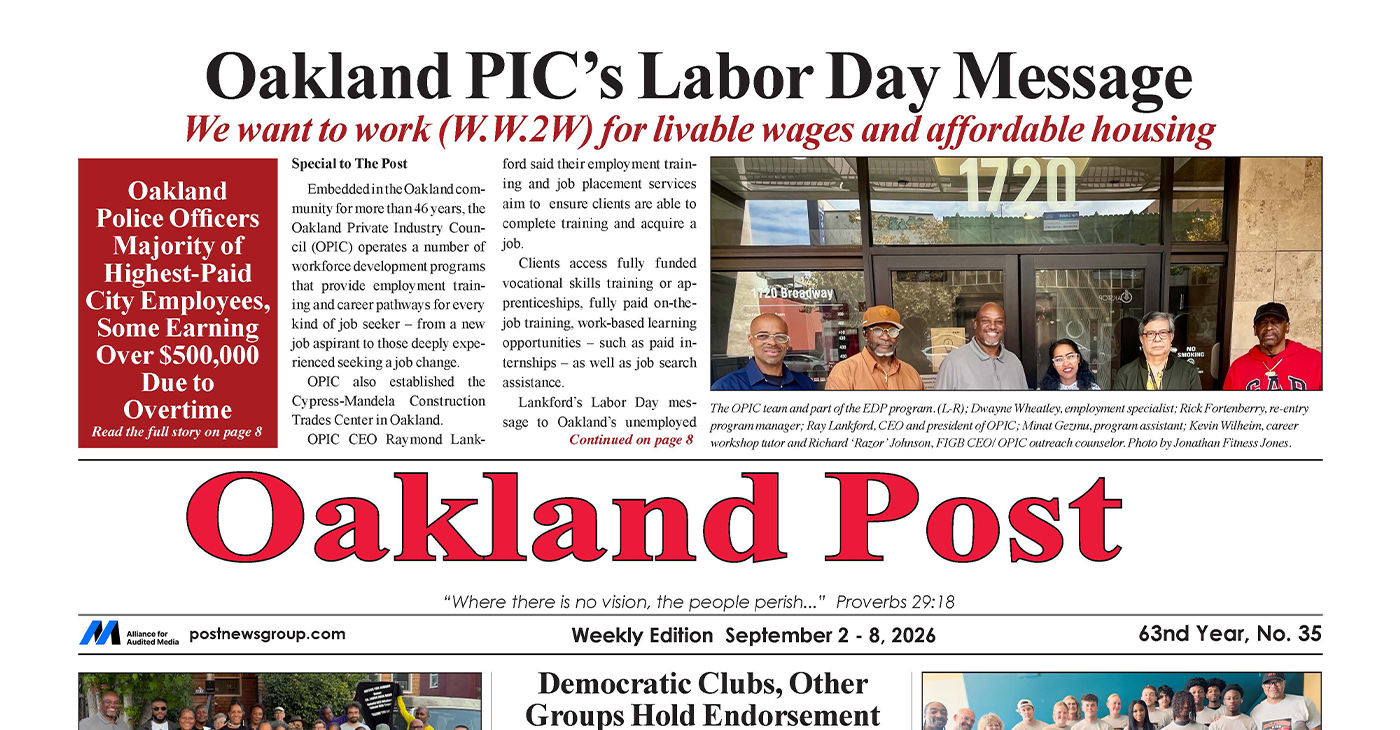
Oakland Post: Week of December 31, 2025 – January 6, 2026

The printed Weekly Edition of the Oakland Post: Week of – December 31, 2025 – January 6, 2026

Published

on

To enlarge your view of this issue, use the slider, magnifying glass icon or full page icon in the lower right corner of the browser window.

Continue Reading

Subscribe to receive news and updates from the Oakland Post

* indicates required

CHECK OUT THE LATEST ISSUE OF THE OAKLAND POST

ADVERTISEMENT

WORK FROM HOME

Home-based business with potential monthly income of $10K+ per month. A proven training system and website provided to maximize business effectiveness. Perfect job to earn side and primary income. Contact Lynne for more details: Lynne4npusa@gmail.com 800-334-0540

Facebook

Costco. Courtesy image.
Bay Area1 month ago

Post Salon to Discuss Proposal to Bring Costco to Oakland Community meeting to be held at City Hall, Thursday, Dec. 18

Saying “Oakland is on the move,” Mayor Barbara Lee announces results of Measure U bond sale, Dec. 9, at Oakland City Hall with city councilmembers and city staff among those present. Photo courtesy of the City of Oakland.
Activism1 month ago

Mayor Lee, City Leaders Announce $334 Million Bond Sale for Affordable Housing, Roads, Park Renovations, Libraries and Senior Centers

Photos courtesy of National Archives.
Activism1 month ago

Ann Lowe: The Quiet Genius of American Couture

Activism1 month ago

Oakland Post: Week of December 10 – 16, 2025

OUSD Supt. Denise Saddler. File photo.
Activism1 month ago

Oakland School Board Grapples with Potential $100 Million Shortfall Next Year

NCAA football history was made this year when Head Coach from Mississippi Valley State, Terrell Buckley and Head Coach Desmond Gumbs both had starting kickers that were Women. This picture was taken after the game.
Activism1 month ago

Desmond Gumbs — Visionary Founder, Mentor, and Builder of Opportunity

The ‘aunties’ playing cards. iStock photo by Andreswd.
Advice1 month ago

COMMENTARY: If You Don’t Want Your ‘Black Card’ Revoked, Watch What You Bring to Holiday Dinners

The Pride and Joy Band performed at the first annual Kwanzaa celebration sponsored by Fayeth Gardens. Courtesy photo.
Arts and Culture1 month ago

Fayeth Gardens Holds 3rd Annual Kwanzaa Celebration at Hayward City Hall on Dec. 28

BRIDGE Housing President and CEO Ken Lombard. Courtesy of BRIDGE Housing.
Activism1 month ago

BRIDGE Housing President and CEO Ken Lombard Scores Top Honors for Affordable Housing Leadership

Kellie Todd Griffin. CBM file photo.
Activism1 month ago

2025 in Review: Seven Questions for Black Women’s Think Tank Founder Kellie Todd Griffin

Christmas lights on a house near the writer’s residence in Oakland. Photo by Joseph Shangosola.
Alameda County1 month ago

Bling It On: Holiday Lights Brighten Dark Nights All Around the Bay

At the International Association of Chiefs of Police Conference, Flock Safety introduces new public safety technology – Amplified Intelligence, a suite of AI-powered tools designed to improve law enforcement investigations. Courtesy photo.
Alameda County1 month ago

Oakland Council Expands Citywide Security Cameras Despite Major Opposition

Councilmember Carroll Fife celebrates major milestone for Black arts, culture, and economic power in Oakland. Courtesy photo.
Activism1 month ago

Black Arts Movement Business District Named New Cultural District in California

Shutterstock
Advice1 month ago

Support Your Child’s Mental Health: Medi-Cal Covers Therapy, Medication, and More

Activism1 month ago

Oakland Post: Week of December 17 – 23, 2025

Trending

Copyright ©2021 Post News Group, Inc. All Rights Reserved.