
Activism
Black Leaders: Redistricting Process Is “Rushed, Inconsistent, Incomplete”
According to the California Citizens Redistricting Commission, because the proposed maps chop up and split districts where African Americans live, Black political power will be diluted in Los Angeles County, San Diego County, the Central Valley, the Bay Area and the Inland Empire. To address the problem, they have submitted proposed maps to the redistricting commission that will protect Black political power and representation.


By Tanu Henry | California Black Media
African American leaders in California are keeping a close eye on the commission drafting congressional, state Senate, state Assembly and Board of Equalization voting maps. They are concerned about the outcome of the redistricting process.
On November 10, the California Citizens Redistricting Commission released the first draft maps of the redrawn lines for the state’s voting districts. By state law, the finalized versions of the new political districts have to be completed by December 27.
But advocates like James Woodson, the policy director of the California Black Census and Redistricting Hub (CBCRH), are asking the commission to press pause and re-evaluate the maps they have come up with so far.
The CBCRH, also called “the Black Hub” is a statewide coalition focused on “racial equity” and “fairness” in the redistricting process.
“The Black Hub appreciates the commission’s hard work and its early release of the maps for public input. At the same time, the Black Hub is deeply concerned that the process for developing the maps has been rushed, inconsistent, and incomplete,” said Woodson. “It has resulted in maps that have ignored the interests of many Black communities and millions of residents in the state’s most populated areas.”
For example, draft maps released by the commission last month collapsed the only two congressional districts in Los Angeles County represented by Black U.S. Congressmembers, Maxine Waters (D-CA-43) and Karen Bass (D-CA-37), into one district. After advocates and activists complained about African Americans losing political power, the commission separated the single district it was proposing into two constituencies again.
But because California lost one seat in the U.S. Congress due to an overall drop in the state’s population, according to the U.S. 2020 Census numbers, advocates worry that it will cause a ripple effect, which will change the racial and political composition of districts across the state.
The “Black Hub” leaders and other advocates in the state are urging Black Californians to speak up and provide input to ensure their communities do not lose representation or resources.
“It’s not just about us losing political power. It’s also about us losing assets,” said Kellie Todd Griffin, a resident of the Los Angeles County city of Carson, where the number of Black residents accounts for more than 25% of the city’s total population. Los Angeles County, where California is expected to lose one congressional seat, is home to about 40% of African Americans in the state.
Griffin, who is an organizer and entrepreneur, is known in California’s political circles for her outspoken advocacy on behalf of Black Californians. She says with the Olympics coming to Los Angeles in 2028, there will be a lot of development and an increase in revenue for government and businesses in Carson. Redrawn political districts, she fears, could hurt her city and others nearby economically.
“When you look at the maps, you see that our congressional district in Carson has been attached more to Redondo Beach and Rancho Palos Verdes instead of being connected to cities like Long Beach and Compton and places like that,” Griffin said. “There is also an assumption that Blacks and other minorities in the area vote the same on issues. As we know, that is not always true. We have specific issues that affect us Blacks differently. So, we vote differently on them – from some criminal justice reforms to the Crown Act.”
One of the realities driving the leaders’ concern is the possibility that the Black vote in five different regions of California will be diluted.
“Rather than adhere to map priorities from BIPOC communities, we are concerned that, in an effort to prioritize all voices, some commissioners have mistakenly and unknowingly elevated voices from less diverse, affluent communities in the process, and at the expense of BIPOC communities,” said Woodson.
According to CBCRH, because the proposed maps chop up and split districts where African Americans live, Black political power will be diluted in Los Angeles County, San Diego County, the Central Valley, the Bay Area and the Inland Empire. To address the problem, they have submitted proposed maps to the redistricting commission that will protect Black political power and representation.
Another major concern is the compressed timeline on which the commission is working, which limits the time for citizens to influence the line-drawing process. This year, due to pandemic-related federal delays, census data the commission relies on to redraw maps was delayed. Instead of its usual release in March, the U.S. Census Bureau did not provide that information until September 21.
“The Black Hub is deeply concerned that the process for developing the maps has been rushed, inconsistent, and incomplete. It has resulted in maps that have ignored the interests of many Black communities and millions of residents in the state’s most populated areas,” said a statement released by CBCRH last week.
Every 10 years, California appoints a new redistricting commission after the U.S. Census. It is tasked with mapping or re-drawing the state’s electoral lines based on population shifts in the state population over the decade between census counts.
According to Census 2020 numbers, California’s Black population decreased from about 2.5 to nearly 2.2 million over the last decade. However, there was a dramatic increase in the number of Californians who identify as more than one race — from 4.9% in 2010 to 14.6% in 2020.
In 2008, California voters approved the Citizens Redistricting Commission through a constitutional amendment called The Voters First Act or Proposition 11. It handed the function of drawing electoral maps to citizens. The policy was set up to avoid the political influence of government officials or special interest groups on the redistricting process.
Before the passage of Prop 11, the state Legislature was responsible for drawing its own electoral districts. There are five Democrats, five Republicans, and four members who are not affiliated with any political party on the committee.
When redrawing maps, the number of voters in all districts across the state has to be equal. That is roughly 761,000 people in each congressional district. For all state Senate districts that number is 988,000, and 494,000 people in Assembly districts.
In California, Blacks make up a little over 5% of the state’s population of about 40 million people. There are 52 congressional districts; 80 Assembly districts; and 40 Senate districts. For the state Board of Equalization, the body responsible for representing taxpayer interests and “equalizing” county-by-county tax assessments across California, there are four districts.
The commission has to comply with a number of constitutional mandates, including Voting Rights Act provisions that all minority groups must be able to elect a representative of their choice; a district must be whole or contiguous (connected geographically); among other rules.
Starting November 17 there will be a series of meetings during which the public will be able to provide their input to commissioners. Another round of map drawing sessions will commence November 30.
“We need to lift our voices and make sure we have said something. That we didn’t just sit by and let these lines be redrawn without us fighting for our interests. We have to define what community means to us,” said Griffin. “We have to make sure we are submitting written comments and letting people know the things that work for us and the things that don’t.”
To make a public comment to the commission, email votersfirstact@crc.ca.gov or complete the Community Feedback Form.
____________________________________________________________
Photo Caption:
Website Tags and Keywords:
Twitter Tags/Handles:
@Tanu_Henry @CaliforniaBlack2 @RepMaxineWaters @RepKarenBass @CACalls @jdublu44 @BlackPressUSA @NNPA_BlackPress











Activism
Oakland Post: Week of March 11 -17, 2026
The printed Weekly Edition of the Oakland Post: Week of March 11 – 17, 2026
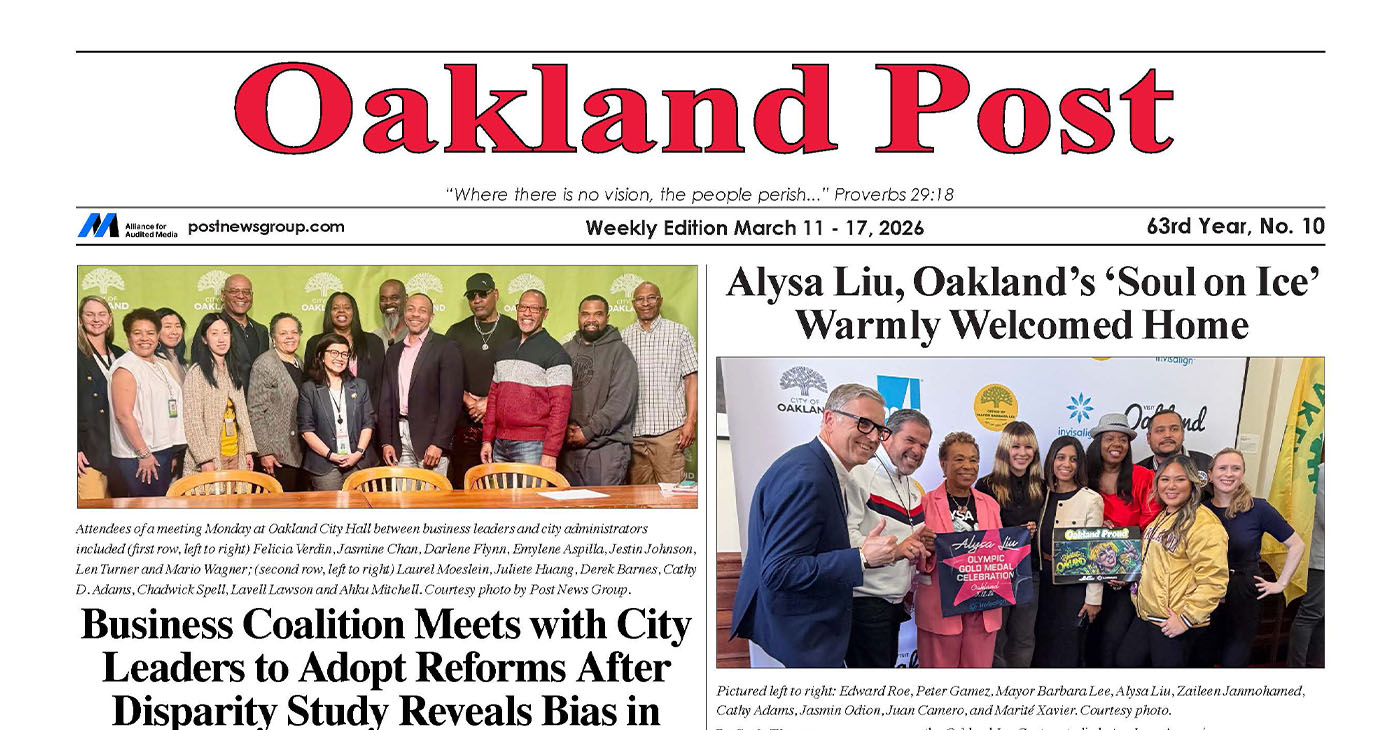
To enlarge your view of this issue, use the slider, magnifying glass icon or full page icon in the lower right corner of the browser window.
Activism
Oakland Post: Week of March 4 – 10, 2026
The printed Weekly Edition of the Oakland Post: Week of March 4 – 10, 2026

To enlarge your view of this issue, use the slider, magnifying glass icon or full page icon in the lower right corner of the browser window.
Activism
Oakland Post: Week of February 25 – March 3, 2026
The printed Weekly Edition of the Oakland Post: Week of – February 25 – March 3, 2026
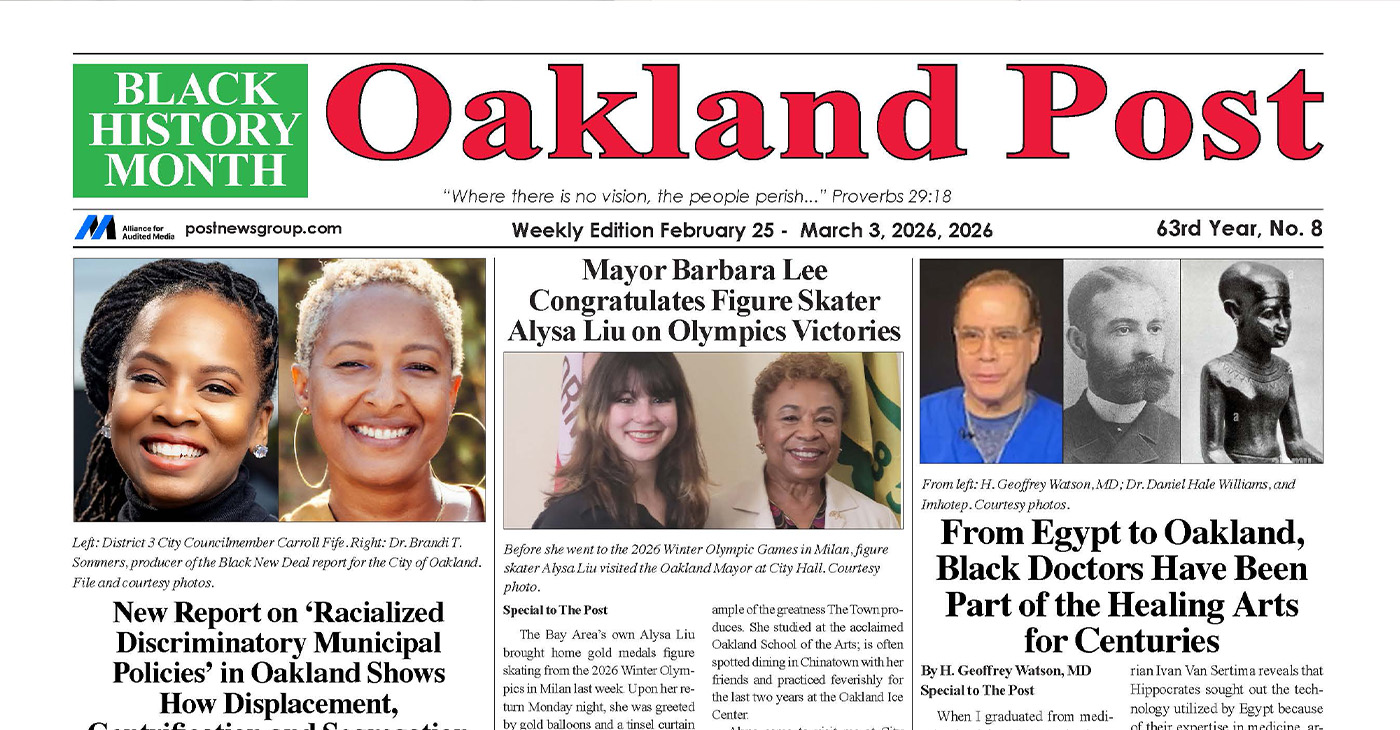
To enlarge your view of this issue, use the slider, magnifying glass icon or full page icon in the lower right corner of the browser window.

WORK FROM HOME
Home-based business with potential monthly income of $10K+ per month. A proven training system and website provided to maximize business effectiveness. Perfect job to earn side and primary income. Contact Lynne for more details: Lynne4npusa@gmail.com 800-334-0540


Financial Wellness and Mental Health: Managing Money Stress in College

Oakland Post: Week of March 11 -17, 2026

Women & Wealth: Tips for Navigating Your Lifelong Financial Journey

COMMENTARY: Women of Color Shape Our Past and Future

Woman’s Search for Family’s Roots Leads to Ancestor John T. Ward – A Successful Entrepreneur and Conductor on the Underground Railroad

Advocates Raise Alarm Over ICE Operation, MOU and Detention Risks in Baltimore County

Pete Buttigieg to Join Mayor Randall Woodfin for Community Town Hall in Birmingham

WATCH: Week One – NNPA’s “Leadership Matters” Video Series

Oakland Post: Week of March 4 – 10, 2026

OP-ED: NNPA Launches 2026 “Leadership Matters” Video Series

PRESS ROOM: PMG and Cranbrook Horizons-Upward Bound Launch Journey Fellowship Cohort 2

Los Angeles Summit Brings Together Leaders to Tackle Poverty and Affordability

Civil Rights TV Launches 24/7 Network Focused on Black History, Education and Equity

REVIEW: The Ultimate Hot Girl Summer Getaway: Sunseeker Resort Florida

COMMENTARY: How You Stop a Prescription Medicine is as Important as How You Start

Book Review: Books on Black History and Black Life for Kids

Community Celebrates Turner Group Construction Company as Collins Drive Becomes Turner Group Drive

Discrimination in City Contracts

California Launches Study on Mileage Tax to Potentially Replace Gas Tax as Republicans Push Back

COMMENTARY: The Biases We Don’t See — Preventing AI-Driven Inequality in Health Care

Black History Events in the East Bay

Post Newspaper Invites NNPA to Join Nationwide Probate Reform Initiative

Art of the African Diaspora Celebrates Legacy and Community at Richmond Art Center

New Bill, the RIDER Safety Act, Would Support Transit Ambassadors and Safety on Public Transit

COMMENTARY: The National Protest Must Be Accompanied with Our Votes

Oakland Post: Week of February 4 – 10, 2026

Oakland Post: Week of February 11 – 17, 2026

Dorothy Lee Bolden: Uniting Domestic Workers

After Don Lemon’s Arrest, Black Officials Raise Concerns About Independent Black Media

Reflecting on Black History Milestones in Birmingham AL

Hyundai Ioniq 5 Parking, Safety, and 360 View #shorts

2025 Ioniq 5 New Wiper & Powerful Performance! #shorts

Electric SUV Range: Is 259 Miles Enough? #shorts

EV Charging: How Fast Can You Charge an Electric Vehicle? #shorts

Biometric Cooling… Messaging Seats…Come on! 2025 Infiniti QX80 Autograph 4WD

Charged Up: Witness the Magic of a Fully Electric Car! #shorts

Range Rover Sport PHEV Included…: See What’s Inside This Luxury SUV! #shorts

Invisible Hood View: Perfect Parking with X-Ray Vision! #shorts

AI Is Reshaping Black Healthcare: Promise, Peril, and the Push for Improved Results in California

ESSAY: Technology and Medicine, a Primary Care Point of View

Sanctuary Cities

The RESISTANCE – FREEDOM NOW

STATE OF THE PEOPLE: Freddie

ECONOMIC BOYCOTT DAY!!!!!

I told You So
-
 #NNPA BlackPress3 weeks ago
Reflecting on Black History Milestones in Birmingham AL
-
 #NNPA BlackPress3 weeks ago
PRESS ROOM: NBA Hall of Fame Nominee Terry Cummings Joins 100 Black Men of DeKalb County to Launch Victory & Values Initiative
-

 #NNPA BlackPress4 weeks ago
U.S. manufacturing rebounds – how foundry services are adapting to rising demand
-

 #NNPA BlackPress4 weeks ago
OP-ED: One Hundred Years of Black Workers Telling the Truth
-
 Activism3 weeks ago
Oakland Post: Week of February 25 – March 3, 2026
-

 #NNPA BlackPress4 weeks ago
Advancements in solar technology that are changing the way we power the world
-

 #NNPA BlackPress3 weeks ago
Trump’s MAGA Allies are Creating Executive Order Plan to Steal the 2026 Midterms
-

 #NNPA BlackPress4 weeks ago
PRESS ROOM: Civil Rights TV Launches in Selma as the World’s First 24/7 Civil Rights Television Network
