
Bay Area
Barrier to Entry No More: UC Ends Use of SAT, ACT in Admissions, Scholarships
In a historic settlement, the UC Regents agreed they would eliminate the SAT and the ACT from admissions and scholarship decisions through 2025.


COMMENTARY
You don’t have to ask Stockton teenager Rain Romeo about standardized testing. We all know tests like the SAT/ACT are discriminatory in nature, failing to reflect a student’s real ability, and advantaging wealthier students who can afford extra tutoring to game the exam.
“I’m not just a score,” Romeo, a 17- year old Filipino American student told me this week on the phone. She was one of the students who had been asked to testify to the UC regents about the fairness and efficacy of standardized tests.
Last Friday, the major barrier to Romeo’s hopes and dreams was removed. In a historic settlement, the UC Regents agreed they would eliminate the SAT and the ACT from admissions and scholarship decisions through 2025.
UC had already figured that standardized tests were unfair last year, but let COVID-19 be the excuse to put a temporary halt on the tests only through 2022. The settlement now bans the test for another three years.
The suit should allow for a greater diversity of students of all backgrounds, but especially Black, Latinx, and Asian groups from less wealthy communities.
“I’m thrilled and so happy to hear the news,” Romeo told me. The tests had put enormous pressure on her life, creating anxiety and self-doubt.

“Coming from a low-income household and a community that is constantly overlooked, I have always felt like I wouldn’t attain success,” she said. “I always based my perceptions and my entire life thought process on these scores. I believed if my score wasn’t good enough, then I wasn’t good enough.”
Romeo immigrated to the U.S. with her family from the Philippines as a child in 2004. She has been active as a youth advocate with the Little Manila Rising group in Stockton. And she feels connected to her community, interested in building it up, not looking forward to leaving it behind. It’s a kind of ambition and drive that doesn’t show up in a standardized test.
“There’s more to me than what is seen on that piece of paper, and the number that score represents,” Romeo said. “I don’t want [admissions officers] to make an assumption or observation of me that they think is true based on a number.”
Romeo said she wanted colleges to see her for who she is and what her true potential represents. In Stockton, Romeo has overcome a lot. She’s a star student (weighted GPA around 4.3) in a neglected, low-income neighborhood, and would be the first in her family to go to college. In school, she studies debate, Honors English, Honors Physics, and is in student government, as well as a community volunteer with Little Manila Rising.
She also isn’t ambitious for a corporate life that would force her to leave her home. Instead, Romeo is ambitious for her community. Perhaps that is a quality colleges should find worth nurturing, as Romeo prepares to apply to UC Berkeley, UCLA, and UC Davis, where admissions will consider her uniqueness rather than her relative value to a made-up standard.
That makes the settlement good news for all young people who are overlooked and filtered out by that thing that has long been an admissions officer’s crutch–the SAT.
Students like Rain now have a chance to stand out and be seen, not by a number, but for who they are.
Emil Guillermo is a veteran Bay Area journalist and commentator. He vlogs at www.amok.com, FaceBook @emilguillermo.media












Activism
Oakland Post: Week of August 5 – 11, 2026
The printed Weekly Edition of the Oakland Post: Week of August 5 – 11, 2026

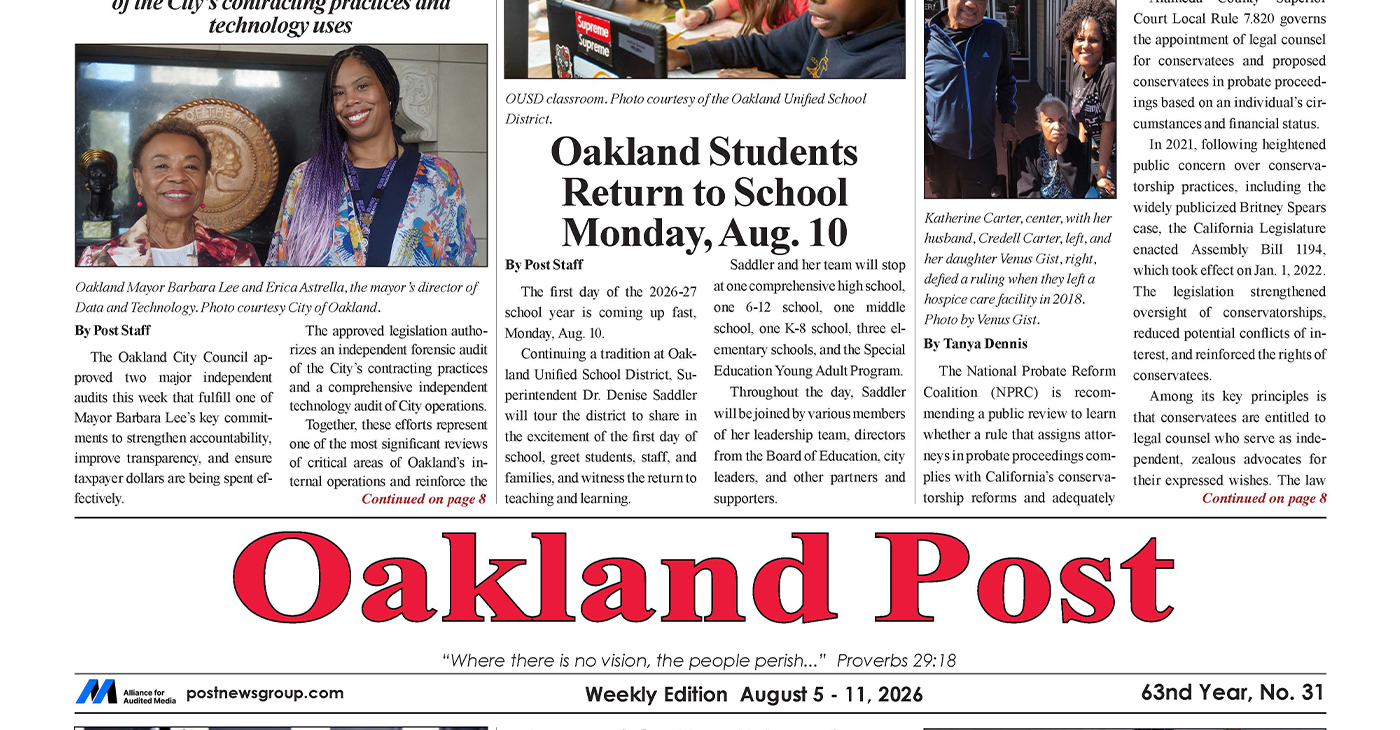
To enlarge your view of this issue, use the slider, magnifying glass icon or full page icon in the lower right corner of the browser window.

Activism
Oakland Post: Week of July 29 – August 4, 2026
The printed Weekly Edition of the Oakland Post: Week of July 29 – August 4, 2026

To enlarge your view of this issue, use the slider, magnifying glass icon or full page icon in the lower right corner of the browser window.
Activism
Oakland Post: Week of July 22 – 28, 2026
The printed Weekly Edition of the Oakland Post: Week of July 22 – 28, 2026

To enlarge your view of this issue, use the slider, magnifying glass icon or full page icon in the lower right corner of the browser window.

WORK FROM HOME
Home-based business with potential monthly income of $10K+ per month. A proven training system and website provided to maximize business effectiveness. Perfect job to earn side and primary income. Contact Lynne for more details: Lynne4npusa@gmail.com 800-334-0540


Misty Copeland Shapes Ballet’s Tomorrow

As Part of Your Back-to- School Checklist, Vaccinate

As Part of Your Back-to- School Checklist, Vaccinate

Congresswoman Simon Demands Investigation into Trump’s Abuse of Emergency Powers for Coal Export Terminal in West Oakland

OPINION: The Philippines Isn’t Foreign When Your Family Still Lives There

Asm. McKinnor’s Bill Banning Drones Above Outdoor Entertainment Events Awaits Senate Decision

California Sen. Padilla Joins Colleagues to Introduce Bill Imposing Term Limits on Supreme Court Justices

Department of Homeland Security Demands California Secretary of State Shirley N. Weber Scrub Voter Rolls

George Cook: The Inventor Who Made Fishing Smarter

Gov. Newsom Announces $109.6 Million in Funding for 278 Supportive Homes in Bakersfield, Contra Costa, Sacramento and Fresno

Rep. Kamlager Dove Demands Care, Justice for Man Shot by ICE

“The Power to See Threats Sooner”: Gov. Newsom, Safety Officials Showcase California’s Investments in Hi-Tech Wildfire Prevention

100 Black Wings’ Team Oakland Youth Athletes Heading to Taiwan for 2026 International Children’s Games

Oakland ‘Port Serves as a Powerful Engine for Good Jobs and Economic Development

Oakland Faith Leaders Welcome New Police Chief, Mobilize Around Housing and Civic Action
Department of Homeland Security Demands California Secretary of State Shirley N. Weber Scrub Voter Rolls

Oakland Children’s Hospital Workers and Patients Rally for Pediatric Medical Care
“The Power to See Threats Sooner”: Gov. Newsom, Safety Officials Showcase California’s Investments in Hi-Tech Wildfire Prevention

New Judge Could Decide if Karmelo Anthony Gets a New Trial

Surveillance Pricing Fight: State Senate Debates Bill Banning Retailers from Using AI to Set Prices Based on a Buyer’s Profile

Mount Zion MBC, Church of Jesus Christ of Latter-day Saints Partner to Bring 29,000 Meals to Alameda County

Alpha Kappa Alpha Sorority, Inc. Celebrates New North Atlantic Regional Director
California Sen. Padilla Joins Colleagues to Introduce Bill Imposing Term Limits on Supreme Court Justices

Starting This Summer, California Car Buyers Can Get an Instant $3500 Off the Cost of Electric Vehicles

COMMENTARY: You Are Already Paying for the AI Boom

California Bill Would Let Abuse Victims Use Trauma as Legal Defense for Violent Crime

Fed Court to Decide Landmark First Amendment Case

Gov. Gavin Newsom Signs Law Streamlining Affordable Housing Rules

Oakland Celebrates $125 Million Coliseum Sale

Saving Black Mothers Starts Outside the Hospital

The Conversation With Al McFarlane 6/23/26

Media Monday 6/22/26

LIVE! ASK ALMA! — TUES. 6.23.26 7PM EST

Car Buying Secrets: 4 Hidden Checks Before You Sign!

Is This 550 HP Charger Worth YOUR Money? AutoNetwork Review

Celebrating Juneteenth – Frederick Douglass on education and resistance

LIVE! — ASK ALMA! — TUES. 6.19.26 7PM EST

Hyundai Ioniq 5 Parking, Safety, and 360 View #shorts

2025 Ioniq 5 New Wiper & Powerful Performance! #shorts

Electric SUV Range: Is 259 Miles Enough? #shorts

EV Charging: How Fast Can You Charge an Electric Vehicle? #shorts

Biometric Cooling… Messaging Seats…Come on! 2025 Infiniti QX80 Autograph 4WD

Charged Up: Witness the Magic of a Fully Electric Car! #shorts

Range Rover Sport PHEV Included…: See What’s Inside This Luxury SUV! #shorts

Invisible Hood View: Perfect Parking with X-Ray Vision! #shorts
-
 Featured3 days ago
Department of Homeland Security Demands California Secretary of State Shirley N. Weber Scrub Voter Rolls
-
 Business2 weeks ago
Oakland Children’s Hospital Workers and Patients Rally for Pediatric Medical Care
-
 Environment3 days ago
“The Power to See Threats Sooner”: Gov. Newsom, Safety Officials Showcase California’s Investments in Hi-Tech Wildfire Prevention
-
 #NNPA BlackPress2 weeks ago
New Judge Could Decide if Karmelo Anthony Gets a New Trial
-
 Business2 weeks ago
Surveillance Pricing Fight: State Senate Debates Bill Banning Retailers from Using AI to Set Prices Based on a Buyer’s Profile
-
 Business2 weeks ago
Mount Zion MBC, Church of Jesus Christ of Latter-day Saints Partner to Bring 29,000 Meals to Alameda County
-
 Black History1 week ago
Alpha Kappa Alpha Sorority, Inc. Celebrates New North Atlantic Regional Director
-
 Featured3 days ago
California Sen. Padilla Joins Colleagues to Introduce Bill Imposing Term Limits on Supreme Court Justices
