
Politics
Attorney General Nominee Moves Closer to Confirmation


Challenged by Senate Judiciary Committee Chairman Sen. Charles Grassley, R-Iowa, Attorney General nominee Loretta Lynch defends President Barack Obama’s decision to shelter millions of immigrants from deportation though they live in the country illegally but she said they have no right to citizenship under the law, as she testifies on Capitol Hill in Washington, Wednesday, Jan. 28, 2015 during her confirmation hearing before the committee. (AP Photo/J. Scott Applewhite)
ERIC TUCKER, Associated Press
ERICA WERNER, Associated Press
WASHINGTON (AP) — Senate Republicans demanded wholesale change at the Justice Department Thursday as they questioned whether President Barack Obama’s attorney general nominee, Loretta Lynch, would provide it.

“The question for me and a lot of members on this side is whether Ms. Lynch is committed to leading the Department of Justice in a new direction,” Senate Judiciary Chairman Charles Grassley, R-Iowa, said as he gaveled open the second day of hearings into her nomination.
“She’s clearly a skilled and competent lawyer,” Grassley said, while complaining that Lynch’s answers during day-long testimony Wednesday were “indirect.” Grassley said he would be following up with more questions in writing.
Still, there was little doubt about the ultimate outcome. Lynch needs support from at least three Republicans on the committee to advance to the full Senate, and she is expected to win those votes and achieve eventual confirmation.
One senior committee Republican, Orrin Hatch of Utah, issued a statement Thursday saying that Lynch “appears to be well qualified, and I appreciated the commitments she made yesterday to enforce the rule of law, act independently of the White House, defend the constitutionality of statutes and work with us on important legislation.” Hatch said he would make his final decision when the committee votes in coming weeks.
And when top committee Democrat Patrick Leahy of Vermont asked the nine outside witnesses testifying Thursday for a show of hands if they were opposed to Lynch’s nomination, not one hand went up.
Lynch did not appear at the second and final day of her confirmation hearing, which was designed instead to feature testimony from outside experts, several summoned by Republicans to amplify their criticism of Obama and his current attorney general, Eric Holder. Republicans deride Holder as a liberal firebrand and Obama cheerleader who has failed to cooperate with Congress.
Witnesses included attorney Jonathan Turley, who has charged the Obama administration engages in executive overreach, and Catherine Engelbrecht, who says she was targeted by the Internal Revenue Service for leading a conservative group. Engelbrecht described the Justice Department as “an increasingly rogue agency.”
Democrats took issue with the GOP focus on Obama and Holder.
“Barack Obama is not the nominee. That may come as a surprise to some who heard the questions. Eric Holder is not the nominee,” Leahy said Thursday.
In her appearance Wednesday, Lynch pledged independence from Obama and promised to work with the Republican-led Congress. She offered support for some controversial Obama administration policies, including the president’s unilateral protections for millions of immigrants in the country illegally.
But she also suggested she would provide a departure from Holder.
“If confirmed as attorney general, I would be myself. I would be Loretta Lynch,” she said, when asked how senators could be assured that she would lead differently.
If approved, Lynch — the top federal prosecutor since 2010 for parts of New York City and Long Island — would become the nation’s first black female attorney general.
Several of the more conservative committee members were frustrated as they tried to draw her into criticism of Obama or Holder.
“Try as I might, there has been nothing I have been able to ask you that has yielded any answer suggesting any limitations whatsoever on the authority of the president,” said Sen. Ted Cruz, R-Texas. Lynch disagreed with that characterization, saying the American people, and not the president, would be “my client and my first thought.”
Copyright 2015 The Associated Press. All rights reserved. This material may not be published, broadcast, rewritten or redistributed.




Activism
Oakland Post: Week of March 18 – 24, 2026
The printed Weekly Edition of the Oakland Post: Week of March 18 – 24, 2026

To enlarge your view of this issue, use the slider, magnifying glass icon or full page icon in the lower right corner of the browser window.
Activism
Oakland Post: Week of March 11 -17, 2026
The printed Weekly Edition of the Oakland Post: Week of March 11 – 17, 2026
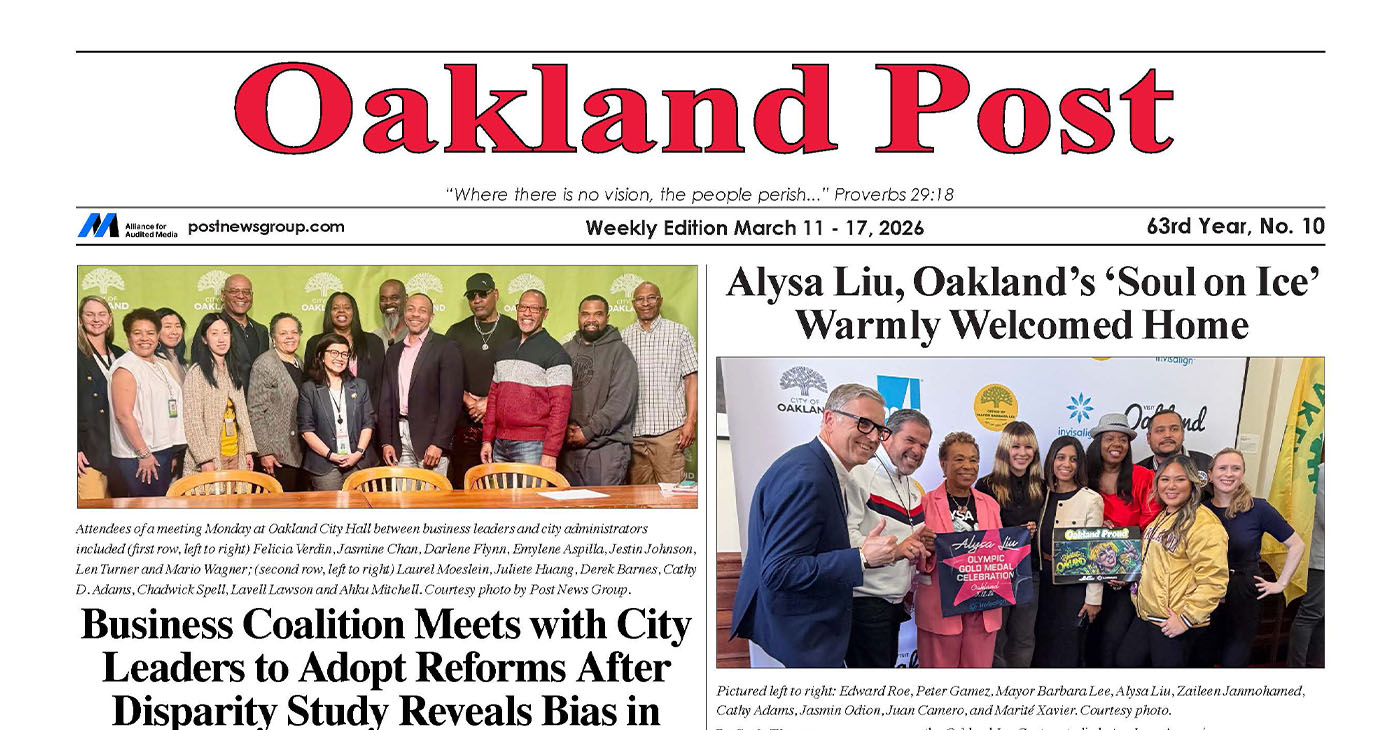
To enlarge your view of this issue, use the slider, magnifying glass icon or full page icon in the lower right corner of the browser window.
Activism
Oakland Post: Week of March 4 – 10, 2026
The printed Weekly Edition of the Oakland Post: Week of March 4 – 10, 2026

To enlarge your view of this issue, use the slider, magnifying glass icon or full page icon in the lower right corner of the browser window.


WORK FROM HOME
Home-based business with potential monthly income of $10K+ per month. A proven training system and website provided to maximize business effectiveness. Perfect job to earn side and primary income. Contact Lynne for more details: Lynne4npusa@gmail.com 800-334-0540


Black Artists in America, Installation Three Wraps at the Dixon Gallery and Gardens

Grief, Advocacy, and Education: A Counselor Reflects on Black Maternal Health

Future of Florida’s Black History Museum in Limbo

New Research Shows the Many Benefits of Early Learning

South Hampton K-8 Students Among Top 10 Finalists for Samsung’s ‘Solve for Tomorrow’ Competition

Cuba: No Negotiation with US on the President or Political System

Brooklyn Academy of Music Names Jamaican-Born Tamara McCaw as President

Trinidad & Tobego – U.S. Launches WhatsApp Channel for American Citizens in the Country

Oakland Post: Week of March 18 – 24, 2026

AI Innovation vs. Ethics and Environmental Impact

AI, Web3, and Digital Reparations

What If You Owned Your AI Agent?

Season 7, Episode 3 – January Reporter’s Roundtable 📱

Season 7, Episode 3 – January Reporter’s Roundtable

AI, Media, and Power | Part 2, Real-World Impacts and Tradeoffs

Oakland Post: Week of February 11 – 17, 2026

Reflecting on Black History Milestones in Birmingham AL

CITY OF SAN LEANDRO STATE OF CALIFORNIA PUBLIC WORKS DEPARTMENT ENGINEERING DIVISION NOTICE TO BIDDERS FOR ANNUAL STREET OVERLAY/REHABILITATION 2019-21 – PHASE III

Oakland Post: Week of February 18 – 24, 2026

PRESS ROOM: NBA Hall of Fame Nominee Terry Cummings Joins 100 Black Men of DeKalb County to Launch Victory & Values Initiative

Oakland Post: Week of February 25 – March 3, 2026

Trump’s MAGA Allies are Creating Executive Order Plan to Steal the 2026 Midterms

U.S. manufacturing rebounds – how foundry services are adapting to rising demand

OP-ED: One Hundred Years of Black Workers Telling the Truth

Chase Oakland Community Center Hosts Alley-Oop Accelerator Building Community and Opportunity for Bay Area Entrepreneurs

Advancements in solar technology that are changing the way we power the world

Poll Shows Support for Policies That Help Families Afford Child Care

Oakland Post: Week of March 4 – 10, 2026

PRESS ROOM: Civil Rights TV Launches in Selma as the World’s First 24/7 Civil Rights Television Network

Woman’s Search for Family’s Roots Leads to Ancestor John T. Ward – A Successful Entrepreneur and Conductor on the Underground Railroad

Hyundai Ioniq 5 Parking, Safety, and 360 View #shorts

2025 Ioniq 5 New Wiper & Powerful Performance! #shorts

Electric SUV Range: Is 259 Miles Enough? #shorts

EV Charging: How Fast Can You Charge an Electric Vehicle? #shorts

Biometric Cooling… Messaging Seats…Come on! 2025 Infiniti QX80 Autograph 4WD

Charged Up: Witness the Magic of a Fully Electric Car! #shorts

Range Rover Sport PHEV Included…: See What’s Inside This Luxury SUV! #shorts

Invisible Hood View: Perfect Parking with X-Ray Vision! #shorts

AI Is Reshaping Black Healthcare: Promise, Peril, and the Push for Improved Results in California

ESSAY: Technology and Medicine, a Primary Care Point of View

Sanctuary Cities

The RESISTANCE – FREEDOM NOW

STATE OF THE PEOPLE: Freddie

ECONOMIC BOYCOTT DAY!!!!!

I told You So
-
 #NNPA BlackPress4 weeks ago
Poll Shows Support for Policies That Help Families Afford Child Care
-
 Activism4 weeks ago
Oakland Post: Week of March 4 – 10, 2026
-
 #NNPA BlackPress3 weeks ago
Woman’s Search for Family’s Roots Leads to Ancestor John T. Ward – A Successful Entrepreneur and Conductor on the Underground Railroad
-

 #NNPA BlackPress4 weeks ago
OP-ED: NNPA Launches 2026 “Leadership Matters” Video Series
-

 #NNPA BlackPress3 weeks ago
Advocates Raise Alarm Over ICE Operation, MOU and Detention Risks in Baltimore County
-

 #NNPA BlackPress3 weeks ago
COMMENTARY: Women of Color Shape Our Past and Future
-

 #NNPA BlackPress3 weeks ago
Pete Buttigieg to Join Mayor Randall Woodfin for Community Town Hall in Birmingham
-
 Activism2 weeks ago
Oakland Post: Week of March 11 -17, 2026
