
Activism
‘All Black Lives Matter’ Mural Dedication Held in Oakland

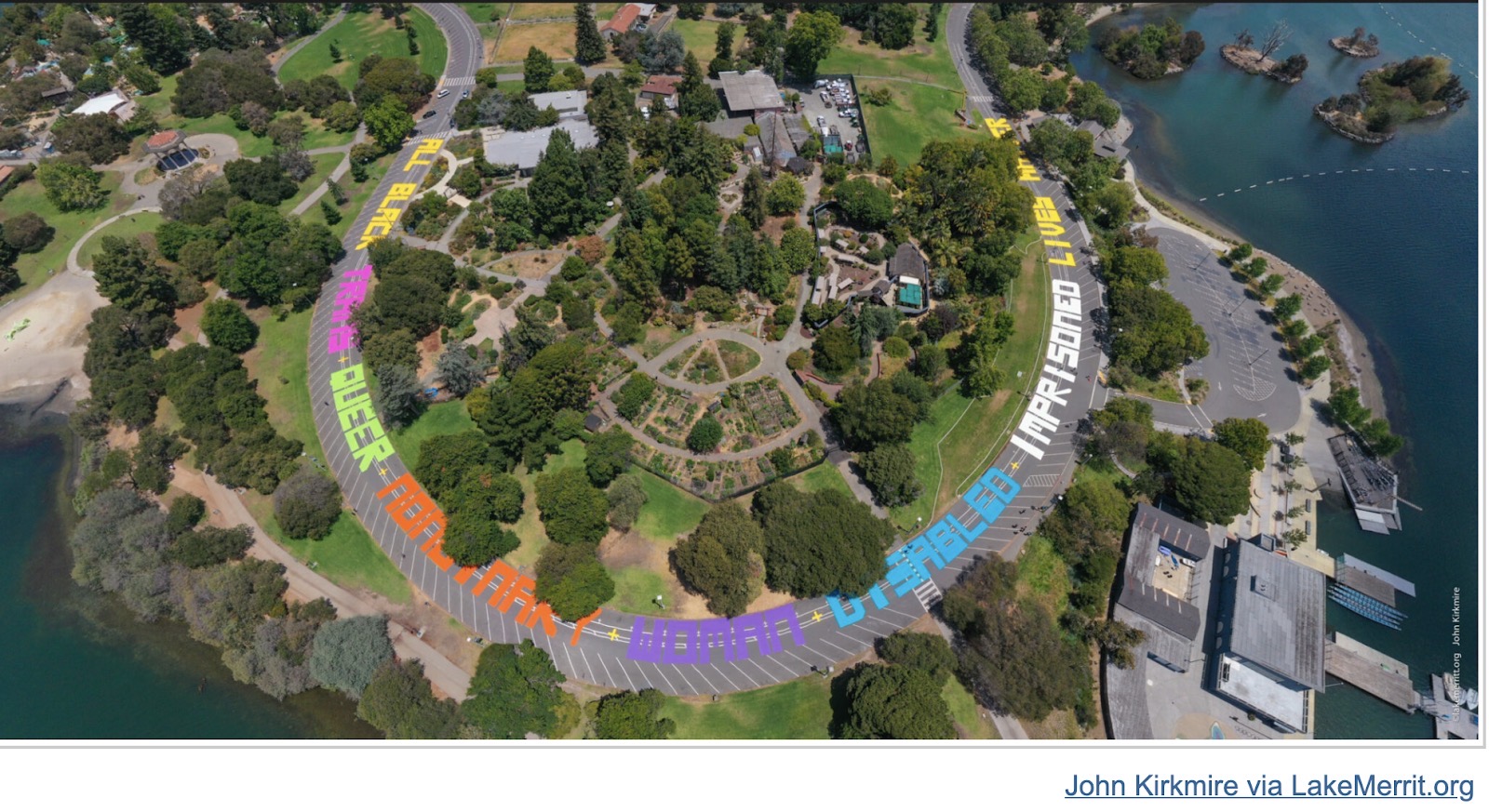
Nearly 100 people gathered to dedicate the ‘All Black Lives Matter’ mural, Oakland’s largest, near the Lake Merritt Boating Center at 568 Bellevue Ave. on June 28.
The ‘All Black Lives Matter’ mural, focusing on the LGBTQ community, was conceived by Kin Folkz of Spectrum Queer Media and co-designed by Kin Folkz also of QueerArtsCenter.com with Guerrilla Davis, WeAreTheOnes, and Janetta Johnson, TGIJP (Transgender Gender-Variant Intersex Justice Project).
Work on the mural, which is painted on the street itself, started in June and was painted by 14 muralists, a graphic designer and more than 250 volunteers.
The multicolored mural reads: “ALL BLACK TRANS + QUEER + NONBINARY +WOMAN + DISABLED + IMPRISONED LIVES MATTER.”
At the dedication, organizers used soil, seeds and crystals to “ . . . bring equity to us in our struggle for an end of oppression based upon our marginalized Black identities,” Kin Folkz said.
In May, Tony McDade was killed by police in Tallahassee, Fla., and Nina Pop who was stabbed to death in Sikestown, Missouri, were two of the many Black transgender people who lost their lives to law enforcement and/or racist and trans-phobic people.
There is an online All Black Lives Matter Solidarity Statement (https://bit.ly/ALLBLMMuralSolidarityStatement), which people can sign:
“We, Black Trans, Queer, Gender Nonconforming, Disabled, +Previously Incarcerated+Currently Imprisoned+Undocumented beings have been targeted for deep oppression. WE are calling for an end to the silencing of our experiences and the deep devaluing of our lives in ALL communities.
Hate speech, discrimination, and violence caused by government institutions (like the Department of Justice) enforce dominant systems of oppression that are used with deadly force against Black beings. Too often the lives of deeply marginalized Black people are ignored – particularly Black Trans Women; Black Femmes of all genders; Black Gender Nonconforming folks; Black Queer folks; Black Disabled folks; Black Undocumented beings; Black imprisoned folks and all Black folks living within these intersections.
“We are unapologetically Black in our positioning. In affirming that Black Lives Matter, we need not qualify our position. To love and desire freedom and justice for ourselves is a prerequisite for wanting the same for others… We affirm the lives of Black queer and trans folks, disabled folks, undocumented folks, folks with records, women, and all Black lives along the gender spectrum. Our network centers those who have been marginalized within Black liberation movements.” BLM (https://blacklivesmatter.com/)
“We ask that the undersigned agree to elevate and value the lives ALL BLACK PEOPLE Black Trans Women; Black Femmes of all genders; Black Gender Nonconforming folks; Black Queer folks; Black Disabled folks; and Black Previously Incarcerated + Currently Imprisoned beings. We ask that they shift their actions and encourage others to use their privilege as opportunities to promote legislation and practices that:
1 – PRIORITIZE OUR LEADERSHIP + COMPENSATE US
2 – RECOGNIZE OUR NAMES AND GENDERS
3 – TAKE ACCOUNTABILITY + PRESS FOR JUSTICE for OUR LIVES
4 – HONOR OUR LEGACIES
5 – SHELTER US
6 – REDISTRIBUTE POLICE FUNDS TO FUND OUR GRASSROOTS ORGS + COMMUNITIES
7 – END SOLITARY CONFINEMENT
8 – ABOLISH THE PRISON INDUSTRIAL COMPLEX
9 – END THE CRIMINALIZATION OF BLACK SELF DEFENSE
10 – EDUCATE + MAINTAIN THE PRACTICE of UPENDING MISOGYNY, TRANSPHOBIA + CLASSISM targeting Black beings.
– Adapted from TGIJP (http://www.tgijp.org/) + Transgender Law Center (TLC) https://transgenderlawcenter.org/
This is a time to affirm that #ALLBlackLivesMatter. Inaction and silence is not the solution. This is a time to join in the struggle to dismantle systemic oppression that targets Black people of all genders – particularly Black Trans Women; Black Femmes of all genders; Black Gender Nonconforming folks; Black Queer folks; Black Disabled folks; and Black imprisoned folks. This is a time to elevate and amplify ALL Black voices in our unified demand for justice. This is a time for action. The time for justice is now.”

Activism
Oakland Post: Week of September 23 – 29, 2026
The printed Weekly Edition of the Oakland Post: Week of September 23 – 29, 2026

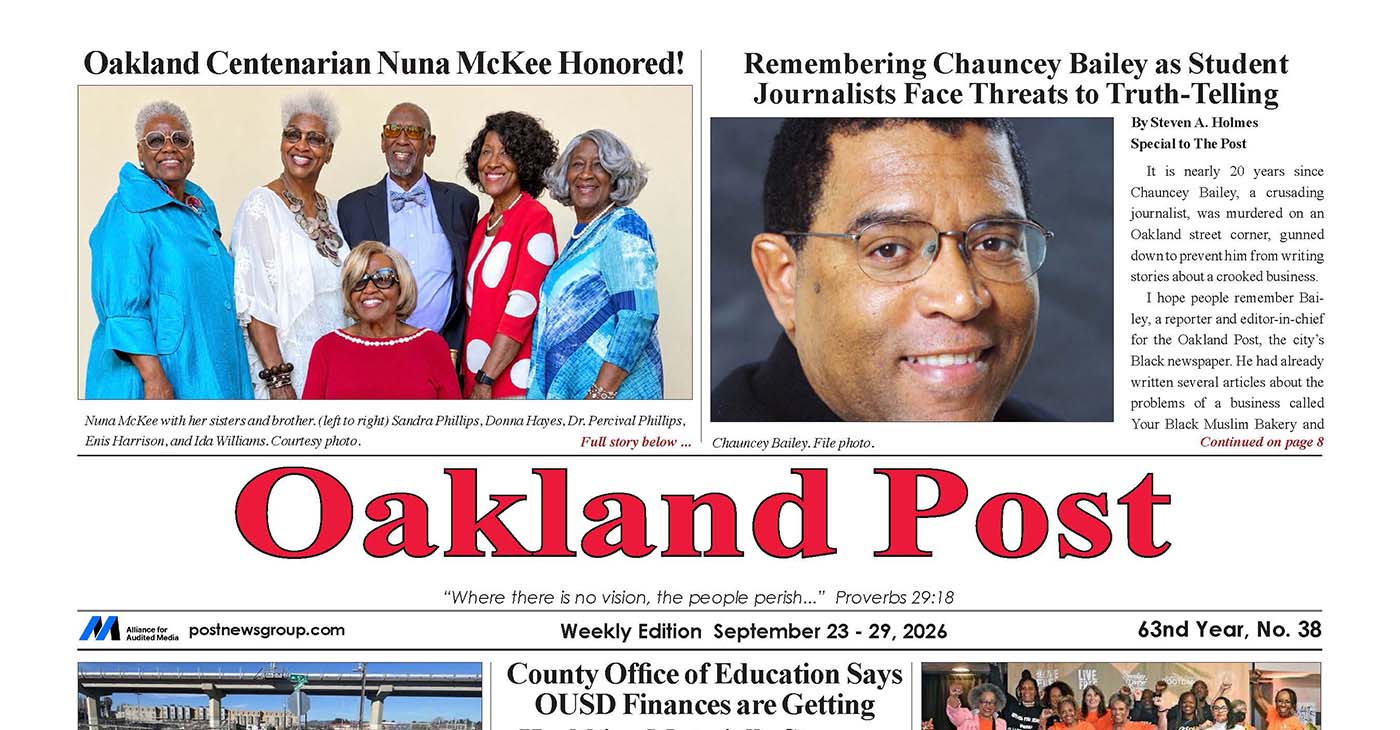
To enlarge your view of this issue, use the slider, magnifying glass icon or full page icon in the lower right corner of the browser window.

Activism
Oakland Post: Week of September 16 – 22, 2026
The printed Weekly Edition of the Oakland Post: Week of September 16 – 22, 2026

To enlarge your view of this issue, use the slider, magnifying glass icon or full page icon in the lower right corner of the browser window.
Activism
Oakland Post: Week of September 9 – 15, 2026
The printed Weekly Edition of the Oakland Post: Week of September 9 – 15, 2026
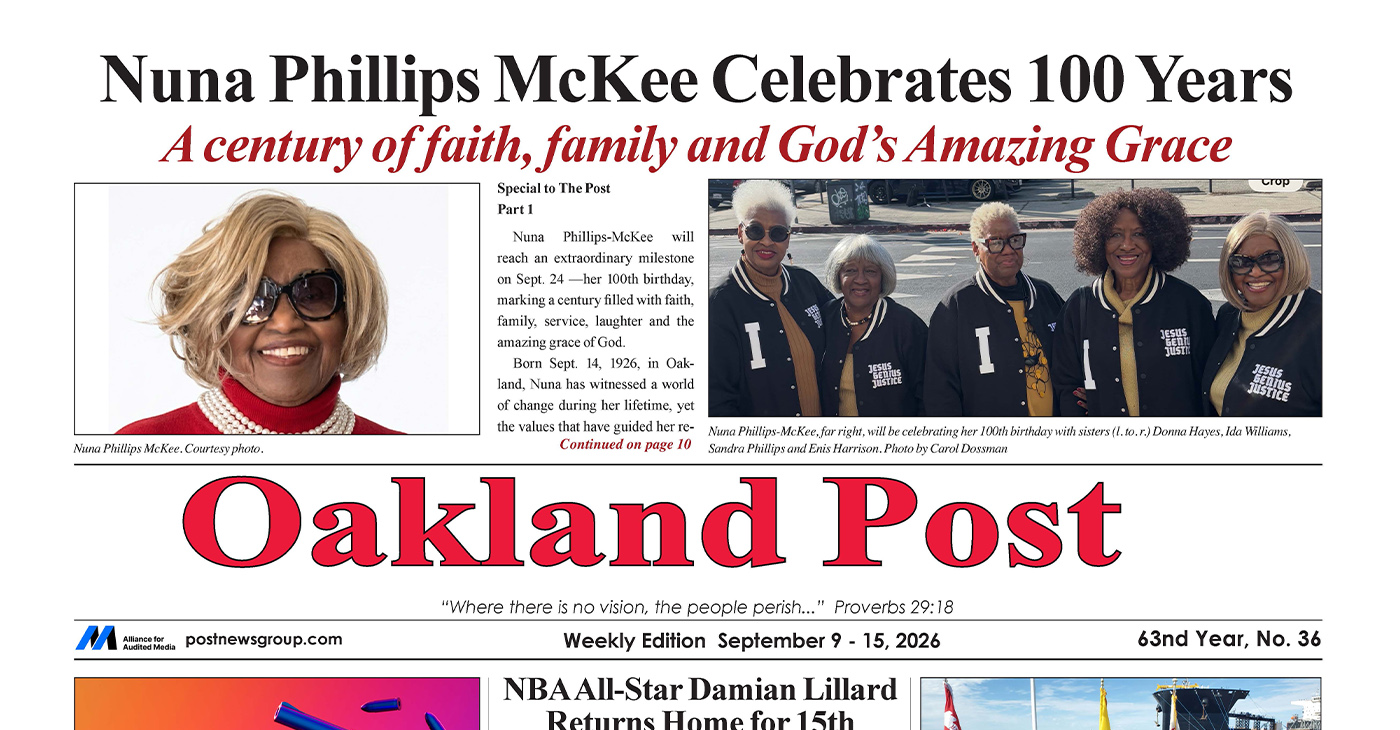
To enlarge your view of this issue, use the slider, magnifying glass icon or full page icon in the lower right corner of the browser window.



Asm. Corey Jackson Announces Launch of 24-Hour Childcare in His District

IN MEMORIAM: The Rev. Leon “Sonny” Clark, Longtime Orange County Pastor and Community Leader, Dies at 72

Poll: Becerra Widens His Lead Over Hilton; Californians Split on Wealth Tax

From Historic Memories to New Possibilities: Oakland Celebrates Coliseum 60

County Office of Education Says OUSD Finances Are Getting Healthier, Materially Stronger

LIVE FREE Sunday Dinner Brings Faith, Fellowship and Civic Conversation to Oakland

Remembering Chauncey Bailey as Student Journalists Face Threats to Truth-Telling

BLACspace Cooperative Invites Bay Area to Experience Oakland’s Black Cultural Ecosystem Through a BLAC Map Tour + Party

In Wake of Death on Doorstep, Williams Chapel Baptist Church Calls for Better Care, Funding for Unhoused

Oakland Centenarian Nuna McKee Honored!

Caribbean Nations Produce Action Plan Calling for UK Reparations Over Slavery

Oakland Post: Week of September 23 – 29, 2026

Doulas Are Helping Black California Moms Navigate Pregnancy–Even as High Mortality Rates Persist

Newsom Signs Addictive Social Media Law to Protect Kids

On Your November Ballot: Prop 38 Would Allocate $8.4 Billion to Immunology and Immunotherapy Funding

Standoff for Justice: Our Homes Are Worth Fighting For

Oakland Post: Week of August 26 – September 1, 2026

Frontier Airlines’ Return to Oakland Airport Brings Flights, Jobs and Opportunity

Gubernatorial Candidate Steve Hilton Blasts California New Tire Rules; Newsom Hits Back

Chef Sharon Lee Blends Culinary Excellence, Education and Empowerment

Jackie Wright Champions Bay Area Stories, Filmmakers and Cultural Institutions

Big City Mayors Ask for “Yes” Vote on Housing Bond Measure; Conservatives Say “No”

Oakland Coliseum Project Opens Door for Small Businesses to Build Bigger

Gov. Newsom’s Latest Appointees Include Sacramento Advocate for Formerly Incarcerated Students; State’s New Tech Chief

Misnamed ‘Parent’ PAC Seeks to Influence Oakland School Board Elections

Longtime BWOPA Member Brendalyn Goodall Appointed to California Workforce Development Board

Gov. Newsom Signs Law Shielding Immigration Aid Workers From Doxing Threats

Secretary of State Shirley N. Weber Urges Californians to Vote Early as Voter ID Battle Intensifies

Oakland Post: Week of September 2 – 8, 2026

IN MEMORIAM: Dolly Parton Dead at 80 — How She Built a Legacy of Love and Earned Her Place in Black Culture

The Conversation With Al McFarlane 6/23/26

Media Monday 6/22/26

LIVE! ASK ALMA! — TUES. 6.23.26 7PM EST

Car Buying Secrets: 4 Hidden Checks Before You Sign!

Is This 550 HP Charger Worth YOUR Money? AutoNetwork Review

Celebrating Juneteenth – Frederick Douglass on education and resistance

LIVE! — ASK ALMA! — TUES. 6.19.26 7PM EST

Hyundai Ioniq 5 Parking, Safety, and 360 View #shorts

2025 Ioniq 5 New Wiper & Powerful Performance! #shorts

Electric SUV Range: Is 259 Miles Enough? #shorts

EV Charging: How Fast Can You Charge an Electric Vehicle? #shorts

Biometric Cooling… Messaging Seats…Come on! 2025 Infiniti QX80 Autograph 4WD

Charged Up: Witness the Magic of a Fully Electric Car! #shorts

Range Rover Sport PHEV Included…: See What’s Inside This Luxury SUV! #shorts

Invisible Hood View: Perfect Parking with X-Ray Vision! #shorts
-
 Community3 weeks ago
Misnamed ‘Parent’ PAC Seeks to Influence Oakland School Board Elections
-
 Activism4 weeks ago
Oakland Post: Week of September 2 – 8, 2026
-

 Community3 weeks ago
Richmond Tiny House Village Farm & Garden Set to Open Gates on Sept. 26
-

 Activism3 weeks ago
Oakland Post: Week of September 9 – 15, 2026
-

 Black History3 weeks ago
Latest Massacre in Haiti Reveals Cruelty U.S. Deportations
-

 Black History3 weeks ago
OPINION: Nolan Wells’ Death One of Several Signifying Racial Terror Lives on in U.S. South
-

 Community3 weeks ago
Democratic Clubs Interview Candidates for Oakland School Board
-

 Business2 weeks ago
Mayor Lee Announces $1 Million Kaiser Permanente Grant for Pilot Program to Address Homelessness, Clean Up Public Spaces throughout Oakland

Pingback: Carroll Fife Helped Moms4Housing Win on Housing, Now She's Looking to Win over District 3 | Post News Group