
Film
AFRO Exclusive: Michael Ealy Previews ‘The Intruder’
THE AFRO — When Scott (Michael Ealy) and Annie (Meagan Good) move from the city of San Francisco to the Napa Valley wine country, they are planning to begin their lives as newlyweds and start a family. Yet when the young Black couple settles in, the original owner of the house, Charlie Peck (Dennis Quaid), keeps popping up in the oddest and sometimes, scariest of ways, making for a new thriller that hits theaters May 3, “The Intruder.”

When Scott (Michael Ealy) and Annie (Meagan Good) move from the city of San Francisco to the Napa Valley wine country, they are planning to begin their lives as newlyweds and start a family. Yet when the young Black couple settles in, the original owner of the house, Charlie Peck (Dennis Quaid), keeps popping up in the oddest and sometimes, scariest of ways, making for a new thriller that hits theaters May 3, “The Intruder.”
In an exclusive interview, Michael Ealy sat down with the AFRO to share how the film manages to engage audiences with a real love story, a relatable plot and scary moments, while leaving viewers with a tough question at the end, “What would I do if this happened to me?”
“Most of the prep work from this role came in terms of working with Meagan [Good] and Deon [Taylor] the director,” Ealy told the AFRO. “We talked about trying to make this couple real. Not just this newlywed bliss fantasy. This couple has a history and we have to come to terms with what that means and whether or not it’s kind of a flaw or window of opportunity for Charlie to kind of manipulate some things and come between us.”
Through the work that Taylor, Good and Ealy put in, the romanticism, frustrations and intimate moments between Scott and Annie are believable on screen.
“We didn’t just want it to be a romanticized version of a relationship where everything is happy; everything is great. And I think we were able to get that done.”
Their relatable romance makes it that much more engaging to watch when Quaid’s character tries to mess up their new life and relationship.
“Dennis Quaid’s character, Charlie Peck, is the sociopath in this one and I’m doing everything in my power to try and protect myself and my wife from his demented way of looking at this house and us. And what he’s trying to do is tear us apart,” Ealy said.
How Quaid tries to ruin this family is what makes the plot incredibly interesting to watch.
A rare sight portrayed onscreen, the young, successful Black couple spends over $3 million on a home that had been owned by Quaid’s character’s family for generations. It is a battle between Old v. New and Black People v. The White Man, but the storyline allows for even more than just a conversation on dueling themes.
“I think where we are in 2019, it’s time to start acknowledging that we’re not a monolith, and that there are characters, there are people, who aren’t in entertainment and can afford a $3 million house. There are people who can afford a $300,000 house, and we run the full spectrum,” Ealy told the AFRO. “I think for years all we ever saw was poor Black people and that’s fine because everything had to be. Why was “Good Times” a hit? Because we had to identify with the struggle. And the reality is at this point, that not every Black child grows up with a struggle.”
“I think with regards to Scott and Annie, they’re doing well, but as you can see in the movie, it almost doesn’t matter when you come across a sociopath like Dennis Quaid’s character, Charlie.”
Ealy emphasized the identifiable common themes and storylines within “The Intruder,” that will make the film significant and enjoyable to many audiences. “I do think the film has a universal quality that can make anyone relate to it, because everyone is trying to buy home. Everyone. Most people try to buy a house at some point in their lives and your first house is where you can start a family. These are all tangible relationship goals, if you will.”
Besides the fact that audiences will see themselves reflected on screen, they will also be entertained.
“It’s a fun movie. It’ll make you laugh, it might make you cry, it might make you a little scared.”
Ealy said that seeing this film will bring feelings of nostalgia and, in the end, will have one questioning their own methods of dealing with crisis.
“This is like an old movie going experience. There’s no special effects. It’s literally a movie that’s grounded in reality. It’s like, it could be you, and I think that’s why the experience is so tangible. That’s why the experience is so fun, because ultimately you’ll see yourselves up on that screen, questioning ‘What would I do in this situation?’”
This article originally appeared in The Afro.












#NNPA BlackPress
IN MEMORIAM: Legendary Funk Pioneer Sly Stone Dies at 82
Sly Stone’s musical approach radically reshaped popular music. He transcended genre boundaries and empowered a new generation of artists. The band’s socially conscious message and infectious rhythms sparked a wave of influence, reaching artists as diverse as Miles Davis, George Clinton, Prince, Dr. Dre, and the Roots.

By Stacy M. Brown
BlackPressUSA.com Newswire
Sylvester “Sly” Stewart—known to the world as Sly Stone, frontman of the groundbreaking band Sly and the Family Stone—has died at the age of 82.
His family confirmed that he passed away peacefully at his Los Angeles home surrounded by loved ones, after battling chronic obstructive pulmonary disease (COPD) and other health complications.
Born March 15, 1943, in Denton, Texas, Stone moved with his family to Vallejo, California, as a child. He began recording gospel music at age 8 with his siblings in a group called the Stewart Four. By his teenage years, he had mastered multiple instruments and was already pioneering racial integration in music—an ethos that would define his career.
In 1966, Sly and his brother Freddie merged their bands to form Sly and the Family Stone, complete with a revolutionary interracial, mixed-gender lineup.
The band quickly became a commercial and cultural force with hits such as “Dance to the Music,” “Everyday People,” and “Thank You (Falettinme Be Mice Elf Agin)”—all penned by Stone himself.
Their album “Stand!” (1969) and live performances—most notably at Woodstock—cemented their reputation, blending soul, funk, rock, gospel, and psychedelia to reflect the optimism and turmoil of their era.
Sly Stone’s musical approach radically reshaped popular music. He transcended genre boundaries and empowered a new generation of artists. The band’s socially conscious message and infectious rhythms sparked a wave of influence, reaching artists as diverse as Miles Davis, George Clinton, Prince, Dr. Dre, and the Roots.
As the 1970s progressed, Stone confronted personal demons. His desire to use music as a response to war, racism, and societal change culminated in the intense album “There’s a Riot Goin’ On” (1971). But drug dependency began to undermine both his health and professional life, leading to erratic behavior and band decline through the early 1980s.
Withdrawn from the public eye for much of the 1990s and early 2000s, Stone staged occasional comebacks. He was inducted into the Rock & Roll Hall of Fame in 1993, received a Lifetime Achievement Award from the Grammys in 2017, and captured public attention following the 2023 release of his memoir “Thank You (Falettinme Be Mice Elf Agin)”—published under Questlove’s imprint. He also completed a biographical screenplay and was featured in Questlove’s documentary “Sly Lives!” earlier this year.
His influence endured across generations. Critics and historians repeatedly credit him with perfecting funk and creating a “progressive soul,” shaping a path for racial integration both onstage and in the broader culture.
“Rest in beats Sly Stone,” legendary Public Enemy frontman Chuck D posted on social media with an illustrative drawing of the artist. “We should thank Questlove of the Roots for keeping his fire blazing in this century.”
Emmy-winning entertainment publicist Danny Deraney also paid homage. “Rest easy Sly Stone,” Deraney posted. “You changed music (and me) forever. The time he won over Ed Sullivan’s audience in 1968. Simply magical. Freelance music publicist and Sirius XM host Eric Alper also offered a tribute.
“The funk pioneer who made the world dance, think, and get higher,” Alper wrote of Sly Stone. “His music changed everything—and it still does.”
Sly Stone is survived by three children.
Arts and Culture
Paul Robeson: A Voice for the Ages, A Champion for Justice
Robeson first gained widespread recognition on stage and screen, delivering commanding performances that captivated audiences. Yet, it was his voice in concert halls that sealed his legacy. His repertoire was vast, spanning spirituals, classical compositions, global folk traditions, and songs of struggle — music that carried the weight of the oppressed and the hopes of the marginalized.
By Tamara Shiloh
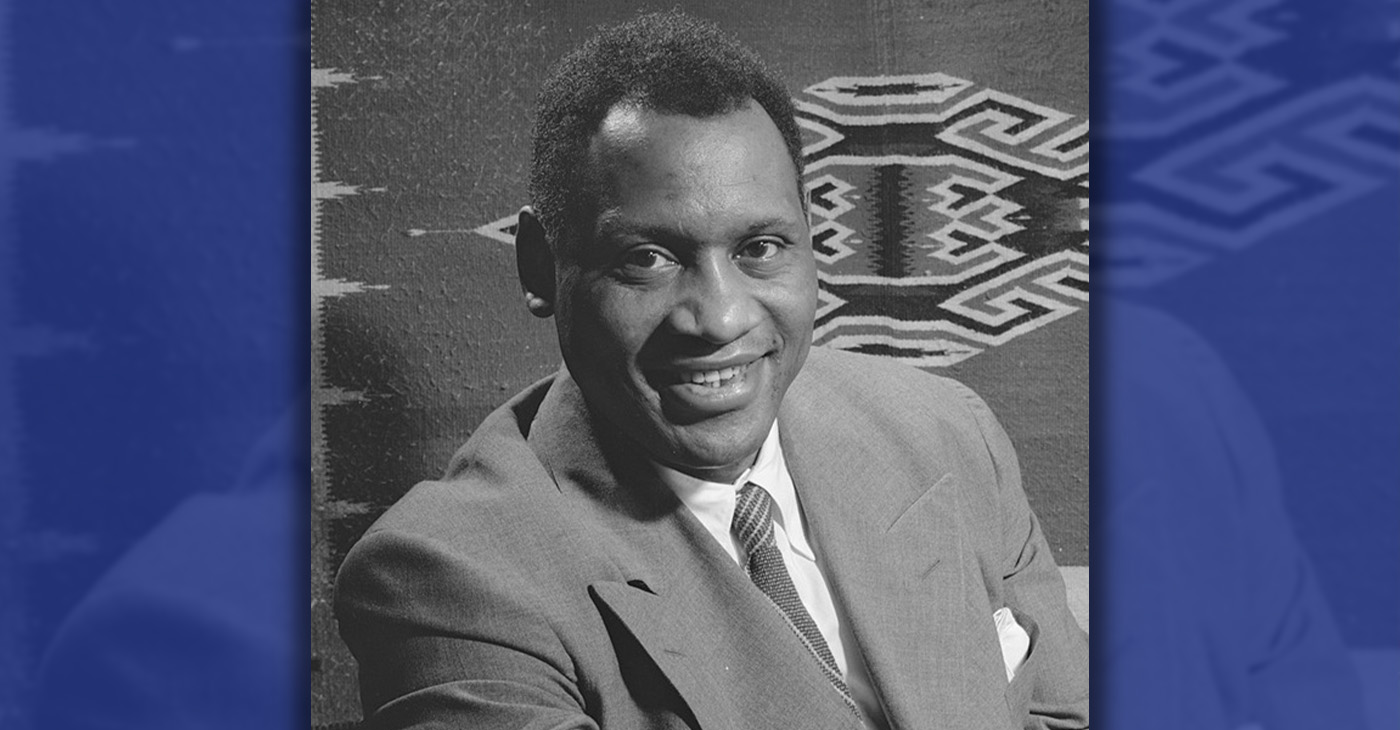
Paul Robeson was born April 9, 1898, in Princeton, New Jersey. At 6’ 3”, he was a towering man of intellect, talent, and conviction. Before he became an international icon, he earned his law degree from Columbia University in 1923, supporting himself by teaching Latin and playing professional football on the weekends. But the law would not hold him for long. His voice had other plans.
Robeson first gained widespread recognition on stage and screen, delivering commanding performances that captivated audiences. Yet, it was his voice in concert halls that sealed his legacy. His repertoire was vast, spanning spirituals, classical compositions, global folk traditions, and songs of struggle — music that carried the weight of the oppressed and the hopes of the marginalized.
In 1921, he married Eslanda Goode, a fellow Columbia student and a journalist with her own remarkable intellect and ambition. Their marriage, which lasted over four decades, was a partnership in every sense. Goode became his manager, encouraging him to leave law behind and fully embrace his calling. In 1927, they welcomed their son, Paul Robeson Jr.
By the mid-1920s, Robeson was making waves in theater. He starred in All God’s Chillun Got Wings (1924) and The Emperor Jones (1925). That same year, he made his film debut in Body and Soul, directed by pioneering Black filmmaker Oscar Micheaux. In 1928, he mesmerized London audiences in Show Boat, where his rendition of Ol’ Man River transformed the song into a powerful anthem of resilience.
Robeson and his family moved to Europe in the late 1920s, and over the next decade, he built an impressive career in both film and music. He starred in Borderline (1930) and later again in the 1933 film adaptation of The Emperor Jones. Over the next few years, he appeared in six British films, including Jericho and Big Fella (both released in 1937). He also starred in the second screen adaptation of Show Boat (1936), alongside Hattie McDaniel and Irene Dunne. However, his final film, Tales of Manhattan (1942), left him deeply disillusioned. He openly criticized its degrading depiction of Black life, signaling his growing commitment to using his platform for activism.
In 1963, after years of political persecution and declining health, Robeson returned to the United States. Following Goode’s death in 1965, he lived quietly with his sister. On January 23, 1976, Robeson passed away from a stroke at the age of 77 in Philadelphia.
Activism
The SixTripleEight: “No Mail, Low Morale”
Women were recruited and trained until May 1942. The Women’s Auxiliary Army Corps was formed, and women of all races were officially allowed to serve. In July of that same year, women were given full benefits in the military, and the word “auxiliary” was removed from their name. The Corps then became known as the Women’s Army Corps (WACs).
By Tamara Shiloh
Many historical accounts of wars do not include women. The word “soldier” often brings to mind a man in uniform. Yet by definition it refers to anyone, including women, serving in the military.
American women were allowed to serve in the army during World War I (1914–1918). Many were nurses and staff who cooked for, and catered to, injured soldiers. Because slavery and racism prevented Black women from giving their services to America, many of these women were White.
Women were recruited and trained until May 1942. The Women’s Auxiliary Army Corps was formed, and women of all races were officially allowed to serve. In July of that same year, women were given full benefits in the military, and the word “auxiliary” was removed from their name. The Corps then became known as the Women’s Army Corps (WACs).
Although the military trained women of all races in all divisions and sections of the army in preparation for war, division among the races remained. Black women were encouraged to become WACs. In other divisions, such as the Navy, Black women were excluded almost entirely. The Army Nurse Corps only allowed 500 Black nurses to serve despite thousands who applied.

But the tables were turned in 1945 when the world’s first all-Black female battalion was sent from the United States to serve in parts of Europe during World War II (1939–1945).
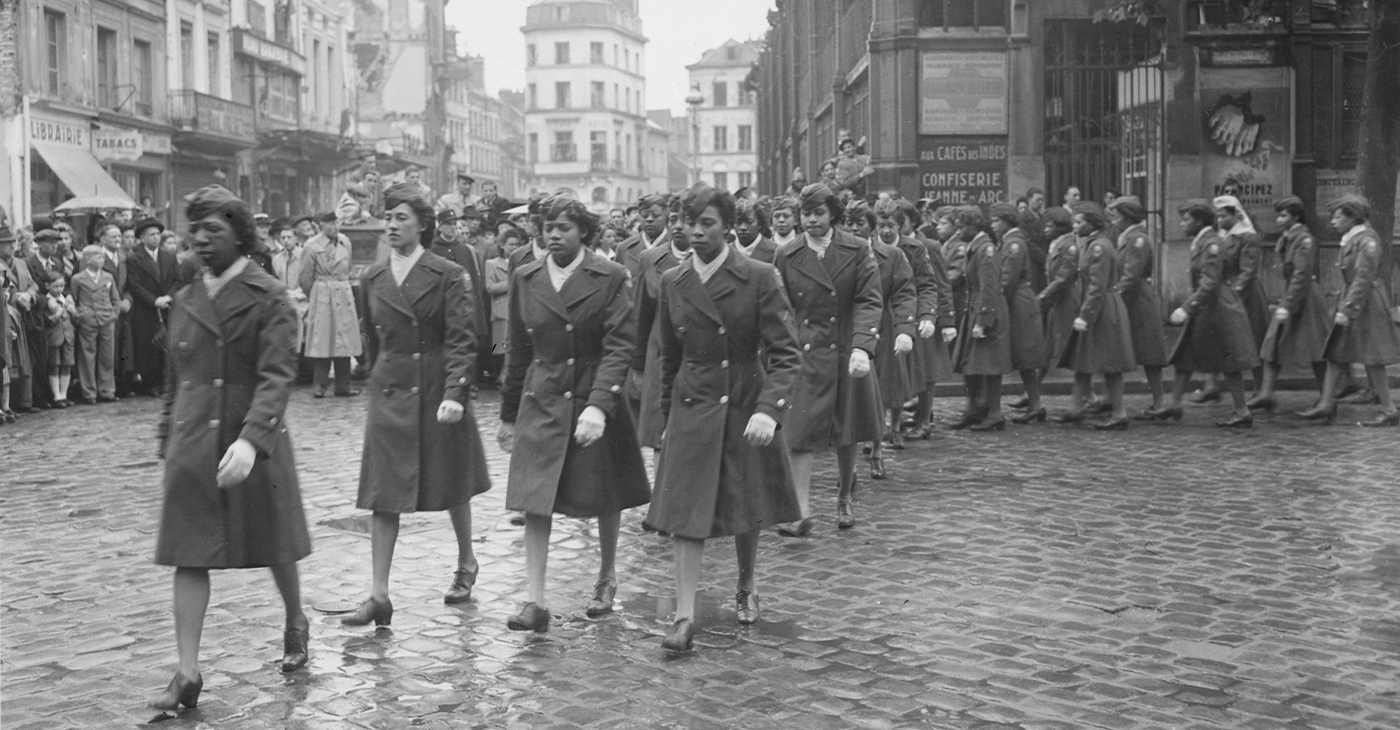
Known as the 6888 Central Postal Directory Battalion, or “the SixTripleEight,” the battalion served in parts of France and England to clear the backlog of mail in the European Theater of Operations. The battalion boasted 855 Black women, both enlisted and officers, and was led by Major Charity Adams Earley. It was the only all-Black, all-female battalion overseas throughout the war.
Many of the women serving were handpicked by civil rights activist and educator Mary McLeod Bethune.
Confronted with racism and sexism from their own leadership and troops, the battalion served with honor and distinction completing their mission in six months. By war’s end, the SixTripleEight had cleared over 17 million pieces of backlogged mail ensuring the troops stayed in touch with their loved ones back home.
Although the SixTripleEight had a motto, “No mail, low morale,” they accomplished more than distributing letters and packages. As the largest contingent of Black women to ever serve overseas, they dispelled stereotypes and represented a change in racial and gender roles in the military.
Between 1945 and 1946, the majority of the women worked under the mail service. Others served as cooks, mechanics, nurse assistants and in other roles when necessary. Working conditions were dangerous and risky, as the women were placed in abandoned and infested aircraft and offices throughout the war.
Women of the SixTripleEight were later honored with the European African Middle Eastern Campaign Medal, the Good Conduct Medal, and the World War II Victory Medal while they were still in service.
The last of the battalion returned home in March 1946.



Asm. Corey Jackson Announces Launch of 24-Hour Childcare in His District

IN MEMORIAM: The Rev. Leon “Sonny” Clark, Longtime Orange County Pastor and Community Leader, Dies at 72

Poll: Becerra Widens His Lead Over Hilton; Californians Split on Wealth Tax

From Historic Memories to New Possibilities: Oakland Celebrates Coliseum 60

County Office of Education Says OUSD Finances Are Getting Healthier, Materially Stronger

LIVE FREE Sunday Dinner Brings Faith, Fellowship and Civic Conversation to Oakland

Remembering Chauncey Bailey as Student Journalists Face Threats to Truth-Telling

BLACspace Cooperative Invites Bay Area to Experience Oakland’s Black Cultural Ecosystem Through a BLAC Map Tour + Party

In Wake of Death on Doorstep, Williams Chapel Baptist Church Calls for Better Care, Funding for Unhoused

Oakland Centenarian Nuna McKee Honored!

Caribbean Nations Produce Action Plan Calling for UK Reparations Over Slavery

Oakland Post: Week of September 23 – 29, 2026

Doulas Are Helping Black California Moms Navigate Pregnancy–Even as High Mortality Rates Persist

Newsom Signs Addictive Social Media Law to Protect Kids

On Your November Ballot: Prop 38 Would Allocate $8.4 Billion to Immunology and Immunotherapy Funding

Standoff for Justice: Our Homes Are Worth Fighting For

Oakland Post: Week of August 26 – September 1, 2026

Frontier Airlines’ Return to Oakland Airport Brings Flights, Jobs and Opportunity

Gubernatorial Candidate Steve Hilton Blasts California New Tire Rules; Newsom Hits Back

Chef Sharon Lee Blends Culinary Excellence, Education and Empowerment

Jackie Wright Champions Bay Area Stories, Filmmakers and Cultural Institutions

Big City Mayors Ask for “Yes” Vote on Housing Bond Measure; Conservatives Say “No”

Oakland Coliseum Project Opens Door for Small Businesses to Build Bigger

Gov. Newsom’s Latest Appointees Include Sacramento Advocate for Formerly Incarcerated Students; State’s New Tech Chief

Misnamed ‘Parent’ PAC Seeks to Influence Oakland School Board Elections

Longtime BWOPA Member Brendalyn Goodall Appointed to California Workforce Development Board

Gov. Newsom Signs Law Shielding Immigration Aid Workers From Doxing Threats

Secretary of State Shirley N. Weber Urges Californians to Vote Early as Voter ID Battle Intensifies

From Palestine to Oakland: Seeds for Liberation Examines Shared Struggles for Freedom

IN MEMORIAM: Dolly Parton Dead at 80 — How She Built a Legacy of Love and Earned Her Place in Black Culture

The Conversation With Al McFarlane 6/23/26

Media Monday 6/22/26

LIVE! ASK ALMA! — TUES. 6.23.26 7PM EST

Car Buying Secrets: 4 Hidden Checks Before You Sign!

Is This 550 HP Charger Worth YOUR Money? AutoNetwork Review

Celebrating Juneteenth – Frederick Douglass on education and resistance

LIVE! — ASK ALMA! — TUES. 6.19.26 7PM EST

Hyundai Ioniq 5 Parking, Safety, and 360 View #shorts

2025 Ioniq 5 New Wiper & Powerful Performance! #shorts

Electric SUV Range: Is 259 Miles Enough? #shorts

EV Charging: How Fast Can You Charge an Electric Vehicle? #shorts

Biometric Cooling… Messaging Seats…Come on! 2025 Infiniti QX80 Autograph 4WD

Charged Up: Witness the Magic of a Fully Electric Car! #shorts

Range Rover Sport PHEV Included…: See What’s Inside This Luxury SUV! #shorts

Invisible Hood View: Perfect Parking with X-Ray Vision! #shorts
-
 Community2 weeks ago
Misnamed ‘Parent’ PAC Seeks to Influence Oakland School Board Elections
-

 Activism3 weeks ago
Oakland Post: Week of September 2 – 8, 2026
-

 Community2 weeks ago
Richmond Tiny House Village Farm & Garden Set to Open Gates on Sept. 26
-

 Black History2 weeks ago
OPINION: Nolan Wells’ Death One of Several Signifying Racial Terror Lives on in U.S. South
-

 Black History2 weeks ago
Latest Massacre in Haiti Reveals Cruelty U.S. Deportations
-

 Activism2 weeks ago
Oakland Post: Week of September 9 – 15, 2026
-

 Community2 weeks ago
Democratic Clubs Interview Candidates for Oakland School Board
-

 Featured2 weeks ago
‘Ready to See These Bills Become Law’: Sen. Weber’s Package of 15 Bills Advance to Gov. Newsom’s Desk
