
Bay Area
No Justice in the Justice System

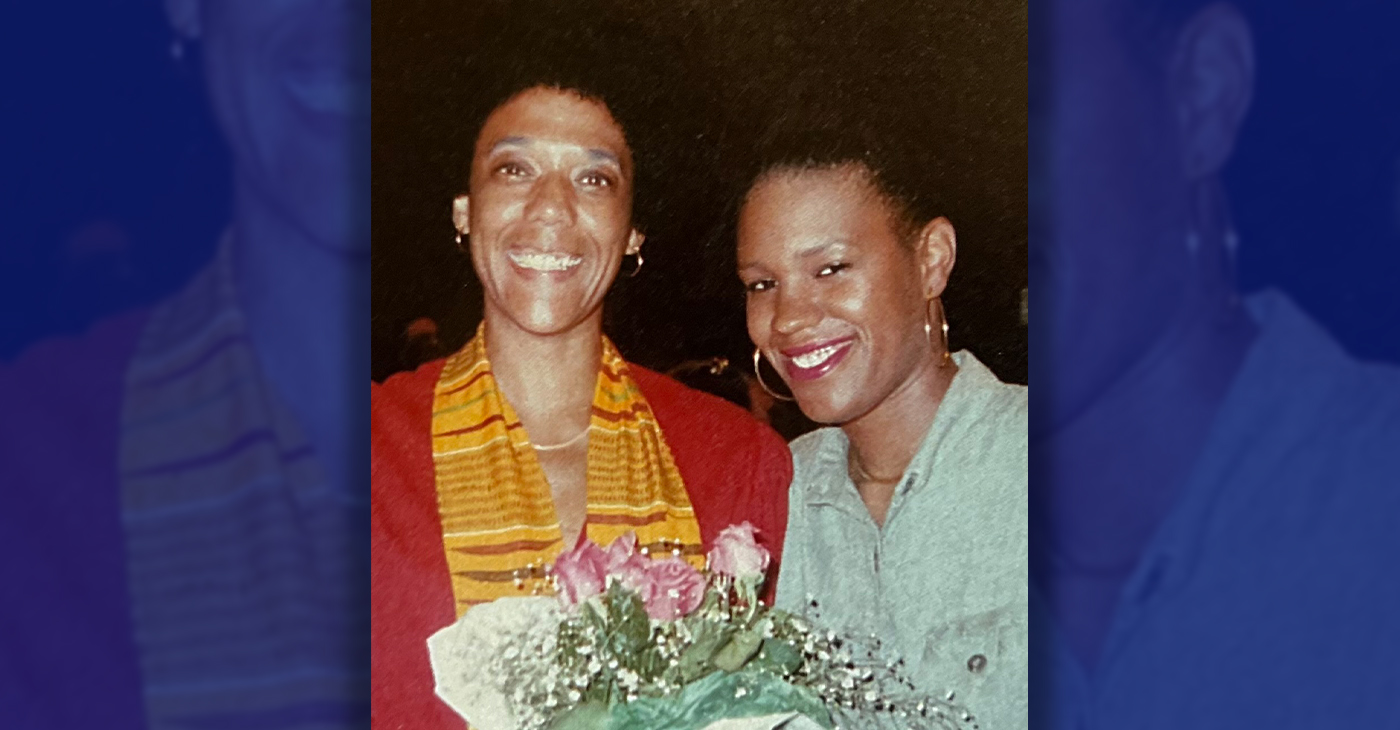
Documented court transcripts reveal that justice was denied by Judge Sandra K. Bean’s ruling that invalidated a Black professor’s trust and property rights. The civil case was misdirected to the probate court instead.
By Tanya Dennis
On March 28, 2023, Alameda County Superior Court Judge Sandra K. Bean issued a ruling that overrode state law, federal constitutional rights, and the final wishes of the late Dr. Laura Dean Head, a well-respected Black Studies professor at San Francisco State University.
Dr. Head’s lawfully executed living trust left her home and entire estate to Zakiya Jendayi, her former student, mentee, sorority sister, and friend of 28 years. Despite this, Bean invalidated the trust based on false testimony, excluded evidence, and legal arguments that contradicted her own statements on the record. What happened in Bean’s courtroom is not just a miscarriage of justice, it is a civil rights crisis happening in probate courts throughout the nation.
Dr. Head transitioned on June 19, 2013. After she passed away, Head’s two estranged sisters, Della Hamlin and Helaine Head hired three different attorneys to sue Jendayi for Dr. Head’s estate. All three attorneys informed them that they did not have standing, since Dr. Head had a trust and they were not named in the trust.
Seven years after Dr. Head transitioned, her sisters found probate attorney, Daniel Leahy, who took their case. He filed a lawsuit against Jendayi to invalidate Dr. Head’s trust, claiming undue influence and/or forgery. Later, they claimed Dr. Head lacked capacity.
After an 18-day trial, Judge Bean ruled the following: The evidence regarding capacity was inconclusive. Therefore, the court found that Dr. Head had capacity; The court had no credible evidence of forgery and thereby found that Dr. Head did execute the trust; The court found that Dr. Head was vulnerable and unduly influenced by Jendayi. That finding invalidated the Laura Dean Head Trust.
The evidence presented in the trial regarding Dr. Head’s capacity was not inconclusive, it was extremely conclusive that Dr. Head was of sound mind. During Dr. Head’s 10-day Kaiser hospital stay, she was seen by 12 physicians, 23 nurses and three social workers. Not one medical team member diagnosed Dr. Head lacked mental capacity. In Dr. Head’s medical records, totaling 972 pages, not once is there any mention that Dr. Head lacked capacity. Two Kaiser doctors, two social workers and a nurse all testified that Dr. Head had capacity.
Bean’s ruling that there was “no credible evidence of forgery” is fraudulent, in that it infers that forgery was, however, was suspected. Dr. Head’s estate planning attorney Elaine Lee testified that she wrote Dr. Head’s trust and witnessed her signing her trust in the presence of two witnesses, a Kaiser nurse, her notary and Jendayi. Kaiser social worker Jennifer Hoppings testified that she filled out Dr. Head’s power of attorney and healthcare directive forms and witnessed Dr. Head signing both documents in the presence of her notary. Dr. Head’s notary, Trina E. Jackson testified that she witnessed Dr. Head signing her trust and will in the presence of Dr. Head’s probate attorney and Dr. Head signing her power of attorney and healthcare directive forms in the presence of a Kaiser social worker.
All three of the women took an oath to the state of California to uphold the truth. None of the three women ever had a complaint filed against them throughout their careers. There was neither evidence nor witnesses presented throughout the entire 18-day trial that Jendayi committed forgery.
Despite the testimony of several credible witnesses that Head was of sound mind and judgement, Bean ruled that Dr. Head was vulnerable and Jendayi unduly influenced her, therefore Bean invalidated Dr. Head’s trust. That ruling was fraudulent because throughout the trial none of the 15 witnesses testified to nor was there evidence presented supporting Bean’s claim that Jendayi unduly influenced Dr. Head. There were, however, numerous testimonies and evidence presented throughout the trial proving Jendayi did not unduly influence Dr. Head.
Dr. Head’s legally executed trust was invalidated by Judge Bean, based on a charge of dishonesty and subterfuge from Attorney Daniel J. Leahy, a certified specialist in Estate Planning.
In a careful examination of the trial transcript of Bean’s Statement of Decision, Jendayi discovered that of the 42 findings and rulings made against her, 30 were false, six were misleading, and six were errors.
Jendayi said she did not receive due process several times, throughout the trial, based on the Constitution of the United States, Fifth and 14th amendments, with a shocking number of fraudulent actions by Bean – all documented in trial transcripts – including, for example, that Head’s sisters had no legal rights to a probate trial.
During the first remote, pre-trial hearing, Bean concurred that the petitioners, Dr. Head’s estranged and disinherited sisters, Della Hamlin and Helaine Head were neither trustees nor beneficiaries, therefore, they had no standing to have their case heard in probate court.
According to the Reporter’s transcript, Aug. 5, 2020, page four, lines 23-27, page five, lines 1-8
THE COURT: “And so, Mr. Leahy, having received all of this information and documents, why shouldn’t the court dismiss this petition for lack of standing?”
MR. LEAHY: “For lack of standing?”
THE COURT: “Standing.”
MR. LEAHY: “OK, it seems like the court enumerated a number of issues that they might have concerns with the merit of my client’s claim.”
THE COURT: “No. It is a standing issue. So, Mr. Leahy, your clients are not named in the documents, right?”
MR LEAHY: “They are not.”
THE COURT: “They are not beneficiaries, so that creates a Barefoot issue.”
Despite this, Bean allowed the petitioners to proceed under Probate Code §17200, which strictly applies only to trustees and beneficiaries. This opened the door for their baseless challenge to move forward, illegally.
On May 10, 2021, during the second pre-trial remote hearing, Bean reaffirmed that the case did not belong in probate court, but authorized this trial to proceed in probate court, which was the wrong jurisdiction, even though she knew that it should have been in civil court in the presence of a jury.
Reporter’s transcript: May 10, 2021, page three, lines 15-21, page four lines 1-6
THE COURT: “Mr. Leahy, the court still has issues with standing. And here’s the issue that the court has. There is no question that you can file this case in CIVIL. But the question for this court is how we can have a petition filed under 17200 when your clients are neither trustee nor beneficiaries under any document. It’s not the court’s position that you don’t have a case. You’ve been very clear that you have some evidence, but it appears that this would be a CIVIL case, not a probate case. Do you want to speak to that?”
MR LEAHY: “Sure. So, two things. The first thing is, I believe, at the first hearing, your honor was not aware that Barefoot vs. Jennings had been overturned.”
THE COURT: “Well, I am aware of it. I just don’t believe it does what you say. We have; we have a disagreement. I believe in footnote two of the Barefoot case [that]the issue is that you can file in CIVIL, but not in, in probate.”
Yet judge Bean kept the case in probate, denying Jendayi a jury trial and protections guaranteed in civil proceedings. This was not a misstep; it was an intentional removal of jurisdictional safeguards.
Jendayi was muted by the court during both pre-trial remote hearings. Jendayi’s rights under the Fifth and 14th constitutional amendments were violated repeatedly and blatantly. Due process focuses on a fair trial and includes the right to be heard, which was denied. Jendayi was only allowed to speak after Bean made the decision to have a trial.
Below is evidence from the pre-trial remote hearing itself:
Reporter’s transcript, Aug. 5, 2020, page two, lines 7-14
THE COURT: “Alright. And who else do I have appearing this morning? It looks like I have Ms. Jendayi.”
MS. JENDAYI: “Zakiya Jendayi.”
THE COURT: “Ms. Jendayi, I’m going to put you on mute because this is Mr. Leahy’s petition and I have some questions for him. And when it’s your turn to talk, you can unmute yourself.”
Note: The court placed Ms. Jendayi on mute so she never had the ability to unmute herself.
Reporter’s transcript, May 10, 2021, page two, lines 11-15
THE COURT: “Alright. And the respondent?”
MS. JENDAYI: “Zakiya Jendayi.”
THE COURT: “I am getting a lot of feedback from Miss Jendayi’s microphone. I am going to keep your mic on mute until it is your time to speak.”
Reporter’s transcript, May 10, 2021, page six, lines 20-28
THE COURT: “And let me hear from Ms. Jendayi as far as whether she agrees with the trial time estimates.”
MS. JENDAYI: “Greetings, your honor. Zakiya Jendayi here. I completely object to the fact that again there’s no standing. They were never in the original trust or will. Matter of fact, the only time that the heirs were brought up in the trust or will is when they were disinherited from the will and the trust. There is absolutely no standing. 17200.”
As you can see from the above excerpts from the transcripts of these hearings, Ms. Jendayi is only allowed to state her name in the first remote hearing. After Ms. Jendayi is allowed to state her name, the judge puts her on mute and never unmutes her or invites her to speak. In the second remote hearing, Ms. Jendayi is only allowed to come off mute after the judge has decided to have the trial in probate court. Jendayi did not receive her due process.
Fraud on the court refers to actions that undermine the integrity of the judicial process, typically involving deceitful conduct that affects the court’s ability to make fair decisions. Tampering with evidence is illegal under both state and federal law. In this case, there were multiple cases of fraud which should invalidate this court ruling.
In numerous instances in the pre-trial remote hearings, the trial itself, and especially in the post-trial statement of decision, the judge excluded key evidence presented by Jendayi that had disproved the claim that Jendayi unduly influenced Dr. Head. Then Bean invalidated the Trust, ruling that Jendayi unduly influenced Dr. Head.
Following are examples of evidence from the first pre-trial remote hearing, the trial, and statement of decision transcripts.
During the first pretrial remote hearing on Aug. 5, 2020, the judge read a declaration written and signed by Dr. Head’s estate planning attorney, Elaine Lee, on July 22, 2020. The declaration stated that Dr. Head was not a victim of fraud or undue influence. The judge excluded the last three words on the declaration and therefore these words were not included into the official transcript.
According to the Reporter’s transcript, Aug. 5, 2020, page four, lines 19-22
THE COURT: “And then the last sentence before the declaration under penalty of perjury, ‘I met with Dr. Dean Head alone, as well as with Ms. Jendayi, and I did not find her to be a victim of fraud.’”
The declaration actually states: “I met with Dr. Head alone, as well as with Ms. Jendayi and I did not find her to be a victim of fraud or undue influence.”
Reporter’s transcript, Aug. 5, 2020, page three, lines 18-19
THE COURT: “And there’s another sentence that I don’t think is relevant.”
Judge Bean is referring to a statement made by Dr. Head’s hospice nurse, Kristen Brady, made on July 18, 2013. The sentence is very relevant, considering Judge Bean ruled that Jendayi unduly influenced Dr. Head. The last sentence reads “Ms. Jendayi kept excellent records of the care she gave to Ms. Head and was a guardian who carried out her wishes.”
Reporter’s transcript, Aug. 5, 2020, page two, last paragraph:
Judge Bean excludes the entire second paragraph of a statement made by Dr. Derethia DuVal, Dr. Head’s friend and colleague of more than 20 years on July 20, 2020. The paragraph that is excluded is as follows: “As I am a psychologist and therapist through training and experience, I have professional knowledge when a person is of sound mind, if not body. Dr. Head was a rational, cognitive, functioning individual until she transitioned. I was with her the day she expired. I am a witness to the wishes of Dr. Laura Head that Zakiya Jendayi cares for her last days at her home because she discussed with me, she did not want to die in the hospital. When she was diagnosed as being terminal, she discussed with me, she wanted Zakiya Jendayi to inherit her property and belongings. They had a long-standing professional and personal relationship. I declare under penalty of perjury State of California that the foregoing is true and correct.”
Judge Bean ruled that the petitioners did not have standing under probate code 17200 and they were not bringing their case under 17200. However, trial transcript proves, that Attorney Leahy did bring his petitioners, petition under 17200, Barefoot v. Jennings, and Judge Bean was aware of that and allowed the illegal hearing in probate court.
Reporter’s Transcript May 10, 2021, page seven, lines 1-2:
THE COURT: That’s what we’re talking about, Miss Jendayi. He’s not bringing the petition under 17200.
Reporter’s Transcript, Oct. 12, 2022
Della Hamlin Page 34, lines 14–17:
THE COURT: Alright. So, Exhibit 1, that’s gonna be in – Exhibit 1 is the petition to invalidate trust and/or finding of undue influence and/or forgery, filed May 18 of 2020. It is in evidence. Go ahead.
This transcript clearly reveals that Judge Bean was aware that Leahy brought his case under Barefoot v. Jennings, 17200 which should have been heard in civil court, not probate court.
It was fraudulent for the Judge to hear the case in probate court.
The court fraudulently excluded key evidence from the statement of decision:
Statement of decision by Judge Sandra Bean: March 28, 2023
The court excluded exhibits 90 and 91, and the trial transcript of Oct. 3, 2022, from the Statement of Decision. Jendayi testified for the entire trial session on Oct. 3, 2022, providing clear, persuasive, and corroborated testimony and evidence, which contradicted all three of the petitioners’ allegations against her. Additionally, exhibits 90 and 91 were key evidence supporting Jendayi and were admitted into evidence, but excluded from Bean’s Statement of Decision.
Exhibit 90 is a letter attributed to Kaiser physician, Dr. Sarafian concerning Dr. Head’s mental capacity. The letter had the wrong day, wrong month, wrong year and refers to Dr. Head as a male. Sarafian’s denial that he wrote that letter should have been included as evidence of wrongdoing. Exhibit 91 was an email dated in 1990 from Dr. Head to both petitioners proving she was estranged from both of her sisters.
Despite the obvious fraud in Dr. Sarafian’s letter on Oct. 3, 2022, the court stated that “The Court will receive Exhibit 90 in its entirety,” but it was excluded from the statement of decision.
The trial transcript below shows that there was court on Oct. 3, 2022, when Exhibit 90 was presented and admitted into evidence.
Court Reporter’s Trial Transcript on Oct. 3, 2022. Zakiya Jendayi Page eight, lines 23-28:
Ms. Jendayi: Greetings. My name is Zakiya Jendayi. I’m the respondent in the Laura Dean Head Living Trust Matter, and I will present today, evidence that all three of the allegations against me are false. Through my documentation I will present today, and my upcoming witnesses, I will present to the court.
Page nine, lines 1-7:
Ms. Jendayi: Again, that all of the accusations against me for undue influence, lack of mental capacity, for Dr. Head, and forgery are all false. Thank you.
THE COURT: All right. Thank you. Any response, counsel?
Mr. Leahy: No, your honor.
The court fraudulently ruled that Jendayi gave attorney Lee the names of the beneficiaries. Jendayi’s deposition page 89, lines 5-15 do not mention any beneficiaries. Jendayi did not name herself beneficiary, as the trial transcripts prove. This is another fraudulent ruling from Judge Bean.
Statement of Decision: March 28, 2023, Page three, paragraph seven, eigth sentence:
The court ruled that “the Respondent gave Attorney Lee the information as to the beneficiaries of the Trust based on her conversation with Laura Dean Head”
(Exhibit 27, Deposition of Zakiya Jendayi, page 89 lines 5–15).
This ruling was false according to court proceedings on Aug. 1, 2022. Attorney Elaine Lee Page 208, lines 11-25 and page 209, line 1
Leahy: You’ll see at the top we see writing that says “primary beneficiaries?”
Lee: Yes.
Leahy: And do you see how it says: “I give my entire estate consisting of both real and personal property and any and all interest therein to the following who survive me by 10 days: to my friend Zakiya Jendayi. If she does not survive me by 10 days, then my estate should be given to Hattie Simsisulu.” do you see that?
Lee: I do.
Leahy: OK. Does that refresh your recollection then that indeed Ms. Jendayi is the exclusive beneficiary of the Laura Dean Head Trust?
Lee: Yes.
Page 263, lines 12–15:
Jendayi: Did I, Zakiya Jendayi, take any part in creating Dr. Head’s estate plan?
Lee: Other than giving me the list of assets, no.
Page 266, line 24–25: Page 267, lines 1-10:
Jendayi: When you met with Dr. Head and you all created her estate planning documents, did she inform you herself that she was making me the sole beneficiary?
Lee: We certainly discussed it.
Jendayi: Was it Dr. Head who informed you that she was leaving me her Estate?
Lee: Yes.
Jendayi: So, she clearly communicated with you herself?
Lee: Yes, she did.
Jendayi: Appeared to be lucid and of clear mind?
Lee: Yes. And she was adamant about not leaving anything to her sisters.
Trial Proceeding Aug. 3, 2022
Zakiya Jendayi, Page 397, lines 14–17: Page 398, Line 8–13:
Leahy: But you were the one who gave all the information to Elaine Lee which enabled her to draft the Laura Dean Head Living Trust. Correct?
Jendayi: No, that is not correct.
Leahy: In other words, you were already the hundred-percent beneficiary of the Laura Dean Head Living Trust when she dropped the document off. Correct?
Jendayi: No, that is not correct.
Page 401, line 17–24:
Leahy: Ms. Jendayi, does that refresh your recollection that it was actually you who informed Ms. Lee to put yourself in as the hundred-percent beneficiary of the Laura Dean Head trust?
Jendayi: That’s incorrect. And if you recall, you were very aggressive and verbally abusive, and I felt uncomfortable. That’s a very persuasive question, and it’s incorrect.
Page 493, Line 15–20:
Leahy: It was Ms. Jendayi who told Elaine Lee to make Ms. Jendayi a hundred-percent beneficiary.
Jendayi: Objection, your honor. That’s false information. I never –
THE COURT: It’s just argument. You can give me your argument. OK.
Court Reporter’s Trial Transcript, Oct. 5, 2022. Social Worker Jenna Noe, Page 17, lines 3–6
Jendayi: And it states, “She wants to leave her things to her friend, Zakiya.” Is that something she shared with you?
Noe: Yes.
Court Reporter’s Trial Transcript, July 20, 2020.
Excerpt from testimony by Dr. Derethia DuVal, Dr. Head’s friend and colleague of over 20 years, which Bean read in the first remote pre-trial hearing.
“When she was diagnosed terminal, she discussed with me, she wanted Zakiya Jendayi to inherit her property and belongings.”
Bean’s denial of this statement on the record, which proves that Jendayi did not name herself beneficiary, amounts to judicial tampering.
Obstruction of Justice. Perjury. Due Process Violation.
This is fraud. Excluding admitted evidence and rewriting the record violates state and federal laws and is grounds for disbarment and criminal prosecution. This was not a simple probate dispute. This was theft of Jendayi’s home, car, the Laura Dean Head Living Trust bank account, all estate assets, Jendayi’s rights, and Dr. Head’s final wishes. Bean weaponized her robe to serve a false narrative.
Fifteen witnesses testified, and not one presented evidence that Jendayi unduly influenced Dr. Head, including both petitioners. Kaiser social workers, nurses, her estate planning attorney, her longtime friends, all confirmed Dr. Head’s mental clarity and her desire for Jendayi to inherit Dr. Head’s estate.
Enough is enough, we must stop the “justice system” from stealing generational wealth from the Black community. Jendayi is working with the Probate Reform Movement and the Center for Estate Administration Reform (CEAR). Together, they are calling on the legal community, elected officials, journalists, and the public to rise up and help expose this injustice within the justice system. Demand accountability. Help restore what was rightfully, and lawfully inherited.
Jendayi has completed a thorough and precise complaint on Bean’s fraudulent ruling. Pages 1-4 1/2 proves the petitioners did not have standing, the trial was heard in the wrong jurisdiction and Jendayi did not receive due process. Pages 4 1/2-27 are all examples of Bean’s fraudulent ruling directly from the trial transcripts and Kaiser medical records.
Zakiya Jendayi has not stayed silent. She has filed complaints against Bean with the California Commission on Judicial Performance, the Oakland Police Department, the Department of Justice, the Federal Bureau of Investigation (FBI), the Mayor of Oakland, Barbara Lee, the Alameda County Board of Supervisors, Oakland City Council members, Congresswoman Lateefah Simon, California State senators, and California Gov. Gavin Newsom.
This case is illegal, unlawful, unconstitutional, and a moral emergency. This case is a crime scene. This was not a legal error. This was fraud, corruption, discrimination, bias, abuse of discretion and theft disguised as justice, according to Jendayi. “I am standing up not only for myself, but for the Probate Reform Movement members and all who have also had their generational wealth stolen from them by the injustices of the probate court system as well. I will continue to fight this injustice until justice is upheld and I am victorious!”


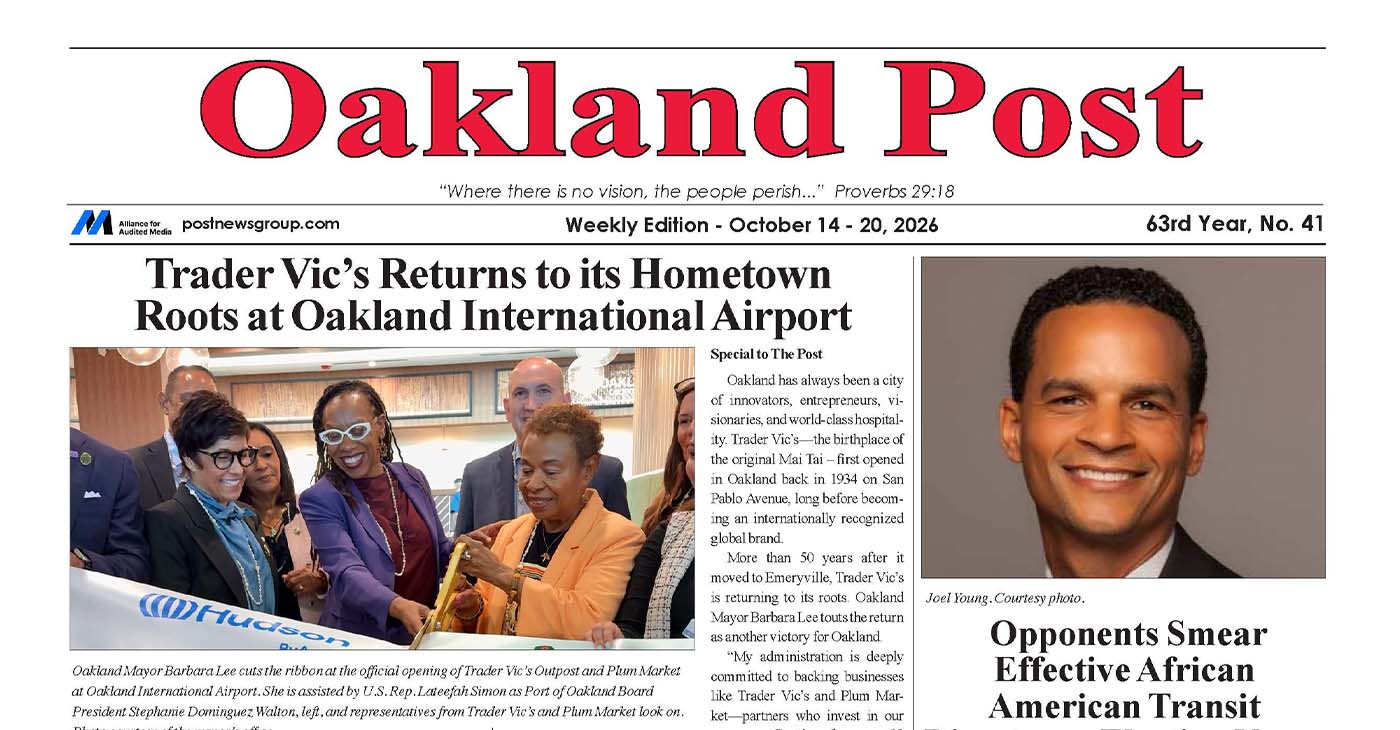
To enlarge your view of this issue, use the slider, magnifying glass icon or full page icon in the lower right corner of the browser window.
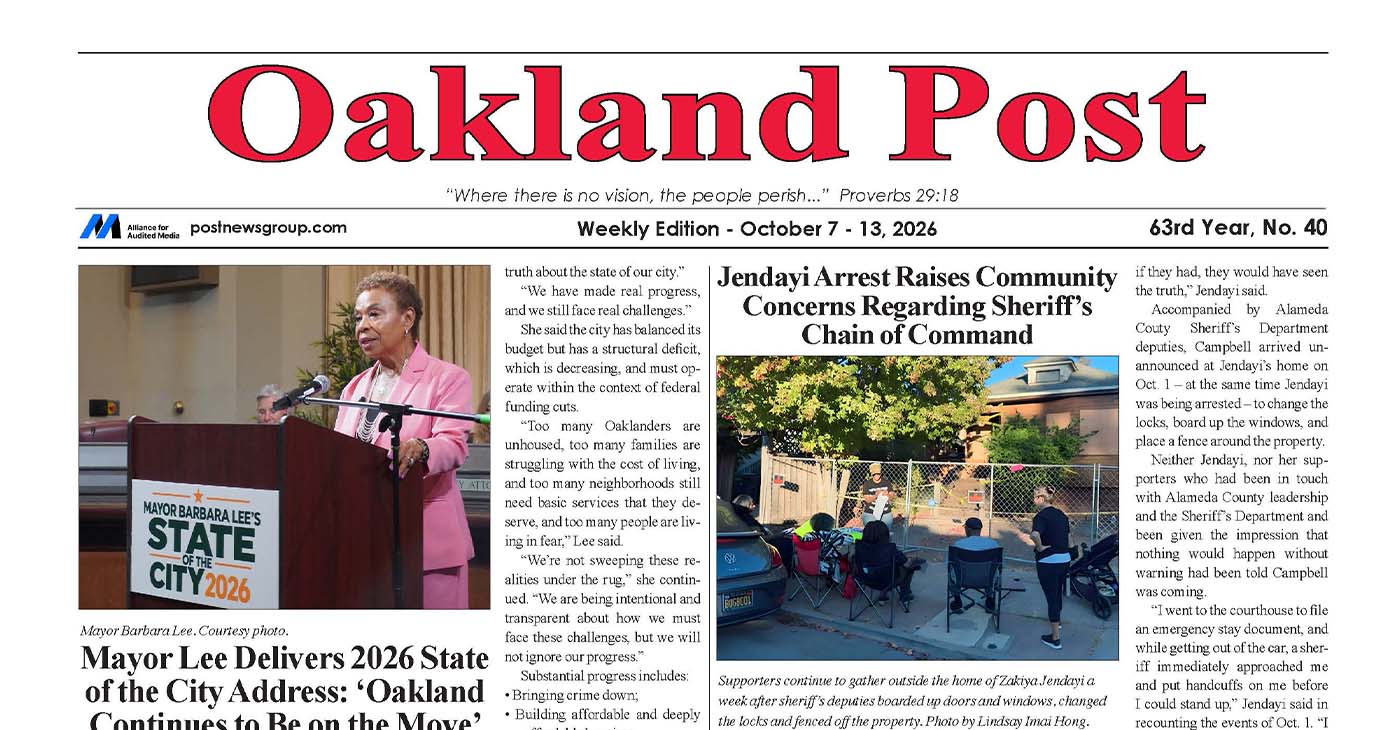
To enlarge your view of this issue, use the slider, magnifying glass icon or full page icon in the lower right corner of the browser window.
Activism
Oakland Post: Week of September 30 – October 6, 2026
The printed Weekly Edition of the Oakland Post: Week of September 30 – October 6, 2026
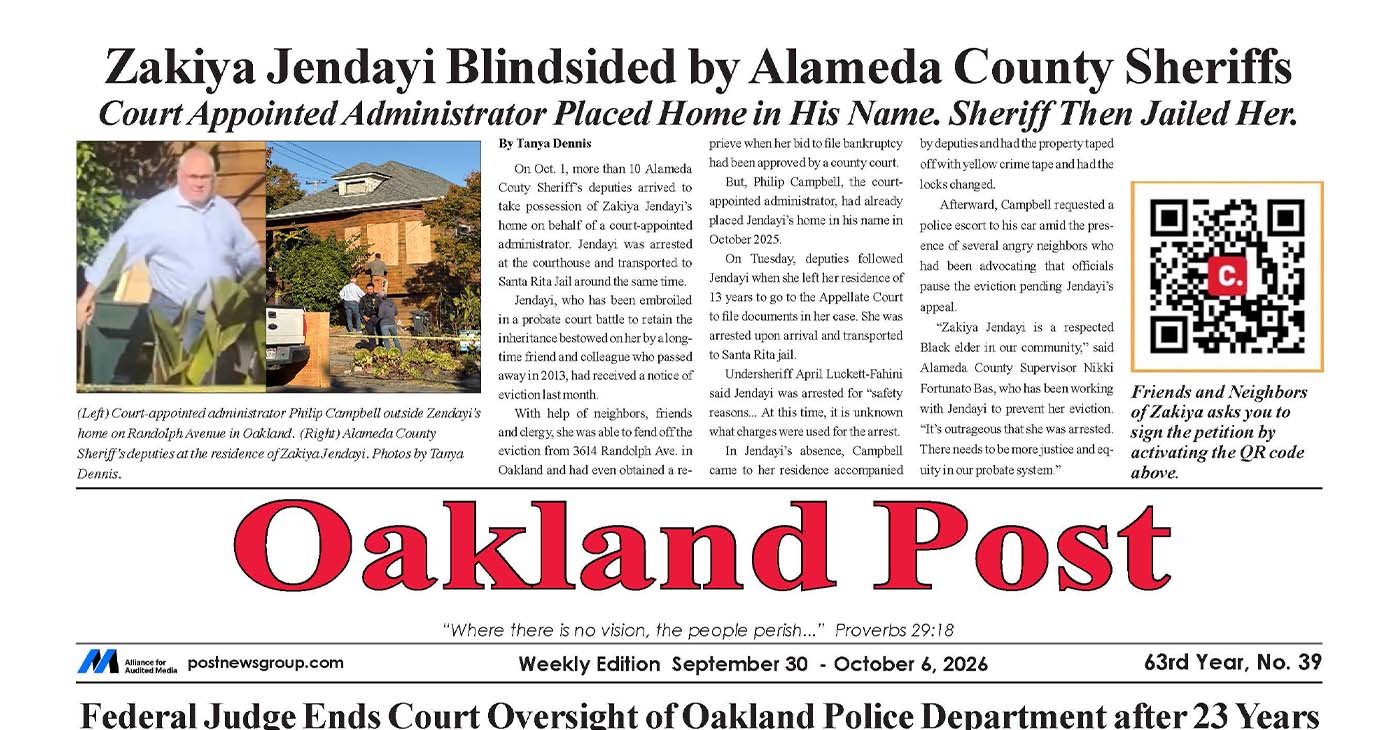
To enlarge your view of this issue, use the slider, magnifying glass icon or full page icon in the lower right corner of the browser window.



Mayor Barbara Lee Holds Special State of the City Address in Deep East Oakland

Practitioners of African Traditional Spirituality Offer Ancestral Reverence Ritual Oct. 31

It’s Time to Lose Weight Before the Holidays

Trader Vic’s Returns to Its Oakland Roots

Oakland Coal Terminal Backed by Trump Would Be Bigger, Dirtier Than Promised, Says Report

Opponents Smear Effective African American Transit Director as Election Nears

Oakland Post: Week of October 14 – 20, 2026

OP-ED: The Black Church Writes AI’s Next Chapter

OP-ED: The Black Church Writes AI’s Next Chapter

WCCUSD Joins Statewide Organic School Food Purchasing Cooperative

Democrats, Community Groups Back Measure EE to Change How Oakland Is Governed

Four Tips to Help You Plan a Holiday “Staycation”

Veterans Housing Project Proposed for South Richmond
PRESS ROOM: Transformative Justice Coalition 2026 Voting Rights Champion Awards Reception ‘Yesterday Is Today: The Battle For Voting Rights

Mayor Lee Delivers 2026 State of the City Address: ‘Oakland Continues to Be on the Move’

Misnamed ‘Parent’ PAC Seeks to Influence Oakland School Board Elections

Oakland Post: Week of September 2 – 8, 2026

Oakland Post: Week of September 9 – 15, 2026

Poll: Becerra Widens His Lead Over Hilton; Californians Split on Wealth Tax

County Office of Education Says OUSD Finances Are Getting Healthier, Materially Stronger

Richmond Tiny House Village Farm & Garden Set to Open Gates on Sept. 26

Latest Massacre in Haiti Reveals Cruelty U.S. Deportations

Mayor Lee Announces $1 Million Kaiser Permanente Grant for Pilot Program to Address Homelessness, Clean Up Public Spaces throughout Oakland

OPINION: Nolan Wells’ Death One of Several Signifying Racial Terror Lives on in U.S. South

Listening as a Lifeline: A Doula’s Witness to Black Maternal Health

Zakiya Jendayi Arrested, Locked Out of Home by Sheriff’s Deputies

BLACspace Cooperative Invites Bay Area to Experience Oakland’s Black Cultural Ecosystem Through a BLAC Map Tour + Party

Oakland Post: Week of September 16 – 22, 2026

Democratic Clubs Interview Candidates for Oakland School Board

Oakland People’s Arms Embargo Coalition Demands End to Military Shipments Thru Oakland

The Conversation With Al McFarlane 6/23/26

Media Monday 6/22/26

LIVE! ASK ALMA! — TUES. 6.23.26 7PM EST

Car Buying Secrets: 4 Hidden Checks Before You Sign!

Is This 550 HP Charger Worth YOUR Money? AutoNetwork Review

Celebrating Juneteenth – Frederick Douglass on education and resistance

LIVE! — ASK ALMA! — TUES. 6.19.26 7PM EST

Hyundai Ioniq 5 Parking, Safety, and 360 View #shorts

2025 Ioniq 5 New Wiper & Powerful Performance! #shorts

Electric SUV Range: Is 259 Miles Enough? #shorts

EV Charging: How Fast Can You Charge an Electric Vehicle? #shorts

Biometric Cooling… Messaging Seats…Come on! 2025 Infiniti QX80 Autograph 4WD

Charged Up: Witness the Magic of a Fully Electric Car! #shorts

Range Rover Sport PHEV Included…: See What’s Inside This Luxury SUV! #shorts

Invisible Hood View: Perfect Parking with X-Ray Vision! #shorts
-
 Economy3 weeks ago
Poll: Becerra Widens His Lead Over Hilton; Californians Split on Wealth Tax
-
 Business3 weeks ago
County Office of Education Says OUSD Finances Are Getting Healthier, Materially Stronger
-
 Business4 weeks ago
Mayor Lee Announces $1 Million Kaiser Permanente Grant for Pilot Program to Address Homelessness, Clean Up Public Spaces throughout Oakland
-
 Black History2 weeks ago
Listening as a Lifeline: A Doula’s Witness to Black Maternal Health
-
 Lead Story2 weeks ago
Zakiya Jendayi Arrested, Locked Out of Home by Sheriff’s Deputies
-
 Art3 weeks ago
BLACspace Cooperative Invites Bay Area to Experience Oakland’s Black Cultural Ecosystem Through a BLAC Map Tour + Party
-
 Activism4 weeks ago
Oakland Post: Week of September 16 – 22, 2026
-
 Uncategorized4 weeks ago
Oakland People’s Arms Embargo Coalition Demands End to Military Shipments Thru Oakland
