
Activism
Essay: Let’s Take an Honest Look at Distrust, Disparities and Discrimination in Medical Care
In medicine, we celebrate J. Marion Sims as the father of obstetrics, but until recently, we rarely mentioned that most of his medical breakthroughs were achieved through the suffering of Black women who were not adequately anesthetized as he experimented on some of the most delicate parts of their bodies. Books such as “Medical Apartheid” and “The Immortal Life of Henrietta Lacks” document the long history of Black bodies being used for scientific experimentation without any compensation or acknowledgement.

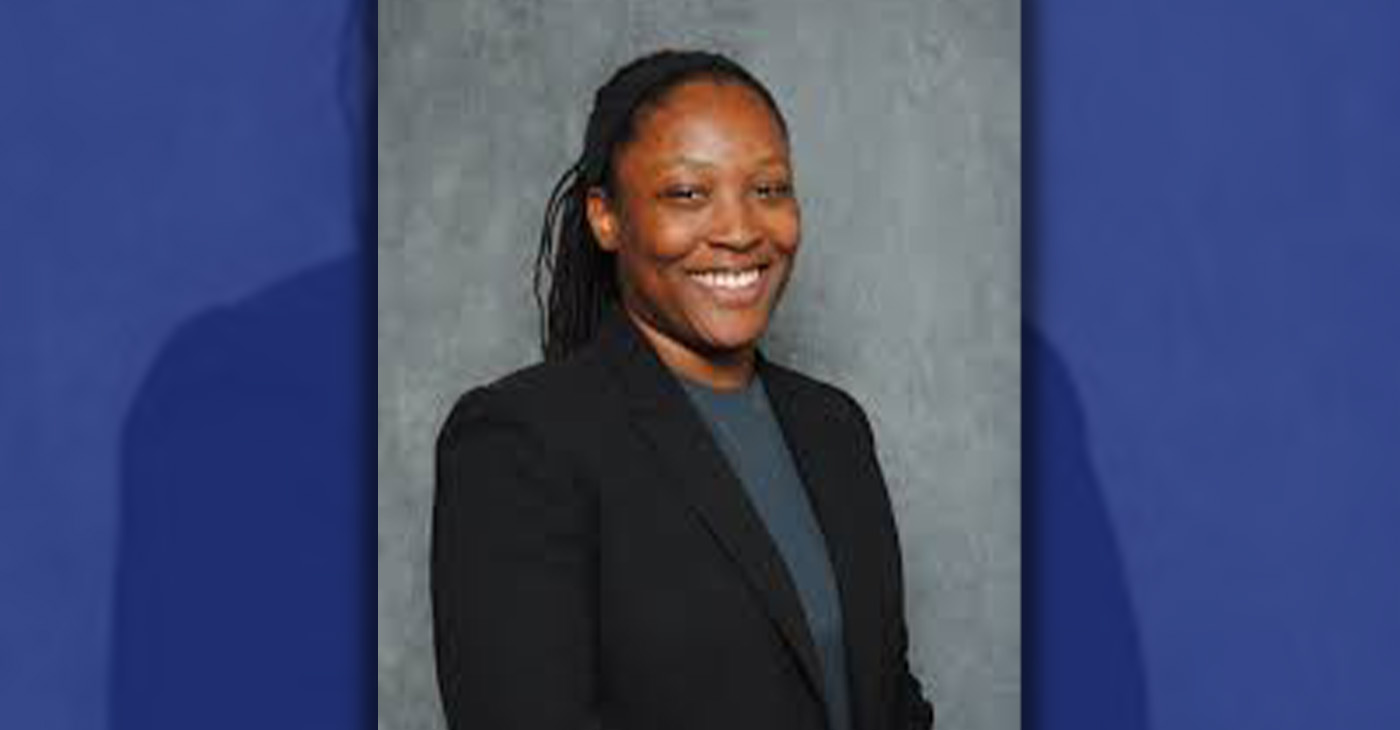
By Dr. Imani McElroy,
Special to California Black Media
As I became part of the small community of Black female surgeons, who represent less than 1% of all physicians, I embraced the responsibility with an understanding that part of my career would be dedicated to being a voice for marginalized and disenfranchised people.
Growing up in the San Francisco Bay Area, I observed the vast economic divide that contributes to health care disparities. Unstable employment and housing, food deserts, underfunded schools, and escalating living expenses all play a significant role in poor health for Black patients.
They also are a direct reflection of centuries of systemic discrimination and racism that has crippled Black Americans dating back to the era of slavery.
The same issues have followed me personally. I live with asthma, which has quietly impacted my breathing since childhood. I have been fortunate to avoid long-term hospitalization, but I have had numerous visits to urgent care and emergency departments.
I discussed my symptoms with my primary care physicians over the years, but it wasn’t until my third year living in Boston that I found a physician who attended to my symptoms and made the necessary adjustments that finally controlled my asthma. My asthma had progressed steadily for 15 years and despite being in the medical field and being able to describe the decline, my symptoms were ignored.

This is a story that is too common among Black Americans. Even fame could not protect Serena Williams when she had to demand appropriate testing and treatment for blood clots in her lungs following the birth of her first child.
I understood that my role as a health care provider extended well beyond the walls of the operating room and the hospital.
The plight of Black Americans within health care and the discrimination we face is well documented in both medical and lay literature.
In medicine, we celebrate J. Marion Sims as the father of obstetrics, but until recently, we rarely mentioned that most of his medical breakthroughs were achieved through the suffering of Black women who were not adequately anesthetized as he experimented on some of the most delicate parts of their bodies. Books such as “Medical Apartheid” and “The Immortal Life of Henrietta Lacks” document the long history of Black bodies being used for scientific experimentation without any compensation or acknowledgment.
If we are going to have an honest discussion about the root cause of medical mistrust within the Black community, the conversation cannot simply begin and end with the United States Public Health Service (USPHS) Untreated Syphilis Study at Tuskegee.
It’s essential to recognize that the generational trauma endured by the Black community contributes significantly to its skepticism towards medical institutions.
Healthcare advocacy is multifaceted. From physician-led initiatives addressing policy and resource allocation, to research that intentionally and thoughtfully addresses disparities in access and outcomes, to development of integrated multidisciplinary treatment teams for personalized care plans, there is quite possibly no more important step than educating the lay person.
Gone are the days of blind trust in a physician simply because of their title.
Furthermore, being able to empower patients to advocate for their health care needs will also allow physicians to understand how medical conditions impact their patients’ quality of life and everyday activities. Shared decision-making rests on a patient’s ability to trust the providers caring for them. The medical community owes it to Black Americans to afford them this trust.
As an advocate, I aim to bridge the gap between medical literature and lay literature. Making sure that our community has updated and accessible information that can impact their understanding of their medical conditions and improve the quality of care they receive.
As a Black woman in America, I face my own challenges, including navigating the health care system, and finding providers who look like me, understand my unique needs, and are willing to engage with me despite my medical background.
As my family members grow older and begin to interact more frequently with medical providers, I find myself in the frustrating position of having to help them advocate for themselves in a system that does not always listen.
My white coat does not shield me from the realities of being Black in America and thus I feel it is my duty to become part of the solution in addressing disparities in healthcare.
While much of the work to fix this problem falls in the hands of physicians and providers, active participation is required from both sides.
Increased representation in clinical trials will improve our understanding of risk factors and treatment responses. Attending health fairs and community outreach events will help increase medical literacy and understanding. Being persistent and truthful about symptom progression or treatment side effects is equally as important to help inform decision making.
Most of our medical knowledge is hidden behind paywalls buried in medical jargon. My goal is to help make what is happening in the medical community more accessible to our community.
About the Author
A native of the Bay Area, Dr. Imani E. McElroy is a clinical fellow of Vascular Surgery at USC Keck School of Medicine. She completed general surgery training at the Massachusetts General Hospital in Boston, MA. She has a master of Public Health from the Harvard T.H. Chan School of Public Health and received a Doctor of Medicine from the Charles R. Drew University/UCLA David Geffen School of Medicine. She earned a bachelor’s degree in Biological Sciences from the University of California Irvine.
This article is supported by the California Black Health Journalism Project, a program created by California Black Media, that addresses the top health challenges African Americans in California face. It relies on the input of community and practitioners; an awareness of historical factors, social contexts and root causes; and a strong focus on solutions as determined by policymakers, advocates and patients.








Activism
Oakland Post: Week of August 5 – 11, 2026
The printed Weekly Edition of the Oakland Post: Week of August 5 – 11, 2026
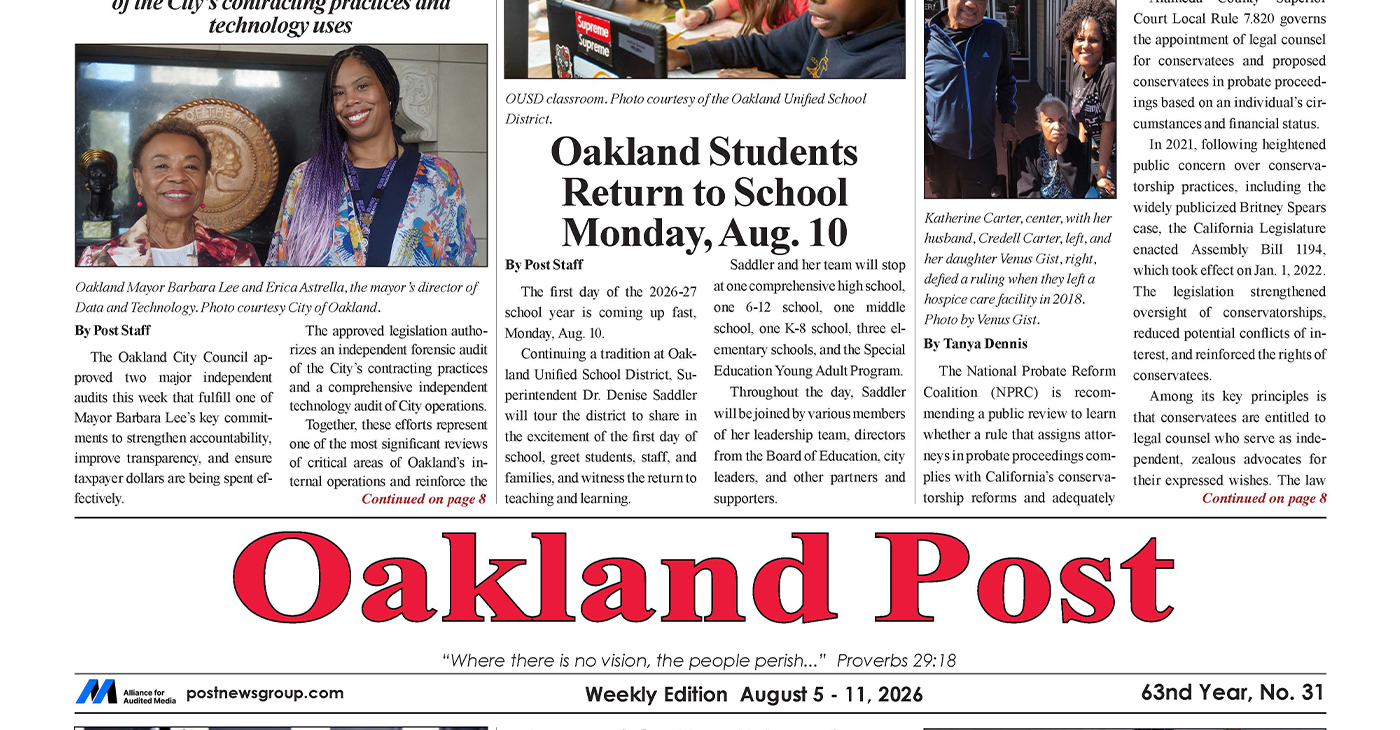
To enlarge your view of this issue, use the slider, magnifying glass icon or full page icon in the lower right corner of the browser window.
Activism
Oakland Post: Week of July 29 – August 4, 2026
The printed Weekly Edition of the Oakland Post: Week of July 29 – August 4, 2026
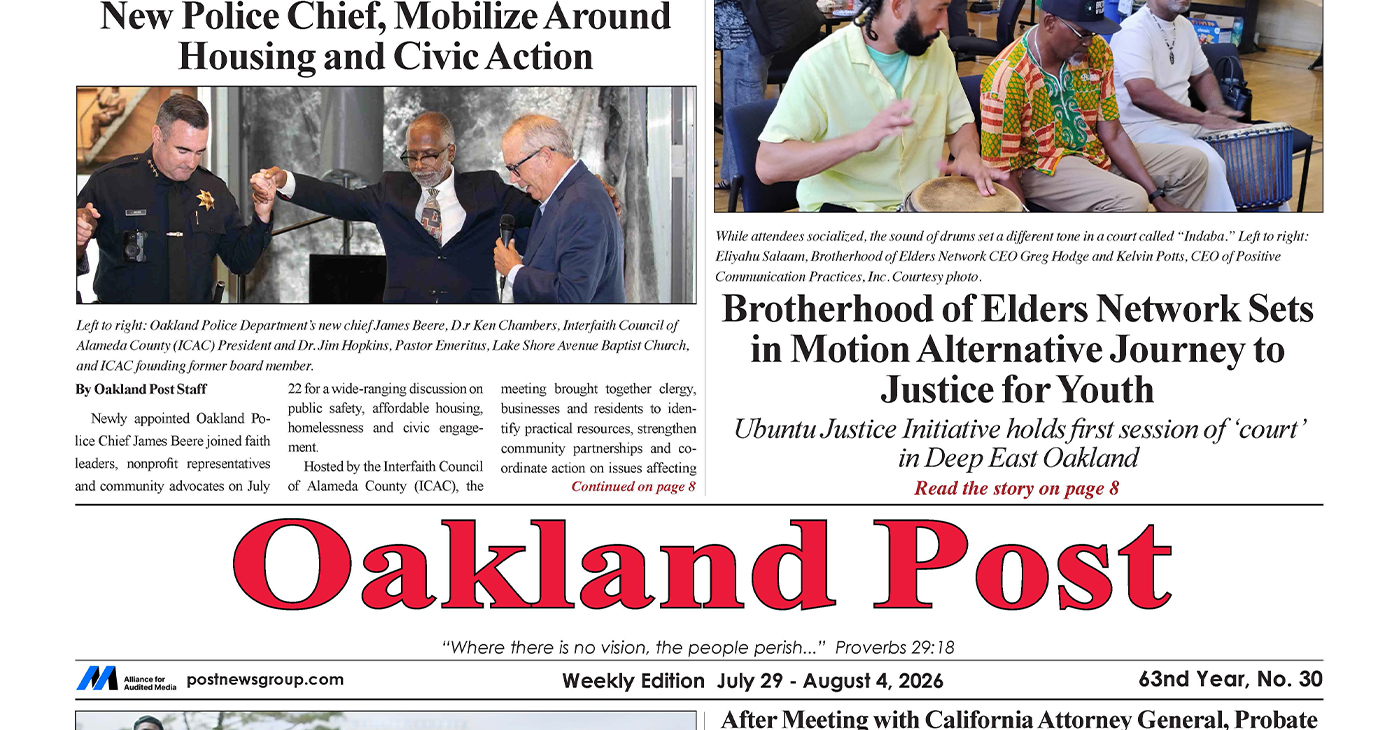
To enlarge your view of this issue, use the slider, magnifying glass icon or full page icon in the lower right corner of the browser window.
Activism
Oakland Post: Week of July 22 – 28, 2026
The printed Weekly Edition of the Oakland Post: Week of July 22 – 28, 2026
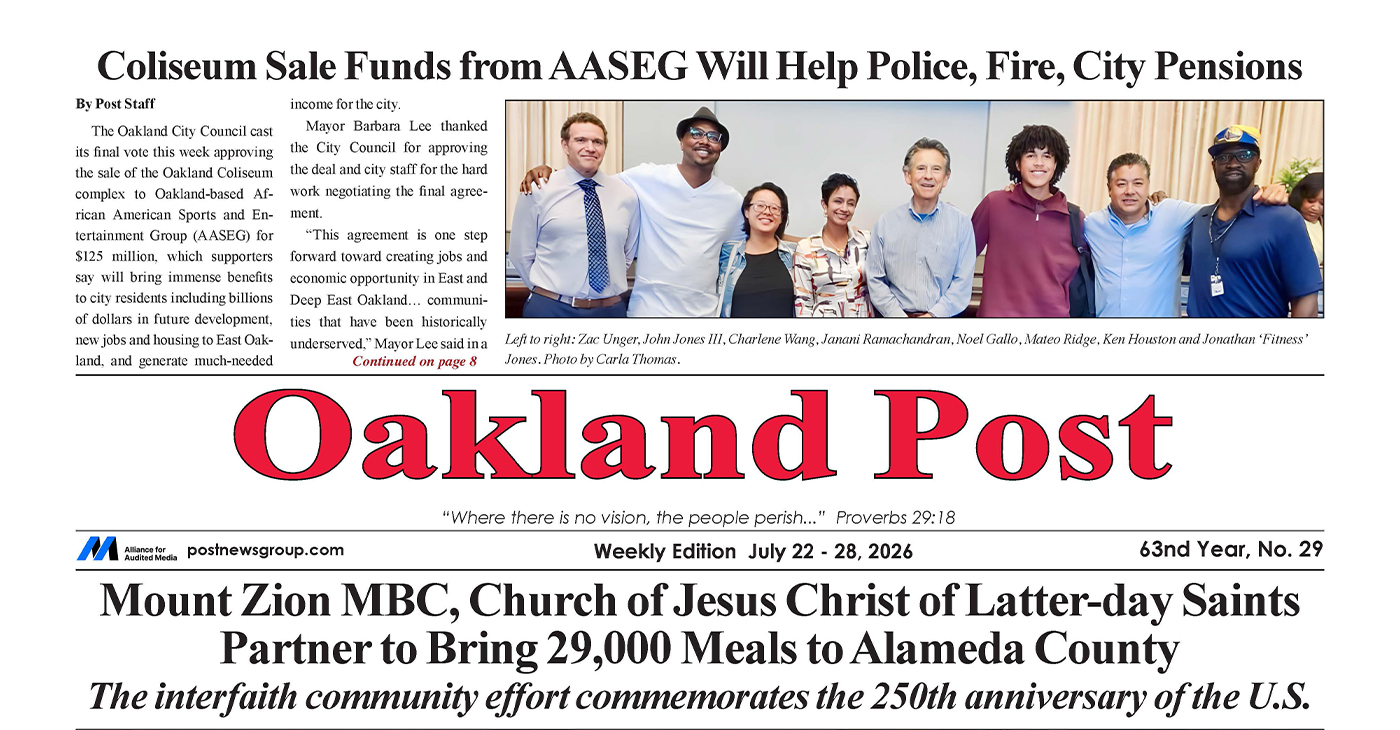
To enlarge your view of this issue, use the slider, magnifying glass icon or full page icon in the lower right corner of the browser window.
WORK FROM HOME
Home-based business with potential monthly income of $10K+ per month. A proven training system and website provided to maximize business effectiveness. Perfect job to earn side and primary income. Contact Lynne for more details: Lynne4npusa@gmail.com 800-334-0540


Misty Copeland Shapes Ballet’s Tomorrow

As Part of Your Back-to- School Checklist, Vaccinate

As Part of Your Back-to- School Checklist, Vaccinate

Congresswoman Simon Demands Investigation into Trump’s Abuse of Emergency Powers for Coal Export Terminal in West Oakland

OPINION: The Philippines Isn’t Foreign When Your Family Still Lives There

Asm. McKinnor’s Bill Banning Drones Above Outdoor Entertainment Events Awaits Senate Decision

California Sen. Padilla Joins Colleagues to Introduce Bill Imposing Term Limits on Supreme Court Justices

Department of Homeland Security Demands California Secretary of State Shirley N. Weber Scrub Voter Rolls

George Cook: The Inventor Who Made Fishing Smarter

Gov. Newsom Announces $109.6 Million in Funding for 278 Supportive Homes in Bakersfield, Contra Costa, Sacramento and Fresno

Rep. Kamlager Dove Demands Care, Justice for Man Shot by ICE

“The Power to See Threats Sooner”: Gov. Newsom, Safety Officials Showcase California’s Investments in Hi-Tech Wildfire Prevention

100 Black Wings’ Team Oakland Youth Athletes Heading to Taiwan for 2026 International Children’s Games

Oakland ‘Port Serves as a Powerful Engine for Good Jobs and Economic Development

Oakland Faith Leaders Welcome New Police Chief, Mobilize Around Housing and Civic Action
Department of Homeland Security Demands California Secretary of State Shirley N. Weber Scrub Voter Rolls

Oakland Children’s Hospital Workers and Patients Rally for Pediatric Medical Care
“The Power to See Threats Sooner”: Gov. Newsom, Safety Officials Showcase California’s Investments in Hi-Tech Wildfire Prevention

New Judge Could Decide if Karmelo Anthony Gets a New Trial

Surveillance Pricing Fight: State Senate Debates Bill Banning Retailers from Using AI to Set Prices Based on a Buyer’s Profile

Mount Zion MBC, Church of Jesus Christ of Latter-day Saints Partner to Bring 29,000 Meals to Alameda County

Alpha Kappa Alpha Sorority, Inc. Celebrates New North Atlantic Regional Director
California Sen. Padilla Joins Colleagues to Introduce Bill Imposing Term Limits on Supreme Court Justices

Starting This Summer, California Car Buyers Can Get an Instant $3500 Off the Cost of Electric Vehicles

COMMENTARY: You Are Already Paying for the AI Boom

California Bill Would Let Abuse Victims Use Trauma as Legal Defense for Violent Crime

Fed Court to Decide Landmark First Amendment Case

Gov. Gavin Newsom Signs Law Streamlining Affordable Housing Rules

Oakland Celebrates $125 Million Coliseum Sale

Saving Black Mothers Starts Outside the Hospital

The Conversation With Al McFarlane 6/23/26

Media Monday 6/22/26

LIVE! ASK ALMA! — TUES. 6.23.26 7PM EST

Car Buying Secrets: 4 Hidden Checks Before You Sign!

Is This 550 HP Charger Worth YOUR Money? AutoNetwork Review

Celebrating Juneteenth – Frederick Douglass on education and resistance

LIVE! — ASK ALMA! — TUES. 6.19.26 7PM EST

Hyundai Ioniq 5 Parking, Safety, and 360 View #shorts

2025 Ioniq 5 New Wiper & Powerful Performance! #shorts

Electric SUV Range: Is 259 Miles Enough? #shorts

EV Charging: How Fast Can You Charge an Electric Vehicle? #shorts

Biometric Cooling… Messaging Seats…Come on! 2025 Infiniti QX80 Autograph 4WD

Charged Up: Witness the Magic of a Fully Electric Car! #shorts

Range Rover Sport PHEV Included…: See What’s Inside This Luxury SUV! #shorts

Invisible Hood View: Perfect Parking with X-Ray Vision! #shorts
-
 Featured3 days ago
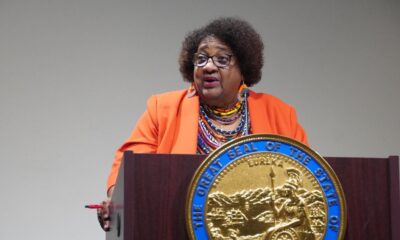
Department of Homeland Security Demands California Secretary of State Shirley N. Weber Scrub Voter Rolls
-
 Business2 weeks ago
Oakland Children’s Hospital Workers and Patients Rally for Pediatric Medical Care
-
 Environment3 days ago
“The Power to See Threats Sooner”: Gov. Newsom, Safety Officials Showcase California’s Investments in Hi-Tech Wildfire Prevention
-
 #NNPA BlackPress2 weeks ago
New Judge Could Decide if Karmelo Anthony Gets a New Trial
-
 Business2 weeks ago
Surveillance Pricing Fight: State Senate Debates Bill Banning Retailers from Using AI to Set Prices Based on a Buyer’s Profile
-
 Business2 weeks ago
Mount Zion MBC, Church of Jesus Christ of Latter-day Saints Partner to Bring 29,000 Meals to Alameda County
-
 Black History1 week ago
Alpha Kappa Alpha Sorority, Inc. Celebrates New North Atlantic Regional Director
-
 Featured3 days ago
California Sen. Padilla Joins Colleagues to Introduce Bill Imposing Term Limits on Supreme Court Justices
