
City Government
OPINION: Black, Unhoused and Mentally Challenged: The Case for Housing and Health Care
Numerous studies have confirmed that homelessness and behavioral and mental health problems affect African Americans at disproportionate rates in California and around the United States.


By Dr. Lenore A. Tate
Special to California Black Media Partners
Numerous studies have confirmed that homelessness and behavioral and mental health problems affect African Americans at disproportionate rates in California and around the United States.
On a very primary and personal level, homelessness affects an individual’s mental health. Looking at the data: approximately 30% of people who are chronically unhoused have a mental health condition, about 50% have a co-occurring substance use problem and 42% have a disabling condition such as a developmental disability, HIV/AIDS or injuries from combat such as post-traumatic stress disorder.
In California, 43% of the Black Californians interviewed reported that someone close to them has experienced homelessness — a rate much higher than any other racial group in the survey, according to a survey conducted by the California Health Care Foundation.
Black women in particular are at a higher risk for exposure to mental health stresses.
“A variety of circumstances put Black women at high risk for mental and emotional stress — economic insecurity, responsibilities of caregiving, neighborhood violence, lack of social support and physical illness or disability,” reads the website of the California Black Women’s Health Project.
“As a result, many are plagued by tension, anxiety, worry and fear. Because of the powerful and complex links between the mind, emotions and body, chronic states of stress and anxiety can have dangerous and sometime fatal, health consequences. In addition, the daily struggles of coping with racism and sexism further exacerbate mental and emotional stress,” the write-up on the website reports.
When these intersecting issues go unaddressed, they can compound and adversely affect individuals.
Black people make up 13.6% of the population in the United States and account for approximately 21% of those living in poverty. Blacks in California comprise 6.5% of the population but are more than 40% of the homeless/unhoused population!
In fact, in most shelters, food banks, drop-in centers for the unhoused, the majority of those served are from Black or Brown communities. Black people outnumber white people 12 to 1 among the homeless population.
California has more unhoused people than any other state. Seventy percent of California’s homeless are living on the streets and in tents, etc. while in New York, data reflects that only 5% of their homeless are living on the streets.
California has instituted several policies and passed a series of laws to address the mental health and homeless crises.
Last year, during his annual budget proposal, Gov. Gavin Newsom connected the challenge of solving homelessness in the state with inadequate approaches the state has taken so far to address mental health.
Among different approaches taken to address the state’s mental health challenges and, consequently, the homelessness crisis is the passage of the Community Assistance, Recovery and Empowerment Act (CARE) Act last year. This law, which Newsom signed into law, establishes CARE Court, an alternative to the Criminal Justice System for people who are mentally ill.
But more needs to be done if we are to address the monumental challenges of our mental health and homelessness crises, particularly as it affects minorities. The resources and programs the state has made available have simply not kept up with the demand for services.
California was the first state in the country to propose housing as a human right under Assembly Constitutional Amendment 10 (ACA-10) (Bonta 2020).
This amendment would ensure shelter for the unhoused and recognize that housing as a human right. However, after more than 70 years, housing still appears to be treated as a commodity rather than a human right.
Across the board — from prevention and early intervention to strategically providing housing and chronic care — we need to do more in the Golden State.
Medical professionals need to be provided cultural sensitivity training and more needs to be done to destigmatize mental health care in the Black community.
Social support systems must be strengthened, and more resources need to be committed to outreach and research so that both care and information can be targeted to serve the needs of Black Californians.
We need a combination of solutions working at the policy level, within the health care delivery system and among our social and community networks that attack the problems from various angles.
Committing to funding, decreasing hurdles in zoning, working collaboratively with public and private sectors, and creating space for ingenuity would be steps toward solving these crises.
Recognizing that Black and Brown communities, children, families and seniors are unhoused as well as those that carry the weight of mental illness, leads us to act and consider prioritizing vulnerable populations of unhoused.
We must utilize all our available resources so that every Californian will be afforded the right to have housing and a ‘home’ and adequate mental health care, allowing for security, safety and comfort.
About the Author
Lenore A. Tate, Ph.D. is a licensed psychologist in private practice in Sacramento. She has previously worked as principal consultant to the California Assembly and Senate Health Committees as well as the Senate Office of Research. Dr. Tate has also served as a university professor in Texas, Arizona and California. She specializes in neuropsychology, geriatrics and behavioral health.
California Black Media’s coverage of mental health in Black communities is made possible with the support of the California Health Care Foundation.














Activism
Oakland Post: Week of September 23 – 29, 2026
The printed Weekly Edition of the Oakland Post: Week of September 23 – 29, 2026
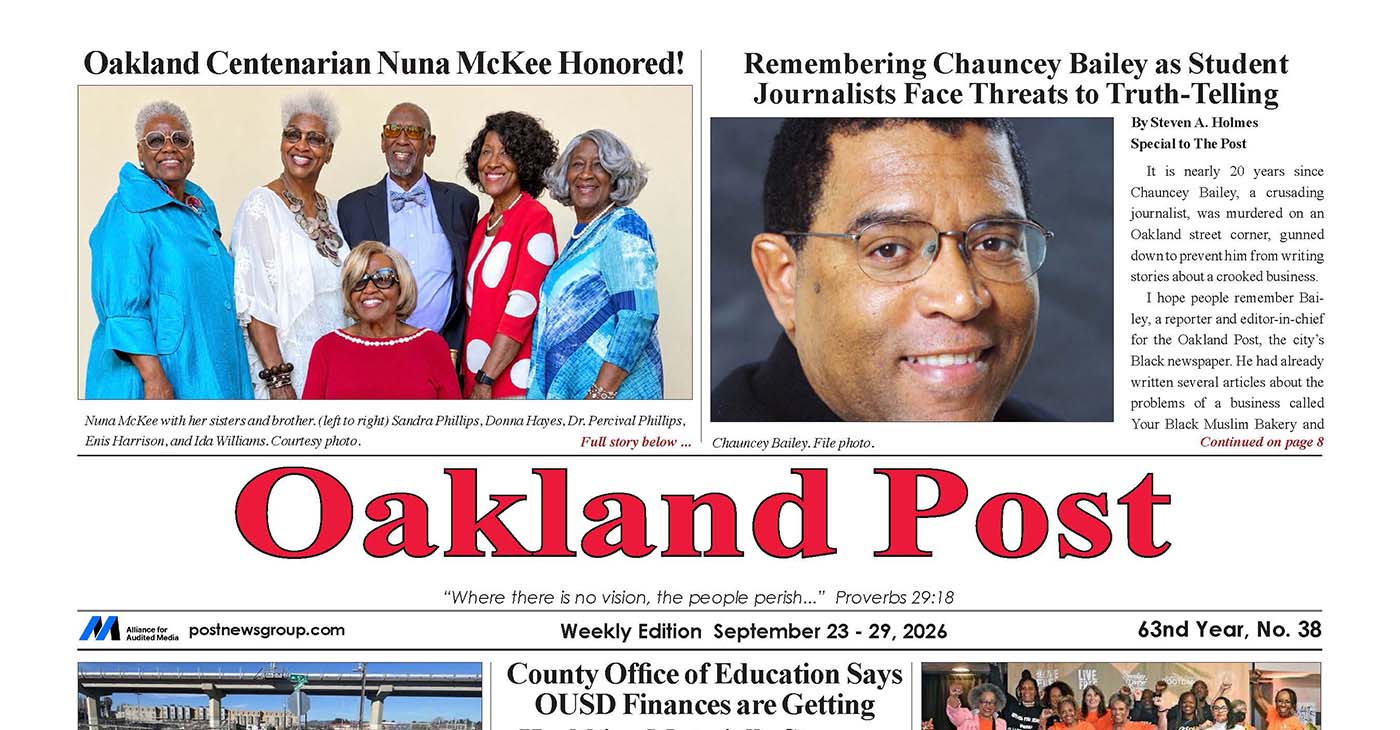
To enlarge your view of this issue, use the slider, magnifying glass icon or full page icon in the lower right corner of the browser window.
Activism
Oakland Post: Week of September 16 – 22, 2026
The printed Weekly Edition of the Oakland Post: Week of September 16 – 22, 2026
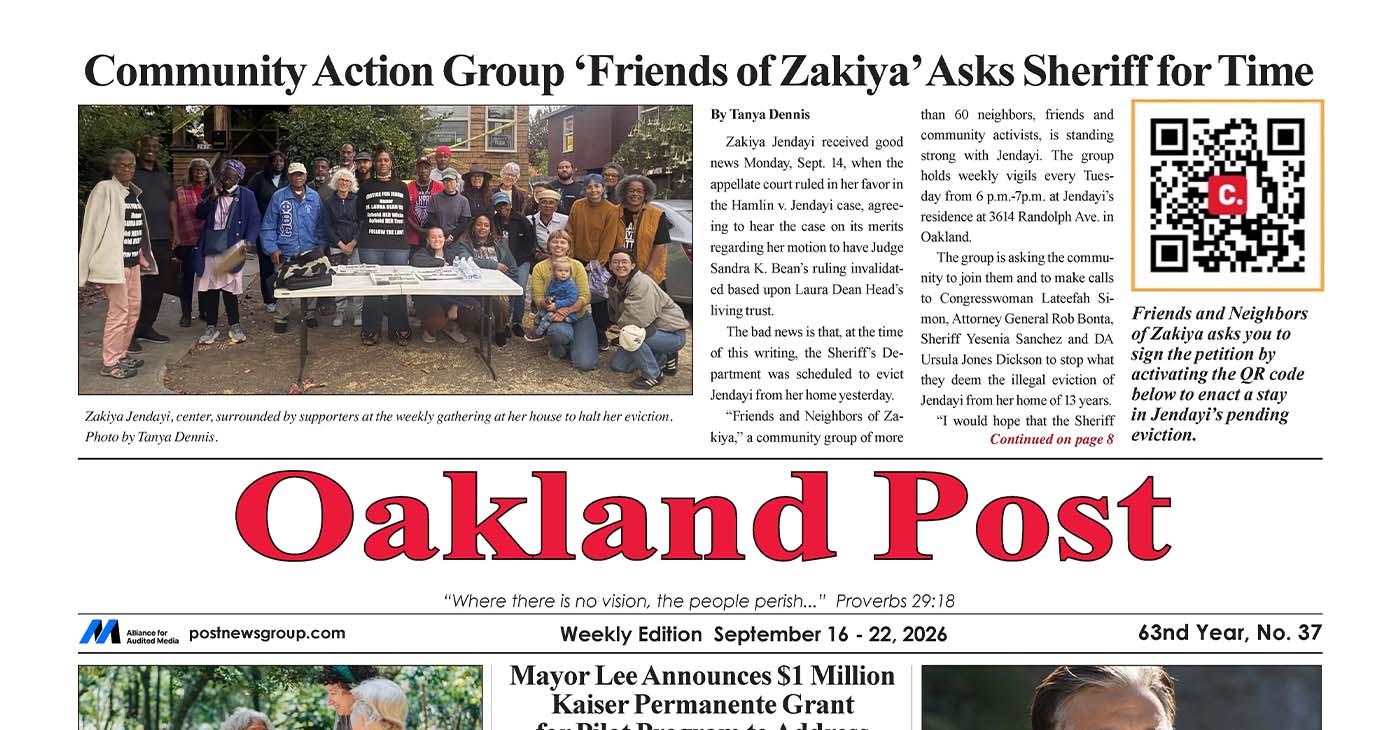
To enlarge your view of this issue, use the slider, magnifying glass icon or full page icon in the lower right corner of the browser window.
Activism
Oakland Post: Week of September 9 – 15, 2026
The printed Weekly Edition of the Oakland Post: Week of September 9 – 15, 2026

To enlarge your view of this issue, use the slider, magnifying glass icon or full page icon in the lower right corner of the browser window.


Asm. Corey Jackson Announces Launch of 24-Hour Childcare in His District

IN MEMORIAM: The Rev. Leon “Sonny” Clark, Longtime Orange County Pastor and Community Leader, Dies at 72

Poll: Becerra Widens His Lead Over Hilton; Californians Split on Wealth Tax

From Historic Memories to New Possibilities: Oakland Celebrates Coliseum 60

County Office of Education Says OUSD Finances Are Getting Healthier, Materially Stronger

LIVE FREE Sunday Dinner Brings Faith, Fellowship and Civic Conversation to Oakland

Remembering Chauncey Bailey as Student Journalists Face Threats to Truth-Telling

BLACspace Cooperative Invites Bay Area to Experience Oakland’s Black Cultural Ecosystem Through a BLAC Map Tour + Party

In Wake of Death on Doorstep, Williams Chapel Baptist Church Calls for Better Care, Funding for Unhoused

Oakland Centenarian Nuna McKee Honored!

Caribbean Nations Produce Action Plan Calling for UK Reparations Over Slavery

Oakland Post: Week of September 23 – 29, 2026

Doulas Are Helping Black California Moms Navigate Pregnancy–Even as High Mortality Rates Persist

Newsom Signs Addictive Social Media Law to Protect Kids

On Your November Ballot: Prop 38 Would Allocate $8.4 Billion to Immunology and Immunotherapy Funding

Less Affluent School Districts, Including Sacramento City, Face Threat of State Takeover

ESSAY: California Can Close Its Colorectal Cancer Gap

California Hispanic Chambers of Commerce Unveils: ‘Powering the Future’ Theme for 47th Annual Statewide Convention

Four Candidates, Including Incumbent Barbara Lee, Qualify for Oakland Mayor’s Race

Oakland Post: Week of August 12 – 18, 2026

From Blueprint to Breakthrough: Tackling Affordable Housing in Oakland

Oakland Observes Black August with Block Parties, Film Showings, Workshops

COMMENTARY: Why Local School Tax Measure G1 Will Not Be on the November Ballot

Standoff for Justice: Our Homes Are Worth Fighting For

Returning to Its Roots, the Oakland Black-Eyed Pea Festival Partners with the Freedom Farmers Market Sept. 12

Oakland Post: Week of August 26 – September 1, 2026

NPRC Scores First Advocacy Victory: David Shaw Finally Gets His Wish to ‘Go Home’

Frontier Airlines’ Return to Oakland Airport Brings Flights, Jobs and Opportunity

Gubernatorial Candidate Steve Hilton Blasts California New Tire Rules; Newsom Hits Back

Chef Sharon Lee Blends Culinary Excellence, Education and Empowerment

The Conversation With Al McFarlane 6/23/26

Media Monday 6/22/26

LIVE! ASK ALMA! — TUES. 6.23.26 7PM EST

Car Buying Secrets: 4 Hidden Checks Before You Sign!

Is This 550 HP Charger Worth YOUR Money? AutoNetwork Review

Celebrating Juneteenth – Frederick Douglass on education and resistance

LIVE! — ASK ALMA! — TUES. 6.19.26 7PM EST

Hyundai Ioniq 5 Parking, Safety, and 360 View #shorts

2025 Ioniq 5 New Wiper & Powerful Performance! #shorts

Electric SUV Range: Is 259 Miles Enough? #shorts

EV Charging: How Fast Can You Charge an Electric Vehicle? #shorts

Biometric Cooling… Messaging Seats…Come on! 2025 Infiniti QX80 Autograph 4WD

Charged Up: Witness the Magic of a Fully Electric Car! #shorts

Range Rover Sport PHEV Included…: See What’s Inside This Luxury SUV! #shorts

Invisible Hood View: Perfect Parking with X-Ray Vision! #shorts
-
 Commentary4 weeks ago
Standoff for Justice: Our Homes Are Worth Fighting For
-
 Activism4 weeks ago
Oakland Post: Week of August 26 – September 1, 2026
-
 Business4 weeks ago
Frontier Airlines’ Return to Oakland Airport Brings Flights, Jobs and Opportunity
-
 Business4 weeks ago
Gubernatorial Candidate Steve Hilton Blasts California New Tire Rules; Newsom Hits Back
-
 Business4 weeks ago
Chef Sharon Lee Blends Culinary Excellence, Education and Empowerment
-

 Community4 weeks ago
Big City Mayors Ask for “Yes” Vote on Housing Bond Measure; Conservatives Say “No”
-

 Black History4 weeks ago
Jackie Wright Champions Bay Area Stories, Filmmakers and Cultural Institutions
-

 Education4 weeks ago
Gov. Newsom’s Latest Appointees Include Sacramento Advocate for Formerly Incarcerated Students; State’s New Tech Chief
