
Art
Q&A: Matt Takaichi’s Sardonic Tech Work Photography
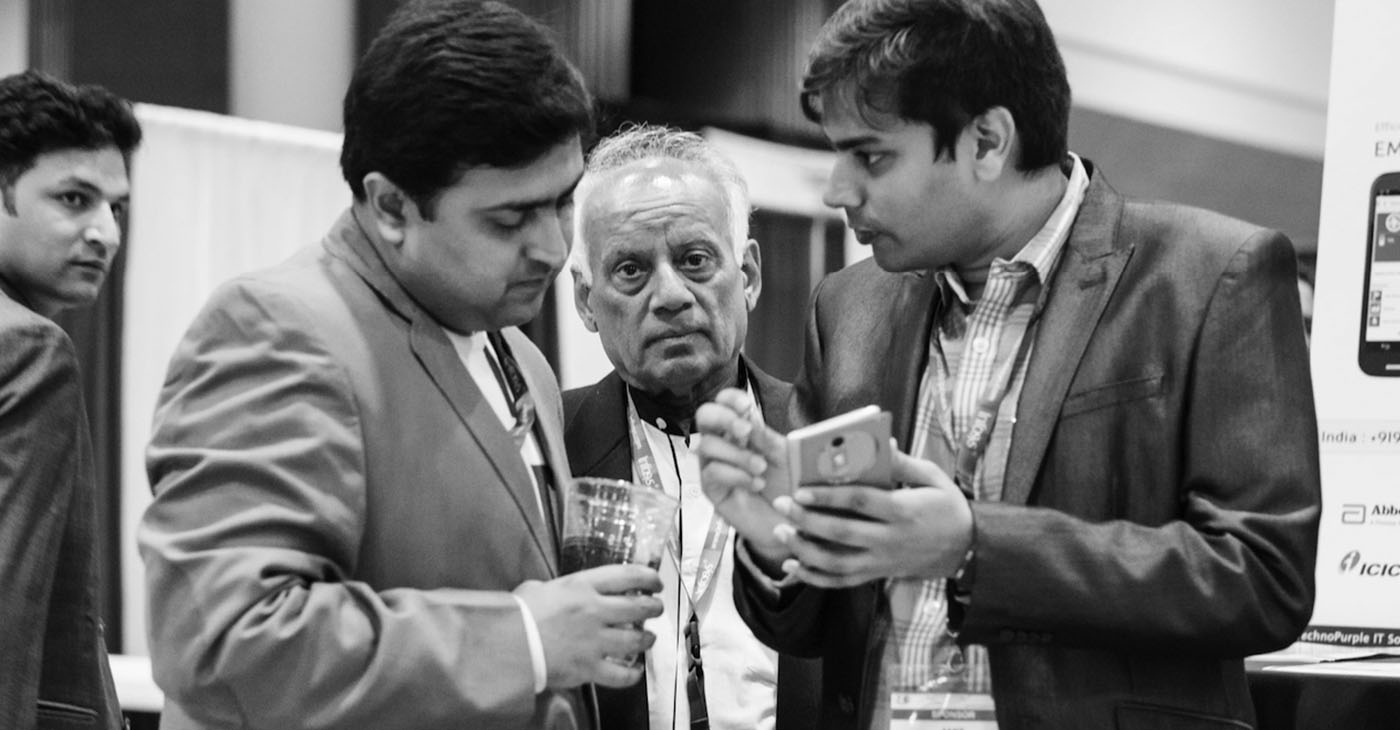
In 2014, East Bay artist Matt Takaichi was taking photos mostly on the street, but he soon started using this process-based approach for a project that would become “Developers,” his recently published first photography book of work from 2015-2020. To make the book, he went to over 50 Bay Area tech conferences, often by sneaking in, and took well over 10,000 photos that captured tech work in sad and funny ways.

By Zack Haber
In an interview from 2014, East Bay artist Matt Takaichi shied away from claiming he had a special eye for taking photos and instead said his ability to capture compelling images stems from “the extent” he takes to “position” himself for them. At that point, Takaichi was taking photos mostly on the street, but he soon started using this process-based approach for a project that would become “Developers,” his recently published first photography book of work from 2015-2020. To make the book, he went to over 50 Bay Area tech conferences, often by sneaking in, and took well over 10,000 photos that captured tech work in sad and funny ways.
While working on the project, Takaichi became obsessed and had trouble fathoming how it could end. But shelter-in-place hit in March of 2020, and the COVID-19 pandemic shuttered these in-person events, making it impossible for him to continue photographing them. He then began a year-long editing process and collaborated with Oakland-based book designer Kate Robinson to organize and self-publish “Developers,” selecting about 120 of these photos, most of which appear in black and white. Readers can purchase the book using this link. Takaichi discusses his book in the following interview, which I’ve edited for brevity and clarity.
Zack Haber: Why did you make a book about tech conferences? The book starts out showing protests. Was there anything political you wanted to explore?
Matt Takaichi: I’d been doing street photography for a while before I had the idea for this book. I was on the streets taking photos of people out and about. As I tried to put those photos together and figure out some way they made sense, I started to feel I needed to do a project that was a little more grounded and had some criticism or point to it.
I had the idea to do this project when I was thinking about how my Mom was a meeting planner for a tech company. Her job was to organize tech conferences. When I was living at home with her, there was one event where she hired me to photograph people as they were receiving awards. I remember thinking at the time ‘this is really stupid, this isn’t the type of photography I want to do.’ I was being kind of bratty. Then I thought about that later and I was like, oh, that could have been really interesting if I had approached it a little bit differently.
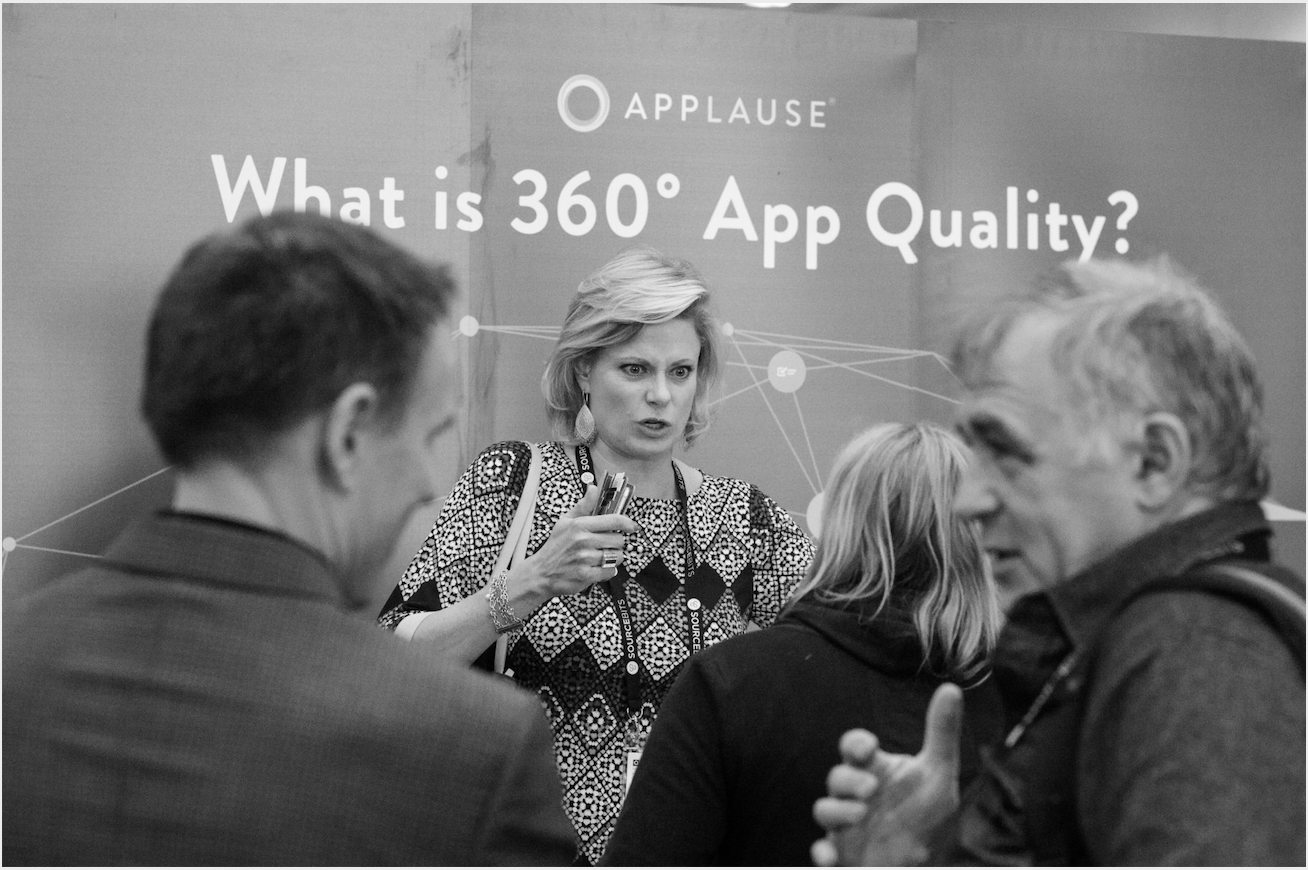
Photo by Matt Takaichi from his book, Developers, which captures Bay Area tech conferences from 2015-2020 and was released in late 2021.
Around this time too, while living in the Bay Area, I was thinking about the economy here and how much of it is centered around tech. It seemed like a pretty straight shot if I did something around photographing tech, but I was also thinking about how I could bring street photography into that. But I couldn’t just walk into Google and start taking photos of people.
Then I thought about going into tech conferences. I had a sense of them while growing up and walked past them a lot in San Francisco. That’s really the only place tech congregates in a somewhat visible public way. It seemed like the only option where you could do a documentary style street photo type of a tech project and be around people to get their natural reactions. I thought ‘Here’s the biggest target and here’s the only way I can conceive of doing it.’ When I started I don’t think I had a real idea of what I was doing. It was just that concept and wanting to do it in a way that could be critical and funny.
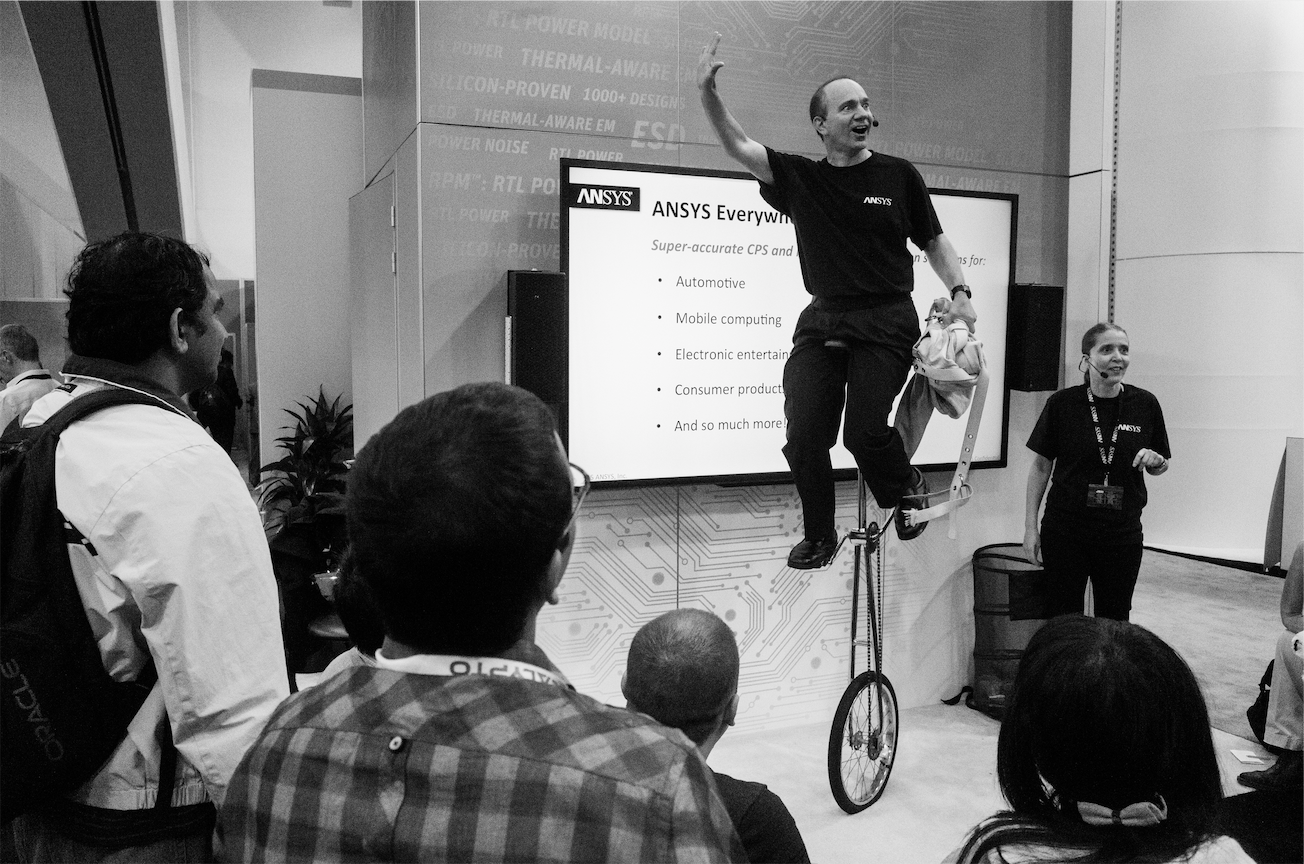
Photo by Matt Takaichi from his book, Developers, which captures Bay Area tech conferences from 2015-2020 and was released in late 2021.
I think especially at the time, 2015, there was a lot of antagonism toward tech. People were blocking Google buses. The anti-techie thing was really proliferating. I wanted to do some photos about how people perceived tech and the power centered around it and the wealth. But then when I was making the photos, I started realizing there was a lot of resentment among the workers, too. People didn’t want to be there. There was a lot of fatigue. As I did more of the project, things started to get really interesting in Bay Area organizing circles. I got really into this group called the Tech Workers Coalition. I thought a lot of their ideas for organizing were really interesting. For them, tech labor organizing should encompass everyone in the industry, not just engineers. There’s people servicing the tech industry, like cooks, and people in all sorts of lower paid positions. To me they all qualify as tech workers. At these events that service work was everywhere. And those workers made it into my book.
Unionizing in tech work was also entering into the popular consciousness more in the Bay Area. It was something I hadn’t really seen before. Now there’s the Alphabet Workers Union at Google, for example. At the same time, being someone who was employed in the industry before, I noticed those types of organizing hadn’t really penetrated the workforce as much as I’d like them to. It wasn’t common and still isn’t.
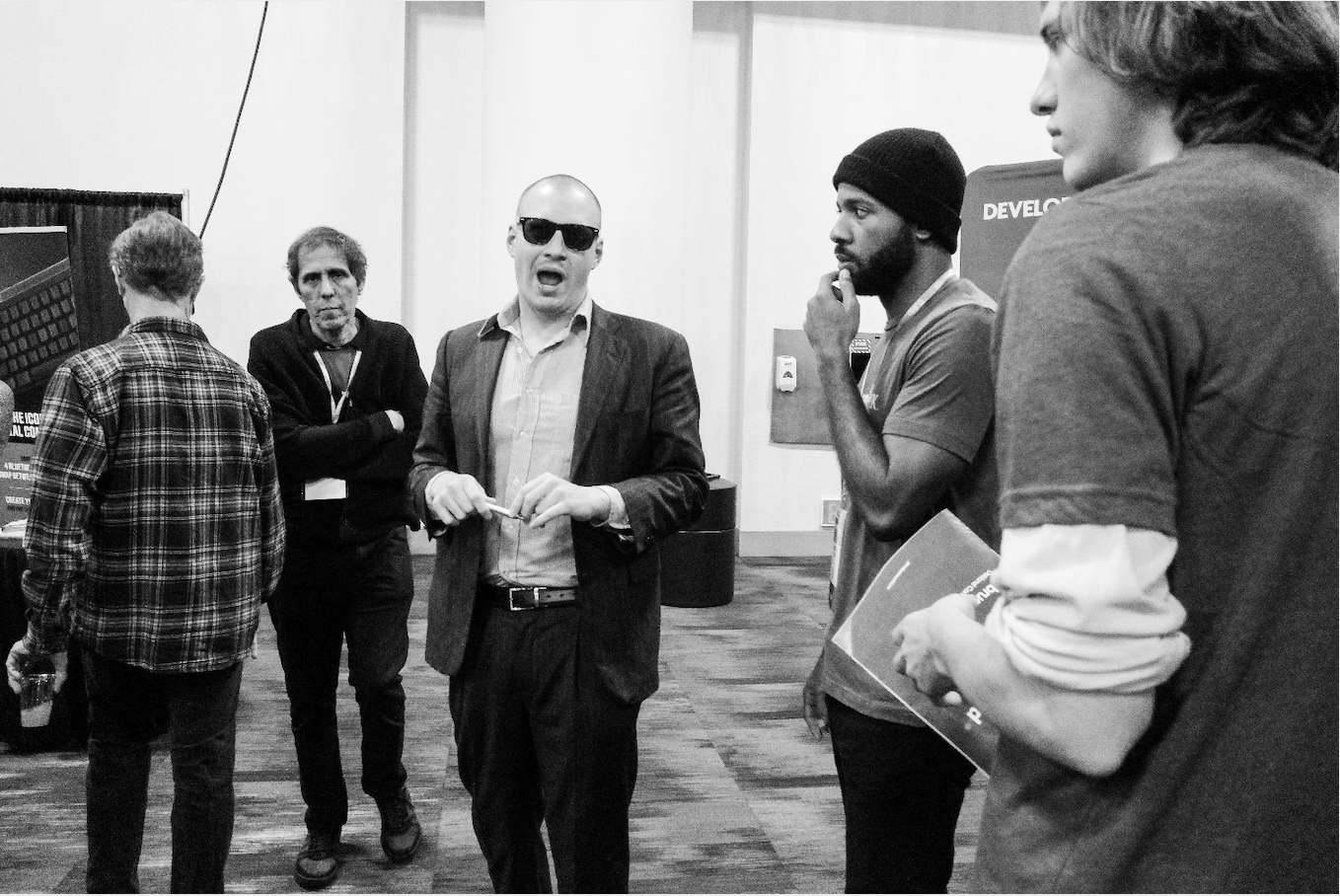
Photo by Matt Takaichi from his book, Developers, which captures Bay Area tech conferences from 2015-2020 and was released in late 2021.
A lot of political photographs I had were labor protests by service workers that took place right outside the tech conventions. I have one that’s the Marriott strikers and they made flyers that were specific to people attending a tech conference. You see from the images there’s not a whole lot of interest from tech workers to engage with that. That’s what I’ve seen in the tech industry. You have workers who are pretty unhappy and are working long hours. At the same time there’s not really an infrastructure around collective bargaining to make the workplace better. But from my images you can see that there might be a latent desire to do that, if it could surface in a way that was a bit more legible to them. Who knows? There could be something there.
Can you talk a little bit about sneaking into these conferences, and what that felt like?
Takaichi: When I started doing this, I’d had the idea for a while but wasn’t sure how I’d execute it. Then one day I was walking around downtown San Francisco and saw the Moscone Center was having a tech conference. On a whim I was just like, let’s go for it. I walked into the building, went up the escalator, entered with a group of people and the security guard didn’t really register me.
That was the first event I snuck into. The security guard came up to me once and was like, ‘oh, hey, where’s your badge?’ Then I mumbled something incoherent and acted like I knew what I was doing, and he was like ‘oh OK, you’re good.’
Based on that first experience, I realized it wasn’t hard and I could just keep doing that going forward. Soon I stopped impulsively going to tech conferences. Instead, I learned about how they were scheduled and that, for about half of them, I could register and enter in for free. Most of the photos from the book though are from ones I snuck into. Sometimes, I could have paid to go to those events but it would have been like $400, which was way too expensive for me.
Subconsciously I always felt like I shouldn’t be there. I worried a little bit that people would find out I was working on this project. But before long though, I realized it was pretty low stakes. The worst thing that could happen is that I’d have been asked to leave. It wouldn’t have been a big deal.
Of course, I preferred not to get caught. But that never really happened. A lot of people just thought I was an event photographer. That was something I kind of had to learn how to navigate at first. Sometimes someone I wasn’t interacting with at first would be like ‘oh cool, take my photo.’
Eventually I just started telling people exactly what my project was when they asked, that I was working on a documentary series of images you might not normally see at a tech conference that showed how it wasn’t always fun. Almost all of them thought it was a good idea and they were often really cordial with me. One time I saw one of these people at a bar months later and he started going on this long rant about different ways he thought I could make a lot of money from my photos, which I thought was really funny.
I counted about 15 photos in “Developers” where people appear to stare directly at you or into the camera. Most, but not all, of these people look perturbed, annoyed, and perhaps suspicious of what you’re doing. I love these photos. They make me feel both unsettled and fascinated. There’s a taboo being broken here. As a child I remember being told not to stare at strangers. Why break that taboo? What did it feel like taking these photos?
To me these questions get at a lot of larger questions around street photography and what it’s like taking photos of people on the street who may not always know I’m doing that. I really struggled with how I felt about that for a while. I’ve been really into a lot of classic Magnum photographers, people like Josef Koudelka. What I really like about their photos is you’re just getting this slice of reality from 50 or 60 years ago. Everything feels really genuine, like it wasn’t posed.
It’s really hard to do that if someone knows you’re about to take their photo. I think to some extent it’s not cool to take those photos. At the same time, street photography has become part of the art canon. People like Henri Cartier-Bresson are seen as great artists of the 20th century. It’s kind of validated doing this type of photography.
All this is to say I never really figured out a way to navigate doing it. But what I will say about this project, and why I don’t feel as weird about doing it as I did about other street photography, is that there’s something about entering into the space of a tech conference that makes people assume you belong there. It’s different from taking photos on the street. Once you’re in a tech conference, there’s an assumption that everyone there is in a segment of workers basically, where maybe you’re all coming from a university background. And there’s security making sure everyone who goes in fits a profile. Due to that I think people drop their guard down pretty significantly.
Also in tech conferences, tons of people are running around with cameras. Some of them are working to boost their companies. There’s this tacit agreement that people there are being presenters speaking on behalf of a company. They’re there to advertise. On the one hand it’s a private space, but people are really putting themselves out there.
Honestly, in photos I have where someone has a weird facial expression, I wasn’t too sure they were even looking at me. These places were so dense with people. I use a pretty wide-angle lens and have a pretty discrete setup. When people looked a little frustrated sometimes, I would quickly snap my photo, especially because people’s facial expressions change so quickly.
I felt a little bit free from having to be super conscious of how I was being perceived all the time. A huge part of street photography is knowing how you appear to other people, because that’s going to inform how they react to you, which will change how they appear. You can smile at someone in the street and sometimes you’ll get this nice reception from them for a photo. But with this project I felt like I could really just be a fly on the wall. People weren’t paying much attention to me.
Your photos show an absurdity that’s often comical but also has a deep sadness. There’s lots of photos of people clearly stressed and/or exhausted while others show a strange carnivalesque showmanship and excitement. It makes me wonder: What was it like being in that space? What did you learn about these people and what tech work does to them?
When I saw people at the booths kind of doing their whole song and dance, it showed how when you’re employed in these jobs, you have to try to convince people that the company you work for is great. You have to keep inside whatever you feel about working there and just put your best face forward. I think there’s just something inherently conflictual about doing that. Needing to give this really positive facing image of your company really wears you down. You feel like you’re doing something that isn’t reflective of how you really feel and what it’s actually like to work there. Your coworkers are doing the same thing but when you look around it seems like they’re happy.
I don’t think people are happy working 80-hour weeks, which is pretty common in the tech industry. I think a lot of people feel bad about it. I wanted to have a lot of shots of the frontward facing image of what tech looks like and then ones where you kind of take a step back after people are done presenting and the fatigue shows up. People are just sitting on the ground looking exhausted. They’re calling their family and wishing they were there instead.
I think there’s a point in a lot of people’s adult life where you kind of just realize ‘I’m going to have to work and do these things I don’t like to do.’ Especially in this context of where the US is at right now, there’s not a whole lot of ways for most people to have any say as to what their company produces and how they’re managed.
Being in these tech conferences, it really was just like a show of force. You feel like you’re coming into something that’s powerful and disciplining to workers. It’s a little overwhelming realizing what people are up against now.







Art
Misty Copeland Shapes Ballet’s Tomorrow
THE POSITIVE COMMUNITY — Misty Copeland will curate the 2026 Joyce Ballet Festival, a two-week event in New York City from August 4-16. This role allows her to influence the future of ballet by showcasing a wide range of dancers, choreographers, and companies. The festival will present both established and contemporary works, blending classical traditions with new artistic expressions.

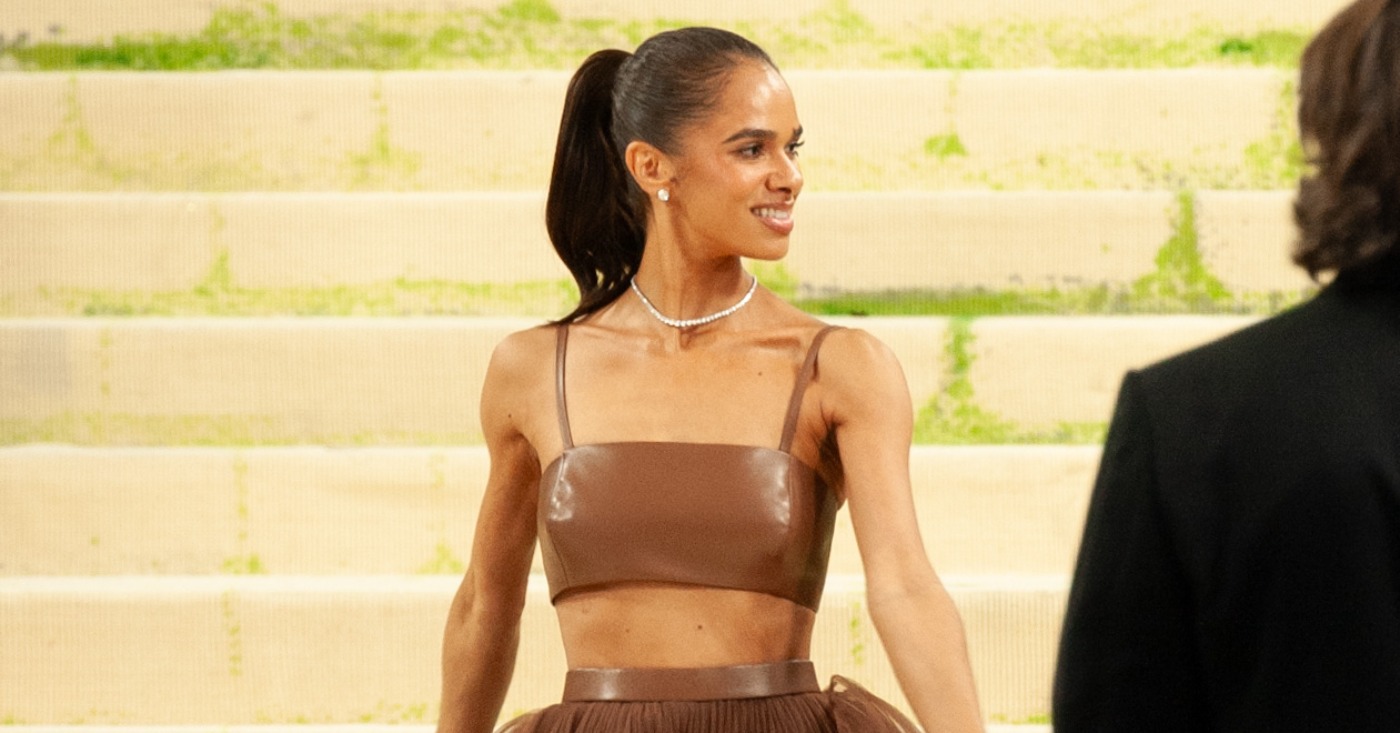
This summer, Misty Copeland will step into a different kind of spotlight. Instead of taking center stage as a dancer, she will help determine what audiences see onstage as curator of the 2026 Joyce Ballet Festival. Taking place August 4 through August 16 at The Joyce Theater in New York City, the two-week celebration will bring together dancers, choreographers and companies representing a broad spectrum of ballet. The festival gives Copeland an opportunity to share not only her appreciation for ballet’s traditions, but also her vision for its future.
Copeland understands better than most how powerful a ballet stage can be. Her historic career with American Ballet Theatre changed the conversation about representation in one of the world’s most traditional performing arts. When she became the company’s first Black woman to reach the rank of principal dancer, her achievement carried significance far beyond a personal milestone. It gave young dancers of color a new image of what was possible and challenged the industry to reconsider who belonged at the center of ballet.
That history informs the perspective she brings to the festival. Copeland has spent much of her career moving between performance, mentorship, advocacy and storytelling. Her curatorial role allows her to bring those interests together by creating a program that does not treat ballet as a museum piece. Instead, the festival presents dance as an evolving language capable of carrying classical traditions into new cultural and artistic territory.
Audiences will encounter a mixture of established works and contemporary creations during the festival. Classical ballet vocabulary will share space with choreography that pushes dancers toward different physical, emotional and theatrical possibilities. The result is intended to give audiences a broader understanding of the art form while demonstrating that tradition and innovation do not have to be competing forces.
The lineup also provides an opportunity to see dancers from different artistic environments. Performers connected to organizations including American Ballet Theatre, New York City Ballet, Paris Opera Ballet, Houston Ballet, Dance Theatre of Harlem and Complexions Contemporary Ballet are among those represented in the festival. Each company carries its own history and artistic identity, making their participation part of a larger conversation about the many ways ballet can be performed and interpreted.
The presence of Dance Theatre of Harlem is particularly meaningful within the larger story of Copeland’s career and the evolution of Black representation in ballet. Founded during a period when opportunities for Black dancers were severely limited, the company helped demonstrate that excellence and classical training could flourish in a Black cultural environment. Its legacy continues to influence dancers and audiences, making its connection to a festival curated by Copeland especially resonant.
The program also reaches beyond a single definition of contemporary ballet. Choreographers with different backgrounds and artistic philosophies contribute to an evening that can move from recognizable classical structures to works shaped by modern dance, theater, popular culture and new approaches to movement. That diversity reflects a generation of artists who increasingly see ballet not as a rigid vocabulary but as a foundation from which they can explore.
For New York audiences, the festival offers something that is increasingly valuable: the opportunity to experience outstanding dancers in an intimate setting. The Joyce is known for presenting dance in a theater where audiences can see movement and artistry up close. That environment can make a familiar ballet work feel newly personal while allowing experimental pieces to communicate with unusual immediacy.
Copeland’s role as curator also sends a message about the importance of artistic leadership. The people who select performers and choreography help determine which stories receive attention and which artists receive opportunities. By bringing a range of voices into the festival, Copeland is using that responsibility to broaden the conversation around ballet. Her choices can introduce audiences to artists they may not otherwise encounter while encouraging longtime ballet followers to look at the form from a different perspective.
The 2026 Joyce Ballet Festival ultimately arrives at an important moment for the art form. Ballet is carrying centuries of tradition into an era defined by changing audiences, broader representation and increasingly adventurous choreography. Copeland’s festival reflects that transition. For two weeks in August, The Joyce will become a meeting place for the familiar and the unexpected—a celebration of where ballet came from and a preview of where it may be going. And with Misty Copeland helping shape the conversation, the future of ballet promises to be as expansive as the dancers who are defining it.
Based on reporting by The Positive Community.

Art
BOOK REVIEW: Never Tell a Black Girl How to Black Girl: Essays
Growing up in North Carolina, she Black Girled her hair her entire life. Her grandma made her sit for box braids when she was small, telling Brown that she was “tenderheaded.” Later, Brown had relaxed hair until she “went broke” and couldn’t afford the process anymore. That was when she got acquainted with her natural hair – although she returned to box braids at least once, and loved them all over again.
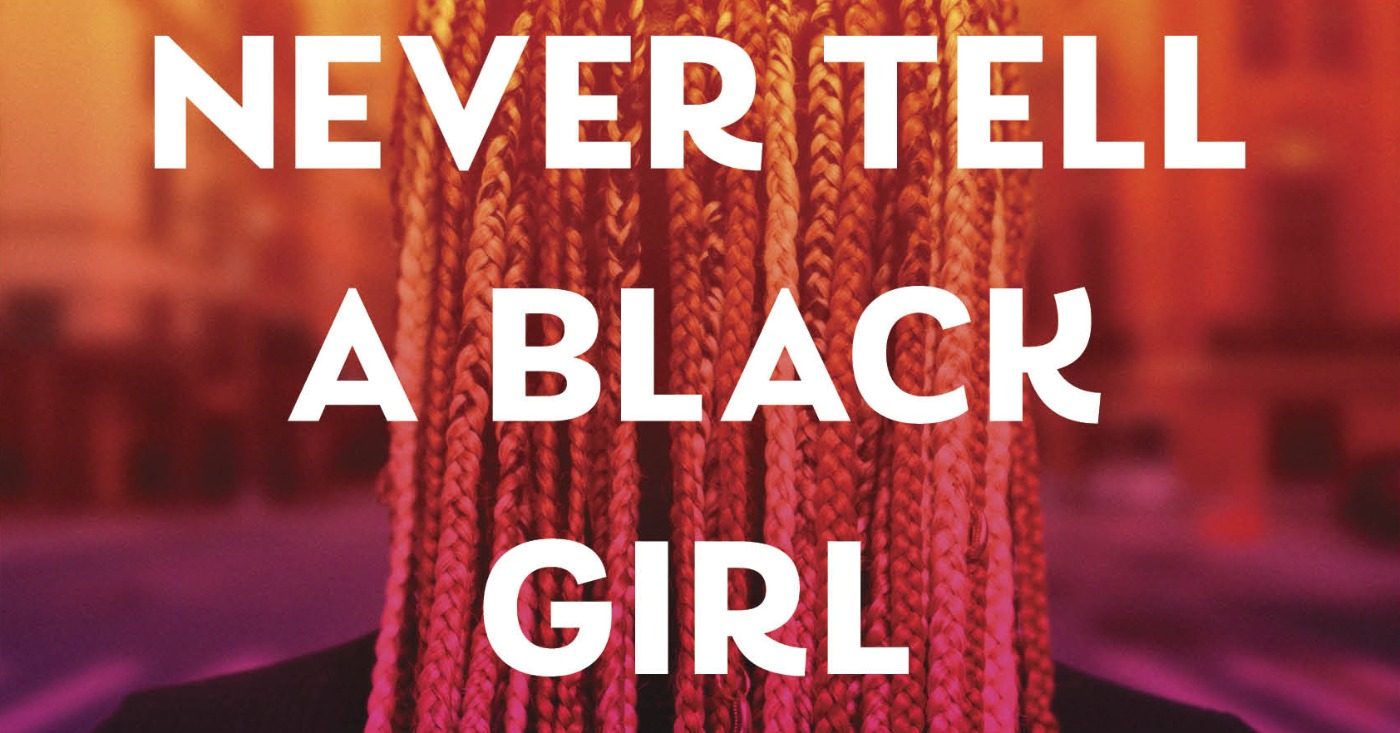
Author: Amena Brown, Copyright: c.2026, Publisher: Tiny Rep Books, SRP: $30.00, Page Count: 320 pages
Some things can really make you cross.
People telling you your business, for instance. People asking questions they have no reason to know the answers to. Folks who criticize your hair or clothes or life. These things would set anyone off; they’d be the last straw for anybody. As in the new book, “Never Tell a Black Girl How to Black Girl” by Amena Brown, some folks just cross the line.
In a way, it’s a matter of grammar.
Depending on how you say it, “Black Girl is a noun and a verb,” says Brown. A Black Girl can be a Black Girl… and she can Black Girl. Brown herself has done it “in six countries.”
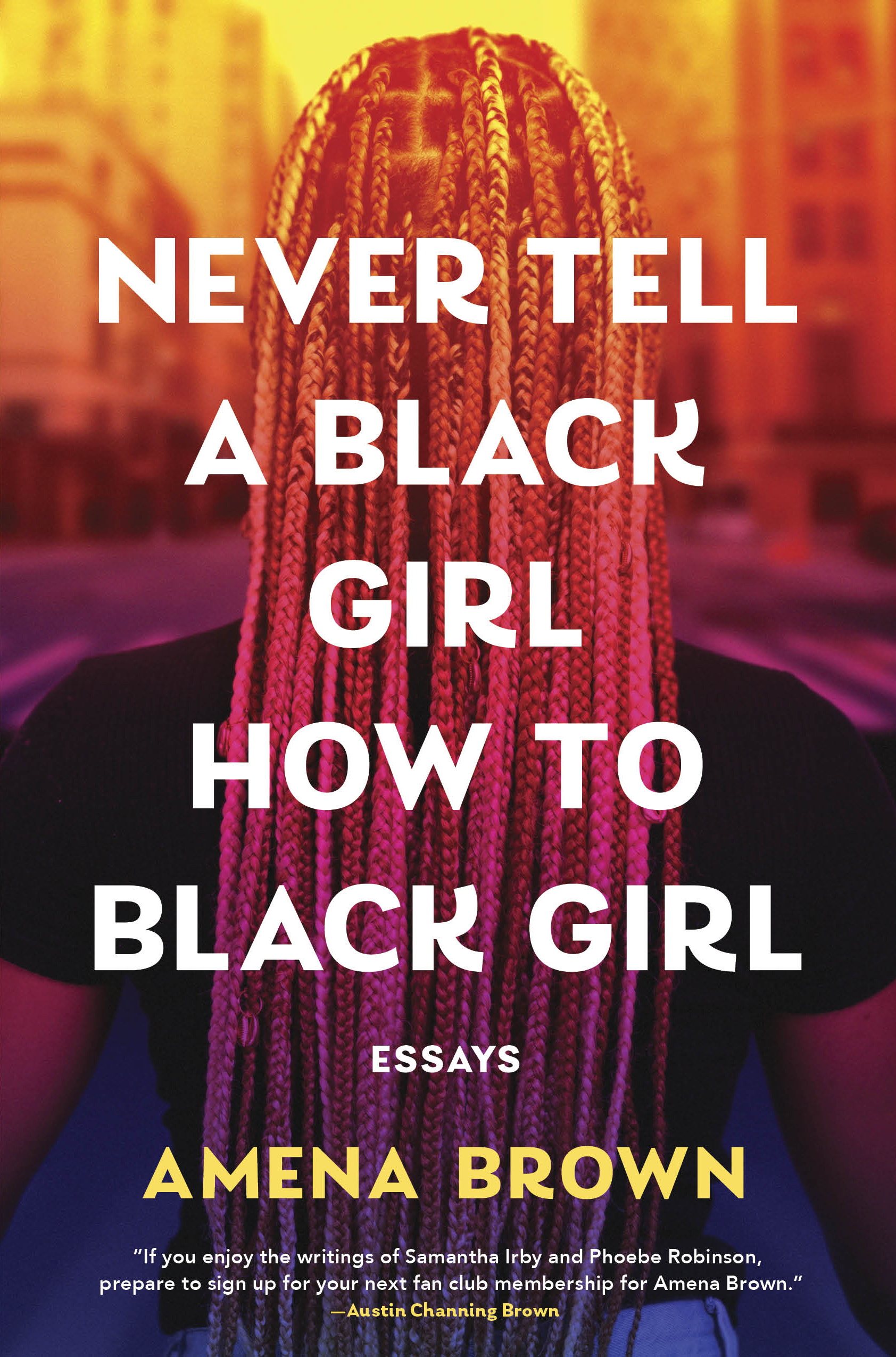
Growing up in North Carolina, she Black Girled her hair her entire life. Her grandma made her sit for box braids when she was small, telling Brown that she was “tenderheaded.” Later, Brown had relaxed hair until she “went broke” and couldn’t afford the process anymore. That was when she got acquainted with her natural hair – although she returned to box braids at least once, and loved them all over again.
As the child of a strict Pentecostal mother, Brown was a “late bloomer.” She didn’t drink alcohol until she was in her twenties. She was chaste while dating and a better church girl than a party girl. After she left the church, she began experimenting with wine first, then cocktails. She learned to cook, reasoning that the path to finding love started in a kitchen, one that happened to be her grandmother’s. And yes, love did eventually come in the form of a red-headed White man who was her friend before he became her boyfriend — and before he became her mother-sanctioned, grandma-approved husband.
Overall, says Brown, there is no single right method for doing this.
“There are so many ways to Black Girl, which means the way you Black Girl is beautiful, and the way I Black Girl is beautiful too.”
Looking for a collection of addictive, can’t-read-just-one essays that’ll make you laugh but that also feel like author Amena Brown is peeking at your life? Want a book that speaks to every corner of your existence?
Yeah, then you want “Never Tell a Black Girl How to Black Girl.”
You know how it is when you spot something so profound, so right, that you just have to call your friends and read it out loud to them? That’s what you’ll find here: truth told with humor that’s also oozing with warmth. Add honesty that’s smart and bold and practically begging for a “Heck, YES!” and you’ve got your new favorite book.
The essays here are short enough to read in a few minutes, but compelling enough to make you want more, so give yourself room.
This is a book for twenty- and thirty-somethings, but also for their mothers and grandmas who can handle respectful irreverence and surefooted playfulness. Can men enjoy “Never Tell a Black Girl How to Black Girl”? Sure, but it’s more for women, cross your heart.
Art
Eric Murphy’s ‘City of Stars’ Honors Culture and Community
Murphy’s artistic journey is grounded in a lifelong passion for storytelling through visuals. Beginning as a child sketching celebrities, he later expanded into collage, blending illustration with found imagery and photography.
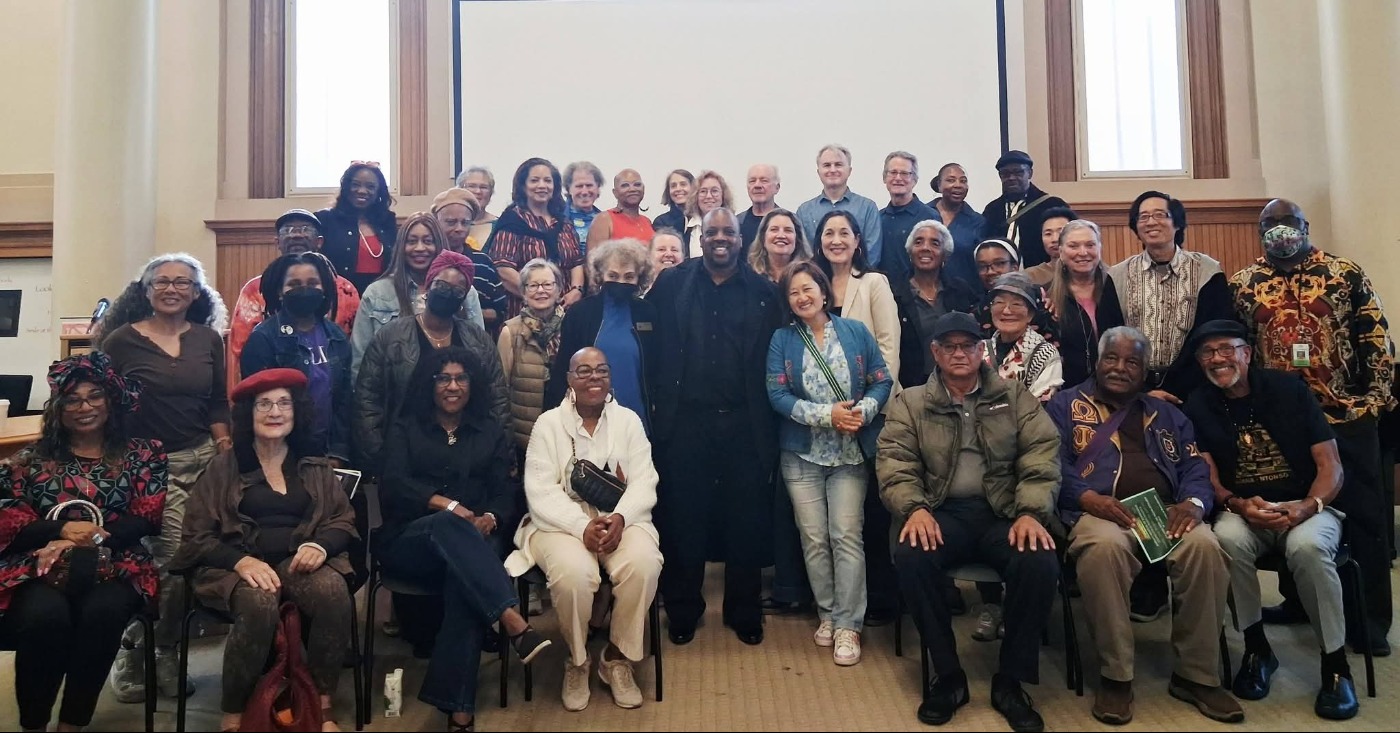
Eric Murphy’s latest exhibition, “Oakland City of Stars: From the Archives,” on view through Aug. 31, offers more than a visual tribute to Oakland; it presents history and a global connection rooted in the city’s cultural legacy.
Curated by Veda Silva at the African American Museum and Library at Oakland (AAMLO), the mixed-media solo show builds on Murphy’s evolving “Oakland All-Stars” series, highlighting figures rooted in community history.
Murphy’s artistic journey is grounded in a lifelong passion for storytelling through visuals. Beginning as a child sketching celebrities, he later expanded into collage, blending illustration with found imagery and photography.
His formal training at Laney College sharpened his photography skills, while his early career as a fashion photographer exposed him to broader creative networks. At the same time, his decade-long work with Pro Arts Gallery in Oakland expanded his artistic journey.
These experiences converge in “City of Stars,” where Murphy combines photography, digital collage, and graphic design into distinctive portraits. Each subject is embedded within a stylized map of Oakland, marked by district lines, and layered with visual references tied to their personal and cultural narratives.

Presented in a ‘playing card’ format, the works replace traditional suits with the City of Oakland logo, while multilingual elements and hand-painted details deepen the storytelling. The result is a series that feels both archival and contemporary, an artistic documentation of Oakland’s influence across generations.
The exhibit’s opening reception was also Murphy’s birthday celebration. “I’m celebrating my birthday, Oakland history, cultural ties, and art.”
About 50 guests attended the exhibit, including Joyce Gordon of Joyce Gordon Gallery, entertainer Zina Escovedo, and activists Alan Banks and Inez Banks. “We loaned one of our pieces to the exhibit,” said Alan Banks proudly.
Murphy credits much of his inspiration to his deep interest in Oakland history and its global intersections. Murphy also created a line of Oakland International language shirts. The concept originated in 2012 during a cultural exchange exhibition he managed between Oakland and its sister city, Fukuoka, Japan, celebrating their 50th anniversary.
Working with artists such as Emmy Award-winner James Gayles and photographer Hiroko To, Murphy began exploring language as a bridge between cultures. After studying Japanese at Laney College, he became fascinated with how “Oakland” could be expressed across languages.
That curiosity evolved into a design series beginning in 2019 with “Oakland” translated into Japanese as “Okurando.” From there, Murphy collaborated with community members and translators to create versions in multiple languages. By incorporating archival materials, cultural symbols, and historical references, Murphy transformed each shirt into a narrative artifact rather than a simple translation.
“Each design allowed me to show how rich our history is and how connected Oakland is to the world,” said Murphy.
This same philosophy drives the “Oakland All-Stars” series. Inspired by a moment of pride watching actor Shemar Moore acknowledge his Oakland roots on national television, Murphy began researching other successful people connected to the city. The series now includes former U.S. Vice President Kamala Harris, actress Zendaya, and the late comedian Paul Mooney, among others linked to Oakland.
“I am proud to feature Oakland in my artwork,” said Murphy. “Oakland is a special place, and art is a great way of showing the world what we are about.”


Port of Oakland, Army Corps Sign Historic Harbor Design Agreement

Democratic Clubs Interview Candidates for Oakland School Board

Nuna Phillips-McKee Celebrates 100 Years: ‘A Century of Faith, Family and God’s Amazing Grace!’

D.A. Ursula Jones Dickson: Terminix to Pay $3.15 Million Over Illegal Disposal of Pesticides, Customer Records

REPORT: Community Level Policy Is Impacting Homelessness and Drug Abuse in California

OPINION: AI Needs to Know Who Is the Boss
Goldi-Locs and Two (or Three) Bears in the Forest in California Hills

Election Watch 2026: 85% of Eligible Voters in California Are Registered

Don’t Let scammers Crash Your School Year

BOOK REVIEW — Curved Air: A Biography of Sickle Cell Anemia and the Quest to Cure the First Molecular Disease

California’s Legal Cannabis Market Hits $8 Billion as State Touts Progress on Fighting Drugs, Crime

Blacks and Latinos Clash Over LA’s Barrio Run; Mayor Karen Bass Calls for Dialogue Across Racial, Neighborhood Lines

Asm. Smallwood-Cuevas’s Bill Repealing ‘Racist’ CalWORKs ‘Man-in-the-House’ Rule Clears Legislature

Asm. Smallwood-Cuevas’s Bill Repealing ‘Racist’ CalWORKs ‘Man-in-the-House’ Rule Clears Legislature

‘Ready to See These Bills Become Law’: Sen. Weber’s Package of 15 Bills Advance to Gov. Newsom’s Desk

Department of Homeland Security Demands California Secretary of State Shirley N. Weber Scrub Voter Rolls

“The Power to See Threats Sooner”: Gov. Newsom, Safety Officials Showcase California’s Investments in Hi-Tech Wildfire Prevention

California Sen. Padilla Joins Colleagues to Introduce Bill Imposing Term Limits on Supreme Court Justices

Less Affluent School Districts, Including Sacramento City, Face Threat of State Takeover

Car Wash Workers Cope with Lingering Impacts of ICE Raids

ESSAY: California Can Close Its Colorectal Cancer Gap

Oakland Post: Week of August 5 – 11, 2026

As Part of Your Back-to- School Checklist, Vaccinate

Oakland ‘Port Serves as a Powerful Engine for Good Jobs and Economic Development

Gov. Newsom Announces $109.6 Million in Funding for 278 Supportive Homes in Bakersfield, Contra Costa, Sacramento and Fresno

California Hispanic Chambers of Commerce Unveils: ‘Powering the Future’ Theme for 47th Annual Statewide Convention

Closing the Gap: What the Data and Frontline Experiences Reveal About Cancer in Black California

Congresswoman Simon Demands Investigation into Trump’s Abuse of Emergency Powers for Coal Export Terminal in West Oakland

Four Candidates, Including Incumbent Barbara Lee, Qualify for Oakland Mayor’s Race

Oakland Post: Week of August 12 – 18, 2026

The Conversation With Al McFarlane 6/23/26

Media Monday 6/22/26

LIVE! ASK ALMA! — TUES. 6.23.26 7PM EST

Car Buying Secrets: 4 Hidden Checks Before You Sign!

Is This 550 HP Charger Worth YOUR Money? AutoNetwork Review

Celebrating Juneteenth – Frederick Douglass on education and resistance

LIVE! — ASK ALMA! — TUES. 6.19.26 7PM EST

Hyundai Ioniq 5 Parking, Safety, and 360 View #shorts

2025 Ioniq 5 New Wiper & Powerful Performance! #shorts

Electric SUV Range: Is 259 Miles Enough? #shorts

EV Charging: How Fast Can You Charge an Electric Vehicle? #shorts

Biometric Cooling… Messaging Seats…Come on! 2025 Infiniti QX80 Autograph 4WD

Charged Up: Witness the Magic of a Fully Electric Car! #shorts

Range Rover Sport PHEV Included…: See What’s Inside This Luxury SUV! #shorts

Invisible Hood View: Perfect Parking with X-Ray Vision! #shorts
-

 Commentary3 weeks ago
Standoff for Justice: Our Homes Are Worth Fighting For
-

 Business3 weeks ago
Gubernatorial Candidate Steve Hilton Blasts California New Tire Rules; Newsom Hits Back
-

 Activism3 weeks ago
Oakland Post: Week of August 26 – September 1, 2026
-

 Business3 weeks ago
Frontier Airlines’ Return to Oakland Airport Brings Flights, Jobs and Opportunity
-

 Business3 weeks ago
Chef Sharon Lee Blends Culinary Excellence, Education and Empowerment
-

 Education3 weeks ago
Gov. Newsom’s Latest Appointees Include Sacramento Advocate for Formerly Incarcerated Students; State’s New Tech Chief
-

 Business3 weeks ago
Oakland Coliseum Project Opens Door for Small Businesses to Build Bigger
-

 Community3 weeks ago
Big City Mayors Ask for “Yes” Vote on Housing Bond Measure; Conservatives Say “No”
