
Activism
Environmental Advocate Margaret Gordon Turns Against Oakland A’s Development
“We, as a community, should hold everybody to task around the issue of equity,” West Oakland community leader and environmental advocate Margaret Gordon said. “The A’s started off talking about equity and ended up putting [all the costs] back on the city. That’s not equity. Unmitigated environmental issues — that’s not equity. I don’t believe they are going to [build affordable] housing — that’s not equity.”

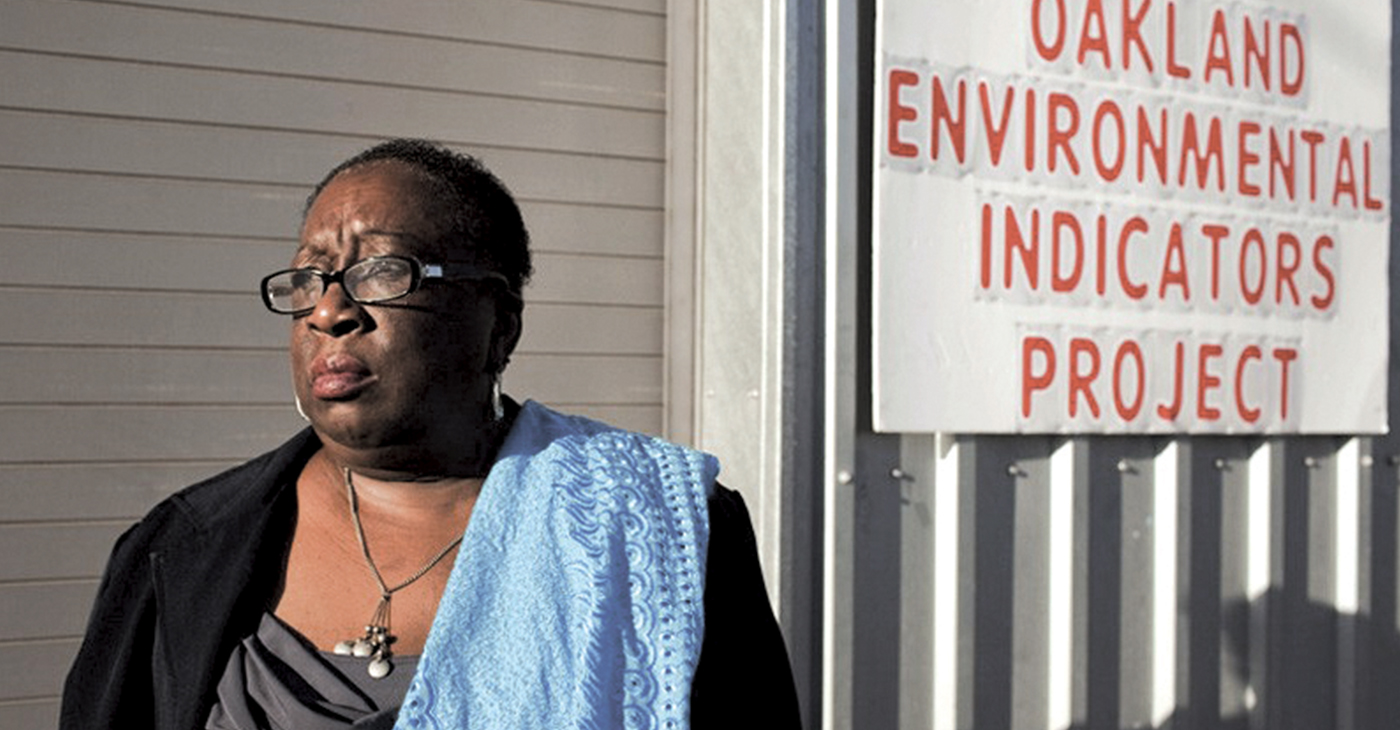
The former Port Commissioner says, ‘The A’s should adopt fair and equitable benefits to Oakland or stop lying and saying (they’re) doing community benefits.’
By Ken Epstein
Until recently, West Oakland community leader and environmental advocate Margaret Gordon had been on board with billionaire John Fisher’s massive real estate and stadium development project at Howard Terminal, which is public land at the Port of Oakland.
She has now withdrawn her support and is actively opposed to the development. In an interview with the Oakland Post this week, she said she was involved since the beginning several years ago, working with others to produce a community benefits agreement with the A’s, which the A’s were expected to pay for.
But the A’s have gone back on their promises, she said.
“We, as a community, should hold everybody to task around the issue of equity,” Gordon said. “The A’s started off talking about equity and ended up putting [all the costs] back on the city. That’s not equity. Unmitigated environmental issues — that’s not equity. I don’t believe they are going to [build affordable] housing — that’s not equity.”
Gordon, co-founder of the West Oakland Environmental Indicators Project (WOEIP), has served on the Port Commission and has struggled for decades to reduce the impact of industrial pollutants that cause respiratory illnesses and improve the overall air quality in her community.

She said her goal in working with the A’s development was to design social justice and environmental justice projects to support West Oakland, Chinatown, Jack London Square area and Old Oakland, four areas that would be most impacted by the massive project.
“We agreed with the City to sit down and do a community benefits agreement, which included education, environmental improvements, housing, jobs, business development,” she said. “We met for almost two years trying to develop our own agreement with the City and the A’s. We finalized our draft, telling them that this is what we want.”
But then the A’s shifted their position. “All of sudden, the A’s stopped the process. We wanted more conversations as part of negotiations. But there never were negotiations to finalize the community benefits agreement,” she said.
“There were no sit-downs with the A’s or city staff. Never.”
Gordon said she was not encouraged by the role of the mayor and city staff in the process. “I don’t see who is going to hold the A’s feet to the fire to enforce community benefits,” not the mayor, the city administrator nor city staff, she said.
She said city leaders are “so hungry for money and development, as long as it’s not in [their] neighborhood, [they] don’t care,” she said, adding that the A’s and the City should adopt benefits to Oakland that are “fair and equitable, or stop lying and saying you’re doing community benefits.”
She said poor people, African Americans, Latinos and others are not going to benefit from this project. “I don’t see them building affordable housing next to the million-dollar townhouses. I just don’t see it.”
People took tours of the Howard Terminal area in December, and it dawned on them that the plans were to create a “whole new city within Oakland,” an exclusive gated new city for rich people
“They decided to release the Final Environmental Impact Report (EIR) during the holidays, minimizing public input,” she said. “The staff, the City of Oakland, they obviously don’t care [about community benefits], otherwise they wouldn’t have written the EIR the way they did,” said Gordon.
“They keep talking about equity, but they’re not practicing equity. This [Environmental Impact Report] is evidence of that. This is all problematic.”
Many of the needed mitigations have not been addressed, Gordon continued. The stadium would be built where thousands of huge semi-trucks are parked now at Howard Terminal, but the City and the A’s still haven’t said where said where the truck parking will be moved, meaning they may be going back onto city streets, polluting residential neighborhoods.
Nor have the officials offered solutions to the large traffic jams that will be produced by the development.
Not only will Oakland residents not get community benefits, they will also end up footing the bill for a lot of the project, Gordon continued.
“We the public are going to end up paying for the infrastructure,” she said. “This is going to use public money.” Over $800 million in public funds will be used on the project.
“The A’s should be paying for this. The rich people who are going to be moving over there should be paying for this,” said Gordon.
“I am not surprised to hear that the A’s have reneged on promises made to the community,“ said Paul Cobb, publisher of the Oakland Post. “The A’s want hundreds of millions of taxpayer money, but they don’t want to pay for community benefits like every other developer does.
“They renege on affordable housing and then turn around and bully our elected leaders by saying if they don’t get what they want, they will leave. Our elected leaders should end this drama now. They need to focus on jobs, homelessness, public safety and real issues affecting Oakland residents, not the ongoing give-and-take sham game played by the A’s.”








Activism
Oakland Post: Week of August 12 – 18, 2026
The printed Weekly Edition of the Oakland Post: Week of August 12 – 18, 2026

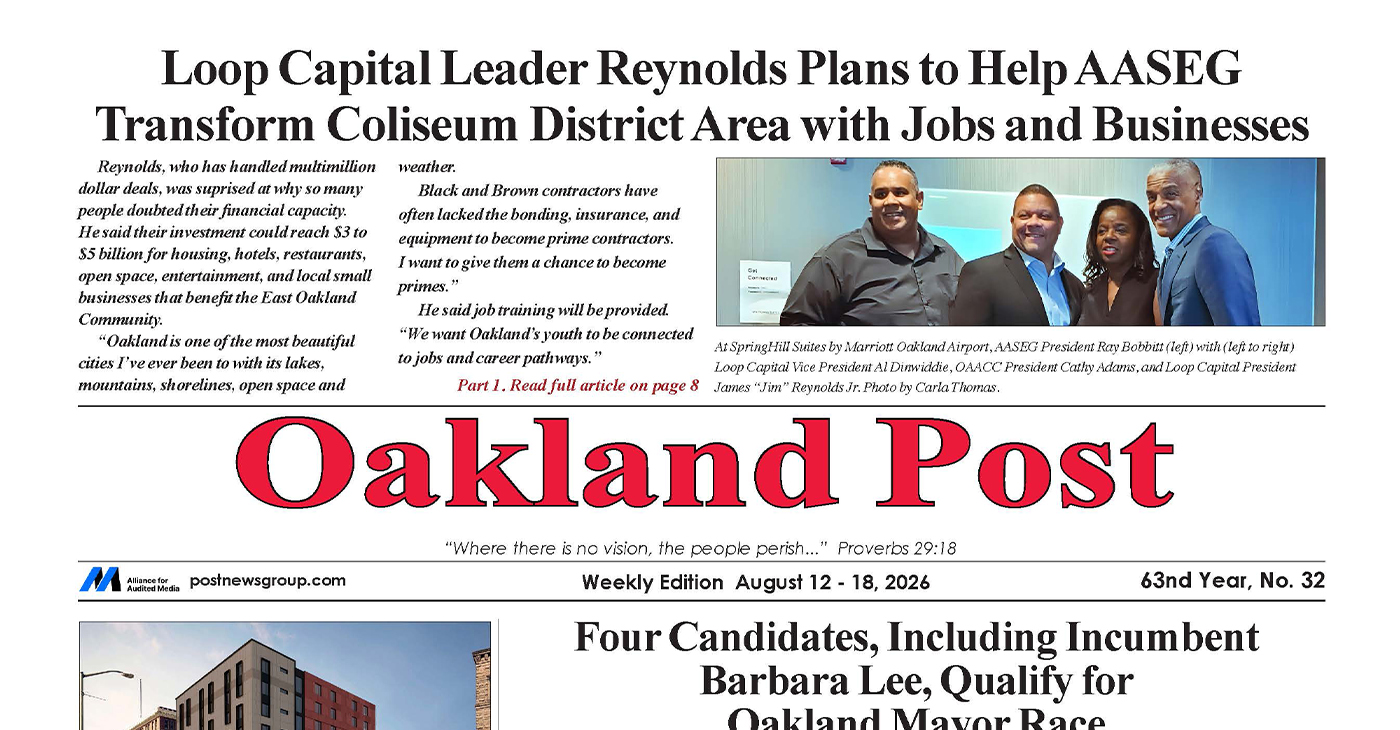
To enlarge your view of this issue, use the slider, magnifying glass icon or full page icon in the lower right corner of the browser window.

Activism
Oakland Post: Week of August 5 – 11, 2026
The printed Weekly Edition of the Oakland Post: Week of August 5 – 11, 2026
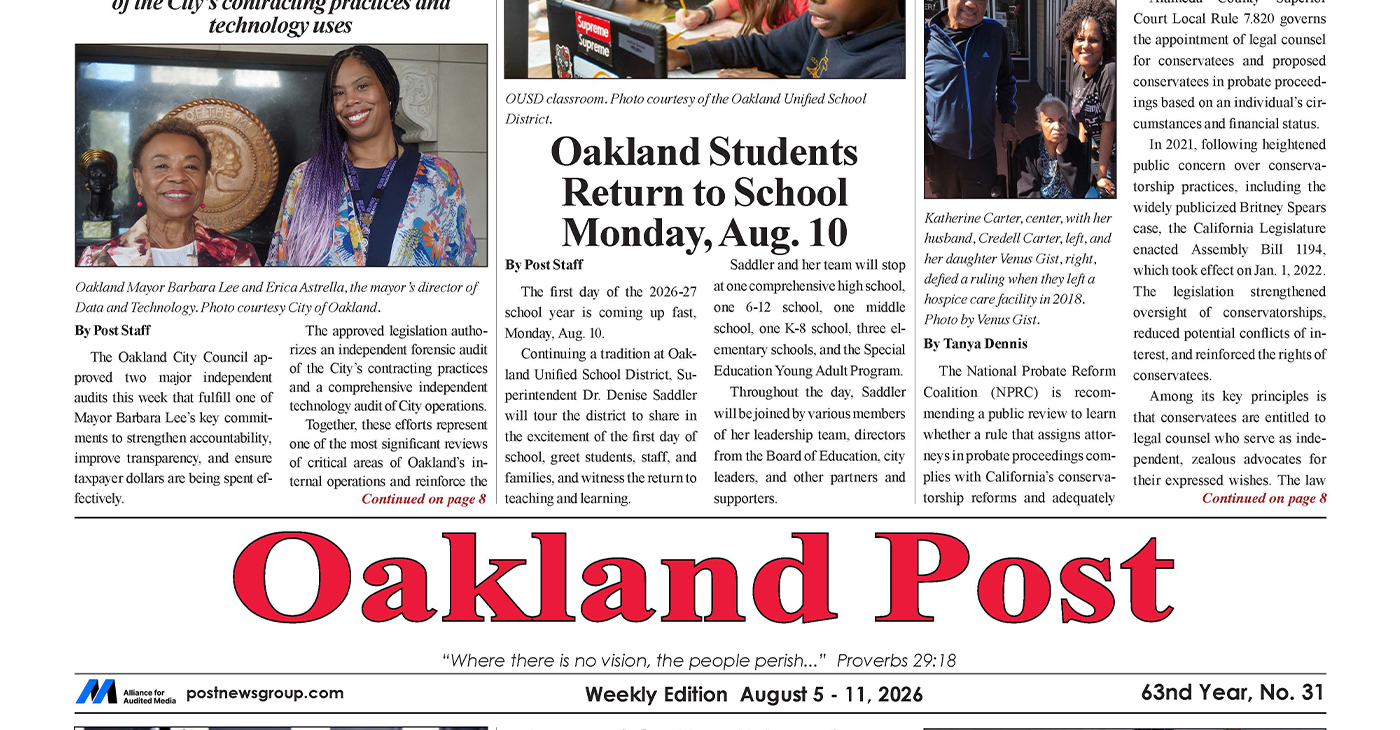
To enlarge your view of this issue, use the slider, magnifying glass icon or full page icon in the lower right corner of the browser window.
Activism
Oakland Post: Week of July 29 – August 4, 2026
The printed Weekly Edition of the Oakland Post: Week of July 29 – August 4, 2026
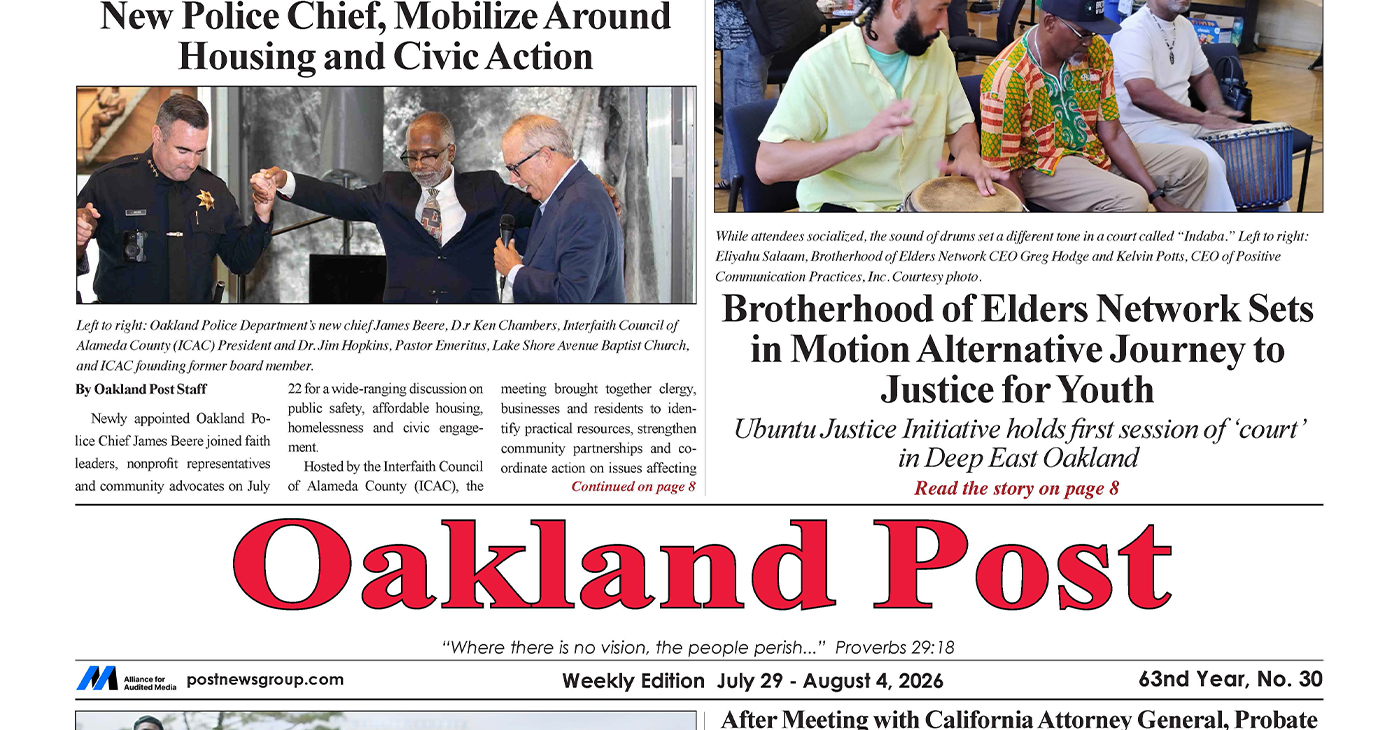
To enlarge your view of this issue, use the slider, magnifying glass icon or full page icon in the lower right corner of the browser window.
WORK FROM HOME
Home-based business with potential monthly income of $10K+ per month. A proven training system and website provided to maximize business effectiveness. Perfect job to earn side and primary income. Contact Lynne for more details: Lynne4npusa@gmail.com 800-334-0540


Oakland Observes Black August with Block Parties, Film Showings, Workshops

Oakland Post: Week of August 12 – 18, 2026

COMMENTARY: Why Local School Tax Measure G1 Will Not Be on the November Ballot

California Hispanic Chambers of Commerce Unveils: ‘Powering the Future’ Theme for 47th Annual Statewide Convention

Returning to Its Roots, the Oakland Black-Eyed Pea Festival Partners with the Freedom Farmers Market Sept. 12

Less Affluent School Districts, Including Sacramento City, Face Threat of State Takeover

From Blueprint to Breakthrough: Tackling Affordable Housing in Oakland

NPRC Scores First Advocacy Victory: David Shaw Finally Gets His Wish to ‘Go Home’

ESSAY: California Can Close Its Colorectal Cancer Gap

Car Wash Workers Cope with Lingering Impacts of ICE Raids

Misty Copeland Shapes Ballet’s Tomorrow

As Part of Your Back-to- School Checklist, Vaccinate

As Part of Your Back-to- School Checklist, Vaccinate

Congresswoman Simon Demands Investigation into Trump’s Abuse of Emergency Powers for Coal Export Terminal in West Oakland

OPINION: The Philippines Isn’t Foreign When Your Family Still Lives There

Department of Homeland Security Demands California Secretary of State Shirley N. Weber Scrub Voter Rolls

Oakland Children’s Hospital Workers and Patients Rally for Pediatric Medical Care

New Judge Could Decide if Karmelo Anthony Gets a New Trial

“The Power to See Threats Sooner”: Gov. Newsom, Safety Officials Showcase California’s Investments in Hi-Tech Wildfire Prevention

Alpha Kappa Alpha Sorority, Inc. Celebrates New North Atlantic Regional Director

Surveillance Pricing Fight: State Senate Debates Bill Banning Retailers from Using AI to Set Prices Based on a Buyer’s Profile

Mount Zion MBC, Church of Jesus Christ of Latter-day Saints Partner to Bring 29,000 Meals to Alameda County

California Sen. Padilla Joins Colleagues to Introduce Bill Imposing Term Limits on Supreme Court Justices

Starting This Summer, California Car Buyers Can Get an Instant $3500 Off the Cost of Electric Vehicles

COMMENTARY: You Are Already Paying for the AI Boom

California Bill Would Let Abuse Victims Use Trauma as Legal Defense for Violent Crime
Car Wash Workers Cope with Lingering Impacts of ICE Raids

Fed Court to Decide Landmark First Amendment Case

Gov. Gavin Newsom Signs Law Streamlining Affordable Housing Rules

OP-ED: ‘The Trusted Messenger’ and the Black Vote

The Conversation With Al McFarlane 6/23/26

Media Monday 6/22/26

LIVE! ASK ALMA! — TUES. 6.23.26 7PM EST

Car Buying Secrets: 4 Hidden Checks Before You Sign!

Is This 550 HP Charger Worth YOUR Money? AutoNetwork Review

Celebrating Juneteenth – Frederick Douglass on education and resistance

LIVE! — ASK ALMA! — TUES. 6.19.26 7PM EST

Hyundai Ioniq 5 Parking, Safety, and 360 View #shorts

2025 Ioniq 5 New Wiper & Powerful Performance! #shorts

Electric SUV Range: Is 259 Miles Enough? #shorts

EV Charging: How Fast Can You Charge an Electric Vehicle? #shorts

Biometric Cooling… Messaging Seats…Come on! 2025 Infiniti QX80 Autograph 4WD

Charged Up: Witness the Magic of a Fully Electric Car! #shorts

Range Rover Sport PHEV Included…: See What’s Inside This Luxury SUV! #shorts

Invisible Hood View: Perfect Parking with X-Ray Vision! #shorts
-
 Featured6 days ago
Department of Homeland Security Demands California Secretary of State Shirley N. Weber Scrub Voter Rolls
-
 Business3 weeks ago
Oakland Children’s Hospital Workers and Patients Rally for Pediatric Medical Care
-
 #NNPA BlackPress2 weeks ago
New Judge Could Decide if Karmelo Anthony Gets a New Trial
-
 Environment6 days ago
“The Power to See Threats Sooner”: Gov. Newsom, Safety Officials Showcase California’s Investments in Hi-Tech Wildfire Prevention
-
 Black History2 weeks ago
Alpha Kappa Alpha Sorority, Inc. Celebrates New North Atlantic Regional Director
-
 Business3 weeks ago
Surveillance Pricing Fight: State Senate Debates Bill Banning Retailers from Using AI to Set Prices Based on a Buyer’s Profile
-
 Business3 weeks ago
Mount Zion MBC, Church of Jesus Christ of Latter-day Saints Partner to Bring 29,000 Meals to Alameda County
-
 Featured6 days ago
California Sen. Padilla Joins Colleagues to Introduce Bill Imposing Term Limits on Supreme Court Justices
