
Activism
Holiday Travel Season: California Black Churches Offering COVID Testing, Vaccinations
The Centers for Disease Control and Prevention (CDC) reports that Black people in the United States are being hospitalized for the virus 2.6 times more than whites. According to the agency’s website, Black people are also dying of COVID-19 at nearly twice the rate of whites.

By Aldon Thomas Stiles | California Black Media

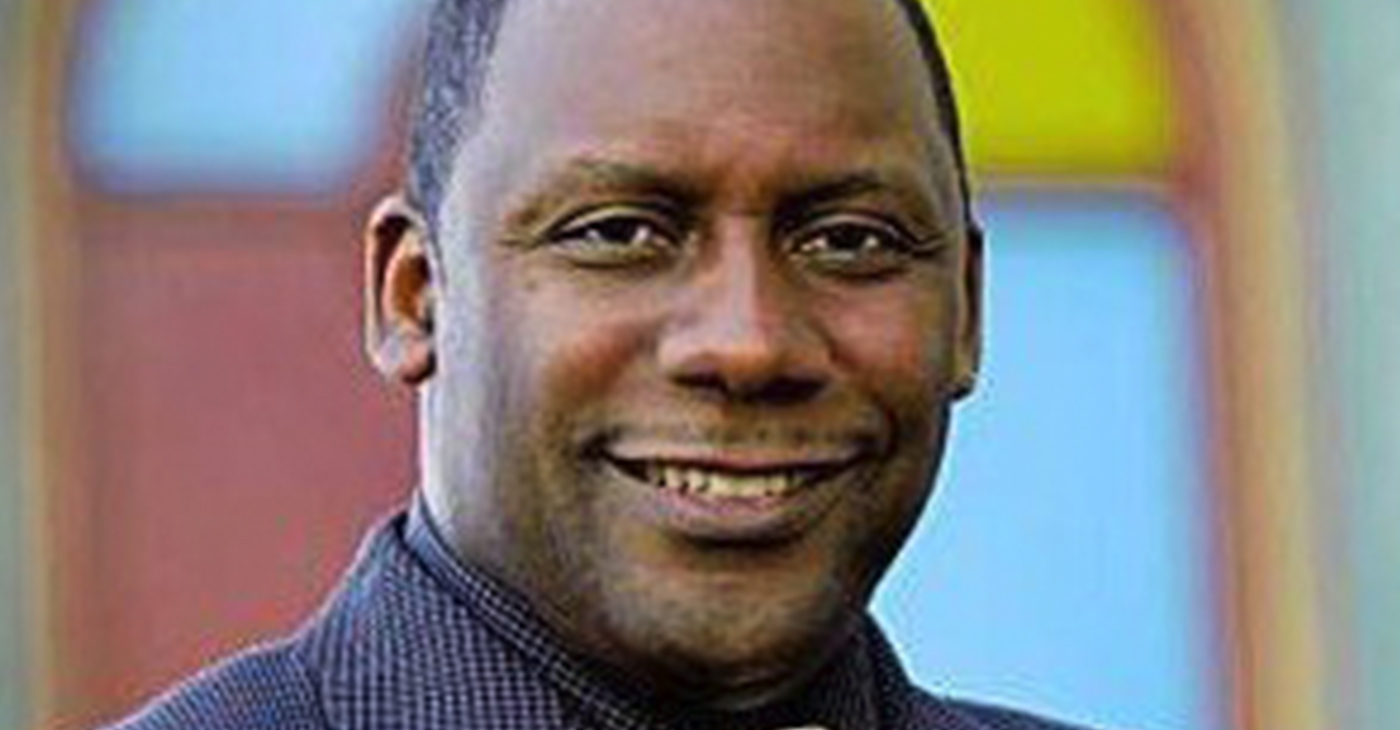
The Rev. Dr. Lawrence E. Van Hook, pastor of Community Church in Oakland, says when COVID-19 vaccinations were first released late last year he did not want to get the shot.
“As African Americans, we have a healthy distrust of the government based on our history,” said Van Hook.
But after some soul searching, there was a shift in his spirit, says Van Hook. It led to a change of his heart.
“It came to me through God’s visitation of the holy spirit that not only do I need to get vaccinated, but I need to become an ambassador in the community where we live, work and worship. So that’s how my journey began.”
A little over a year ago, Van Hook joined hands with 38 other Black pastors from around California and formed the African American Community Empowerment Council (AACEC). With help from the state, members began setting up testing and vaccination sites at their churches.
“It is an initiative led by African American pastors, realizing that we need to pay special attention to our community – an affirmative action plan, if you please — for Black Californians who are understandably skeptical and don’t want to get vaccinated,” Van Hook said.
“Our healing, our hope, comes through vaccination,” he continued. “That is how we will push past this pandemic in a healthy way to get to our new normal.”
Now, ahead of the holidays, Van Hook and other pastors are encouraging Black Californians to get vaccinated and tested before traveling and getting together with relatives.
“A majority of the cases and deaths are among those who are unvaccinated,” said Van Hook. “For those of us who have been waiting to see what was in it, what it was all about, we now have over a year of vaccinations and nobody’s eyes have fallen out. No bug has been placed in us where we can be tracked. There are so many stories we have heard in social media.”
The Centers for Disease Control and Prevention (CDC) reports that Black people in the United States are being hospitalized for the virus 2.6 times more than whites. According to the agency’s website, Black people are also dying of COVID-19 at nearly twice the rate of whites.
During the thick of the pandemic, the AACEC website says the pastors “stepped up,” responding to a call to action by Gov. Gavin Newsom, who asked all Californians to deploy every resource available to them to confront and defeat the deadly virus.
“Through this effort, testing of at-risk, underrepresented, and under-resourced African Americans, and all community members appearing for a test, will be phased across the state beginning in Alameda County and extending in regular intervals to encompass San Francisco, Sacramento, Solano, Contra Costa, San Joaquin, Los Angeles, Riverside, San Gabriel, and San Diego counties,” the AACEC website reads.
There are now also testing sites in San Bernardino County. Vaccination sites are located in Oakland, Pasadena, Sacramento and San Francisco.
Across the country, another organization called Choose Healthy Life (CHL) has similarly united Black religious leaders to battle COVID-19, opting to focus on tackling misinformation and increasing vaccination rates.
Black clergy members and civil rights leaders such as the Rev. Al Sharpton and the Rev. Calvin O. Butts III, pastor of Abyssinian Baptist Church in New York, are leading the charge for this program.
“COVID-19 has exposed health disparities, and more disturbingly, the impact of misinformation among our own people. But I have looked beyond the horizon of today’s headlines. After 750,000 deaths in America and more than 5 million worldwide, the pendulum is beginning to swing —and Choose Healthy Life is at the vanguard of that change,” Sharpton said.
CHL spokesperson Judy Klym detailed the program’s scope.
“After launching CHL in 50 churches in five major cities in January 2021, the program’s expansion has led to more than 50,000 members of the public being educated and empowered,” she said. “Through this collaborative effort, more than 6 million people have been impacted. Choose Healthy Life now has 120 participating churches in 13 states.”
Klym cited the new Omicron variant as part of the reason for the urgency of this program’s implementation.
“As the threat from COVID continues with the emergence of the Omicron variant, the ongoing nature of the pandemic seems inevitable. CHL is rising to meet the challenge by building a sustainable infrastructure to help Black communities throughout the pandemic and future health crises,” Klym stated.
Debra Fraser-Howze, founder of CHL, says the Black church’s involvement in the COVID-19 fight is critical.
“The Black church and clergy have been a steadfast center of strength and leadership during so many of our crises and struggles in the past. Now, through the Choose Healthy Life Action Plan, they are once again leading the way by ensuring that Black communities are better informed and safer throughout the pandemic,” she said.
Van Hook says when vaccination began at his church earlier this year on Resurrection Sunday, he drew a parallel.
“Vaccinations equal resurrection. Both of them give life as opposed to the death that this invisible, deadly virus has ministered all over the world,” he said.











Activism
Oakland Post: Week of September 30 – October 6, 2026
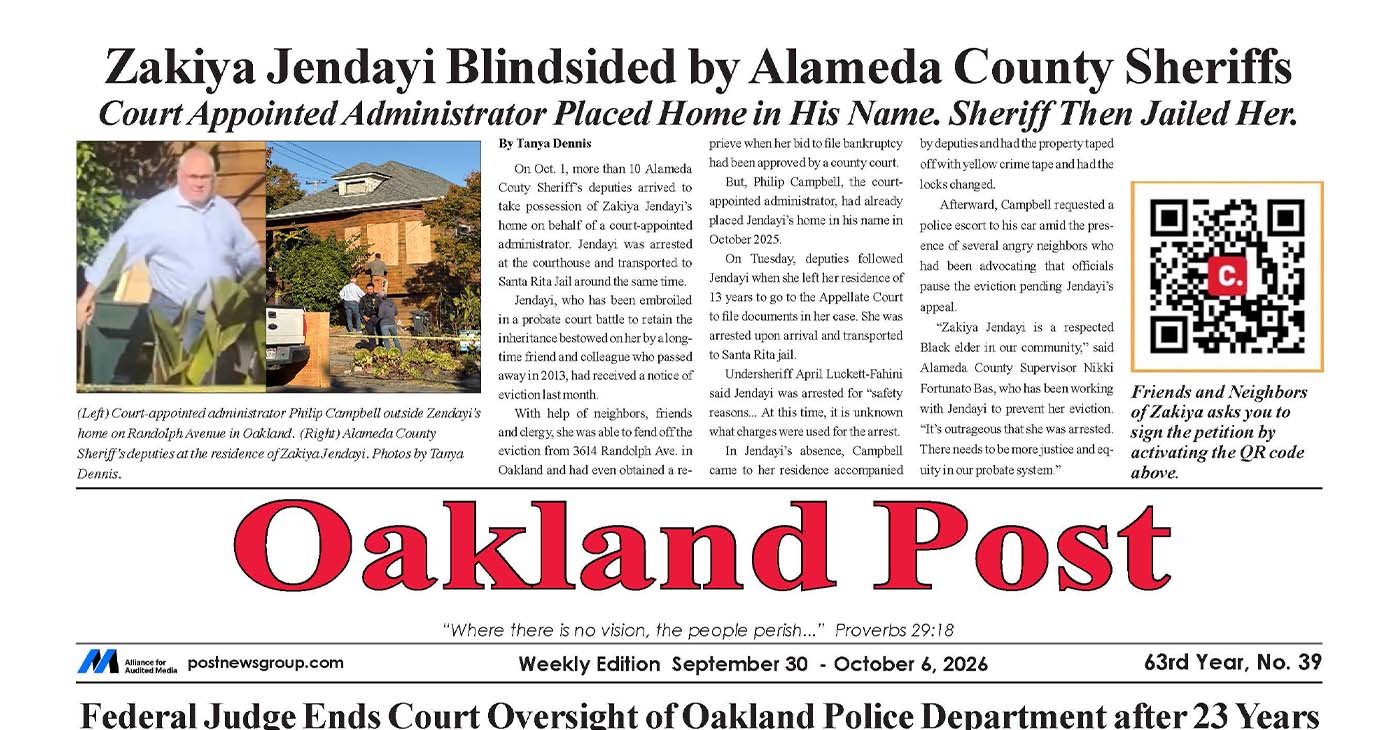
The printed Weekly Edition of the Oakland Post: Week of September 30 – October 6, 2026
To enlarge your view of this issue, use the slider, magnifying glass icon or full page icon in the lower right corner of the browser window.
Activism
Oakland Post: Week of September 23 – 29, 2026
The printed Weekly Edition of the Oakland Post: Week of September 23 – 29, 2026

To enlarge your view of this issue, use the slider, magnifying glass icon or full page icon in the lower right corner of the browser window.
Activism
Oakland Post: Week of September 16 – 22, 2026
The printed Weekly Edition of the Oakland Post: Week of September 16 – 22, 2026

To enlarge your view of this issue, use the slider, magnifying glass icon or full page icon in the lower right corner of the browser window.


Listening as a Lifeline: A Doula’s Witness to Black Maternal Health

New Protections for Ticket Buyers: Gov. Newsom Signs Assemblymember Isaac Bryan’s Bill

‘We Don’t Talk Trash — We Pick Up Trash!’

Zakiya Jendayi Arrested, Locked Out of Home by Sheriff’s Deputies

Oakland Post: Week of September 30 – October 6, 2026

Asm. Corey Jackson Announces Launch of 24-Hour Childcare in His District

IN MEMORIAM: The Rev. Leon “Sonny” Clark, Longtime Orange County Pastor and Community Leader, Dies at 72

Poll: Becerra Widens His Lead Over Hilton; Californians Split on Wealth Tax

From Historic Memories to New Possibilities: Oakland Celebrates Coliseum 60

County Office of Education Says OUSD Finances Are Getting Healthier, Materially Stronger

LIVE FREE Sunday Dinner Brings Faith, Fellowship and Civic Conversation to Oakland

Remembering Chauncey Bailey as Student Journalists Face Threats to Truth-Telling

BLACspace Cooperative Invites Bay Area to Experience Oakland’s Black Cultural Ecosystem Through a BLAC Map Tour + Party

In Wake of Death on Doorstep, Williams Chapel Baptist Church Calls for Better Care, Funding for Unhoused

Oakland Centenarian Nuna McKee Honored!

Standoff for Justice: Our Homes Are Worth Fighting For

Oakland Post: Week of August 26 – September 1, 2026

Frontier Airlines’ Return to Oakland Airport Brings Flights, Jobs and Opportunity

Gubernatorial Candidate Steve Hilton Blasts California New Tire Rules; Newsom Hits Back

Chef Sharon Lee Blends Culinary Excellence, Education and Empowerment

Jackie Wright Champions Bay Area Stories, Filmmakers and Cultural Institutions

Misnamed ‘Parent’ PAC Seeks to Influence Oakland School Board Elections

Oakland Coliseum Project Opens Door for Small Businesses to Build Bigger

Big City Mayors Ask for “Yes” Vote on Housing Bond Measure; Conservatives Say “No”

Gov. Newsom’s Latest Appointees Include Sacramento Advocate for Formerly Incarcerated Students; State’s New Tech Chief

Longtime BWOPA Member Brendalyn Goodall Appointed to California Workforce Development Board

Gov. Newsom Signs Law Shielding Immigration Aid Workers From Doxing Threats

Secretary of State Shirley N. Weber Urges Californians to Vote Early as Voter ID Battle Intensifies

Oakland Post: Week of September 2 – 8, 2026

IN MEMORIAM: Dolly Parton Dead at 80 — How She Built a Legacy of Love and Earned Her Place in Black Culture

The Conversation With Al McFarlane 6/23/26

Media Monday 6/22/26

LIVE! ASK ALMA! — TUES. 6.23.26 7PM EST

Car Buying Secrets: 4 Hidden Checks Before You Sign!

Is This 550 HP Charger Worth YOUR Money? AutoNetwork Review

Celebrating Juneteenth – Frederick Douglass on education and resistance

LIVE! — ASK ALMA! — TUES. 6.19.26 7PM EST

Hyundai Ioniq 5 Parking, Safety, and 360 View #shorts

2025 Ioniq 5 New Wiper & Powerful Performance! #shorts

Electric SUV Range: Is 259 Miles Enough? #shorts

EV Charging: How Fast Can You Charge an Electric Vehicle? #shorts

Biometric Cooling… Messaging Seats…Come on! 2025 Infiniti QX80 Autograph 4WD

Charged Up: Witness the Magic of a Fully Electric Car! #shorts

Range Rover Sport PHEV Included…: See What’s Inside This Luxury SUV! #shorts

Invisible Hood View: Perfect Parking with X-Ray Vision! #shorts
-
 Community3 weeks ago
Misnamed ‘Parent’ PAC Seeks to Influence Oakland School Board Elections
-
 Activism4 weeks ago
Oakland Post: Week of September 2 – 8, 2026
-

 Community3 weeks ago
Richmond Tiny House Village Farm & Garden Set to Open Gates on Sept. 26
-

 Activism3 weeks ago
Oakland Post: Week of September 9 – 15, 2026
-

 Black History3 weeks ago
Latest Massacre in Haiti Reveals Cruelty U.S. Deportations
-

 Black History3 weeks ago
OPINION: Nolan Wells’ Death One of Several Signifying Racial Terror Lives on in U.S. South
-

 Business2 weeks ago
Mayor Lee Announces $1 Million Kaiser Permanente Grant for Pilot Program to Address Homelessness, Clean Up Public Spaces throughout Oakland
-

 Community3 weeks ago
Democratic Clubs Interview Candidates for Oakland School Board
