
Bay Area
Who Is Janani Ramachandran, Candidate for Assembly District 18?
Social justice lawyer Janani Ramachandran is a runoff election for State Assembly District 18, which will be held on Tuesday, Aug. 31.

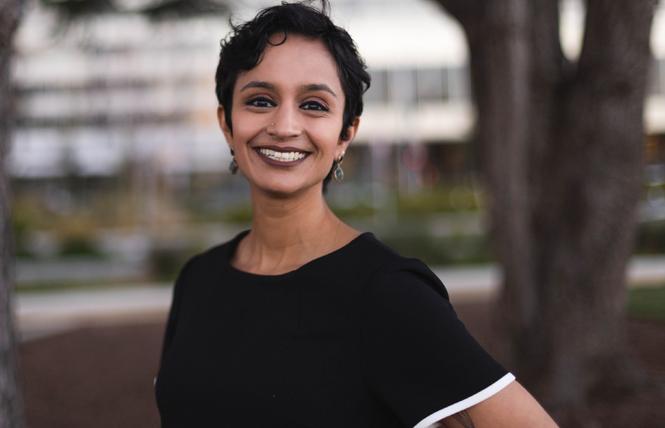
Post columnist Richard Johnson conducted the following interview with the candidate, which has been edited for length and clarity.
(RJ): Tell us about your background and upbringing?
(JR): I am the granddaughter of immigrants from a small village in South India who immigrated to this country for a better life, education, jobs and health care. My grandparents were represented by labor unions that eventually led to stable jobs, higher living wages, health care and decent benefits. I am grateful to have been part of a family that was lifted out of poverty because of the strength of their labor unions.
When I went to my undergrad at Stanford, I worked at a community health clinic for a few years serving teen moms and immigrant mothers while providing Case Management services for many folks. A majority of my work there was with survivors of domestic violence. Many were on the brink of homelessness.
(Later), I lived in Oakland and attended Berkeley law school and continued to do a lot of direct Community Services representing elderly tenants who were facing eviction. I worked on restorative justice programs to address community violence, interpersonal violence, and continuing to represent survivors of violence.

All of these experiences got me thinking about the corruption in many parts of the system whether it is Oakland Calif., local governments or across the country. So, I joined the City of Oakland Public Ethics Commission to determine where the corruption really lies, to uncover bribery and lack of transparency.
(RJ): What do you bring to the table that others are lacking?
Firstly, real compassion. You know, we have a lot of leaders working in politics but are faking it, because they want political power. They are driven by ego and greed. I have provided Community Services my entire life. I’m driven to do this, because I’ve seen the unintended consequences of our laws that are not written with the interests of us and not written with the interests of communities in Oakland.
(RJ): Can you name two main challenges that you feel passionate about that would benefit the people?
(JR): One thing is raising the minimum wage because $15 does not cut it for anyone, especially here in the East Bay. In Oakland, if you made $15 an hour, you would have to work 89 hours a week for a one-bedroom apartment. Our wages are too low, and I want to raise the minimum wage to $22 an hour.
The second thing is housing. A lot of my work as an attorney was representing elderly tenants in Oakland who are being evicted and/or survivors of violence. Many of these people are being evicted despite the global pandemic. So, our state does not put any priority on tenants.
(RJ): Far too many legislators in office tend to renege on their promises that govern them.
(JR): Corporate money is a huge reason why people don’t keep their promises. Our own governor, Gavin Newsom, promised that he would implement a “Medicare for All” system that would be paid for by the government. This system will save lives and save our state money. The only people that it would harm are big pharmaceutical companies, or big health insurance companies.
These are the very industries that are lining the campaign’s pockets of even our so-called progressive Democrats, including my opponent who insists she is for universal health care.
To the contrary, she’s gotten over $200,000 from the healthcare industry and Big Pharma who do not want a universal health care system because it’s going to impact their profits. This happens time and again!
(RJ): What do you put first in your life to help you remain on the right path?
(JR): I believe in God and I’m spiritual. This is important to me because my spirituality guides me to make sure that I’m not operating in greed, but I’m doing so for the service of others.
(RJ): What is your position on LGBTQA issues?
(JR): I support them as I am LGBTQ myself. I identify as a queer woman and as a lesbian woman.
(RJ): How has women’s liberation helped or hinder the community?
(JR): It’s important that genders are equal, and we need to start treating all genders as equal. Women do not make the same money, and we earn approximately .35 cents to the dollar.
We need to make sure that we have equality. We need to make sure that women have paid leave to take care of family members, children and elders without having to risk their jobs. We have so many women who are incarcerated for reasons unrelated and even though they’re Victims of Crime themselves. We need to unpack this and dive deeper and make sure we have equality in so many different ways.
(RJ): What is your position on providing living spaces, employment training and substance funding to those who have paid their dues to society by serving their time?
(JR): Absolutely, we need to make sure that we are providing all the required social, mental, housing and employment opportunities for those who are re-entering society. We need to make those pathways easier, not more difficult in the way that we have them.
(RJ): Will you support more family visits (for inmates? Will you support legislation that requires education and training for inmates?
(JR) Yes. We need to provide all sorts of services and opportunities for all inmates. I previously volunteered in the San Quentin Restorative Justice Project. I learned so much from and about these men. The programs offered prepared them to engage in a conversation about growth, learning and the restorative justice process with fellow inmates and leaders. These types of programs should be funded more and eliminated.
(RJ): Given the fact that we live in a divided country, one blue and one red, how can you help to bring people together in unification?
(JR): We need to return to compassion and empathy. We need to see humanity and each other right now. But I need to say this is not only the case in California. It’s not just about blue versus red. You know, it’s about Democrat versus Democrat as well. I’m going up against an opponent who slammed it and she was a fellow Democratic and woman of color who slanders, comes up with lies, and dirty-nasty smear campaigns that violate all sorts of ethics. So, we need to look within our own party.
(RJ): Since marijuana has been legalized, (why are offenders still incarcerated)?
(JR): I don’t understand why we still have individuals incarcerated for crimes related to marijuana and cannabis. They need to have an immediate pathway to release and to be pardoned. It is unacceptable that we haven’t already implemented that.
(RJ): How do you see the role of the police? Do they truly serve and protect the communities?
(JR): I know we need to hold police accountable. We really do need to make sure that police are not getting away with committing crimes and with a sense of impunity. Last year, there were 1172 people killed at the hands of police. How many of their families got any sense of justice? How many of those police officers faced justice? Few cases have been fully investigated.
(RJ): What should the voters know about you that they don’t already know?
(JR): I’m real, I’m authentic. I’m not going to be someone who makes empty campaign promises while turning my back on the people. When I say I’m listening to the people, I am. When I am elected, I’m coming back to make sure that I continue to hear from you and implement the answers.
I want us to march together, protest together and fight together because politics can’t be the answer alone. It has to be politics along-side social movements that create change. We have to work together, and I will continue to ask for your feedback, ideas and solutions.
(RJ): How do you see the recall of Governor Newsome?
(JR): I oppose the recall. If we as voters decide that we’re not happy with what he’s doing, then next year is an opportunity for voters to vote him out. I think about what those hundreds of millions of dollars could have gone towards instead of being used on a recall: public education, recovery, supporting small businesses, raising the minimum wage.
(RJ): Back to religion, how can churches assist someone in your position?
(JR): I’ve had the honor of speaking at several churches in Oakland with pastors inviting me to address their congregation. I also spoke to their church members who reside in East and West Oakland to share my message and connect with folks. I really appreciate having the opportunity to speak at churches.
The Oakland Post’s coverage of local news in Alameda County is supported by the Ethnic Media Sustainability Initiative, a program created by California Black Media and Ethnic Media Services to support community newspapers across California.











Activism
Oakland Post: Week of September 16 – 22, 2026
The printed Weekly Edition of the Oakland Post: Week of September 16 – 22, 2026


To enlarge your view of this issue, use the slider, magnifying glass icon or full page icon in the lower right corner of the browser window.

Activism
Oakland Post: Week of September 9 – 15, 2026
The printed Weekly Edition of the Oakland Post: Week of September 9 – 15, 2026

To enlarge your view of this issue, use the slider, magnifying glass icon or full page icon in the lower right corner of the browser window.
Activism
Oakland Post: Week of September 2 – 8, 2026
The printed Weekly Edition of the Oakland Post: Week of September 2 – 8, 2026
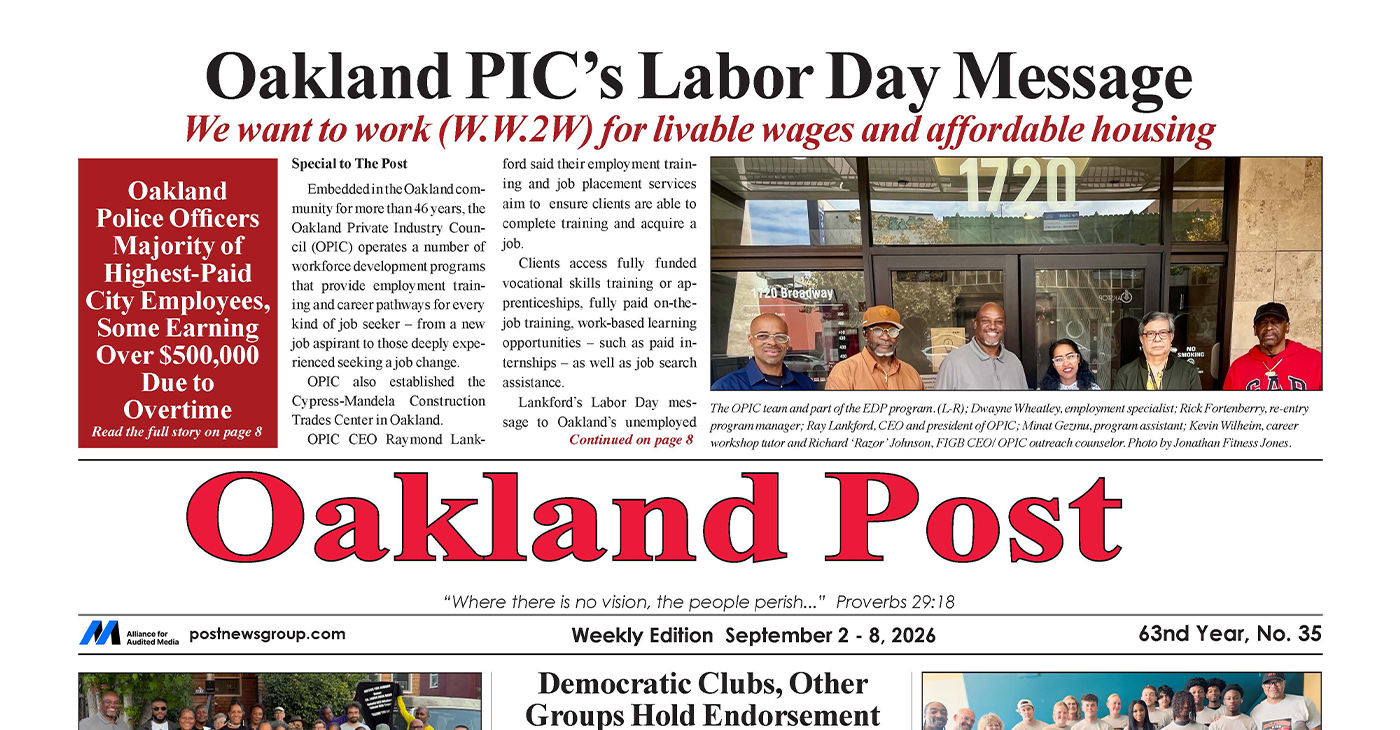
To enlarge your view of this issue, use the slider, magnifying glass icon or full page icon in the lower right corner of the browser window.



Doulas Are Helping Black California Moms Navigate Pregnancy–Even as High Mortality Rates Persist

Newsom Signs Addictive Social Media Law to Protect Kids

On Your November Ballot: Prop 38 Would Allocate $8.4 Billion to Immunology and Immunotherapy Funding

Ask California: Golden State Releases New AI Chatbot

Asm. Isaac Bryan’s Bill Banning California Police From ICE Side Jobs Reaches Newsom’s Desk

Assemblymember LaShae Sharp-Collins’s Bill Would Pause Law Enforcement’s Use of Shock Gloves Pending Study

BOOK REVIEW: ‘Laws of Solomon’ Reveals Tender Heart of Former Child Soldier

OPINION: The New American Fear – From 9-11 to AI

Passing for White, Fighting for Black America: The Courage of Walter White

Oakland People’s Arms Embargo Coalition Demands End to Military Shipments Thru Oakland

Barbara Lee Mourns Gloria Steinem, Remembers a Friendship Rooted in Equality

Event Preview: ‘Fashion v. Fascism’ – A Runway Revolution Is Coming to the Bay Area

Two Looming Threats Every Alameda County Elder Should Know About

Oakland Mayor Reads to Children at Bookout Block Party at Marcus Books Store

Tradition Comes to the Streets in 11th Annual Black-Eyed Pea Festival at the Freedom Farmers Market

Less Affluent School Districts, Including Sacramento City, Face Threat of State Takeover

ESSAY: California Can Close Its Colorectal Cancer Gap

California Hispanic Chambers of Commerce Unveils: ‘Powering the Future’ Theme for 47th Annual Statewide Convention

Four Candidates, Including Incumbent Barbara Lee, Qualify for Oakland Mayor’s Race

Oakland Post: Week of August 12 – 18, 2026

From Blueprint to Breakthrough: Tackling Affordable Housing in Oakland

Oakland Observes Black August with Block Parties, Film Showings, Workshops

COMMENTARY: Why Local School Tax Measure G1 Will Not Be on the November Ballot

Standoff for Justice: Our Homes Are Worth Fighting For

Returning to Its Roots, the Oakland Black-Eyed Pea Festival Partners with the Freedom Farmers Market Sept. 12

Oakland Post: Week of August 26 – September 1, 2026

NPRC Scores First Advocacy Victory: David Shaw Finally Gets His Wish to ‘Go Home’

Frontier Airlines’ Return to Oakland Airport Brings Flights, Jobs and Opportunity

Gubernatorial Candidate Steve Hilton Blasts California New Tire Rules; Newsom Hits Back

Chef Sharon Lee Blends Culinary Excellence, Education and Empowerment

The Conversation With Al McFarlane 6/23/26

Media Monday 6/22/26

LIVE! ASK ALMA! — TUES. 6.23.26 7PM EST

Car Buying Secrets: 4 Hidden Checks Before You Sign!

Is This 550 HP Charger Worth YOUR Money? AutoNetwork Review

Celebrating Juneteenth – Frederick Douglass on education and resistance

LIVE! — ASK ALMA! — TUES. 6.19.26 7PM EST

Hyundai Ioniq 5 Parking, Safety, and 360 View #shorts

2025 Ioniq 5 New Wiper & Powerful Performance! #shorts

Electric SUV Range: Is 259 Miles Enough? #shorts

EV Charging: How Fast Can You Charge an Electric Vehicle? #shorts

Biometric Cooling… Messaging Seats…Come on! 2025 Infiniti QX80 Autograph 4WD

Charged Up: Witness the Magic of a Fully Electric Car! #shorts

Range Rover Sport PHEV Included…: See What’s Inside This Luxury SUV! #shorts

Invisible Hood View: Perfect Parking with X-Ray Vision! #shorts
-
 Commentary4 weeks ago
Standoff for Justice: Our Homes Are Worth Fighting For
-
 Activism4 weeks ago
Oakland Post: Week of August 26 – September 1, 2026
-
 Business4 weeks ago
Frontier Airlines’ Return to Oakland Airport Brings Flights, Jobs and Opportunity
-
 Business4 weeks ago
Gubernatorial Candidate Steve Hilton Blasts California New Tire Rules; Newsom Hits Back
-
 Business4 weeks ago
Chef Sharon Lee Blends Culinary Excellence, Education and Empowerment
-

 Community4 weeks ago
Big City Mayors Ask for “Yes” Vote on Housing Bond Measure; Conservatives Say “No”
-
 Black History4 weeks ago
Jackie Wright Champions Bay Area Stories, Filmmakers and Cultural Institutions
-

 Education4 weeks ago
Gov. Newsom’s Latest Appointees Include Sacramento Advocate for Formerly Incarcerated Students; State’s New Tech Chief
