
Berkeley
Facing Eviction, Tenant Sues UC Regents to Release Public Records
In a letter sent in August last year to Logusch, Wallace, and other 1921 Walnut Street tenants, UC Berkeley Real Estate Director Michelle De Guzman wrote, “The University will not be holding in-person or virtual conversations regarding the property for the foreseeable future.”

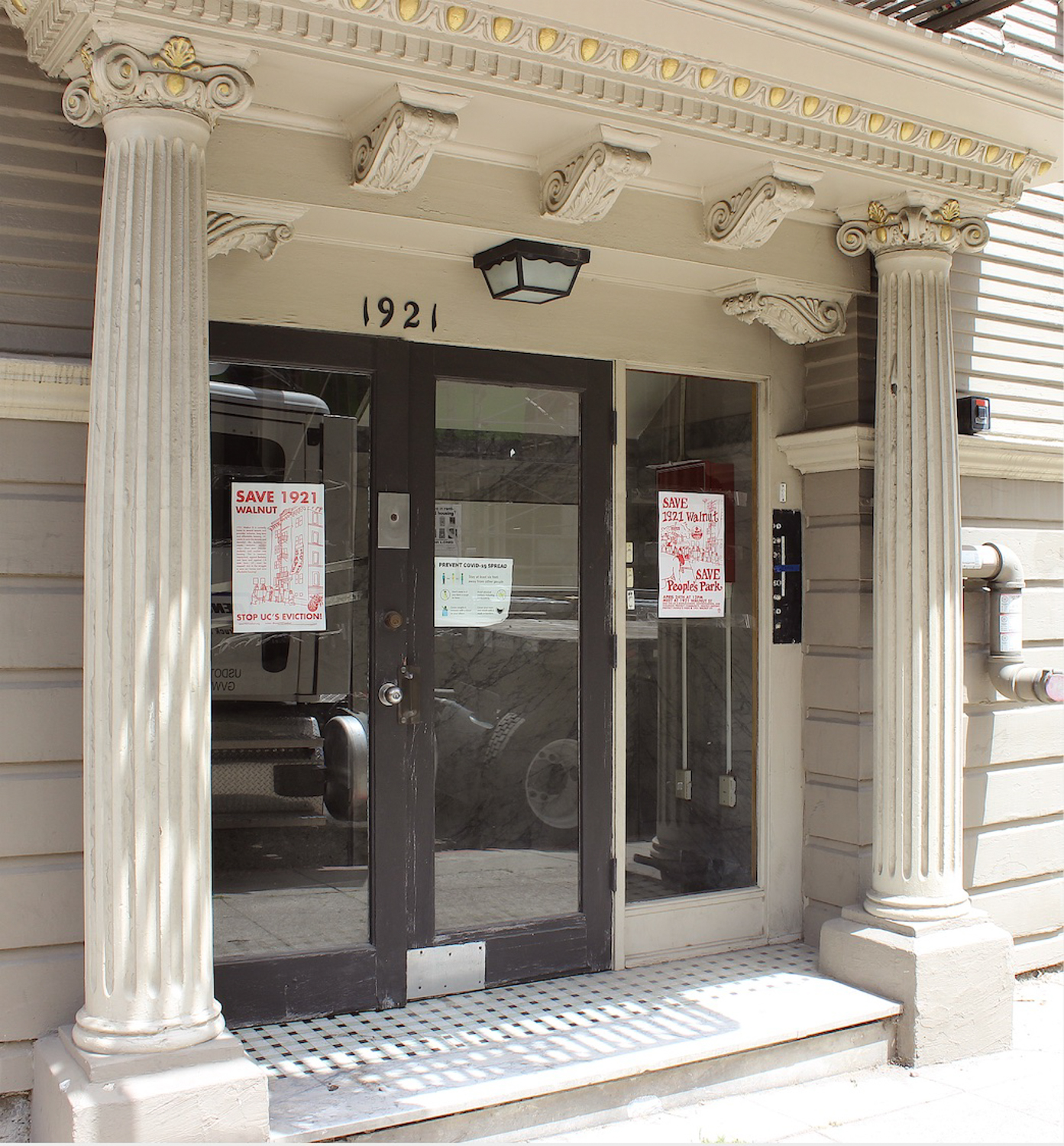
Tenant Natalie Logusch is suing the UC Board of Regents to demand they release public records she requested about a year ago related to UC Berkeley’s demolition and development plans that could displace her and her neighbors from their apartments at 1921 Walnut St.
“The public has to know the truth about what the plans are,” said Logusch. “The UC thinks they can push this through by withholding information.”
According to Kyle Gibson, Communications Director for UC Berkeley Capital Strategies, Logusch could receive the records soon.
“The university is discussing a settlement of the lawsuit with Ms. Logusch’s counsel that includes production of documents,” he said. “We hope this matter will be quickly resolved.”
For Logusch, suing to get the UC Regents to release their records is part of the broader effort to save her and her neighbors’ homes. Paul Wallace, another Walnut Street tenant, said that by not releasing the records, UC is “keeping us [tenants] in the dark.” According to Wallace, he and his neighbors have requested meetings with the university about the development that could displace them, both on their own and through Berkeley’s student union, the ASUC, but the university has always refused.
In a letter sent in August last year to Logusch, Wallace, and other 1921 Walnut Street tenants, UC Berkeley Real Estate Director Michelle De Guzman wrote, “The University will not be holding in-person or virtual conversations regarding the property for the foreseeable future.” At a meeting with the UC Regents during May of this year, UC Berkeley Chancellor Carol Christ claimed the university has initiated “hundreds of hours of community engagement” related to the Long Range Development Plan, which includes Walnut Street’s redevelopment. According to Wallace, however, the university has never met with him and other tenants in his building, and the only avenue he has had for the Regents to hear his concerns has been to call into their meetings and make public comments that are limited to one minute.
“You want to appeal to keep your home, but you only have a minute to do it,” he said. “It’s ludicrous.”
Logusch and Wallace are two of seven tenants, including one child, who currently live in the 112-year-old apartment building on 1921 Walnut St, next to UC Berkeley’s campus. These tenants have lived there from between six and over 25 years. In April last year, the university delivered a letter to the Walnut Street tenants telling them the Regents planned to demolish and redevelop the property they live in. While the letter stated there was “no imminent action planned,” it stressed tenants, who would be offered a relocation plan, could be forced to leave after being given 90 days’ notice.
In July 2020, the UC Regents purchased the Walnut Street building from its previous owner, Waterbury Properties. Since the housing units were covered under rent control, City of Berkeley law had limited the amount that Waterbury Properties could raise the rent on the building per year. But the tenants may have lost these protections when UC Berkeley purchased the property.
“UC Berkeley is exempt from any local zoning and housing ordinances,” said John Selawsky, a Berkeley Rent Board Commissioner. “In terms of state and local law that makes them a sovereign entity.”
Due to local and state laws that cover the City of Berkeley, if a private developer demolished and then rebuilt housing on the same property, as UC Berkeley plans to do, they would have to relocate tenants and then provide them with a right to return. If they demolished rent controlled units, they would have to rebuild the same number of units at a lower-than-market-rate rental price. But these laws do not apply to UC Berkeley.
“These current tenants could lose housing,” said Selawsky. “But Berkeley could also lose a rent controlled building forever. There’s no provision for replacement that UC has offered. And that galls me.”
According to UC Berkeley, the plan is to demolish the building as part of a broader plan for the area to build student housing for transfer students. The project is called Anchor House. The university claims Anchor House will allow 244 apartments with 772 individual bedrooms to be built, funded by donations from a private donor. Gibson claims that demolishing the Walnut Street building will allow 75 students to be housed and that revenues the project generates “will go toward providing annual scholarships for students from underrepresented populations and first generation college students.”
The current Walnut Street tenants disagree with UC. Their website describes the project as “high-end student housing with luxury amenities.” They discovered through a public records request that Jaclyn Safier heads the foundation that is financing the project, and have questioned her intentions after learning she is a billionaire who made at least 13 donations to the Republican Party and National Committee in 2016. They note that the Anchor House plan includes 17,000-square-feet of commercial retail space that can be leased to non-UC vendors and amenities such as a dorm lounge and a teaching kitchen with a scullery. They think there could be enough space for student housing and for their apartments to remain if the plan did not include such additional spaces and amenities.
The Walnut Street tenants feel they have wide support for preserving their rent controlled apartments. The Berkeley Architectural Association recently released a 161-page report agreeing that the existing apartments could be saved if the university reduced some amenities and removed the commercial spaces from the Anchor House plan. A section of the tenants’ website lists supporters including The Sierra Club, UC Berkeley staff and students, and Bay Area Tenants and Neighborhood Councils. Berkeley’s Rent Stabilization Board sent a letter on June 8 last year calling for the building to be preserved, and Berkeley’s City Council unanimously passed a resolution called “Support the Preservation of 1921 Walnut Street” on July 28 of the same year.
On March 18 this year, Berkeley Mayor Jesse Arreguín spoke at a rally in support of the Walnut Street tenants, saying “We need more student housing, but it cannot happen by eliminating existing affordable housing.”
UC Berkeley has its own supporters. The website for Anchor House shows a letters of support from the Downtown Berkeley association, San Francisco Housing Action Coalition, and the Berkeley Chamber of Commerce. They also list support statements from four transfer students. Alice Waters, the founder of Chez Panisse restaurant and a 1967 UC Berkeley graduate, is quoted praising the Anchor House plans, and specifically the kitchens and gardens it could accommodate.
Spokespeople for UC Berkeley and Chancellor Christ have also repeatedly described the relocation package they are offering tenants as “generous.” The Regents are offering rental assistance for three-and-a-half years in another apartment they deem as a “comparable dwelling unit” to where the tenants currently live by paying the difference each month between what tenants currently pay, and what the new unit’s rental price would be. The tenants see this as only a temporary fix, claiming that after three and a half years, when the assistance ends, they will no longer be able to afford the new units. While the Regents have also offered a lump sum option to tenants, the tenants say it is not enough to pay for a mortgage in Berkeley.
Wallace is unhappy with the exit package and fears what will happen if he is displaced from his home. “I’ll be driven out of California,” he said, “or certainly Berkeley.”
Facing limited legal options to stop the destruction and redevelopment of the stie, tenants and their supporters have turned to protest. Shortly after the tenants received the letter informing them of the university’s plans in April of last year, they formed the 1921 Walnut Street Association, which included all tenants in the building except one, totaling about a dozen tenants. Some tenants have since left the association after moving from the area.
The association has regularly written letters, commented in public meetings, and launched twitter campaigns. They organized four large protests that have attracted public figures, local politicians and activists. During one protest, on April 24 this year, about 100 people came out to support the tenants, marching from the 1921 Walnut Street to People’s Park, the location of another site of UC proposed development for student housing that has faced pushback from the local community.
One request for public records that Logusch is currently suing to have released asks for all public comments in response to the UC’s development plans and preparation and environmental impact reports related to the Walnut Street project. Releasing those comments, she said, could allow her to build a stronger movement by finding other supporters interested in saving the Walnut Street apartments.
“Who are the other people who oppose this?” Logusch said. “I have no idea because UC won’t put that information out there. And that’s probably part of the reason they haven’t released the records.”
In her case, Logusch v. The UC Regents, Logusch’s lawyer, Sara B. Kohgadai, accuses the Regents of violating California’s constitution by withholding public records. The case states that the California Public Records Act requires the UC Regents to determine if they have records within 10 days and that the determination period can only be extended to 14 days. Since Logusch initially filled the requests, on June 24 last year, the UC Regents have never formally stated whether it had the records Logusch requested or provided a reason why withholding the records was subject to exemption. Instead, the Regents responded to Logusch’s follow up emails with the same form letter on three separate occasions, which attributed delays in responding to the coronavirus.
“Judging from its form communications,” wrote Kohgadai in the case, “it appears [the UC Regents] violates these duties as a matter of course.”
When asked why the UC Regents has not already released the public records, UC Berkeley Capital Strategies Communications Director Kyle Gibson claimed that several other people requested the same documents around the same time as Logusch, that the Regents responded to those requests, and “believed [she] was among those who received the documents, but inadvertently she was not.”
Whether or not Logusch receives the documents, she is determined to keep organizing with her neighbors and their supporters to save her home.
“I will fight this every way I can,” she said. “This is my home. I am not going quietly. I will not let them displace me.”








Activism
Black Repertory Group Needs Volunteers to Help Shape the Next Generation of Artists and Leaders
Legendary performers such as Whoopi Goldberg and Danny Glover worked with and were inspired by BRG’s founders. More recently, Grammy award-winning artist Kehlani attended the Black Repertory Group Summer Day Camp for several years.


By Sean Vaughn Scott, Special to The Post
For more than 60 years, the Black Repertory Group (BRG) has changed lives through the arts.
Founded in 1964 by educators and visionaries Birel L. Vaughn and Nora Vaughn, BRG has become one of America’s oldest continuously operating Black theater institutions. For generations, it has preserved culture, developed talent, and provided opportunities for young people to discover their voices and their potential.
The results speak for themselves.
Legendary performers such as Whoopi Goldberg and Danny Glover worked with and were inspired by BRG’s founders. More recently, Grammy award-winning artist Kehlani attended the Black Repertory Group Summer Day Camp for several years.
Long before international recognition, Kehlani performed on the BRG stage. During a summer day camp production of “Princess and da Frog,” she portrayed Ray, the lovable firefly whose light guided others through the darkness. Her journey is proof that today’s camper may become tomorrow’s artist, entrepreneur, educator, or leader.
Located at 3201 Adeline St. in Berkeley, BRG continues that mission through its Youth Summer Day Camp of the Arts.
BRG is currently accepting applications and maintains an open enrollment program. Students may enroll throughout the summer as space permits and immediately become part of the BRG family.
We are also proud to be a multicultural opportunity program, welcoming children and families from all backgrounds, cultures, and communities. Through theater, music, dance, public speaking, visual arts, technical theater, and leadership development, students gain confidence, discipline, creativity, and lifelong skills.
As our programs grow, so does our need for volunteers.
We are seeking community members to assist with youth mentoring, registration, costumes, set construction, painting, props, ushering, photography, social media, marketing, technical theater, and fundraising activities. Whether you volunteer for a few hours or throughout the season, your support directly impacts the lives of young people.
BRG also partners with churches, civic organizations, alumni associations, fraternities, sororities, and community groups through theater party fundraisers, group sales, and buy-out performances. These partnerships have helped organizations raise funds while supporting arts and cultural programming.
The theater also serves as the home of the Berkeley NAACP Chapter, which meets every second Saturday of the month from 1 to 3 p.m.
For more than six decades, the Black Repertory Group has remained committed to one belief: every child deserves an opportunity to shine.
The next great artist may already be among us.
The next Kehlani may already be walking through our doors.
We invite you to volunteer, enroll, participate, and become part of the legacy.
For more information please go to www.blackrepertorygroup.com, call (510) 652-2120, or email info@blackrepertorygroup.com
Sean Vaughn Scott is the director of the Black Repertory Group.

Bay Area
UC Berkeley Named Top Public University in the U.S. and No. 7 in the World by ‘U.S. News’
Berkeley has been consistently awarded the distinction of the U.S.’s top public university since the Best Global Universities list was first published in 2014. “A strong position in the Best Global Universities rankings recognizes a school’s profound commitment to world-class research and cross-border academic excellence,” said LaMont Jones, managing editor for education at U.S. News.

The 2026 Best Global Universities rankings evaluated 2,250 research institutions from more than 100 countries
By Lila Thulin
U.S. News & World Report has ranked UC Berkeley No. 7 in its 2026 list of the best global universities, which assesses more than 2,250 research institutions worldwide.
Berkeley also claimed the honor of top public university in the U.S.
Released on Monday, the list evaluates universities from more than 100 countries on 13 metrics such as global and research reputation (as reported by academics and peers) and number of highly cited scholarly papers.
Berkeley has been consistently awarded the distinction of the U.S.’s top public university since the Best Global Universities list was first published in 2014.
“A strong position in the Best Global Universities rankings recognizes a school’s profound commitment to world-class research and cross-border academic excellence,” said LaMont Jones, managing editor for education at U.S. News.
The rankings also assess a university’s strength in various subject areas; these assessments are separate from U.S. News’ 2026 Best Graduate Programs rankings released in April.
This year, Berkeley was named in the top three nationally in seven subject areas – environment/ecology, ecology, water resources, physics, computer science, chemistry, and engineering – and in the top five for a total of 17 subjects. Subject rankings are based heavily on scholarly publications and citations as well as reputation.

In September, U.S. News also released its 2026 Best Colleges list, in which Berkeley was also named the No. 1 public institution among American universities.
That honor joins other accolades judging campus to be the best public university in the country, such as those from Forbes, The Wall Street Journal and Times Higher Education.
Arts and Culture
Farwest Region Deltas Celebrate Centennial With “September Breakfast” Honoring Vivian Osborne Marsh
The region was established in 1925 under the leadership of Vivian Osborne Marsh, who became its first Regional Director. Marsh was a pioneering scholar and civic leader, earning recognition as the first Black woman to receive both a bachelor’s and a master’s degree in anthropology from UC Berkeley.

By Antoinette Porter
Hundreds of members of Delta Sigma Theta Sorority, Inc., and their guests gathered at the Martin Luther King Jr. Student Union at the University of California, Berkeley, to mark the 100th anniversary of the sorority’s Farwest Region.
The region was established in 1925 under the leadership of Vivian Osborne Marsh, who became its first Regional Director. Marsh was a pioneering scholar and civic leader, earning recognition as the first Black woman to receive both a bachelor’s and a master’s degree in anthropology from UC Berkeley.
Marsh went on to serve as Delta Sigma Theta’s 7th National President, where she launched the sorority’s National Library Project to expand access to books in underserved Black communities in the South. During her presidency, the organization also became a prominent voice in the civil rights movement, lobbying Congress to pass anti-lynching legislation.
Bak in the Bay Area, Marsh devoted her career to advancing educational opportunities, mentoring young people, and strengthening community life. That commitment continues to shape the region, which supports initiatives in education, social justice, and economic development. Current projects include raising scholarship funds for students at Historically Black Colleges and Universities, voter education campaigns, and health and wellness programs.
A century after its founding, the Farwest Region of Delta Sigma Theta remains active across California and other western states, carrying forward Marsh’s vision of service and advocacy.

WORK FROM HOME
Home-based business with potential monthly income of $10K+ per month. A proven training system and website provided to maximize business effectiveness. Perfect job to earn side and primary income. Contact Lynne for more details: Lynne4npusa@gmail.com 800-334-0540


Car Wash Workers Cope with Lingering Impacts of ICE Raids

Misty Copeland Shapes Ballet’s Tomorrow

As Part of Your Back-to- School Checklist, Vaccinate

As Part of Your Back-to- School Checklist, Vaccinate

Congresswoman Simon Demands Investigation into Trump’s Abuse of Emergency Powers for Coal Export Terminal in West Oakland

OPINION: The Philippines Isn’t Foreign When Your Family Still Lives There

Asm. McKinnor’s Bill Banning Drones Above Outdoor Entertainment Events Awaits Senate Decision

California Sen. Padilla Joins Colleagues to Introduce Bill Imposing Term Limits on Supreme Court Justices

Department of Homeland Security Demands California Secretary of State Shirley N. Weber Scrub Voter Rolls

George Cook: The Inventor Who Made Fishing Smarter

Gov. Newsom Announces $109.6 Million in Funding for 278 Supportive Homes in Bakersfield, Contra Costa, Sacramento and Fresno

Rep. Kamlager Dove Demands Care, Justice for Man Shot by ICE

“The Power to See Threats Sooner”: Gov. Newsom, Safety Officials Showcase California’s Investments in Hi-Tech Wildfire Prevention

100 Black Wings’ Team Oakland Youth Athletes Heading to Taiwan for 2026 International Children’s Games

Oakland ‘Port Serves as a Powerful Engine for Good Jobs and Economic Development
Department of Homeland Security Demands California Secretary of State Shirley N. Weber Scrub Voter Rolls

Oakland Children’s Hospital Workers and Patients Rally for Pediatric Medical Care
“The Power to See Threats Sooner”: Gov. Newsom, Safety Officials Showcase California’s Investments in Hi-Tech Wildfire Prevention

New Judge Could Decide if Karmelo Anthony Gets a New Trial

Surveillance Pricing Fight: State Senate Debates Bill Banning Retailers from Using AI to Set Prices Based on a Buyer’s Profile

Alpha Kappa Alpha Sorority, Inc. Celebrates New North Atlantic Regional Director

Mount Zion MBC, Church of Jesus Christ of Latter-day Saints Partner to Bring 29,000 Meals to Alameda County
California Sen. Padilla Joins Colleagues to Introduce Bill Imposing Term Limits on Supreme Court Justices

Starting This Summer, California Car Buyers Can Get an Instant $3500 Off the Cost of Electric Vehicles

COMMENTARY: You Are Already Paying for the AI Boom

California Bill Would Let Abuse Victims Use Trauma as Legal Defense for Violent Crime

Fed Court to Decide Landmark First Amendment Case

Gov. Gavin Newsom Signs Law Streamlining Affordable Housing Rules

Oakland Celebrates $125 Million Coliseum Sale

Saving Black Mothers Starts Outside the Hospital

The Conversation With Al McFarlane 6/23/26

Media Monday 6/22/26

LIVE! ASK ALMA! — TUES. 6.23.26 7PM EST

Car Buying Secrets: 4 Hidden Checks Before You Sign!

Is This 550 HP Charger Worth YOUR Money? AutoNetwork Review

Celebrating Juneteenth – Frederick Douglass on education and resistance

LIVE! — ASK ALMA! — TUES. 6.19.26 7PM EST

Hyundai Ioniq 5 Parking, Safety, and 360 View #shorts

2025 Ioniq 5 New Wiper & Powerful Performance! #shorts

Electric SUV Range: Is 259 Miles Enough? #shorts

EV Charging: How Fast Can You Charge an Electric Vehicle? #shorts

Biometric Cooling… Messaging Seats…Come on! 2025 Infiniti QX80 Autograph 4WD

Charged Up: Witness the Magic of a Fully Electric Car! #shorts

Range Rover Sport PHEV Included…: See What’s Inside This Luxury SUV! #shorts

Invisible Hood View: Perfect Parking with X-Ray Vision! #shorts
-
 Featured4 days ago
Department of Homeland Security Demands California Secretary of State Shirley N. Weber Scrub Voter Rolls
-
 Business3 weeks ago
Oakland Children’s Hospital Workers and Patients Rally for Pediatric Medical Care
-
 Environment4 days ago
“The Power to See Threats Sooner”: Gov. Newsom, Safety Officials Showcase California’s Investments in Hi-Tech Wildfire Prevention
-
 #NNPA BlackPress2 weeks ago
New Judge Could Decide if Karmelo Anthony Gets a New Trial
-
 Business2 weeks ago
Surveillance Pricing Fight: State Senate Debates Bill Banning Retailers from Using AI to Set Prices Based on a Buyer’s Profile
-
 Black History1 week ago
Alpha Kappa Alpha Sorority, Inc. Celebrates New North Atlantic Regional Director
-
 Business3 weeks ago
Mount Zion MBC, Church of Jesus Christ of Latter-day Saints Partner to Bring 29,000 Meals to Alameda County
-
 Featured4 days ago
California Sen. Padilla Joins Colleagues to Introduce Bill Imposing Term Limits on Supreme Court Justices
