
Activism
California Awards Ceremony Celebrates the Best of Ethnic Journalism
“Ethnic media has quickly become an increasingly indispensable bridge for communicating with diverse populations within our state,” Gov. Gavin Newsom said at the opening ceremony.


Some 30 ethnic media journalists were honored for their coverage of the epic events of 2020 at a virtual California Ethnic Media Awards ceremony, which took place June 3.
Selected from 235 submissions from reporters working in print, digital, TV and radio (in eight languages), the winners were chosen by judges with language and cultural fluency who know the challenges of working in the sector.
“Ethnic media has quickly become an increasingly indispensable bridge for communicating with diverse populations within our state,” Gov. Gavin Newsom said at the opening ceremony.
“You have worked against enormous odds to make sure our communities were informed about historic news events of the year. You are key to sustaining an inclusive communications infrastructure that knits our communities together when so many forces, as you know well, threaten to drive us apart,” the governor added.
The multilingual awards were sponsored by Ethnic Media Services and California Black Media. Each winner received $1,000 in cash. Entries were submitted in nine categories:
- The 2020 census,
- The COVID-19 pandemic and its disproportionate impact on ethnic communities,
- The economic crisis that exacerbated racial and economic fault lines in California, the rights of immigrants,
- The movement for racial justice sparked by the murder of George Floyd, exceptional reporting on the impact of climate change, the 2020 elections, commentary that serves as a call to action for ethnic audiences, and community media innovation and resilience to survive the pandemic.
“Thank you to all the journalists, reporters, editors, photographers and publishers who work long hours without recognition every day. You are committed to telling stories and covering underreported stories that we would otherwise never hear,” said Regina Brown Wilson, Executive Director of California Black Media.
In their acceptance speeches, the awardees recognized the support of their editors, publishers and families, as well as the challenges of covering ethnic communities disproportionately impacted by COVID-19, racist policies, and hate crimes.
“Words can be deadly, or they can be life affirming. While the idle intellectual elite strive to cancel culture, we are tasked with removing the knee out of the throat of truth and reaffirming and defining journalism in our own image,” said Rose Davis of Indian Voices, awarded for her landmark essay: “The Census and the Fourth Estate,” which advocates for the participation of Native Americans in the census despite centuries of being excluded.
Danny Morrison, winner in the category of English language broadcast TV for his analysis of the Black Lives Matter movement in Bakersfield said that “as an African American man in central California, I’ve always known that we have a lot of work to do regarding the inequities within our ethnicity. That is the reason why my team and I went to prisons, schools, churches, youth groups and more to speak to the underserved and the forgotten because we understand the struggle that in most cases we have lived through.”
Jorge Macias, awarded for his digital coverage of climate change for Univision, recalled how in the last four years, “we all suffered from the denial of climate change, and even in moments of terror in California with these devastating fires, the former president (Donald) Trump said that science didn’t know. This prize means a lot because as human beings we have to battle with that absurd view denying climate change.”
Hosts for the evening were Odette Alcazaren-Keeley and Pilar Marrero, both distinguished veterans of the ethnic media industry. Some 20 elected officials, community leaders, scholars and writers paid tribute to the sector in videotaped remarks.
Sandip Roy, once a software engineer in Silicon Valley, now an award-winning author and journalist in India, said if it weren’t for ethnic media giving him a platform, he wouldn’t be a writer today.
After presenting awards to Chinese, Korean and Vietnamese reporters for stories on issues impacting Black and Latinx communities, Alcazaren-Keeley announced a special judge’s award for cross-cultural reporting. The winner, Jeanne Ferris of News from Native California, documented how the destinies of two groups of people converged when Japanese Americans were incarcerated in World War II on reservation lands.
At the closing of the ceremony, Sandy Close, executive director of Ethnic Media Services, said the coming together of reporters from so many racial and ethnic groups to celebrate not just their own but each other’s work was the real takeaway for the night. “Ethnic media are like fingers on a hand,” she said, quoting Chauncey Bailey, a veteran of Black media killed in 2007 for investigating wrongdoing in his own community. “When we work together, we’re a fist.”











Activism
Oakland Post: Week of September 30 – October 6, 2026
The printed Weekly Edition of the Oakland Post: Week of September 30 – October 6, 2026

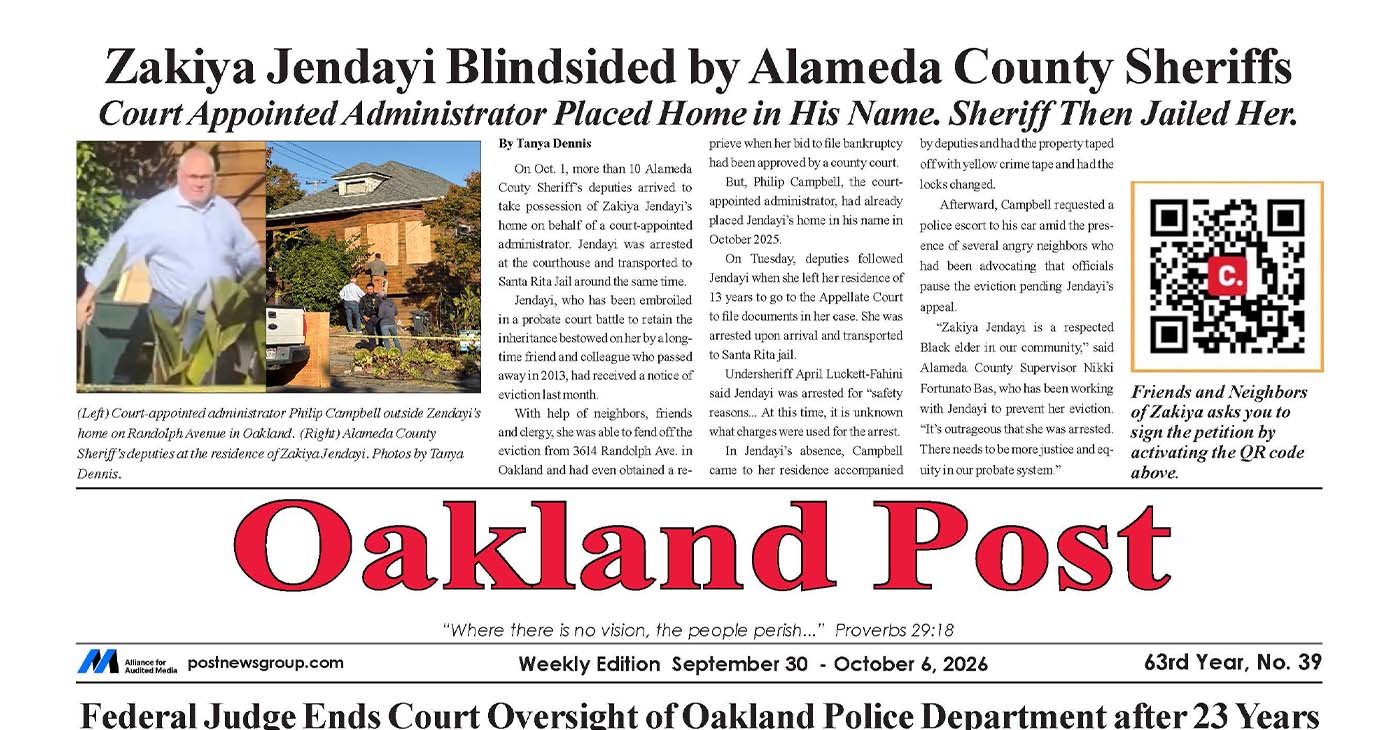
To enlarge your view of this issue, use the slider, magnifying glass icon or full page icon in the lower right corner of the browser window.

Activism
Oakland Post: Week of September 23 – 29, 2026
The printed Weekly Edition of the Oakland Post: Week of September 23 – 29, 2026

To enlarge your view of this issue, use the slider, magnifying glass icon or full page icon in the lower right corner of the browser window.
Activism
Oakland Post: Week of September 16 – 22, 2026
The printed Weekly Edition of the Oakland Post: Week of September 16 – 22, 2026

To enlarge your view of this issue, use the slider, magnifying glass icon or full page icon in the lower right corner of the browser window.



Listening as a Lifeline: A Doula’s Witness to Black Maternal Health

New Protections for Ticket Buyers: Gov. Newsom Signs Assemblymember Isaac Bryan’s Bill

‘We Don’t Talk Trash — We Pick Up Trash!’

Zakiya Jendayi Arrested, Locked Out of Home by Sheriff’s Deputies

Oakland Post: Week of September 30 – October 6, 2026

Asm. Corey Jackson Announces Launch of 24-Hour Childcare in His District

IN MEMORIAM: The Rev. Leon “Sonny” Clark, Longtime Orange County Pastor and Community Leader, Dies at 72

Poll: Becerra Widens His Lead Over Hilton; Californians Split on Wealth Tax

From Historic Memories to New Possibilities: Oakland Celebrates Coliseum 60

County Office of Education Says OUSD Finances Are Getting Healthier, Materially Stronger

LIVE FREE Sunday Dinner Brings Faith, Fellowship and Civic Conversation to Oakland

Remembering Chauncey Bailey as Student Journalists Face Threats to Truth-Telling

BLACspace Cooperative Invites Bay Area to Experience Oakland’s Black Cultural Ecosystem Through a BLAC Map Tour + Party

In Wake of Death on Doorstep, Williams Chapel Baptist Church Calls for Better Care, Funding for Unhoused

Oakland Centenarian Nuna McKee Honored!

Standoff for Justice: Our Homes Are Worth Fighting For

Oakland Post: Week of August 26 – September 1, 2026

Frontier Airlines’ Return to Oakland Airport Brings Flights, Jobs and Opportunity

Gubernatorial Candidate Steve Hilton Blasts California New Tire Rules; Newsom Hits Back

Chef Sharon Lee Blends Culinary Excellence, Education and Empowerment

Jackie Wright Champions Bay Area Stories, Filmmakers and Cultural Institutions

Misnamed ‘Parent’ PAC Seeks to Influence Oakland School Board Elections

Oakland Coliseum Project Opens Door for Small Businesses to Build Bigger

Big City Mayors Ask for “Yes” Vote on Housing Bond Measure; Conservatives Say “No”

Gov. Newsom’s Latest Appointees Include Sacramento Advocate for Formerly Incarcerated Students; State’s New Tech Chief

Longtime BWOPA Member Brendalyn Goodall Appointed to California Workforce Development Board

Gov. Newsom Signs Law Shielding Immigration Aid Workers From Doxing Threats

Secretary of State Shirley N. Weber Urges Californians to Vote Early as Voter ID Battle Intensifies

Oakland Post: Week of September 2 – 8, 2026

IN MEMORIAM: Dolly Parton Dead at 80 — How She Built a Legacy of Love and Earned Her Place in Black Culture

The Conversation With Al McFarlane 6/23/26

Media Monday 6/22/26

LIVE! ASK ALMA! — TUES. 6.23.26 7PM EST

Car Buying Secrets: 4 Hidden Checks Before You Sign!

Is This 550 HP Charger Worth YOUR Money? AutoNetwork Review

Celebrating Juneteenth – Frederick Douglass on education and resistance

LIVE! — ASK ALMA! — TUES. 6.19.26 7PM EST

Hyundai Ioniq 5 Parking, Safety, and 360 View #shorts

2025 Ioniq 5 New Wiper & Powerful Performance! #shorts

Electric SUV Range: Is 259 Miles Enough? #shorts

EV Charging: How Fast Can You Charge an Electric Vehicle? #shorts

Biometric Cooling… Messaging Seats…Come on! 2025 Infiniti QX80 Autograph 4WD

Charged Up: Witness the Magic of a Fully Electric Car! #shorts

Range Rover Sport PHEV Included…: See What’s Inside This Luxury SUV! #shorts

Invisible Hood View: Perfect Parking with X-Ray Vision! #shorts
-
 Community3 weeks ago
Misnamed ‘Parent’ PAC Seeks to Influence Oakland School Board Elections
-
 Activism4 weeks ago
Oakland Post: Week of September 2 – 8, 2026
-

 Community3 weeks ago
Richmond Tiny House Village Farm & Garden Set to Open Gates on Sept. 26
-

 Activism3 weeks ago
Oakland Post: Week of September 9 – 15, 2026
-

 Black History3 weeks ago
Latest Massacre in Haiti Reveals Cruelty U.S. Deportations
-

 Black History3 weeks ago
OPINION: Nolan Wells’ Death One of Several Signifying Racial Terror Lives on in U.S. South
-

 Business2 weeks ago
Mayor Lee Announces $1 Million Kaiser Permanente Grant for Pilot Program to Address Homelessness, Clean Up Public Spaces throughout Oakland
-

 Community3 weeks ago
Democratic Clubs Interview Candidates for Oakland School Board
