
Bay Area
Newsom Calls Out “Naysayers and Doomsdayers” in State of the State Address
“This is a fight for California’s future,” Newsom said. “With more compassion, empathy, and connection, we can write the next chapter in the California story.”

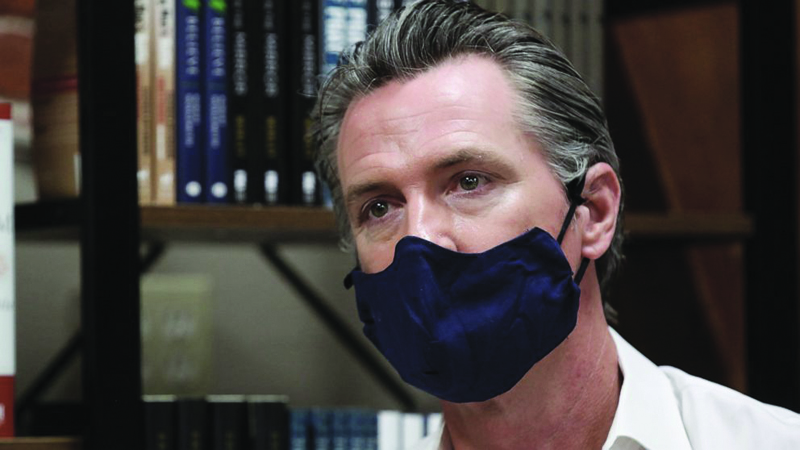
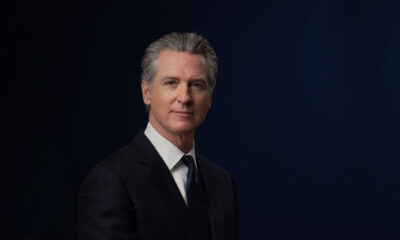
California is determined to stay on a path to a brighter future and, “won’t change course just because of a few naysayers and doomsdayers,” said Gov. Gavin Newsom in his third State of the State Address as he reflected on California’s year-long battle against the COVID-19 pandemic and the economic instability it has caused.
“This is a fight for California’s future,” Newsom said. “With more compassion, empathy, and connection, we can write the next chapter in the California story.”
Newsom delivered the remarks at Dodger Stadium in Los Angeles, which is doubling as a mass community vaccine site.
California was the first state in the nation to launch mass vaccine sites in partnership with the Federal Emergency Management Agency (FEMA) to dull the impact of the coronavirus crisis in California.
Gov. Newsom’s plan to counter the pandemic includes “vaccine equity” programs in vulnerable communities, a $6.6 billion education bill to reopen schools and $7.6 billion in relief funds for low-income residents and small businesses.
Newsom says the stark reality of the deaths of nearly 55,000 Californians since the pandemic began in early 2020 helped prompt the high level of state investments to help people move past the difficulties and build an economy that will be stronger and fairer than it was pre-pandemic.

“Our journey back must also be a path to close inequities. There is no economic recovery without economic justice,” said Newsom.
Since California began its effort to get COVID-19 shots in the arms of people, the state has been ranked sixth for vaccine distribution worldwide. Healthcare workers have administered more than 11 million vaccine doses to Californians, including 200,000 educators, school staff, and childcare workers.
“We don’t just talk about vaccine equity — we designed our entire system around it,” said Newsom.
“I agree with Governor Newsom that California will come back stronger and wiser. We will not only have economic recovery but also economic justice,” said Assemblymember Mike Gipson (D-Carson), chair of the legislative Democratic Caucus.
“And, just like our response to the pandemic, we will follow science and data. There is light at the end of this tunnel and the best is yet to come,” he said.
Toni Atkins, President Pro Tempore of the California Senate, said fiscal policy lawmakers have helped to “prevent major cuts during the pandemic and restore funding that was in jeopardy.”
“Too many people are still just barely hanging on,” Atkins said. “They need us to do more.”
Lieutenant Governor Eleni Kounalakis, said a top priority is to ensure that essential workers, who are among the 18 % of vaccinated Californians, have enough support to tackle the final stretch of the pandemic.
“We can all breathe a little easier, knowing that the most vulnerable among us, especially in underserved communities are safer, and safer with each passing day,” said Kounalakis.
State officials said although there were a few hits-and-misses in the early stages of the pandemic, they are learning from their mistakes to work toward the safe reopening of the state.
Polarized discussions about health equity have surrounded much of Newsom’s efforts as the state has taken steps to shore up a weakened economy, reopen schools against spirited pushback from large unions, and distribute vaccines to as many people as possible.
Because many essential workers are Black and Latino, some critics say state efforts to increase employee wages and advocate for vaccine equity have been neither timely nor forceful enough.
Newsom said lawmakers are working on raising the minimum wage to $14 an hour. In response to California’s health disparities, vaccine equity is the right thing to do and the fastest way through the pandemic, he said.
According to state officials, the number of recorded coronavirus cases has dropped from over 50,000 cases to less than 3,000 per day. The rate of hospitalizations has also reduced by more than 80 % since early January when infection numbers peaked, said state officials.
Despite the governor’s efforts to lead initiatives aimed at turning around the devastating effects of the pandemic, a budding movement to recall him spearheaded by Republicans is gaining traction.
“The celebratory press conference on the schools bill has not been matched with actions to actually get our kids back to school,” said Sen. Patricia Bates (R-Laguna Niguel), referring to a briefing the governor held last week announcing his plan to reopen schools across the state.
“In fact, the state this week denied the San Dieguito Union High and Carlsbad Unified School Districts in my region the chance to reopen their middle and high schools for in-person instruction, even though the districts’ applications to re-open had received the county public health officer’s approval,” Bates continued.
Newsom says he will not let his detractors cause him to lose focus.
“We will not be distracted from getting shots in arms and our economy booming again,” said Newsom, responding to critics “who are promoting partisan power grabs and outdated prejudices.”









Activism
Oakland Post: Week of September 16 – 22, 2026
The printed Weekly Edition of the Oakland Post: Week of September 16 – 22, 2026

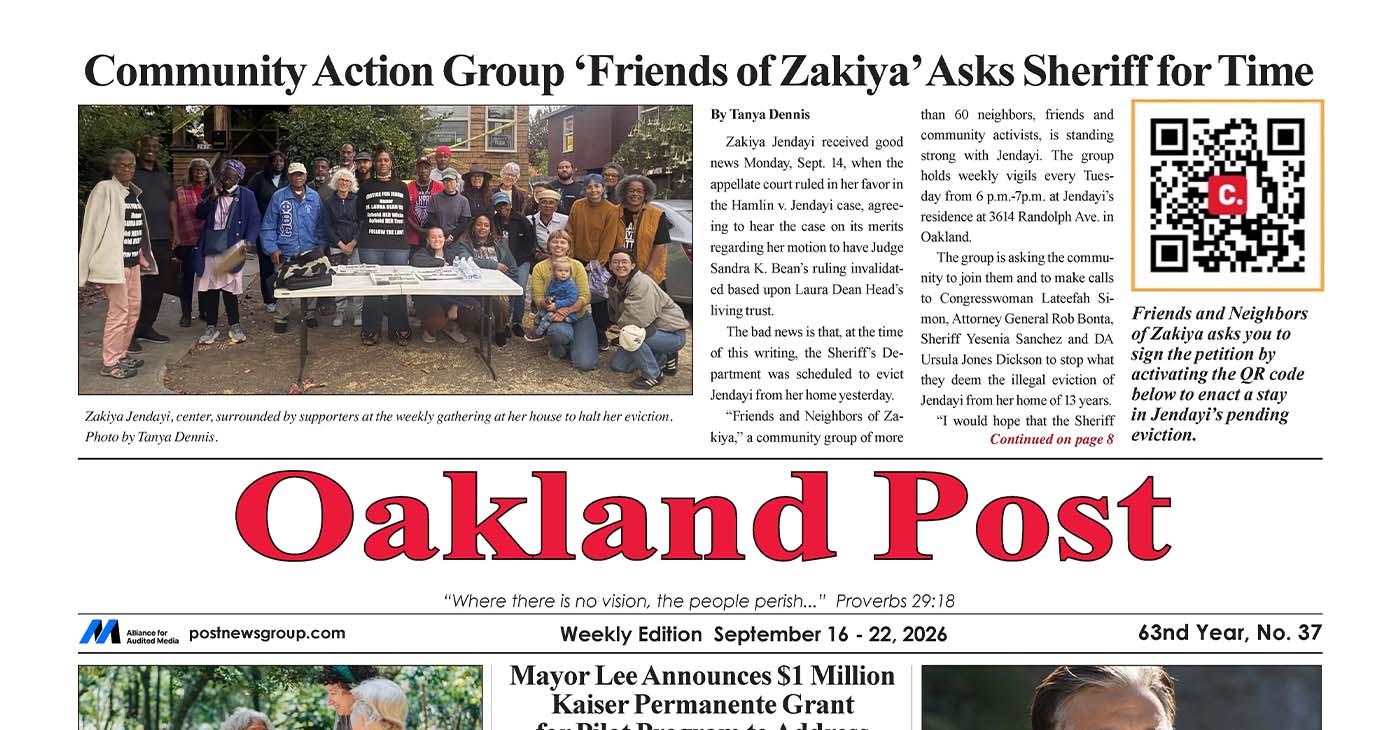
To enlarge your view of this issue, use the slider, magnifying glass icon or full page icon in the lower right corner of the browser window.

Activism
Oakland Post: Week of September 9 – 15, 2026
The printed Weekly Edition of the Oakland Post: Week of September 9 – 15, 2026

To enlarge your view of this issue, use the slider, magnifying glass icon or full page icon in the lower right corner of the browser window.
Activism
Oakland Post: Week of September 2 – 8, 2026
The printed Weekly Edition of the Oakland Post: Week of September 2 – 8, 2026
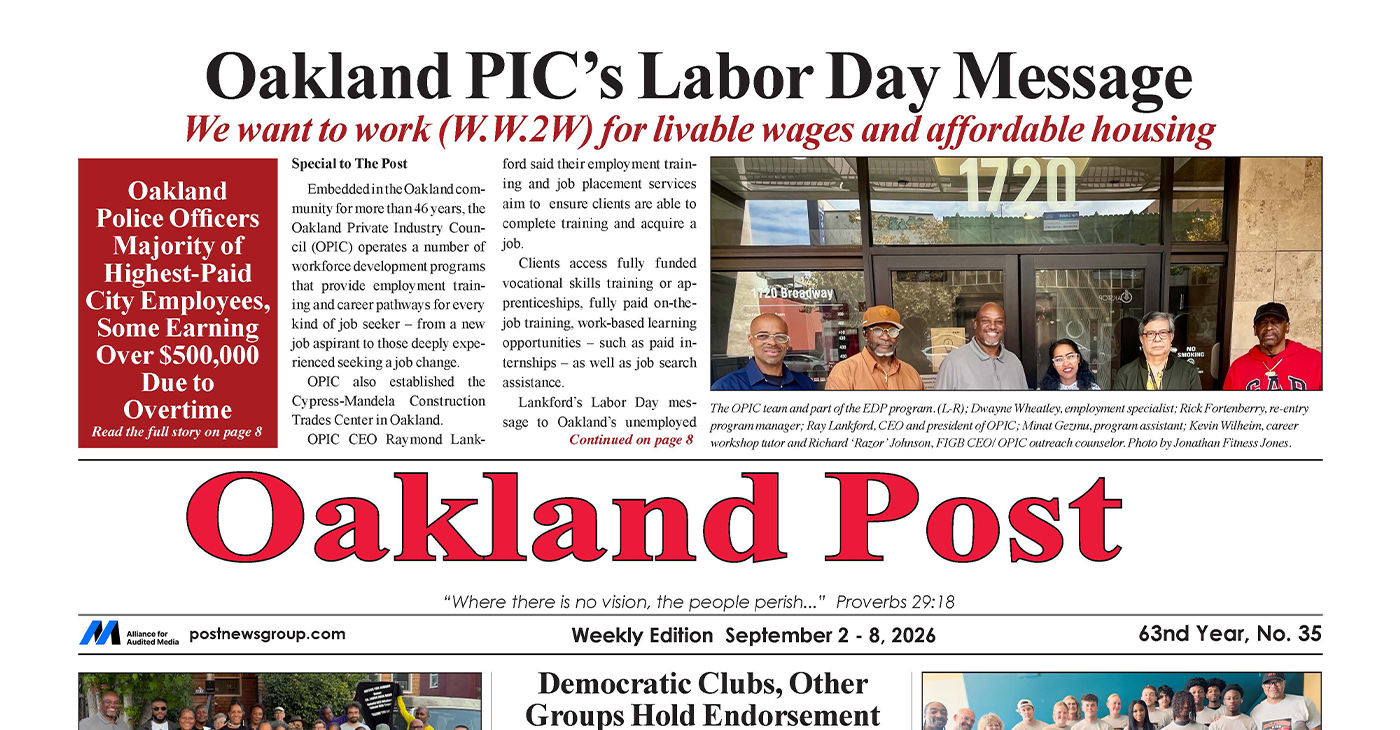
To enlarge your view of this issue, use the slider, magnifying glass icon or full page icon in the lower right corner of the browser window.



Doulas Are Helping Black California Moms Navigate Pregnancy–Even as High Mortality Rates Persist

Newsom Signs Addictive Social Media Law to Protect Kids

On Your November Ballot: Prop 38 Would Allocate $8.4 Billion to Immunology and Immunotherapy Funding

Ask California: Golden State Releases New AI Chatbot

Asm. Isaac Bryan’s Bill Banning California Police From ICE Side Jobs Reaches Newsom’s Desk

Assemblymember LaShae Sharp-Collins’s Bill Would Pause Law Enforcement’s Use of Shock Gloves Pending Study

BOOK REVIEW: ‘Laws of Solomon’ Reveals Tender Heart of Former Child Soldier

OPINION: The New American Fear – From 9-11 to AI

Passing for White, Fighting for Black America: The Courage of Walter White

Oakland People’s Arms Embargo Coalition Demands End to Military Shipments Thru Oakland

Barbara Lee Mourns Gloria Steinem, Remembers a Friendship Rooted in Equality

Event Preview: ‘Fashion v. Fascism’ – A Runway Revolution Is Coming to the Bay Area

Two Looming Threats Every Alameda County Elder Should Know About

Oakland Mayor Reads to Children at Bookout Block Party at Marcus Books Store

Tradition Comes to the Streets in 11th Annual Black-Eyed Pea Festival at the Freedom Farmers Market

Less Affluent School Districts, Including Sacramento City, Face Threat of State Takeover

ESSAY: California Can Close Its Colorectal Cancer Gap

California Hispanic Chambers of Commerce Unveils: ‘Powering the Future’ Theme for 47th Annual Statewide Convention

Four Candidates, Including Incumbent Barbara Lee, Qualify for Oakland Mayor’s Race

Oakland Post: Week of August 12 – 18, 2026

From Blueprint to Breakthrough: Tackling Affordable Housing in Oakland

Oakland Observes Black August with Block Parties, Film Showings, Workshops

COMMENTARY: Why Local School Tax Measure G1 Will Not Be on the November Ballot

Standoff for Justice: Our Homes Are Worth Fighting For

Returning to Its Roots, the Oakland Black-Eyed Pea Festival Partners with the Freedom Farmers Market Sept. 12

NPRC Scores First Advocacy Victory: David Shaw Finally Gets His Wish to ‘Go Home’

Oakland Post: Week of August 26 – September 1, 2026

Frontier Airlines’ Return to Oakland Airport Brings Flights, Jobs and Opportunity

Gubernatorial Candidate Steve Hilton Blasts California New Tire Rules; Newsom Hits Back

Chef Sharon Lee Blends Culinary Excellence, Education and Empowerment

The Conversation With Al McFarlane 6/23/26

Media Monday 6/22/26

LIVE! ASK ALMA! — TUES. 6.23.26 7PM EST

Car Buying Secrets: 4 Hidden Checks Before You Sign!

Is This 550 HP Charger Worth YOUR Money? AutoNetwork Review

Celebrating Juneteenth – Frederick Douglass on education and resistance

LIVE! — ASK ALMA! — TUES. 6.19.26 7PM EST

Hyundai Ioniq 5 Parking, Safety, and 360 View #shorts

2025 Ioniq 5 New Wiper & Powerful Performance! #shorts

Electric SUV Range: Is 259 Miles Enough? #shorts

EV Charging: How Fast Can You Charge an Electric Vehicle? #shorts

Biometric Cooling… Messaging Seats…Come on! 2025 Infiniti QX80 Autograph 4WD

Charged Up: Witness the Magic of a Fully Electric Car! #shorts

Range Rover Sport PHEV Included…: See What’s Inside This Luxury SUV! #shorts

Invisible Hood View: Perfect Parking with X-Ray Vision! #shorts
-
 Commentary4 weeks ago
Standoff for Justice: Our Homes Are Worth Fighting For
-
 Activism4 weeks ago
Oakland Post: Week of August 26 – September 1, 2026
-
 Business4 weeks ago
Frontier Airlines’ Return to Oakland Airport Brings Flights, Jobs and Opportunity
-
 Business4 weeks ago
Gubernatorial Candidate Steve Hilton Blasts California New Tire Rules; Newsom Hits Back
-
 Business4 weeks ago
Chef Sharon Lee Blends Culinary Excellence, Education and Empowerment
-

 Education4 weeks ago
Gov. Newsom’s Latest Appointees Include Sacramento Advocate for Formerly Incarcerated Students; State’s New Tech Chief
-

 Community4 weeks ago
Big City Mayors Ask for “Yes” Vote on Housing Bond Measure; Conservatives Say “No”
-

 Business4 weeks ago
Oakland Coliseum Project Opens Door for Small Businesses to Build Bigger
