
Activism
Peralta Village Tenants and Supporters Protest Oakland Housing Authority Office
“I would like for the tenants to come together more and not fear retaliation,” said Eddie Simmon, who has lived in Peralta Village for over 20 years, at the protest. “The more the tenants vent their frustrations as a group, the better [OHA] will respond.”

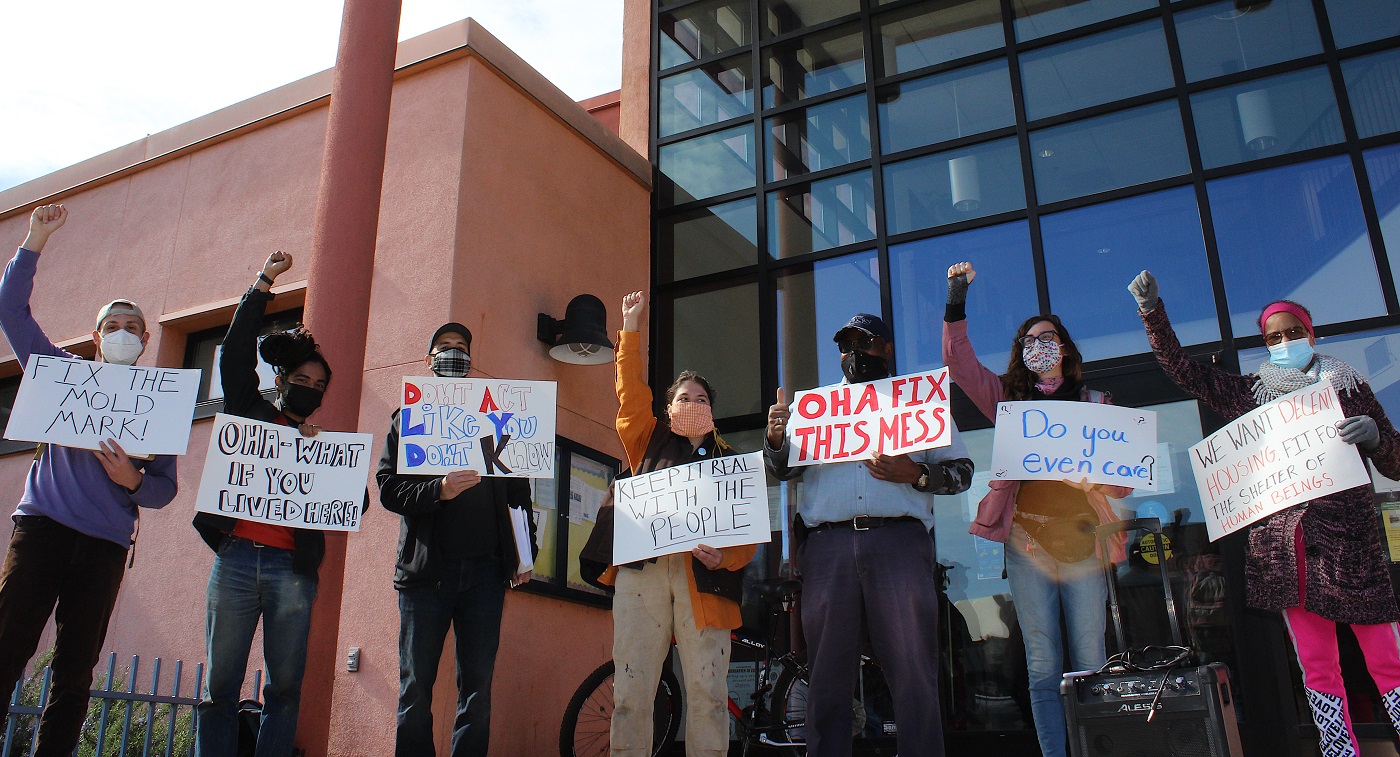
Peralta Village tenants and supporters gathered outside of Oakland Housing Authority’s [OHA] offices from noon to 1:00 p.m. on February 13 to protest what they see as insufficient maintenance and unfair threats of eviction despite Alameda County’s and Oakland’s COVID-19 related eviction moratoriums.

Peralta Village is a public housing project in West Oakland consisting of 390 units and over 700 residents. It was founded just after World War II as segregated, all-Black housing. Today, many of the residents, almost all of whom are still Black, feel they are being treated unfairly. Some are coming together to demand change.
“I would like for the tenants to come together more and not fear retaliation,” said Eddie Simmon, who has lived in Peralta Village for over 20 years, at the protest. “The more the tenants vent their frustrations as a group, the better [OHA] will respond.”
A February 1 article from this publication showed tenants who complained of black mold, overflowing trash, inconsistent clean up, an inoperable overhead light despite services requests dating back a year, a six-week delay to repair a window that would not shut, a lack of recycling services, and eviction threats despite the moratorium. In reaction to these circumstances, 85 Peralta Village tenants signed and delivered a petition to OHA demanding better treatment.
Shortly after the article’s publication and residents delivered their petition, about a dozen tenants received a notice from Oakland Rent Adjustment Program informing them that eviction notices OHA had sent “may have been served in error and/or in contradiction to the current laws in place prohibiting most forms of eviction in Oakland.”
The notice also broadly outlined rights tenants have under Oakland’s eviction moratorium. Under a section marked “What should you do if you’ve received an eviction notice?,” the notice reads “You are likely not required to move at this time.”
“If you didn’t have knowledge of what the [eviction notices] represent, you think it’s a serious threat but, in reality, it’s just intimidation,” said Dayton Andrews at the protest. Andrews is a member of The United Front Against Displacement, an anti-gentrification group that has been organizing with Peralta Village tenants for better treatment from OHA.
An OHA spokesperson, Greer McVay, said that OHA has not threatened to evict any residents during the COVID-19 emergency for non-payment of rent. But some residents report they have received three-day notice or quit notices from OHA, not due to rent non-payment, but due to OHA accusing them of breaking its rules.
Oakland’s Rent Adjustment Board classifies such notices as eviction notices. Still, no residents have claimed that OHA has followed through on such evictions and, when interviewed for the February 1 article, McVay claimed OHA is not currently evicting any residents.
In an interview with The Oakland Post, an OHA worker who asked not to be named due to fear of retaliation said that through discussions with OHA’s upper management and personal experience on the job, the recent eviction notices were delivered as a “bully tactic.” The worker also was sympathetic to resident complaints about rodents, inconsistent trash pick-up, and slow repairs.
“[For] every resident I’ve been in contact with,” the worker said, “it’s the same story. As an insider, there’s no reason why they should live in those types of conditions. It’s so baffling for us.”
Residents claim trash still regularly overflows from Peralta Village dumpsters and onto the streets, sometimes blowing near their homes. OHA’s McVay, said the agency has increased its trash clean-up services under COVID-19 but blames much of the mess on illegal dumping that she claims comes from outside of Peralta Village.
In response to residents’ complaints about mold, McVay said OHA “actively works with residents to resolve [mold] issues if noted during a unit inspection” or if tenants report such a problem, and that OHA’s “primary goal is to educate residents on mildew and mold prevention.”
McVay said OHA is prioritizing emergency repairs under COVID-19, which are addressed within “four to 24 hours depending on the severity” and that “non-emergencies are based on the availability of the maintenance crew.”
Residents claim that even during emergencies their requests for maintenance often get delayed for weeks or months and that favoritism, not COVID-19, causes delays.
“They’ll look at the list [of maintenance requests] and they’ll choose which apartment they want to go to,” said an OHA tenant at the protest who asked not to be named due to fear of retaliation. “It’s not in the order of the call. That’s what I hate!” This resident claimed they had to wait six weeks for OHA to fix a window in her unit that would not close.
Mark Schiferl, director of Property Management for OHA, has recently called and e-mailed both The United Front Against Displacement and some residents mentioned in the February 1 article to ask about problems residents complained about.
JaCynthia Givens, a resident who complained about black mold, and Simmon, who complained about insufficient trash pick-up and cleaning of shared outdoor common areas, said Schiferl called them. They said Schiferl listened to them but has not yet offered plans to fix their problems. He did not respond to requests to comment on this article.
Simmon was pleased that Schiferl reached out. “It felt like we got somebody’s attention finally,” said Simmon, “because this guy is calling me and I’m just another tenant.”
Residents and their supporters are hoping that by protesting and organizing, OHA will respond to repair requests in a more effective quicker manner, stop eviction threats, and keep the neighborhood cleaner. To get OHA’s attention they posted signs on OHA’s office doors during the February 13 protest. One read “FIX THE MOLD MARK!” and another read “OHA FIX THIS MESS!”
Although 10 people showed up to the protest, the demands the protestors made have much broader support as 91 Peralta Village residents, about 12% its total population, have now signed the petition demanding better treatment from OHA. OHA tenants and supporters are hoping more people show up to support their demands at future actions.
“It’s going to take a bunch of us coming together to get anything done,” said Simmon.
“We’re out here to prove to folks that the sky’s not going to fall if you take a stand,” said Andrews at the protest. “And things are only going to get worse if you don’t.”
The United Front Against Displacement is encouraging residents to call them at 510-815-9978 or email them at wewontgo@riseup.net if they want to sign the petition and/or get involved in future actions.











To enlarge your view of this issue, use the slider, magnifying glass icon or full page icon in the lower right corner of the browser window.

To enlarge your view of this issue, use the slider, magnifying glass icon or full page icon in the lower right corner of the browser window.
Activism
Oakland Post: Week of September 30 – October 6, 2026
The printed Weekly Edition of the Oakland Post: Week of September 30 – October 6, 2026


To enlarge your view of this issue, use the slider, magnifying glass icon or full page icon in the lower right corner of the browser window.



Mayor Barbara Lee Holds Special State of the City Address in Deep East Oakland

Practitioners of African Traditional Spirituality Offer Ancestral Reverence Ritual Oct. 31

It’s Time to Lose Weight Before the Holidays

Trader Vic’s Returns to Its Oakland Roots

Oakland Coal Terminal Backed by Trump Would Be Bigger, Dirtier Than Promised, Says Report

Opponents Smear Effective African American Transit Director as Election Nears

Oakland Post: Week of October 14 – 20, 2026

OP-ED: The Black Church Writes AI’s Next Chapter

OP-ED: The Black Church Writes AI’s Next Chapter

WCCUSD Joins Statewide Organic School Food Purchasing Cooperative

Democrats, Community Groups Back Measure EE to Change How Oakland Is Governed

Four Tips to Help You Plan a Holiday “Staycation”

Veterans Housing Project Proposed for South Richmond
PRESS ROOM: Transformative Justice Coalition 2026 Voting Rights Champion Awards Reception ‘Yesterday Is Today: The Battle For Voting Rights

Mayor Lee Delivers 2026 State of the City Address: ‘Oakland Continues to Be on the Move’

Misnamed ‘Parent’ PAC Seeks to Influence Oakland School Board Elections

Poll: Becerra Widens His Lead Over Hilton; Californians Split on Wealth Tax

Listening as a Lifeline: A Doula’s Witness to Black Maternal Health

Oakland Post: Week of September 9 – 15, 2026

County Office of Education Says OUSD Finances Are Getting Healthier, Materially Stronger

Richmond Tiny House Village Farm & Garden Set to Open Gates on Sept. 26

Mayor Lee Announces $1 Million Kaiser Permanente Grant for Pilot Program to Address Homelessness, Clean Up Public Spaces throughout Oakland

Latest Massacre in Haiti Reveals Cruelty U.S. Deportations

Zakiya Jendayi Arrested, Locked Out of Home by Sheriff’s Deputies

OPINION: Nolan Wells’ Death One of Several Signifying Racial Terror Lives on in U.S. South

BLACspace Cooperative Invites Bay Area to Experience Oakland’s Black Cultural Ecosystem Through a BLAC Map Tour + Party

Doulas Are Helping Black California Moms Navigate Pregnancy–Even as High Mortality Rates Persist

Oakland Post: Week of September 16 – 22, 2026

Oakland People’s Arms Embargo Coalition Demands End to Military Shipments Thru Oakland

Democratic Clubs Interview Candidates for Oakland School Board

The Conversation With Al McFarlane 6/23/26

Media Monday 6/22/26

LIVE! ASK ALMA! — TUES. 6.23.26 7PM EST

Car Buying Secrets: 4 Hidden Checks Before You Sign!

Is This 550 HP Charger Worth YOUR Money? AutoNetwork Review

Celebrating Juneteenth – Frederick Douglass on education and resistance

LIVE! — ASK ALMA! — TUES. 6.19.26 7PM EST

Hyundai Ioniq 5 Parking, Safety, and 360 View #shorts

2025 Ioniq 5 New Wiper & Powerful Performance! #shorts

Electric SUV Range: Is 259 Miles Enough? #shorts

EV Charging: How Fast Can You Charge an Electric Vehicle? #shorts

Biometric Cooling… Messaging Seats…Come on! 2025 Infiniti QX80 Autograph 4WD

Charged Up: Witness the Magic of a Fully Electric Car! #shorts

Range Rover Sport PHEV Included…: See What’s Inside This Luxury SUV! #shorts

Invisible Hood View: Perfect Parking with X-Ray Vision! #shorts
-
 Economy4 weeks ago
Poll: Becerra Widens His Lead Over Hilton; Californians Split on Wealth Tax
-
 Black History3 weeks ago
Listening as a Lifeline: A Doula’s Witness to Black Maternal Health
-
 Business4 weeks ago
County Office of Education Says OUSD Finances Are Getting Healthier, Materially Stronger
-
 Lead Story3 weeks ago
Zakiya Jendayi Arrested, Locked Out of Home by Sheriff’s Deputies
-
 Art4 weeks ago
BLACspace Cooperative Invites Bay Area to Experience Oakland’s Black Cultural Ecosystem Through a BLAC Map Tour + Party
-
 Black History4 weeks ago
Doulas Are Helping Black California Moms Navigate Pregnancy–Even as High Mortality Rates Persist
-

 Business4 weeks ago
From Historic Memories to New Possibilities: Oakland Celebrates Coliseum 60
-

 Community4 weeks ago
Asm. Corey Jackson Announces Launch of 24-Hour Childcare in His District
