Connect with us

Activism

Shelter-in-Place Order for COVID-19 Poses Danger to Domestic Violence Victims

Published

on

     For several months, the most vulnerable have been suffering. COVID-19, in the form of shelter-in-place, has created another level of isolation, not only for adult victims but also for children. Unfortunately, there is evidence that during this imposed isolation domestic violence has been escalating. Most recently, the U.N. described the worldwide increase in domestic violence as a “shadow pandemic” alongside COVID-19.  

     Reports from women speak to their feelings of uncertainty. “Should they try and leave or stick it out.”  Many feel trapped, while others are leaving due to the increased abuse. The consequences are horrific for all women living with a perpetrator. Many women fear the unknown. Trapped in the home during the pandemic, they are afraid to leave since the options to escape that existed before COVID-19 no longer exist. Family and friends are reluctant to welcome another family into their homes due to safety issues created by the virus. Many shelters have limited capacity for the same safety reasons. Some survivors are seeking support via texting or finding other creative means to communicate. 

     Another problem was the closure of the courts and, even though they are open now, are working at a significantly reduced level.  Child custody orders, protective orders and other domestic violence-related matters are not getting the same attention due to restricted court schedules. Arrests for domestic violence are often disputed by survivors, making it difficult for law enforcement to intervene. 

    Finally, one of the greatest fears among those experiencing domestic violence, and those who are at risk of being abused, is that they might become homeless due to lack of income. In the economic crisis caused by COVID-19, many workers have been furloughed, and this loss of employment can result in families at risk being trapped in an unsafe home. They cannot afford to sustain the rent alone and will stay with the perpetrator since he “helps with the bills.” Women tell stories of perpetrators threatening to “put them out” on the streets since some survivors are facing unemployment.  

     Power and control are primary issues with perpetrators. Withholding financial and other kinds of support are the primary ways they perpetrate financial abuse. Threats and psychological abuse create a volatile and hostile environment for both the survivor and the children. 

     Children are living in homes each day with no outlet or escape; they cannot speak out or receive the daily support normally received through school and other extracurricular activities. The mental and psychological effects of this time in confinement for children will be long term. 

     Children who witness domestic violence are often traumatized. Due to the rising levels of tension and anger in abusers caused by the stresses of shelter-in-place and unemployment, children may also be physically abused. The long-term effects will become manifest as children return to school. Protective factors must be considered in supporting children who are living in homes where domestic violence is occurring.  

     Minority communities are often most affected during disasters, often forced to compromise their health to maintain employment and it is even worse for survivors of domestic violence. These life stressors, along with constant mental and physical abuse, will create a need for mental health support in reducing the trauma experienced during the pandemic.

     Shelter-in-place is critical and is one of the most important methods to remain safe amid the COVID-19. However, it has had a tremendous negative impact on survivors of domestic violence and their children.  

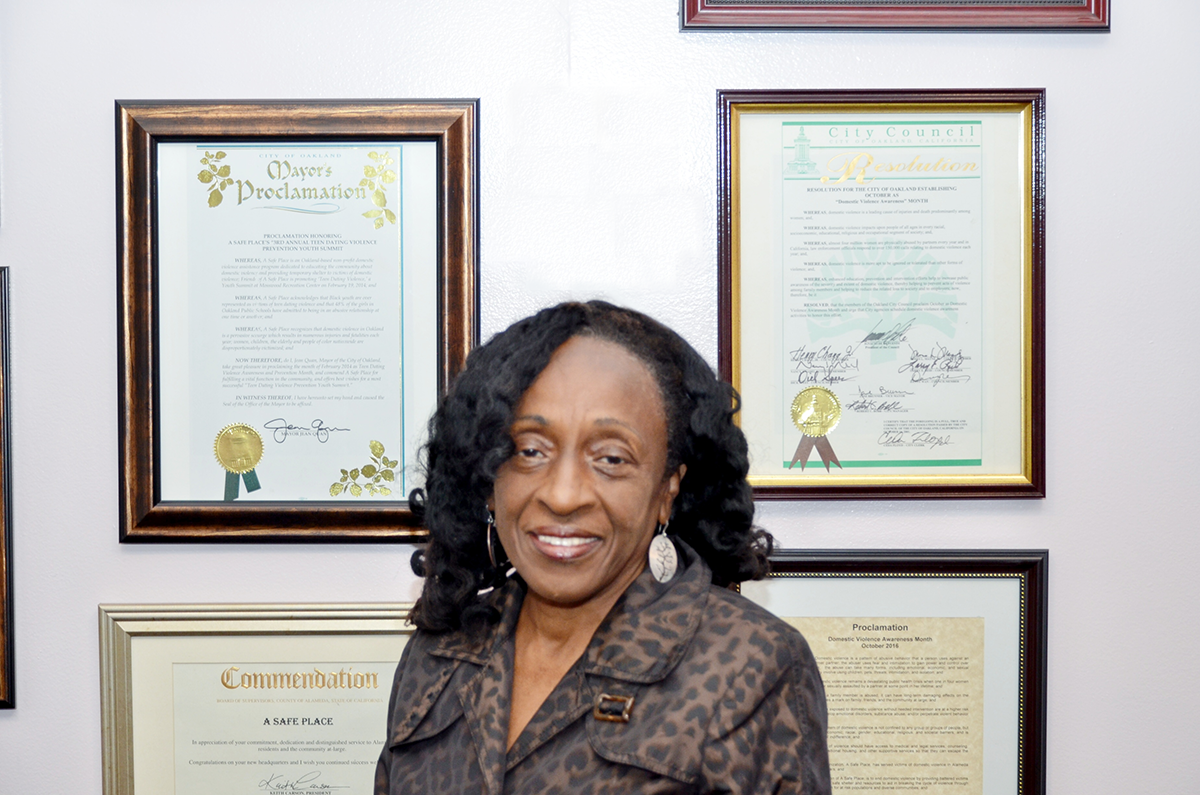
Carolyn Russell, executive director of A Safe Place Domestic Violence Assistance Program, holds a master’s degree in social work and a master’s degree in forensic psychology.

 

Activism

The Ladies of Delta Sigma Theta Hold Day of Advocacy at the Capitol in Sacramento

A member of the “Divine Nine,” Delta Sigma Theta Sorority, Inc., was founded on Jan. 13, 1913, at Howard University in Washington, D.C. The organization was established by 22 women who sought to shift the group’s focus from social activities to public service, academic excellence, and social activism.

Published

on

Sen. Laura Richardson (D-San Pedro) presents a Senate resolution to the Delta Theta Sigma Sorority Farwest Region at the State Capitol on May 4. Photo courtesy of the Senate Rules Committee.

By Antonio Ray Harvey, California Black Media

On May 4, members of the Farwest Region of Delta Sigma Theta Sorority, Inc., convened at the California State Capitol for the organization’s 23rd annual Delta Days in Sacramento.

The two-day advocacy event brings together chapters from across California to engage directly in the legislative process, connect with lawmakers, and advocate for policies impacting Black communities.

Members of the sorority were honored on the Senate floor by Sen. Laura Richardson (D-San Pedro), who is also a member of Delta Sigma Theta.

Richardson welcomed the Farwest Region during the presentation of a Senate resolution recognizing outgoing Regional Director Kimberly Usher for her leadership and service.

“In addition to the Far West Region, we are led by a fearless leader, regional director Kimberly Usher. She has now served her full term of what’s allowed,” Richardson said. “We are going to be having our regional conference, but we wanted to give it to her here, officially recognizing her service.”

The resolution was co-authored by Richardson and fellow members of the California Legislative Black Caucus (CLBC) and Delta Sigma Theta, Sen. Akilah Weber Pierson (D-San Diego) and Assemblymember Rhodesia Ransom (D-Stockton).

Usher has served in the leadership role since 2022.

A member of the “Divine Nine,” Delta Sigma Theta Sorority, Inc., was founded on Jan. 13, 1913, at Howard University in Washington, D.C. The organization was established by 22 women who sought to shift the group’s focus from social activities to public service, academic excellence, and social activism.

“We are founded on sisterhood that is deeply rooted in scholarship, service, and social action,” said Weber Pierson, a member of the Gamma Alpha chapter of Delta Sigma Theta Sorority.

“Today, we continue a legacy of empowering communities and upholding the high cultural, intellectual, and moral standards established by our founders over a century ago,” she added.

Continue Reading

Activism

Rep. Kamlager-Dove Introduces Bill to Protect Women in Custody After Reports Detailing Miscarriages and Neglect

The Pregnant Women in Custody Act would expand safeguards beyond the federal prison system to include women detained by U.S. Immigration and Customs Enforcement, U.S. Customs and Border Protection and the Office of Refugee Resettlement. The proposal follows reports of pregnant women being shackled, denied medical care and suffering miscarriages while in immigration detention.

Published

on

iStock
iStock

By Bo Tefu, California Black Media

Congresswoman Sydney Kamlager-Dove (D-CA-37) on May 7, reintroduced updated legislation aimed at strengthening protections and healthcare standards for pregnant and postpartum women held in federal custody, including in immigration detention facilities.

The Pregnant Women in Custody Act would expand safeguards beyond the federal prison system to include women detained by U.S. Immigration and Customs Enforcement, U.S. Customs and Border Protection and the Office of Refugee Resettlement. The proposal follows reports of pregnant women being shackled, denied medical care and suffering miscarriages while in immigration detention.

The legislation builds on a bipartisan version previously passed by the House during the 117th Congress. The updated bill includes new standards for healthcare access, mental health and substance use treatment, high-risk pregnancy care, family unity protections and increased federal oversight.

“Proper pregnancy care is a human right, regardless of your immigration or incarceration status,” Kamlager-Dove said in a statement. “It’s unacceptable that there are virtually no legal safeguards for pregnant women in federal custody.”

The bill would also limit the use of restraints and restrictive housing for pregnant women, improve data collection on maternal health in custody and require additional staff training and enforcement measures.

Supporters of the measure said the legislation is intended to address long-standing concerns about maternal healthcare and safety in detention settings, particularly for Black women and low-income women who are disproportionately impacted by incarceration and health disparities.

“Pregnant women in custody should never be subjected to dangerous and inhumane treatment that threatens their health, dignity, or the well-being of their babies,” said Patrice Willoughby, chief of policy and legislative affairs for the NAACP and a longtime public policy and government affairs strategist, in a statement.

A 2021 report estimated there are about 58,000 admissions of pregnant women into U.S. jails and prisons each year. Kamlager’s statement also cited a recent investigation by NBC News and Bloomberg Law that identified allegations of severe mistreatment or medical neglect involving at least 54 pregnant women or families in county jails between 2017 and 2024.

Federal policy under the Department of Homeland Security restricts the detention of pregnant, postpartum and nursing immigrants except in extreme cases. However, the agency reported that ICE deported 363 pregnant, postpartum or nursing women between January 2025 and February 2026, including 16 recorded miscarriages during that period.

The bill is cosponsored by several House Democrats and backed by organizations including the NAACP and the Vera Institute of Justice.

Continue Reading

Activism

OPINION: The Fire of Oakland’s Justin Jones

Jones made headlines three years ago when he was one of a pair of Justins. Along with fellow State Rep. Justin Pearson (D-Memphis), he fought their removal from the state house in Tennessee and won reinstatement. Now, Pearson is running for Congress and Jones is still fighting for all of us.

Published

on

Tennessee State Rep. Justin Jones (D-Nashville). File photo.

By Emil Amok Guillermo

You may know Tennessee State Rep. Justin Jones (D-Nashville).

He grew up in Oakland and the East Bay. His mother is Filipino. You can tell by his full name Justin Shea Bautista Jones.

His father is African American.

He is fighting for all of us.

Jones made headlines three years ago when he was one of a pair of Justins. Along with fellow State Rep. Justin Pearson (D-Memphis), he fought their removal from the state house in Tennessee and won reinstatement.

Now, Pearson is running for Congress and Jones is still fighting for all of us.

The recent 6-3 Supreme Court decision barring the use of race in drawing congressional districts marks a major turning point in U.S. history.

The decision took away the Voting Rights Act’s power to assure minority voices were both heard and represented.

“What we’re seeing now is this new Jim Crow system in which Black and Brown communities are without voice in our political process,” he told Fredricka Whitfield on CNN last weekend.

“That’s a canary in the coal mine for the rest of the nation. If they come for one of us, they’re coming for all of us, and some of my message to America is that the South is the front line of democracy,” Jones said. “They are dismantling multi-racial democracy here in the South, in states like Tennessee and Louisiana. But they aren’t going to stop here.”

That’s why Jones said we have to start paying attention to the South, and start helping them fight back there,” he said.

“I want to be clear that this terror, this type of system they’re enacting, are the same systems my grandparents told me about who grew up in Tennessee, a system where people like me couldn’t even be in political office. That’s the time they’re bringing us back to and I’m not sounding the alarm to be alarmist. But I am sounding it because we’ve seen this before in our history.”

Jones talked about Reconstruction and about what happened between the end of the 1800s and the beginning of the 1960s, when there was no Black political representation.

It’s a rebellion to keep our democracy going forward, he said.

“Stand with us and help us fight back against this extremist power grab — this racist power grab against our vision of a multi-racial democracy,” Jones added.

“While there is a litigation strategy, it’s important to maintain what he called a “movement strategy” that leads to the largest voter mobilization and registration that has ever been seen in the South,” he encouraged.

In 2026.

“Tennessee is an oppressed state,” Jones said. “It’s a state where one in five Black voters can’t vote because of felony disenfranchisement. It is where you can use a gun permit to vote, but you can’t use a student ID card to vote.

That’s the Asian American African American voice of Justin Jones.

Read his words for inspiration.

About the Author

Emil Guillermo is a veteran journalist, commentator, and comic stage monologist. His new show “69, Emil Amok: Anchorman—The News Made Me Do It,” is at the San Diego Fringe at New Destiny/Lincoln Park, 4931 Logan Ave. Ste. 102. May 14-23, at various times. Get tickets here.

Continue Reading

Subscribe to receive news and updates from the Oakland Post

* indicates required

CHECK OUT THE LATEST ISSUE OF THE OAKLAND POST

ADVERTISEMENT

WORK FROM HOME

Home-based business with potential monthly income of $10K+ per month. A proven training system and website provided to maximize business effectiveness. Perfect job to earn side and primary income. Contact Lynne for more details: Lynne4npusa@gmail.com 800-334-0540

Facebook

Oakland Mayor Barbara Lee. File photo.
Bay Area1 week ago

Oakland Mayor Pushes Charter Overhaul to Clarify Roles in City Government, Increase Accountability and Improve Service Delivery

Sen. Laura Richardson (D-San Pedro) presents a Senate resolution to the Delta Theta Sigma Sorority Farwest Region at the State Capitol on May 4. Photo courtesy of the Senate Rules Committee.
Activism1 week ago

The Ladies of Delta Sigma Theta Hold Day of Advocacy at the Capitol in Sacramento

iStock
Activism1 week ago

Rep. Kamlager-Dove Introduces Bill to Protect Women in Custody After Reports Detailing Miscarriages and Neglect

Hon. Steve Bradford, candidate for California Insurance Commissioner.
Bay Area1 week ago

Q&A with Steven Bradford: Why He Wants Your Vote for California Insurance Commissioner

Tennessee State Rep. Justin Jones (D-Nashville). File photo.
Activism1 week ago

OPINION: The Fire of Oakland’s Justin Jones

iStock
Bay Area1 week ago

How Is AI Affecting California? The State Wants You to Share Your Story

iStock
Activism1 week ago

California Launches Free Diaper Program for Newborns Statewide

Book covers. Photo courtesy of Terri Schlichenmeyer.
Advice1 week ago

Book Review: Books for College-Bound Students

Photo courtesy of the office of Assemblymember Corey Jackson (D-Moreno Valley).
Activism1 week ago

Asm. Jackson Bill Requiring Anti-Hate Speech Training for Calif. Public Officials Sent to “Suspense File”

iStock
Activism1 week ago

More and More, Black Californians Are Worried About Rising Costs of Housing, Energy, Food and Gas 

Crime Survivors Speak at the California State Capitol was a multi-day advocacy event held May 4–6 that called for increased support, services, and funding for crime victims. Organized by Crime Survivors for Safety and Justice (CSSJ), the gathering brought together more than 200 survivors and family members to advocate for legislative reforms. CBM photo by Antonio Ray Harvey.
Activism1 week ago

Advocates Rally at State Capitol to Demand Heat Protections for Incarcerated People; More Funding for DV Survivors

Lecturer Lisa Troseth will speak on "Moving past fear to healing" on May 23 at the Orinda Library Auditorium. Photo courtesy of the Christian Science Board of Lectureship.
Bay Area1 week ago

Coming to Orinda: A Lecture on Finding the Strength to Heal and Move Past Fear With Divine Love

William “Bill” Patterson, Jr. Courtesy Peralta College District
Activism1 week ago

EBMUD Enshrines the Legacy of  its First Black Board Member William ‘Bill’ Patterson 

Mary Jackson. Public domain.
Arts and Culture1 week ago

Against All Odds: Mary Jackson’s Journey to NASA Engineer

Researchers pointed out that the number amounts to 1 in every 50 adults, with 3 out of 4 disenfranchised living in their communities, having completed their sentences or remaining supervised while on probation or parole. (Photo: iStockphoto)
Activism1 week ago

Supreme Court Voting Rights Ruling Reverberates From the South to California

At St. Rose Hospital in Hayward, Alameda Health System and Stanford Announce Partnership.(L-R) Mark Fratzke, COO Alameda Health System (AHS), James Jackson, CEO AHS, Richard Espinoza, chief administrative officer AHS, California Assemblymember Liz Ortega (D-San Leandro), Rick Shumway, COO Stanford Health Care (SHC), Alameda County Supervisor Elisa Márquez, and Hayward Mayor Mark Salinas. Photo by Carla Thomas.
Alameda County1 month ago

Stanford Health Care Collaborates with Alameda Health System Affiliate, Expanding Access to Care in East Bay

At D. Monaghan’s on the Hill, a resolution declaring April 9 ‘100 Black Men of the Bay Area Day’ was witnessed by (l.-r.) 100 Black Men leaders Maurice Harold, Marco T. Lindsey, Danny Lee Williams, Oakland Mayor Barbara Lee, Oakland City Council President Kevin Jenkins, Port of Oakland Commissioner Derek Mohammad, and Oakland Councilmember Janani Ramachandran. Photo by Carla Thomas.
Activism1 month ago

Mayor Barbara Lee Proclaims April 9 as ‘100 Black Men of the Bay Area Day’

Activism1 month ago

Oakland Post: Week of April 15 – 21, 2026

Black Leadership Council (BLC) Advocacy Day in Sacramento. BLC works to advance meaningful change through policy engagement to unlock the full potential of Black and low-income communities. Photo courtesy PRC.
Activism1 month ago

Up to the Job: How San Francisco’s PRC Is Providing Work Opportunities That Turn Into Lasting Stability

Patricia Roque (far right) pictured with her family at a Stop Asian Hate rally after her father's assault (far left). (Courtesy of AAPI Equity Alliance)
Activism1 month ago

Building Bridges of Support: How AAPI Equity Alliance Is Strengthening California’s Anti-Hate Network

Activism1 month ago

Oakland Post: Week of April 22 – 28, 2026

#NNPA BlackPress1 month ago

IN MEMORIAM: Rest in Power — Minnesota Loses a True Warrior in Yusef Mgeni

Black Leadership Council (BLC) Advocacy Day in Sacramento. BLC works to advance meaningful change through policy engagement to unlock the full potential of Black and low-income communities. Photo courtesy of PRC.
Activism4 weeks ago

Up to the Job: How San Francisco’s PRC Is Providing Work Opportunities That Turn Into Lasting Stability

#NNPA BlackPress1 month ago

Mamdani Plans City Grocery Store in East Harlem 

#NNPA BlackPress4 weeks ago

2026 Mazda CX‑90 PHEV Premium Plus — Luxury SUV or Overpriced Plug‑In? | Walkaround Review

#NNPA BlackPress1 month ago

Revolve Fund to Provide $20,000 to Support Food Access Efforts in Alabama Black Belt

#NNPA BlackPress3 weeks ago

OP-ED: Small Businesses Need Minnesota to Act on Pass-Through Tax Policy

#NNPA BlackPress1 month ago

Cuban President Vows to Defend the Country Against US Invasion

#NNPA BlackPress3 weeks ago

Snoop Dogg Celebrates 10 Til’ Midnight at the Compound

#NNPA BlackPress3 weeks ago

2026 Lucid Air Grand Touring Review — Is This $136K EV Sedan Worth It?

Trending

Copyright ©2021 Post News Group, Inc. All Rights Reserved.