
Activism
Opinion: The Murder of Ahmaud Arbery — and Our Continuing Terror

Today there is a national outcry about the murder of Ahmaud Arbery. The public condemnation has forced a belated response.
Those accused of his murder finally have been arrested. His murder has become a global embarrassment for whites.
For Blacks, however, it is another humiliation, a continuing terror. It is the normal silence, however, that condemns thousands of African Americans to unjust deaths and millions to shattered lives. When the camera turns away, the savage injustice that embarrasses us becomes simply business as usual.
The horror of Ahmaud Arbery’s murder is now well known. The 25-year-old Black man went for a jog down the middle of the street in the middle of the day on Feb. 23. Two white men decided he was suspicious, hunted him down and shot him point-blank in the middle of the street at 1 p.m.
Local law enforcement had video evidence of the crime. Yet no arrest was made until 74 days later, two months and two weeks after the murder. Local authorities chose not to act. Two U.S. senators said nothing. The white church — that had blessed slavery, segregation, apartheid in South Africa — was silent.
Why did the arrests finally take place? Because an intrepid reporter from the New York Times investigated the story and made it public; the murder video was leaked to the public on the 72nd day after Ahmaud’s murder.
As the public outrage grew, the arrests were made. Never forget, as one commentator noted, they did not make the arrests because THEY saw the incriminating video. They made the arrests because WE saw the video. Embarrassed, faced with an aroused community and an international scandal, they finally acted.
So it goes. African Americans suffer in silence the savage injuries of institutionalized racism.
We live in northern ghettos — driven there in the early part of the last century by terrorism — most strikingly the Ku Klux Klan and their signature lynchings. The Equal Justice Initiative reports there were 4,084 lynchings of Blacks in the South from 1877 to 1950. The Klan, embraced by and often made up of the white gentry of the South, often gathered at their churches to organize the public lynchings. They terrorized Blacks to end the fusion multiracial coalitions that grew up in the Reconstruction and to take back control of their states.
The lynchings and violence were greeted with silence, if not approval. White authorities, white churches, white society turned their heads if they weren’t applauding in approval.
Fleeing north, Blacks were redlined into ghettos, with jobs hard to get, and discrimination closing doors. To this day, African Americans are last hired and first fired. We suffer the worst poverty, the highest unemployment, the highest childhood hunger and malnutrition, the most inadequate health care. This reality is sustained by the silence of white elites, the silence of the white church, the silence of the evangelicals, the silence of the best-minded citizens.
Then, the virus hits, and its most lethal effect is on those who are vulnerable: the elderly, the sick, the hungry, those with asthma and obesity. It hits hardest among the suddenly proclaimed “essential workers” who do the work that previously was largely “invisible: the bus drivers, the grocery clerks, the nurses and medical aides. Not surprisingly, African Americans make up a disproportionate number of those killed or infected by the virus.
The racial disparities are so stark that they gain national and international attention. Pundits express shock and outrage at the reports as if they were surprised by the results. Editorials demand reform. Politicians call for action. The informed public is embarrassed.
But little happens: the rescue packages passed by Congress send most of the money to the biggest companies and the most affluent investors. Banks are saved; the post office — with a largely minority workforce — is starved. Hunger spreads. Any expansion of food stamps is blocked.
Arrested for leading nonviolent protests against segregation, Dr. Martin Luther King penned his letter from the Birmingham jail expressing his grave disappointment with the “white moderate” and the “white church.” He suggested that the “great stumbling block” for African Americans seeking their freedom is “not the White Citizen’s Councilor or the Ku Klux Klanner, but the white moderate “who is more devoted to order than to justice.” He decried a religious community “largely adjusted to the status quo, standing as a tail-light behind other community agencies rather than a headlight leading men to higher levels of justice.”
The virus didn’t discriminate. The society enforced the discrimination; the virus just preyed upon its victims. We have gone too long, struggled too hard to adjust to the reality that it is dangerous to be Black while jogging or to be Black in a pandemic.
It isn’t enough to express dismay when the newspapers highlight the horrors. We need leaders and citizens of conscience who will act and not rest until justice is done.

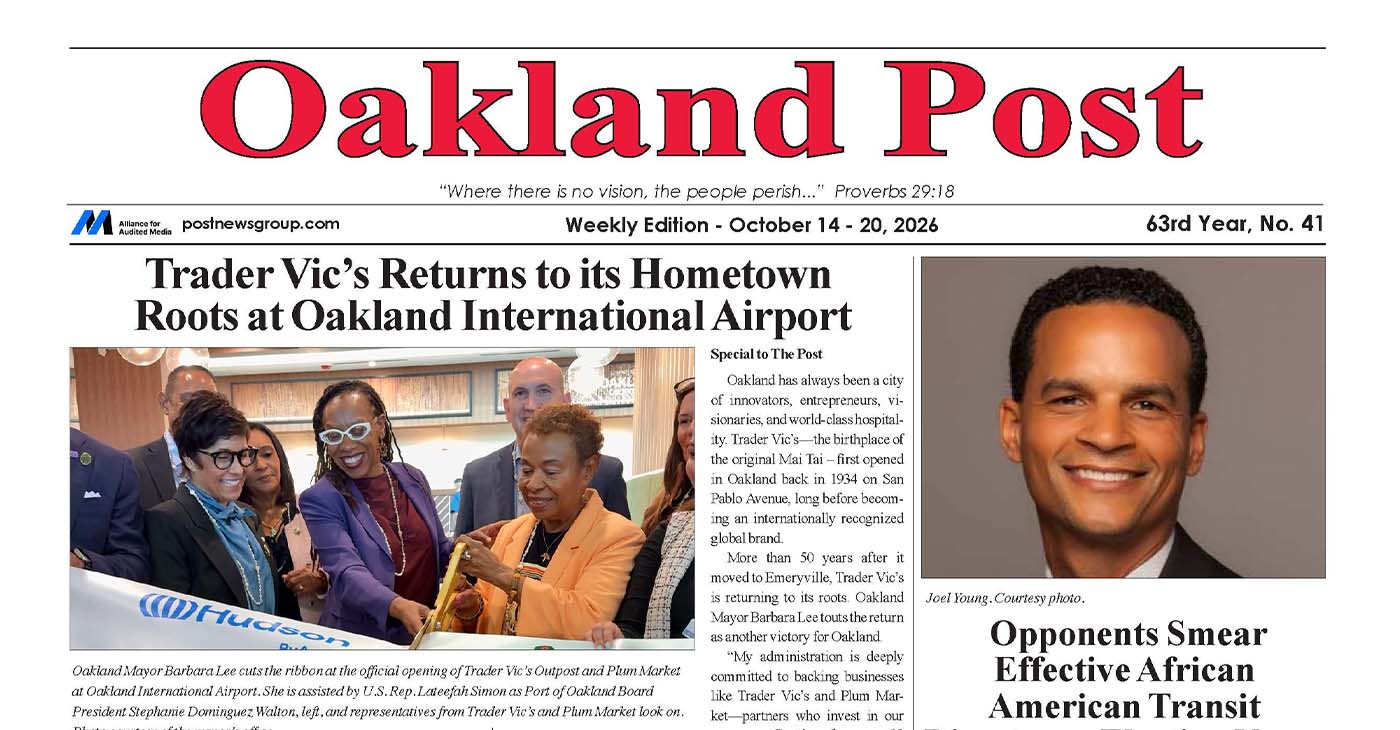
To enlarge your view of this issue, use the slider, magnifying glass icon or full page icon in the lower right corner of the browser window.

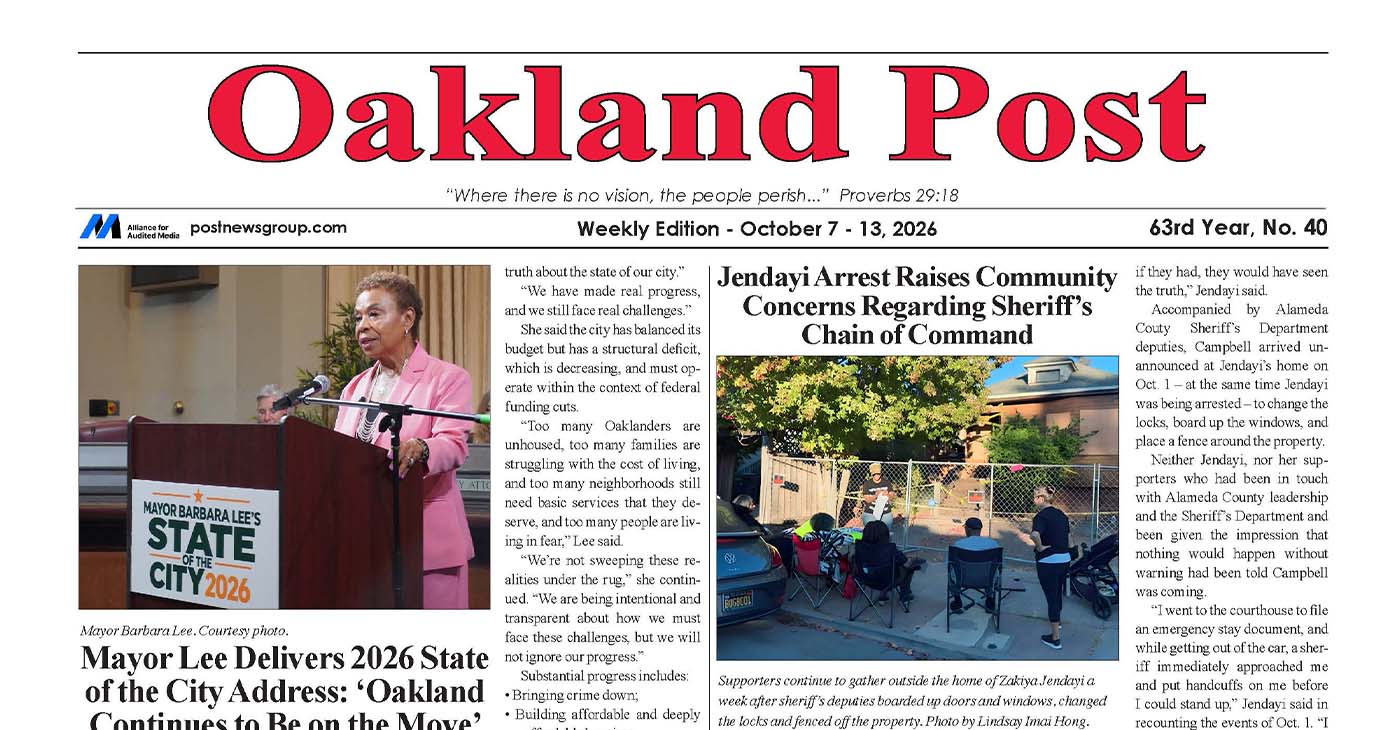
To enlarge your view of this issue, use the slider, magnifying glass icon or full page icon in the lower right corner of the browser window.
Activism
Oakland Post: Week of September 30 – October 6, 2026
The printed Weekly Edition of the Oakland Post: Week of September 30 – October 6, 2026

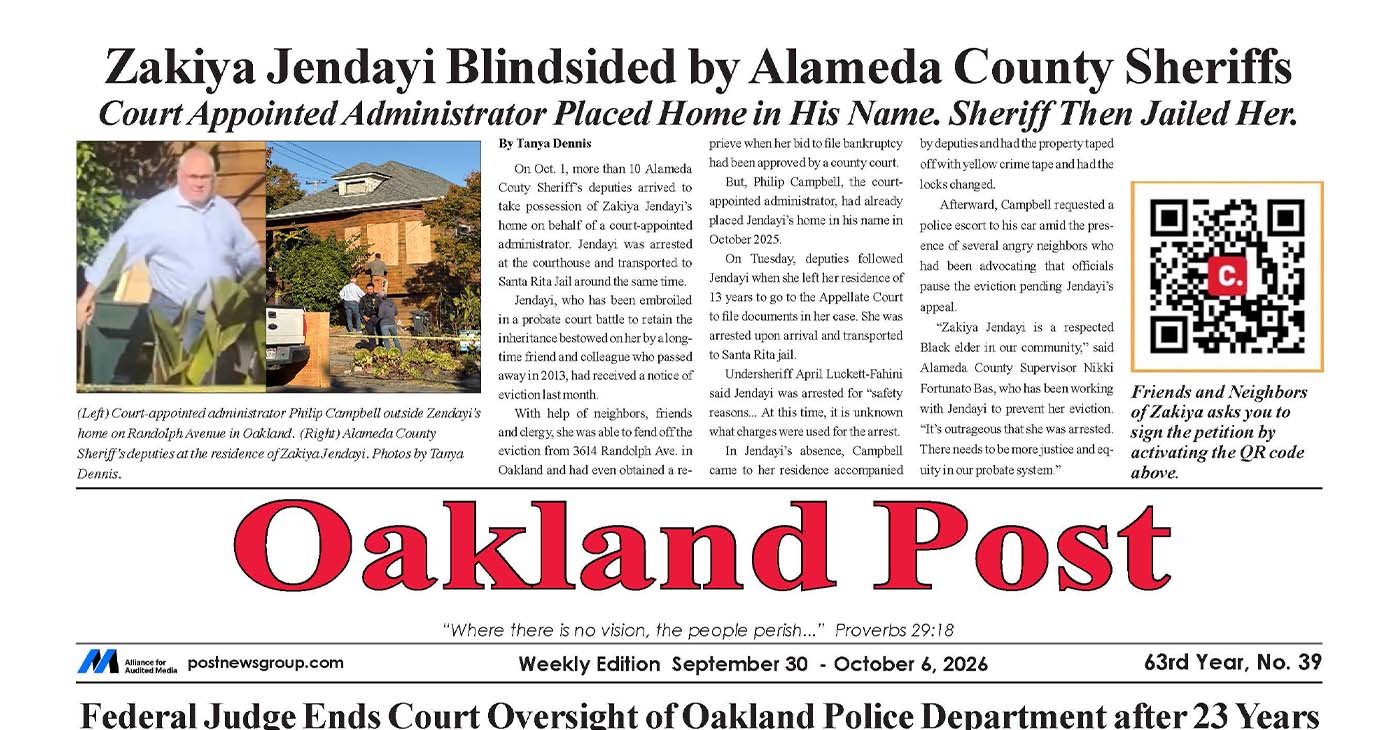
To enlarge your view of this issue, use the slider, magnifying glass icon or full page icon in the lower right corner of the browser window.


Mayor Barbara Lee Holds Special State of the City Address in Deep East Oakland

Practitioners of African Traditional Spirituality Offer Ancestral Reverence Ritual Oct. 31

It’s Time to Lose Weight Before the Holidays

Trader Vic’s Returns to Its Oakland Roots

Oakland Coal Terminal Backed by Trump Would Be Bigger, Dirtier Than Promised, Says Report

Opponents Smear Effective African American Transit Director as Election Nears

Oakland Post: Week of October 14 – 20, 2026

OP-ED: The Black Church Writes AI’s Next Chapter

OP-ED: The Black Church Writes AI’s Next Chapter

WCCUSD Joins Statewide Organic School Food Purchasing Cooperative

Democrats, Community Groups Back Measure EE to Change How Oakland Is Governed

Four Tips to Help You Plan a Holiday “Staycation”

Veterans Housing Project Proposed for South Richmond
PRESS ROOM: Transformative Justice Coalition 2026 Voting Rights Champion Awards Reception ‘Yesterday Is Today: The Battle For Voting Rights

Mayor Lee Delivers 2026 State of the City Address: ‘Oakland Continues to Be on the Move’

Misnamed ‘Parent’ PAC Seeks to Influence Oakland School Board Elections

Poll: Becerra Widens His Lead Over Hilton; Californians Split on Wealth Tax

Listening as a Lifeline: A Doula’s Witness to Black Maternal Health

Oakland Post: Week of September 9 – 15, 2026

County Office of Education Says OUSD Finances Are Getting Healthier, Materially Stronger

Richmond Tiny House Village Farm & Garden Set to Open Gates on Sept. 26

Mayor Lee Announces $1 Million Kaiser Permanente Grant for Pilot Program to Address Homelessness, Clean Up Public Spaces throughout Oakland

Latest Massacre in Haiti Reveals Cruelty U.S. Deportations

Zakiya Jendayi Arrested, Locked Out of Home by Sheriff’s Deputies

OPINION: Nolan Wells’ Death One of Several Signifying Racial Terror Lives on in U.S. South

BLACspace Cooperative Invites Bay Area to Experience Oakland’s Black Cultural Ecosystem Through a BLAC Map Tour + Party

Doulas Are Helping Black California Moms Navigate Pregnancy–Even as High Mortality Rates Persist

Oakland Post: Week of September 16 – 22, 2026

Oakland People’s Arms Embargo Coalition Demands End to Military Shipments Thru Oakland

Democratic Clubs Interview Candidates for Oakland School Board

The Conversation With Al McFarlane 6/23/26

Media Monday 6/22/26

LIVE! ASK ALMA! — TUES. 6.23.26 7PM EST

Car Buying Secrets: 4 Hidden Checks Before You Sign!

Is This 550 HP Charger Worth YOUR Money? AutoNetwork Review

Celebrating Juneteenth – Frederick Douglass on education and resistance

LIVE! — ASK ALMA! — TUES. 6.19.26 7PM EST

Hyundai Ioniq 5 Parking, Safety, and 360 View #shorts

2025 Ioniq 5 New Wiper & Powerful Performance! #shorts

Electric SUV Range: Is 259 Miles Enough? #shorts

EV Charging: How Fast Can You Charge an Electric Vehicle? #shorts

Biometric Cooling… Messaging Seats…Come on! 2025 Infiniti QX80 Autograph 4WD

Charged Up: Witness the Magic of a Fully Electric Car! #shorts

Range Rover Sport PHEV Included…: See What’s Inside This Luxury SUV! #shorts

Invisible Hood View: Perfect Parking with X-Ray Vision! #shorts
-
 Economy4 weeks ago
Poll: Becerra Widens His Lead Over Hilton; Californians Split on Wealth Tax
-
 Black History3 weeks ago
Listening as a Lifeline: A Doula’s Witness to Black Maternal Health
-
 Business4 weeks ago
County Office of Education Says OUSD Finances Are Getting Healthier, Materially Stronger
-
 Lead Story3 weeks ago
Zakiya Jendayi Arrested, Locked Out of Home by Sheriff’s Deputies
-
 Art4 weeks ago
BLACspace Cooperative Invites Bay Area to Experience Oakland’s Black Cultural Ecosystem Through a BLAC Map Tour + Party
-
 Black History4 weeks ago
Doulas Are Helping Black California Moms Navigate Pregnancy–Even as High Mortality Rates Persist
-
 Business4 weeks ago
From Historic Memories to New Possibilities: Oakland Celebrates Coliseum 60
-
 Community4 weeks ago
Asm. Corey Jackson Announces Launch of 24-Hour Childcare in His District
