
Entertainment
B.B. King Estate Fight Looms for Family Group, Longtime Aide


In this May 7, 2015, file photo, LaVerne Toney, center, arrives in Clark County Family Court in Las Vegas. Less than two weeks after blues legend B.B. King was laid to rest near his birthplace in the Mississippi Delta, a battle over his estate is moving from the headlines to the courthouse in Las Vegas. Attorneys for King’s designated executor, Toney, have filed documents in Nevada state court to fend off allegations that King family members were kept away in his dying days, that he was mistreated medically and that his money was siphoned off before he died May 14 at his Las Vegas home at age 89. (AP Photo/John Locher, File)
KEN RITTER, Associated Press

LAS VEGAS (AP) — Just days after blues legend B.B. King was laid to rest near his birthplace in the Mississippi Delta, a battle over his estate is moving from the headlines to the courthouse in Las Vegas.
Attorneys for King’s designated executor, LaVerne Toney, have filed documents in a Nevada court to fend off allegations that King family members were kept away in his dying days, that he was mistreated medically and that his money was siphoned off before he died May 14 at his Las Vegas home at age 89.
“We’re asking the probate commissioner to approve (Toney) as executor and personal representative of the estate,” attorney Brent Bryson said Monday.
“The spurious and unjustified allegations made against Ms. Toney by Patty King, Karen Williams and Larissa Drohobyczer will be dealt with at a later time,” he added.
Among King’s 11 surviving adult children, Williams and Patty King have been most outspoken about the music icon’s care in his final days. Through their attorney, Drohobyczer, they accused Toney and B.B. King’s personal assistant, Myron Johnson, of poisoning him to hasten his death.
Toney and Johnson denied the claims, and Bryson dismissed them as ridiculous, defamatory and libelous.
But the allegation prompted an autopsy by the Clark County coroner the day after a King memorial at a Las Vegas funeral chapel. Results of toxicology tests are expected in several weeks. Police said there was no active homicide investigation.
King was buried May 30 at the B.B. King Museum and Delta Interpretive Center in Indianola, Mississippi.
Toney, who managed King’s road show business for 39 years and had power-of-attorney over his personal affairs, is the executor named in his will. She declined on Monday to comment. A King daughter, Riletta Mitchell, was second in line, but she died last September
Bryson said Monday the value of King’s estate was being tallied, but wasn’t expected to amount to the tens of millions of dollars suggested during Williams’ failed court bid to wrest guardianship from Toney a month ago.
One court document filed April 29 said one King bank account was believed to have had $5 million in May 2014, and his home was valued at $330,000. It said family members were unable to obtain updated figures or determine the value of King’s road show business or the rights and royalties from his music.
Drohobyczer has said she represents at least five of King’s children who refer to themselves as a family board. She said Monday she’ll file papers this week challenging Toney as executor, and didn’t want to comment before documents are filed.
Three daughters — Williams and Patty King, both of North Las Vegas, and Barbara King Winfree of Houston — declined to comment Monday about the upcoming probate hearing.
They’ve said previously that they want Toney out of the picture.
“We are the King family,” Patty King said. “We are fighting for the King estate.”
Son Willie King of Chicago didn’t immediately respond to messages.
Daughter Rita Washington, the fifth family board member, denied the fight to remove Toney is about money. She accused Toney of misleading family members about King’s finances and blocking them from visiting when King was dying.
“Dad died by himself,” Washington said. “If it was his wish not to let us see him in that condition, she still could have allowed us to visit him.”
In documents filed late Friday, Bryson provided an affidavit from one granddaughter who visited King the day before he died, and sworn testimonials from three doctors saying King was properly cared-for before he died in his sleep.
“Mr. King was able to smile, eat, laugh and watch westerns on television up until the time he fell asleep on May 13, 2015,” the court document said. It noted he never awoke.
King’s personal physician, Dr. Darin Brimhall, said drops that King’s daughters said they saw being administered to King in recent months were atropine, a drug commonly administered to people in hospice care to prevent respiratory congestion and difficulty swallowing.
Copyright 2015 The Associated Press. All rights reserved. This material may not be published, broadcast, rewritten or redistributed.


Activism
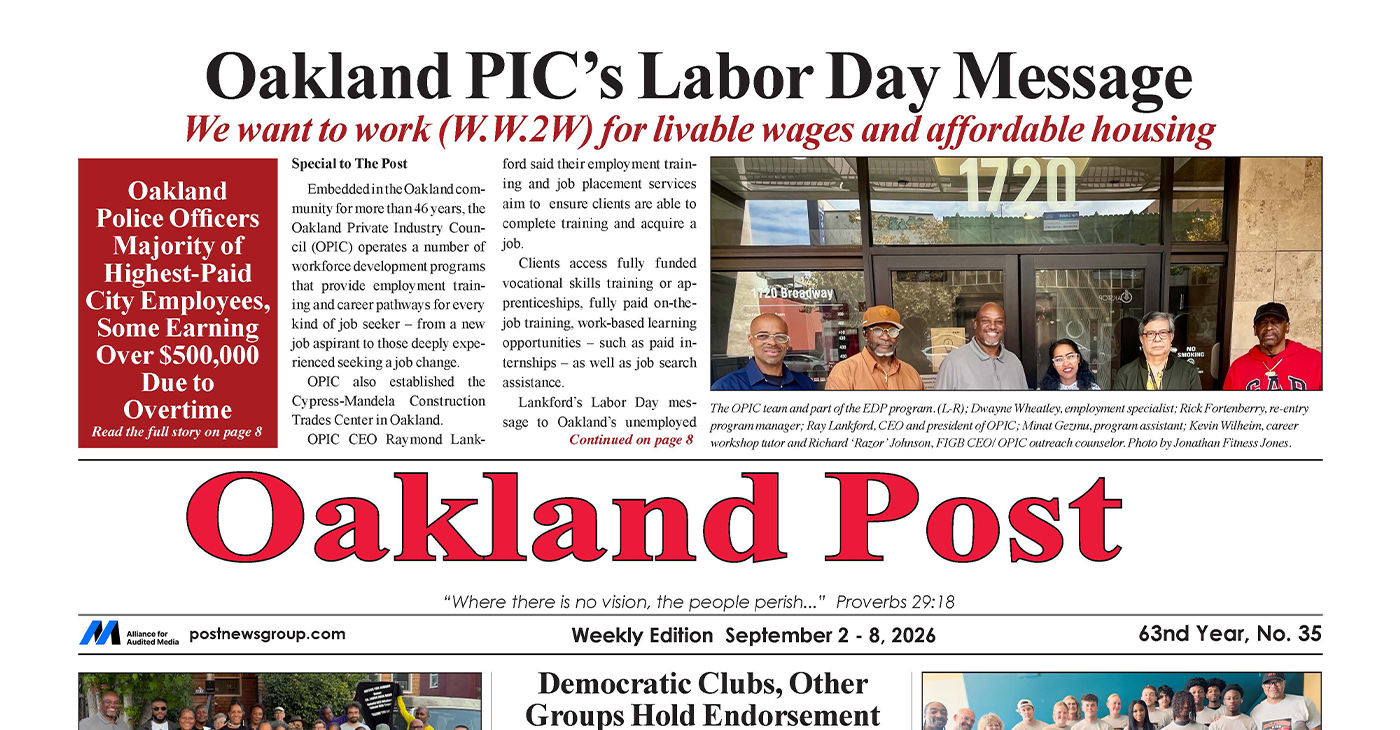
Oakland Post: Week of September 2 – 8, 2026
The printed Weekly Edition of the Oakland Post: Week of September 2 – 8, 2026
To enlarge your view of this issue, use the slider, magnifying glass icon or full page icon in the lower right corner of the browser window.
Black History
Jackie Wright Champions Bay Area Stories, Filmmakers and Cultural Institutions
As an award-winning communications professional, Wright has worked with corporations, nonprofits, government agencies, educational institutions, artists, and community organizations. In 2026, she expanded that work by launching an introductory public relations class for small businesses and nonprofits, offering practical tools for gaining visibility, shaping messages and building productive relationships with the media.

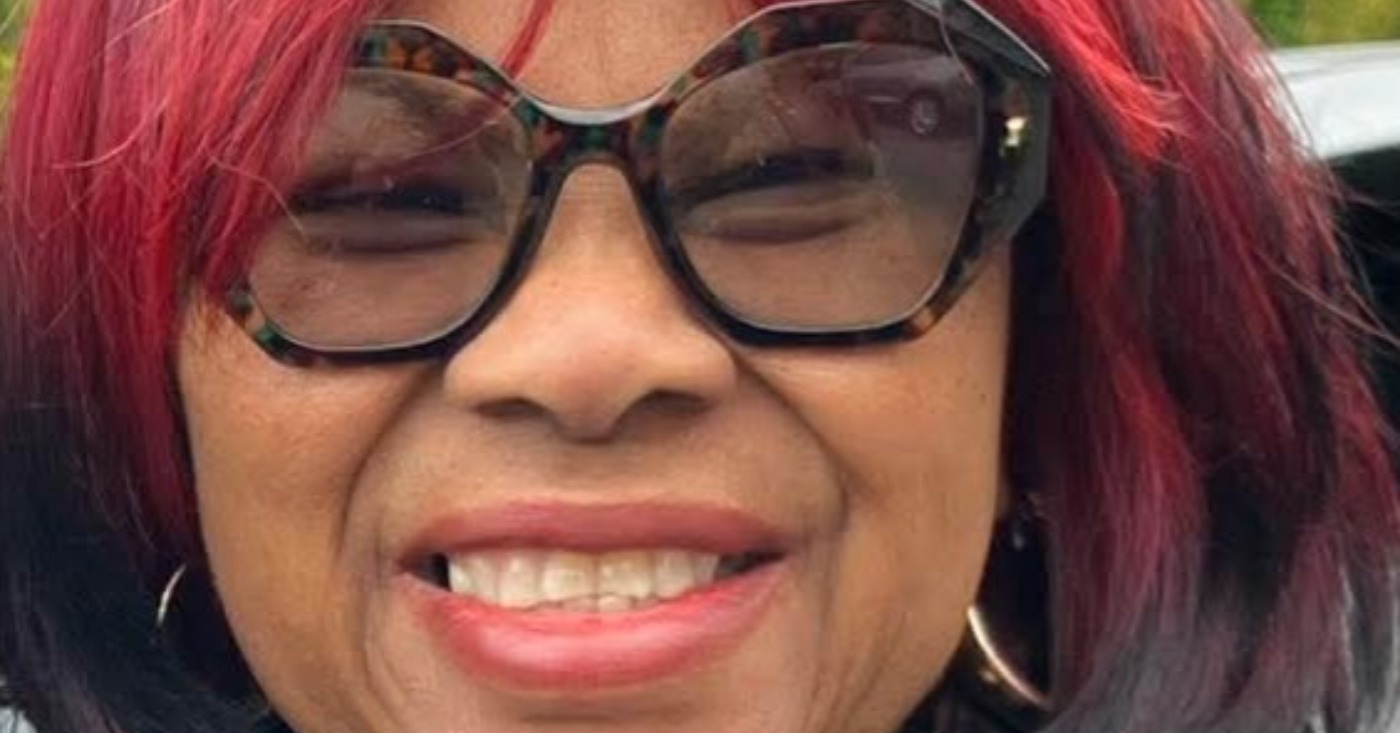
Jackie Wright has spent more than two decades helping people, organizations and communities understand the power of a well-told story.
As founder and president of Wright Enterprises, a San Francisco-based strategic communications and public affairs firm, Wright has built a career spanning journalism, public relations, media relations, crisis communications, community engagement and multimedia storytelling.
As an award-winning communications professional, Wright has worked with corporations, nonprofits, government agencies, educational institutions, artists, and community organizations. In 2026, she expanded that work by launching an introductory public relations class for small businesses and nonprofits, offering practical tools for gaining visibility, shaping messages and building productive relationships with the media.
Wright’s commitment to storytelling is also deeply personal. She wrote and co-directed the 15-minute documentary, “Love Separated in Life…Love Reunited in Honor,” which chronicles the story of her parents, Specialist Five (S5 Wyley Wright Jr. and Ouida Fay McClendon Wright. Her father, a U.S. Army helicopter crew chief, died in Vietnam in 1964 while serving as an honor guard during a visit by then-Secretary of Defense Robert McNamara. Decades later, Wright and her siblings had their father exhumed from a segregated cemetery in Jacksonville, Florida, and their mother moved from her burial place in Georgia so the couple could be reunited at Arlington National Cemetery in 2014.
The family journey later took Wright and her sister to Vietnam, where they discovered the former military compound that had been named in honor of their father and another fallen soldier. The documentary, centered on love, war, family, racial understanding, and remembrance, earned festival recognition at screenings.
“It was quite an honor to learn about my family’s history and share it on film,” said Wright.
That filmmaking experience complements Wright’s longstanding advocacy for independent cinema. She has served as a media partner and brand ambassador for Bay Area film festivals, including the San Francisco Black Film Festival, Oakland International Film Festival, and the Durban International Film Festival in South Africa.
“It’s important to help filmmakers and underrepresented stories reach broader audiences,” said Wright.
Whether promoting a neighborhood organization, championing an independent filmmaker or preserving her own family history, Wright has remained consistent. Through Wright Enterprises, she has turned communications into both a profession and a form of community service, telling stories that might otherwise go unheard.
“Our stories are an integral part of our history, and our history is not only American history, but worldwide,” she said.

Activism
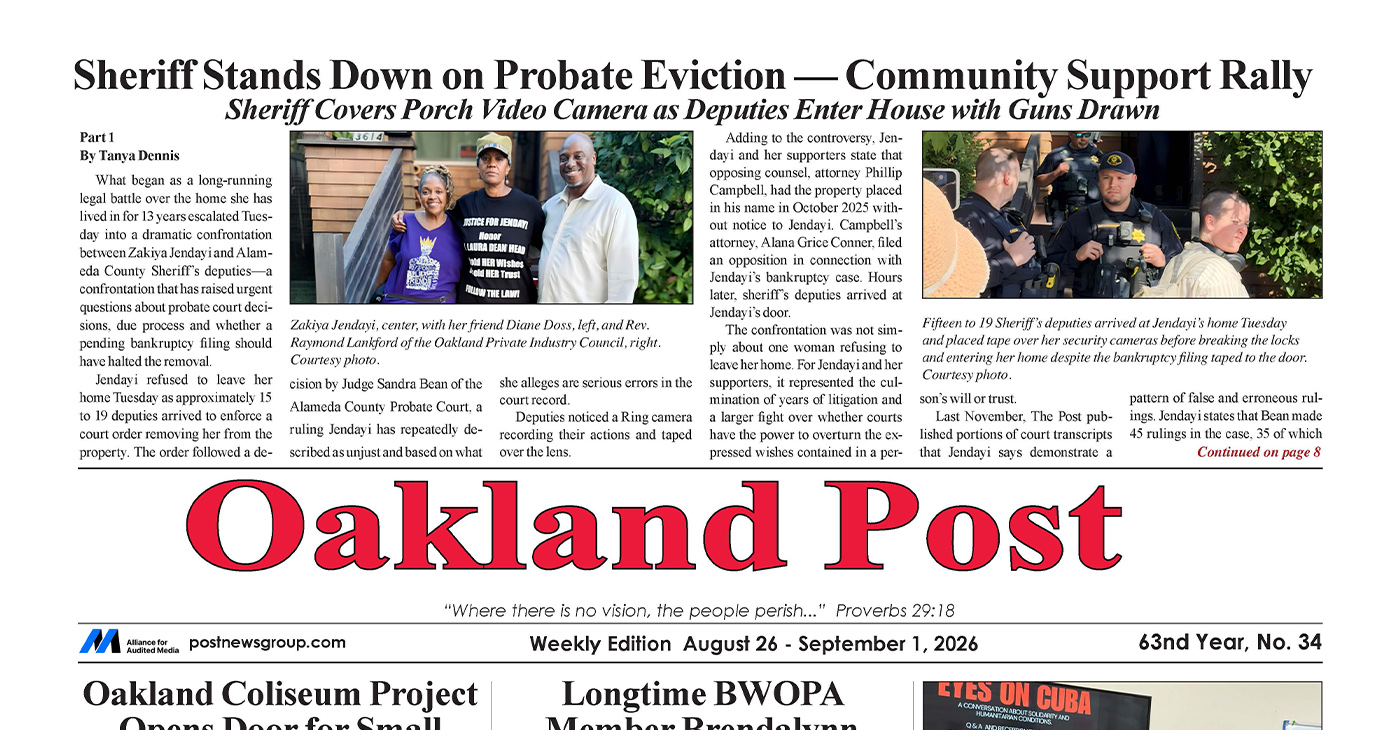
Oakland Post: Week of August 26 – September 1, 2026
The printed Weekly Edition of the Oakland Post: Week of August 26 – September 1, 2026
To enlarge your view of this issue, use the slider, magnifying glass icon or full page icon in the lower right corner of the browser window.


Prostate Cancer is Twice as Likely to Kill Black Men. Talking to Your Doctor Could Help Save Your Life

Oakland Post: Week of September 2 – 8, 2026

Longtime BWOPA Member Brendalyn Goodall Appointed to California Workforce Development Board

Jackie Wright Champions Bay Area Stories, Filmmakers and Cultural Institutions

Chef Sharon Lee Blends Culinary Excellence, Education and Empowerment

‘Passing a Law Isn’t The Finish Line’: California Assembly Evaluates Implementation, Results

OPINION: Angie Nixon Will Turn You Into a Democratic Socialist If Donald Trump Hasn’t Already

Gov. Newsom Signs Law Shielding Immigration Aid Workers From Doxing Threats

BOOK REVIEW: Every Inch of a Lady

Big City Mayors Ask for “Yes” Vote on Housing Bond Measure; Conservatives Say “No”

Madeline M. Turner: The Inventor Who Made Juicing Easier

Gubernatorial Candidate Steve Hilton Blasts California New Tire Rules; Newsom Hits Back

Frontier Airlines’ Return to Oakland Airport Brings Flights, Jobs and Opportunity

Secretary of State Shirley N. Weber Urges Californians to Vote Early as Voter ID Battle Intensifies

Gov. Newsom’s Latest Appointees Include Sacramento Advocate for Formerly Incarcerated Students; State’s New Tech Chief

Department of Homeland Security Demands California Secretary of State Shirley N. Weber Scrub Voter Rolls

New Judge Could Decide if Karmelo Anthony Gets a New Trial

“The Power to See Threats Sooner”: Gov. Newsom, Safety Officials Showcase California’s Investments in Hi-Tech Wildfire Prevention

Alpha Kappa Alpha Sorority, Inc. Celebrates New North Atlantic Regional Director

California Sen. Padilla Joins Colleagues to Introduce Bill Imposing Term Limits on Supreme Court Justices

Less Affluent School Districts, Including Sacramento City, Face Threat of State Takeover

Car Wash Workers Cope with Lingering Impacts of ICE Raids

COMMENTARY: You Are Already Paying for the AI Boom

California Bill Would Let Abuse Victims Use Trauma as Legal Defense for Violent Crime

Oakland Post: Week of July 29 – August 4, 2026

OP-ED: ‘The Trusted Messenger’ and the Black Vote

How Oakland’s Courtsmith is Scaling its Business and Local Impact

ESSAY: California Can Close Its Colorectal Cancer Gap

As Part of Your Back-to- School Checklist, Vaccinate

Oakland Post: Week of August 5 – 11, 2026

The Conversation With Al McFarlane 6/23/26

Media Monday 6/22/26

LIVE! ASK ALMA! — TUES. 6.23.26 7PM EST

Car Buying Secrets: 4 Hidden Checks Before You Sign!

Is This 550 HP Charger Worth YOUR Money? AutoNetwork Review

Celebrating Juneteenth – Frederick Douglass on education and resistance

LIVE! — ASK ALMA! — TUES. 6.19.26 7PM EST

Hyundai Ioniq 5 Parking, Safety, and 360 View #shorts

2025 Ioniq 5 New Wiper & Powerful Performance! #shorts

Electric SUV Range: Is 259 Miles Enough? #shorts

EV Charging: How Fast Can You Charge an Electric Vehicle? #shorts

Biometric Cooling… Messaging Seats…Come on! 2025 Infiniti QX80 Autograph 4WD

Charged Up: Witness the Magic of a Fully Electric Car! #shorts

Range Rover Sport PHEV Included…: See What’s Inside This Luxury SUV! #shorts

Invisible Hood View: Perfect Parking with X-Ray Vision! #shorts
-
 Community4 weeks ago
Less Affluent School Districts, Including Sacramento City, Face Threat of State Takeover
-
 Commentary4 weeks ago
ESSAY: California Can Close Its Colorectal Cancer Gap
-
 Business4 weeks ago
California Hispanic Chambers of Commerce Unveils: ‘Powering the Future’ Theme for 47th Annual Statewide Convention
-

 Community4 weeks ago
Four Candidates, Including Incumbent Barbara Lee, Qualify for Oakland Mayor’s Race
-

 Business4 weeks ago
From Blueprint to Breakthrough: Tackling Affordable Housing in Oakland
-

 Activism4 weeks ago
Oakland Post: Week of August 12 – 18, 2026
-

 Black History4 weeks ago
Oakland Observes Black August with Block Parties, Film Showings, Workshops
-

 Commentary4 weeks ago
COMMENTARY: Why Local School Tax Measure G1 Will Not Be on the November Ballot
