Connect with us

Uncategorized

Before Rosa Parks: The 15-year-old Alabaman who also refused to give up her seat

Published

on

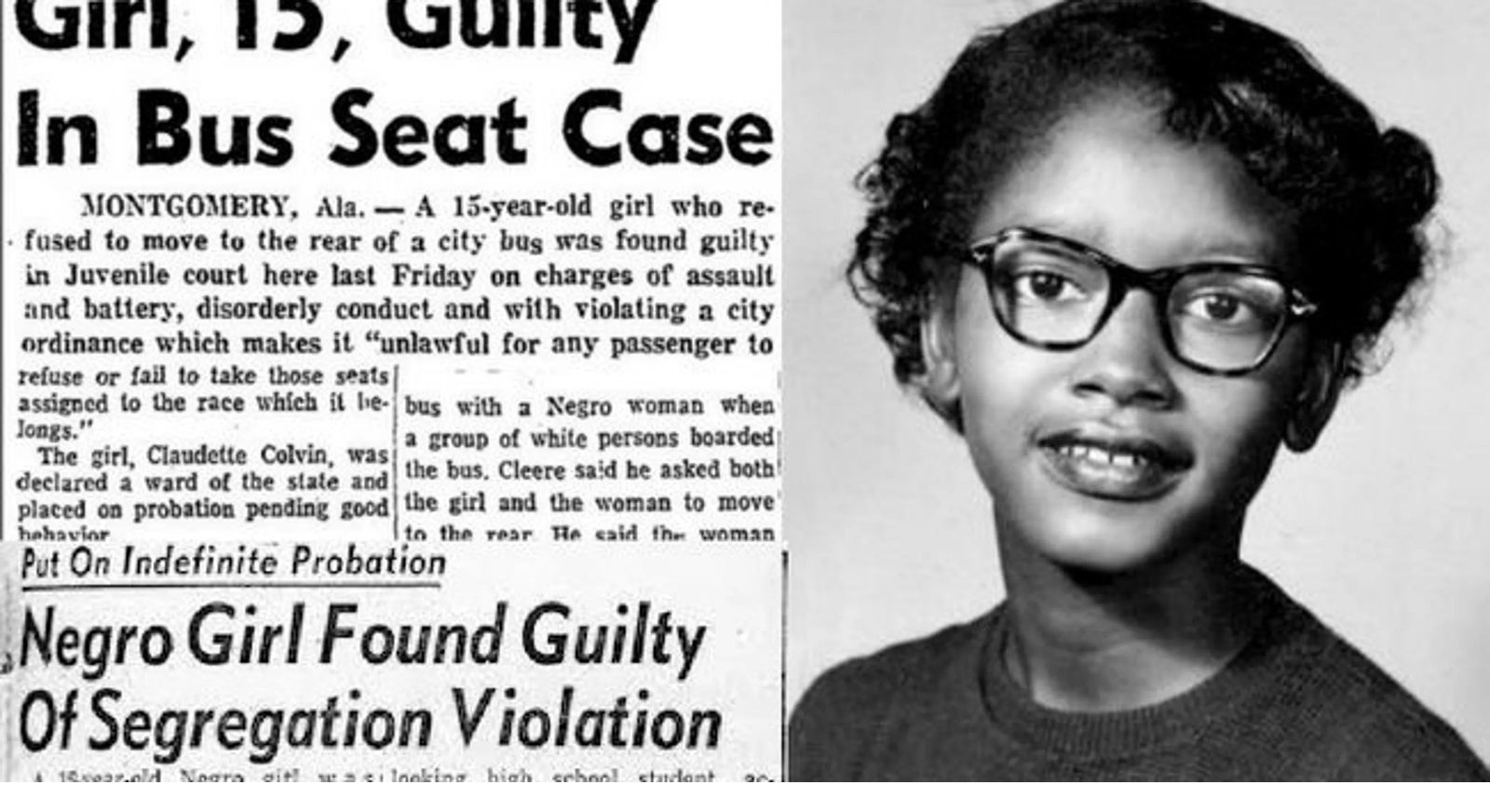
Nine months before Rosa Parks’ historic act of civil disobedience on a Montgomery, Ala. bus, 15-year-old Claudette Colvin also refused to give up her seat.

Claudette was born in Montgomery on Sept. 5, 1939. She grew up in one of the city’s poorer neighborhoods. A good student, she studied hard at school and earned mostly A’s in her classes. On March 2, 1955, Claudette was riding home from school on a city bus when the driver demanded she give up her seat to a white passenger. She refused, saying, “It’s my constitutional right to sit here as much as that lady. I paid my fare.” Claudette felt compelled to stand her ground.

“I felt like Sojourner Truth was pushing down on one shoulder and Harriet Tubman was pushing down on the other—saying, ‘Sit down girl!’ I was glued to my seat,” she later told Newsweek.

Refusing to give up her seat resulted in Claudette’s arrest on several charges, including violating the city’s segregation laws. She shared that she sat in jail for several hours, terrified. “I was really afraid, because you just didn’t know what white people might do at that time,” she later said. She did not spend the night in jail because her minister paid her bail. Her family spent the night without sleep in fear that there might have been some retaliation for Claudette’s actions.

After considerable deliberation, the NAACP decided not to use Claudette’s case in challenging segregation partly due to concerns that her pregnancy outside of marriage would distract from their cause.

In court, Claudette declared that she was not guilty. She was ruled against and given probation, which made finding a job difficult.

Claudette became one of four plaintiffs in Browder v. Gayle that ruled Montgomery’s segregated bus system unconstitutional. Claudette later moved to New York City and worked as a nurse’s aide. She retired in 2004.

“It just killed me to leave the bus. I hated to give that white woman my seat when so many Black people were standing. I was crying hard. The cops put me in the back of a police car and shut the door,” she said.

It could be said that Claudette initiated the fight against this injustice. Rita Dove’s “Claudette Colvin Goes to Work” later became a song, and Phillip Hoose gives her story a fresh perspective in “Claudette Colvin: Twice Toward Justice.” Colvin’s former attorney, Fred Gray, told Newsweek, “Claudette gave all of us moral courage. If she had not done what she did, I am not sure that we would have been able to mount the support for Mrs. Parks.”

Tamara Shiloh

Tamara Shiloh


About Tamara Shiloh


Tamara Shiloh has published the first two books in her historical fiction chapter book series, Just Imagine…What If There Were No Black People in the World is about African American inventors, scientists and other notable Black people in history. The two books are Jaxon’s Magical Adventure with Black Inventors and Scientists and Jaxon and Kevin’s Black History Trip Downtown. Tamara Shiloh has also written a book a picture book for Scholastic, Cameron Teaches Black History, that will be available in June, 2022.

Tamara Shiloh’s other writing experiences include: writing the Black History column for the Post Newspaper in the Bay area, Creator and Instruction of the black History Class for Educators a professional development class for teachers and her non-profit offers a free Black History literacy/STEM/Podcast class for kids 3d – 8th grade which also includes the Let’s Go Learn Reading and Essence and tutorial program.   She is also the owner of the Multicultural Bookstore and Gifts, in Richmond, California,

Previously in her early life she was the /Editor-in-Chief of Desert Diamonds Magazine, highlighting the accomplishments of minority women in Nevada; assisting with the creation, design and writing of a Los Angeles-based, herbal magazine entitled Herbal Essence; editorial contribution to Homes of Color; Editor-in-Chief of Black Insight Magazine, the first digital, interactive magazine for African Americans; profile creations for sports figures on the now defunct PublicFigure.com; newsletters for various businesses and organizations; and her own Las Vegas community newsletter, Tween Time News, a monthly publication highlighting music entertainment in the various venues of Las Vegas.

She is a member of:

  • Society of Children’s Book Writers and Illustrators (SCBWI)

  • Richmond Chamber of Commerce

  • Point Richmond Business Association

  • National Association of Professional Women (NAPW)

  • Independent Book Publishers Association (IPBA)

  • California Writers Club-Berkeley & Marin

  • Richmond CA Kiwanis

  • Richmond CA Rotary

  • Bay Area Girls Club


Tamara Shiloh, a native of Northern California, has two adult children, one grandson and four great-grand sons. She resides in Point Richmond, CA with her husband, Ernest.

www.multiculturalbookstore.com

About Tamara Shiloh

Tamara Shiloh has published the first two books in her historical fiction chapter book series, Just Imagine…What If There Were No Black People in the World is about African American inventors, scientists and other notable Black people in history. The two books are Jaxon’s Magical Adventure with Black Inventors and Scientists and Jaxon and Kevin’s Black History Trip Downtown. Tamara Shiloh has also written a book a picture book for Scholastic, Cameron Teaches Black History, that will be available in June, 2022. Tamara Shiloh’s other writing experiences include: writing the Black History column for the Post Newspaper in the Bay area, Creator and Instruction of the black History Class for Educators a professional development class for teachers and her non-profit offers a free Black History literacy/STEM/Podcast class for kids 3d – 8th grade which also includes the Let’s Go Learn Reading and Essence and tutorial program.   She is also the owner of the Multicultural Bookstore and Gifts, in Richmond, California, Previously in her early life she was the /Editor-in-Chief of Desert Diamonds Magazine, highlighting the accomplishments of minority women in Nevada; assisting with the creation, design and writing of a Los Angeles-based, herbal magazine entitled Herbal Essence; editorial contribution to Homes of Color; Editor-in-Chief of Black Insight Magazine, the first digital, interactive magazine for African Americans; profile creations for sports figures on the now defunct PublicFigure.com; newsletters for various businesses and organizations; and her own Las Vegas community newsletter, Tween Time News, a monthly publication highlighting music entertainment in the various venues of Las Vegas. She is a member of:
  • Society of Children’s Book Writers and Illustrators (SCBWI)
  • Richmond Chamber of Commerce
  • Point Richmond Business Association
  • National Association of Professional Women (NAPW)
  • Independent Book Publishers Association (IPBA)
  • California Writers Club-Berkeley & Marin
  • Richmond CA Kiwanis
  • Richmond CA Rotary
  • Bay Area Girls Club
Tamara Shiloh, a native of Northern California, has two adult children, one grandson and four great-grand sons. She resides in Point Richmond, CA with her husband, Ernest. www.multiculturalbookstore.com

Continue Reading
Click to comment

Leave a Reply

Your email address will not be published. Required fields are marked *

Uncategorized

Not Just a Southern Issue: Advocates Say SCOTUS Voting Rights Decision Has Already Started to Reshape Black Political Power

OAKLAND POST — Following the Civil War and Reconstruction, constitutional amendments expanded Black citizenship and voting rights across the South, leading to dramatic increases in Black political representation. But those gains were quickly met with violent backlash and the rise of Jim Crow laws designed to suppress Black voting through poll taxes, literacy tests, and other “race-neutral” restrictions.

Published

on

Shutterstock

By Edward Henderson, California Black Media

U.S. Rep. Sydney Kamlager-Dove (D-CA-37), a member of the Congressional Black Caucus (CBC) whose district spans parts of Los Angeles County, joined fellow CBC member U.S. Rep. Troy Carter (D-LA-2) for a May 21 briefing with Black media outlets in California. 

The lawmakers highlighted what they describe as a mounting threat to Black political representation resulting from an April 29 U.S. Supreme Court ruling that weakened key protections under the federal Voting Rights Act.  

Kamlager-Dove and Carter warned that the decision, which narrowed the role of race in redistricting, is already reshaping congressional districts across the South and undermining Black voters’ ability to elect candidates of their choice.

“While we are a super blue state, we have far to go when it comes to Black representation; we tend to take that for granted,” Kamlager-Dove said of California, noting that the Golden State has the fifth largest Black population in the country and only has three Black members of Congress.   

“While I support building coalitions, we have to make sure that as a Black community we are not yielding our power,” she added.

Calling the fight “not unique to the South,” Carter urged Black communities nationwide to recognize the broader implications of the legal and political battles unfolding in Southern legislatures and courtrooms. 

The Supreme Court ruling centers on Section 2 of the Voting Rights Act of 1965, the portion of the law that prohibits voting systems or district maps that dilute the voting strength of racial minorities. For decades, Section 2 allowed civil rights groups to challenge district maps that weakened Black political representation even when lawmakers did not openly state discriminatory intent.

Now, advocates fear that standard has fundamentally changed. 

“You have to have smoking gun evidence,” said Mitchell Brown, senior voting rights counsel at the Southern Coalition for Social Justice, during a recent media briefing hosted by American Community Media on May 15. “Legislators are not going to say the quiet part out loud.” 

The implications could stretch far beyond congressional elections, Brown said.  

Section 2 protections have historically applied not only to U.S. House districts, but also to state legislatures, school boards, county commissions, judgeships, and local governing bodies. Voting rights advocates warn that weakening those protections could reshape political representation throughout the South, particularly in states with large Black populations. 

“This is not just a Southern issue,” said Amir Badat, manager of Black Voters on the Rise and voting special counsel at the NAACP Legal Defense and Educational Fund.

Badat described the current moment as part of a much longer historical pattern. 

Following the Civil War and Reconstruction, constitutional amendments expanded Black citizenship and voting rights across the South, leading to dramatic increases in Black political representation. But those gains were quickly met with violent backlash and the rise of Jim Crow laws designed to suppress Black voting through poll taxes, literacy tests, and other “race-neutral” restrictions. 

“This is the same move,” Badat said.

Advocates also emphasized that the consequences of weakened voting protections extend into everyday life. 

Local elected offices such as school boards, city councils, county commissions, and judgeships often determine funding priorities, public safety policy, education standards, and infrastructure investments.

“These are not abstract numbers,” Badat said. “These have real political consequences and policy consequences on people’s day-to-day lives.” 

Continue Reading

Uncategorized

Rest in Peace: A.M.E. Pastor and L.A Civil Rights Icon Cecil “Chip” Murray Passes

The Rev. Dr. Cecil L. “Chip” Murray, former pastor of First African Methodist Episcopal Church (FAME) in Los Angeles, died of natural causes April 6 at his Windsor Hills Home. He was 94. “Today, we lost a giant. Reverend Dr. Cecil Murray dedicated his life to service, community, and putting God first in all things. I had the absolute honor of working with him, worshiping with him, and seeking his counsel,” said Los Angeles Mayor Karen Bass of the dynamic religious leader whose ministry inspired and attracted millionaires as well as former gang bangers and people dealing with substance use disorder (SUD).

Published

on

The Rev. Dr. Cecil L. “Chip” Murray, former pastor of First African Methodist Episcopal Church (FAME) in Los Angeles, died of natural causes April 6 at his Windsor Hills Home. He was 94.

“Today, we lost a giant. Reverend Dr. Cecil Murray dedicated his life to service, community, and putting God first in all things. I had the absolute honor of working with him, worshiping with him, and seeking his counsel,” said Los Angeles Mayor Karen Bass of the dynamic religious leader whose ministry inspired and attracted millionaires as well as former gang bangers and people dealing with substance use disorder (SUD).

Murray oversaw the growth of FAME’s congregation from 250 members to 18,000.

“My heart is with the First AME congregation and community today as we reflect on a legacy that changed this city forever,” Bass continued.

Murray served as Senior Minister at FAME, the oldest Black congregation in the city, for 27 years. During that time, various dignitaries visited and he built strong relationships with political and civic leaders in the city and across the state, as well as a number of Hollywood figures. Several national political leaders also visited with Murray and his congregation at FAME, including Presidents George W. Bush and Bill Clinton.

Murray, a Florida native and U.S. Air Force vet, attended Florida A&M University, where he majored in history, worked on the school newspaper and pledged Alpha Phi Alpha Fraternity.  He later attended Claremont School of Theology in Los Angeles County, where he earned his doctorate in Divinity.

Murray is survived by his son Drew. His wife Bernadine, who was a committed member of the A.M.E. church and the daughter of his childhood pastor, died in 2013.

Continue Reading

Uncategorized

Court Throws Out Law That Allowed Californians to Build Duplexes, Triplexes and RDUs on Their Properties

Charter cities in California won a lawsuit last week against the state that declared Senate Bill (SB) 9, a pro-housing bill, unconstitutional. Passed in 2021, SB 9 is also known as the California Housing Opportunity and More Efficiency Act (HOME). That law permits up to four residential units — counting individual units of duplexes, triplexes and residential dwelling units (RDUs) – to be built on properties in neighborhoods that were previously zoned for only single-family homes.

Published

on

Charter cities in California won a lawsuit last week against the state that declared Senate Bill (SB) 9, a pro-housing bill, unconstitutional.

Passed in 2021, SB 9 is also known as the California Housing Opportunity and More Efficiency Act (HOME). That law permits up to four residential units — counting individual units of duplexes, triplexes and residential dwelling units (RDUs) – to be built on properties in neighborhoods that were previously zoned for only single-family homes.

A Los Angeles Superior Court Judge ruled in favor of the cities, pointing out that SB 9 discredited charter cities that were granted jurisdiction to create new governance systems and enact policy reforms. The court ruling affects 121 charter cities that have local constitutions.

Attorney Pam Lee represented five Southern California cities in the lawsuit against the state and Attorney General Rob Bonta.

“This is a monumental victory for all charter cities in California,” Lee said.

However, general law cities are excluded from the court ruling as state housing laws still apply in residential areas.

Attorney General Bonta and his team are working to review the decision and consider all options that will protect SB 9 as a state law. Bonta said the law has helped provide affordable housing for residents in California.

“Our statewide housing shortage and affordability crisis requires collaboration, innovation, and a good faith effort by local governments to increase the housing supply,” Bonta said.

“SB9 is an important tool in this effort, and we’re going to make sure homeowners have the opportunity to utilize it,” he said.

Charter cities remain adamant that the state should refrain from making land-use decisions on their behalf. In the lawsuit, city representatives argued that SB 9 eliminates local authority to create single-family zoning districts and approve housing developments.

Continue Reading

Subscribe to receive news and updates from the Oakland Post

* indicates required

CHECK OUT THE LATEST ISSUE OF THE OAKLAND POST

ADVERTISEMENT

WORK FROM HOME

Home-based business with potential monthly income of $10K+ per month. A proven training system and website provided to maximize business effectiveness. Perfect job to earn side and primary income. Contact Lynne for more details: Lynne4npusa@gmail.com 800-334-0540

Facebook

Trending

Copyright ©2021 Post News Group, Inc. All Rights Reserved.