
Economy
Durkan Signs Affordable Housing Legislation For Fort Lawton In Magnolia
THE SEATTLE MEDIUM — On Tues, Seattle Mayor Jenny Durkan signed into law a vision for a more livable, affordable community at Fort Lawton Army Reserve in the Magnolia neighborhood.

By The Seattle Medium
On Tues, Seattle Mayor Jenny Durkan signed into law a vision for a more livable, affordable community at Fort Lawton Army Reserve in the Magnolia neighborhood.
The legislation rezones nearly a third of the 34-acre property from single-family to multi-family adding more affordable housing in a high-opportunity neighborhood. The redevelopment will further fair housing choices by adding up to 238 units of mixed-income affordable housing including supportive housing for seniors and veterans, apartments for low-income households, and opportunities for homeownership. Much of the Fort Lawton site will be set aside for parks and open recreational uses.
“We must continue to act urgently to address our affordability and housing crisis. This plan builds on our commitment to create hundreds of more affordable homes while ensuring that our neighborhoods can be vibrant, livable spaces today and for the next generation,” said Durkan. “We stand on the shoulders of the efforts not just of the last 15 years, but of all those who have demanded that Seattle is more accessible, more welcoming, and more equitable. There should be no neighborhood in Seattle that people can’t live, and today we’re one step closer to making that vision real.”
“The plan to create 237 new affordable homes at Fort Lawton is the result of fifteen years of community engagement, planning, and advocacy. With housing costs soaring and displacement at crisis levels, the need for these homes has never been greater,” said Seattle City Councilmember Teresa Mosqueda. “The Fort Lawton plan will further fair housing, create greater equity, and advance opportunity by opening access to a high-cost area of the city that has previously been largely out of reach to low-income people and communities of color. Today, we celebrate as we move forward on an inclusive vision for the Fort Lawton site that will turn former military land into affordable homes for our military veterans, aging seniors, low-income families, and our neighbors who struggle with access to homeownership.”

This article originally appeared in The Seattle Medium.





Economy
Mayor Lee Delivers 2026 State of the City Address: ‘Oakland Continues to Be on the Move’
To create a police force that better serves and protects Oakland, the city is working toward the goal of reaching 700 sworn police officers, she said. These steps include recruiting from Oakland, holding academies, reinstituting a cadet program, and increasing foot patrols.

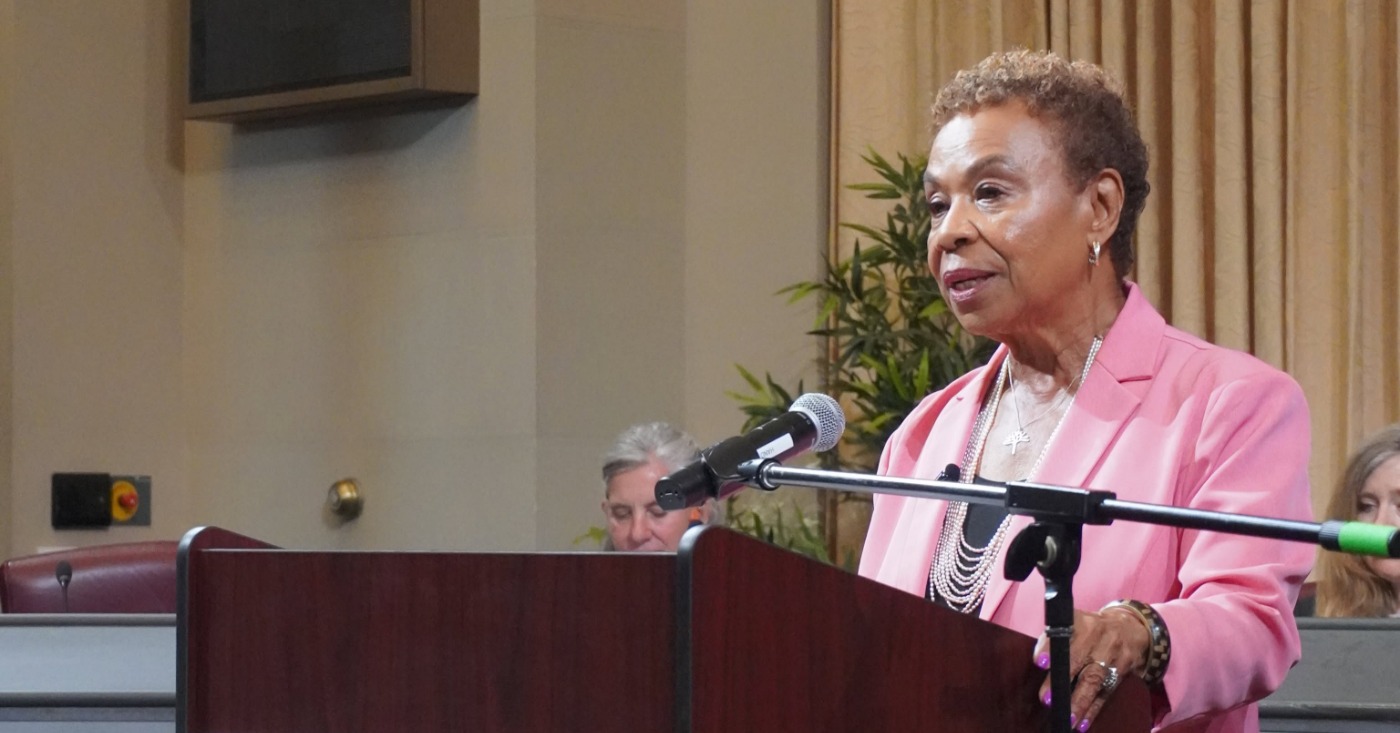
Mayor Barbara Lee, speaking this week to Oakland residents and elected leaders in City Council chambers, delivered the annual mayoral State of the City Address, highlighting the city’s accomplishments as well as the challenges Oakland is facing going forward.
Lee began her remarks praising city workers, who picketed outside City Hall before the meeting, and are currently negotiating with the city for a wage increase and ending understaffing that leaves many departments shorthanded.
“We are working very hard (not) just to get a contract, but to get a fair contract,” she said. “I know that our City Council and myself are working constantly toward that end.”
The mayor also praised Councilmember Carroll Fife for her legislation for a 45-day moratorium on data center construction, which passed unanimously at the council meeting Tuesday following Lee’s presentation.
Speaking bluntly, she said, “Oakland continues to be a city on the move, (but) I want to tell you the truth about the state of our city.”
“We have made real progress, and we still face real challenges.”
She said the city has balanced its budget but has a structural deficit, which is decreasing, and must operate within the context of federal funding cuts.
“Too many Oaklanders are unhoused, too many families are struggling with the cost of living, and too many neighborhoods still need basic services that they deserve, and too many people are living in fear,” Mayor Lee said.
“We’re not sweeping these realities under the rug,” she continued. “We are being intentional and transparent about how we must face these challenges, but we will not ignore our progress.”
Substantial progress includes:
• Bringing crime down;
• Building affordable and deeply affordable housing;
• Cleaning the streets and fixing the roads;
• Helping small businesses.
“We are bringing new investment to Oakland,” she said. “We’re making City Hall work better. There’s more to do, but make no mistake, Oakland is on the move.”
Speaking broadly about the city’s public safety initiatives, she said that crime continues to decline. Burglaries fell by 26%, and violent crime fell by 17%.
In recent years, homicides and shootings have fallen by double digits, and gun violence has dropped by more than 50% in the last 33 months.
“These aren’t just statistics: these are lives. These are families. These are people who never made it home,” Mayor Lee said.
She talked about what to expect now that federal court oversight of the Oakland Police Department ended last week after 23 years. “Ending federal oversight does not mean ending accountability; quite the opposite,” she said. “Accountability and civilian oversight must remain our standard. Community trust must be our standard.”
Mayor Lee also emphasized that Oakland remains a city of refuge.
“We do not work with ICE; we do not cooperate with ICE; our police do not cooperate with ICE; we will not be militarized,” she said.
The mayor also emphasized that investing in youth is a top priority of her administration and should be considered a public safety strategy.
“We advocated for almost $2 million to restore the mayor’s youth summer employment program,” she said. “We connected youth with Oakland businesses to develop skills that will support them for years to come, and that’s a big deal.”
To create a police force that better serves and protects Oakland, the city is working toward the goal of reaching 700 sworn police officers, she said. These steps include recruiting from Oakland, holding academies, reinstituting a cadet program, and increasing foot patrols.
The city also is strengthening other programs, including the Department of Violence Prevention and Ceasefire, she said. “We must have this comprehensive public safety strategy, because we must also prevent violence before it happens.”
Continuing, Lee said public safety is connected to unsanitary conditions in city neighborhoods.
“Illegal dumping is unacceptable, and it’s a moral disgrace,” she said. “No child should have to walk past piles of garbage on their way to school; no senior should have to live next to it; no small business should have to clean it up outside its door.”
She said the city is changing the way it fights illegal dumping, securing a $9.2 million investment to develop a new strategy. “We’re not just cleaning it up; we’re working to stop it before it starts. We have the three E’s – Eradication, enforcement, and education,” she said.
Focusing on the continuing crisis of Oakland’s unhoused residents, she said, “We consider housing a basic human right, and homelessness remains one of Okland’s greatest challenges.”
“There are two things we must do: keep people from becoming unsheltered and help people who are unsheltered get back into housing with services that they need,” Lee said.
Since 2024, homelessness in Oakland has fallen by 20%, she said. In the past year prevention programs helped keep 1,000 families in their homes, and over 1,300 affordable homes opened over the past two years.
Addressing community tensions over encampments, she said, “We should never have to choose between compassion for people experiencing homelessness and the health and safety of our neighborhoods.”
“A strong city has to deliver both,” she said. “That’s the work we’re advancing through Oakland’s new homelessness strategic action plan.”

Business
Marin County Supes Expand Small Business Options with Home Kitchen Pilot Program
“This will deliver immediate financial relief to entrepreneurs in areas like Marin City, West Marin and the Canal neighborhood, removing barriers right where economic opportunity is needed the most,” said Shannon Bell, consumer protection supervisor with Marin County Environmental Health Services, at the meeting.

The Marin County Board of Supervisors adopted a three-year pilot program that will allow cooks and food entrepreneurs to prepare and sell meals from their homes on Sept. 29
The Microenterprise Home Kitchen Operation program, or MEHKO, will establish a permitting process for small-scale home food businesses. California state law allows licenses if local governments opt in.
“This will deliver immediate financial relief to entrepreneurs in areas like Marin City, West Marin and the Canal neighborhood, removing barriers right where economic opportunity is needed the most,” said Shannon Bell, consumer protection supervisor with Marin County Environmental Health Services, at the meeting.
MEHKO licenses fill the gap between cottage food permits, which only apply to non-potentially hazardous foods like baked goods and jams, and full commercial kitchens.
Microenterprises can serve as commissaries for up to two mobile food operations; they require food to be prepared and served the same day. They are exempt from commercial facility requirements, such as industrial grease traps and commercial stove hoods.

The program allows takeout or on-site dining with strict limits of 30 meals per day, or 90 meals per week, and an annual sales cap of $100,000.
The pilot would begin March 1, 2027, and permits would be capped at 100 per year. Application fees are $725 with an annual renewal fee of $414, but fee waivers for a third of the permits are reserved for low-income communities.
After two years, supervisors will consider making the program permanent.
“By eliminating the need for commercial leases and expensive equipment, entrepreneurs can safely test their businesses and ideas with minimal financial risk,” Bell said. According to statewide data from the Cook Alliance, 85% of MEHKO operators are women, immigrants, and people of color, and over 70% rely on this income to support their families, she said.
Bell also said unpermitted sales are already happening in areas like the Canal.
Local Vendors Seek a Legal Path
Marina Palma advocates for San Rafael’s Canal neighborhood, which is home to a vulnerable community of over 13,000 low-income residents. About 84% are Latino and roughly half of all households spend more than 50% of their income on housing.
Palma told the board that the pandemic caused many Canal residents to lose their jobs, and that’s why the neighborhood has so many vendors selling food in public. Because they have no license, enforcement actions can be harsh.
“They have really high tickets of $600, and their food has been thrown away,” said Palma.
She said MEHKO would help vendors get an official license, but she questions whether vendors will need a Social Security number and be legally in the country.
According to the home-chef’s national nonprofit Cook Alliance, MEHKO applicants need no proof of citizenship nor a Social Security number to obtain a permit.
“I’m from Mexico, and I’m one of the mobile vendors,” said Elsie Vega through a Spanish translator. “I have two jobs. Everything is pricey — house, food, everything. I am here to work hard, to pay taxes. I don’t make enough money to pay the community kitchens.”
MEHKO license holders must pass inspection under the oversight of the Marin County Department of Environmental Health Services and comply with local zoning, parking and noise ordinances.
California authorized MEHKO programs in 2019. Seventeen counties have since adopted them, including Sonoma, San Mateo, Solano, Contra Costa, Alameda and Santa Clara counties.
Other commenters who spoke in favor of the program represented a range of food system and small business organizations. They included the Agricultural Institute of Marin, which operates nine Bay Area farmers markets, the University of California Cooperative Extension, the Cook Alliance, the West Marin Food Systems Group, which coordinates farm-to-school food access, and the Marin Small Business Development Center.
Business
OP-ED: Proposition 44 Would Put a Price on Trust
The danger in Proposition 44 is not only its 90 percent figure. It is that the meaning of “qualifying” spending will be worked out later. A clinic preparing a budget today may not know whether a navigator, health educator, transportation program, outreach worker, technology upgrade, or other patient-support service will be counted the way it expects. Yet the financial consequence of getting it wrong could be immediate.




Mayor Barbara Lee Holds Special State of the City Address in Deep East Oakland

Practitioners of African Traditional Spirituality Offer Ancestral Reverence Ritual Oct. 31

It’s Time to Lose Weight Before the Holidays

Trader Vic’s Returns to Its Oakland Roots

Oakland Coal Terminal Backed by Trump Would Be Bigger, Dirtier Than Promised, Says Report

Opponents Smear Effective African American Transit Director as Election Nears

Oakland Post: Week of October 14 – 20, 2026

OP-ED: The Black Church Writes AI’s Next Chapter

OP-ED: The Black Church Writes AI’s Next Chapter

WCCUSD Joins Statewide Organic School Food Purchasing Cooperative

Democrats, Community Groups Back Measure EE to Change How Oakland Is Governed

Four Tips to Help You Plan a Holiday “Staycation”

Veterans Housing Project Proposed for South Richmond
PRESS ROOM: Transformative Justice Coalition 2026 Voting Rights Champion Awards Reception ‘Yesterday Is Today: The Battle For Voting Rights

Mayor Lee Delivers 2026 State of the City Address: ‘Oakland Continues to Be on the Move’

Misnamed ‘Parent’ PAC Seeks to Influence Oakland School Board Elections

Poll: Becerra Widens His Lead Over Hilton; Californians Split on Wealth Tax

Listening as a Lifeline: A Doula’s Witness to Black Maternal Health

Oakland Post: Week of September 9 – 15, 2026

County Office of Education Says OUSD Finances Are Getting Healthier, Materially Stronger

Richmond Tiny House Village Farm & Garden Set to Open Gates on Sept. 26

Mayor Lee Announces $1 Million Kaiser Permanente Grant for Pilot Program to Address Homelessness, Clean Up Public Spaces throughout Oakland

Latest Massacre in Haiti Reveals Cruelty U.S. Deportations

Zakiya Jendayi Arrested, Locked Out of Home by Sheriff’s Deputies

OPINION: Nolan Wells’ Death One of Several Signifying Racial Terror Lives on in U.S. South

Doulas Are Helping Black California Moms Navigate Pregnancy–Even as High Mortality Rates Persist

BLACspace Cooperative Invites Bay Area to Experience Oakland’s Black Cultural Ecosystem Through a BLAC Map Tour + Party

Oakland Post: Week of September 16 – 22, 2026

Oakland People’s Arms Embargo Coalition Demands End to Military Shipments Thru Oakland

Democratic Clubs Interview Candidates for Oakland School Board

The Conversation With Al McFarlane 6/23/26

Media Monday 6/22/26

LIVE! ASK ALMA! — TUES. 6.23.26 7PM EST

Car Buying Secrets: 4 Hidden Checks Before You Sign!

Is This 550 HP Charger Worth YOUR Money? AutoNetwork Review

Celebrating Juneteenth – Frederick Douglass on education and resistance

LIVE! — ASK ALMA! — TUES. 6.19.26 7PM EST

Hyundai Ioniq 5 Parking, Safety, and 360 View #shorts

2025 Ioniq 5 New Wiper & Powerful Performance! #shorts

Electric SUV Range: Is 259 Miles Enough? #shorts

EV Charging: How Fast Can You Charge an Electric Vehicle? #shorts

Biometric Cooling… Messaging Seats…Come on! 2025 Infiniti QX80 Autograph 4WD

Charged Up: Witness the Magic of a Fully Electric Car! #shorts

Range Rover Sport PHEV Included…: See What’s Inside This Luxury SUV! #shorts

Invisible Hood View: Perfect Parking with X-Ray Vision! #shorts
-
 Economy4 weeks ago
Poll: Becerra Widens His Lead Over Hilton; Californians Split on Wealth Tax
-
 Black History3 weeks ago
Listening as a Lifeline: A Doula’s Witness to Black Maternal Health
-
 Business4 weeks ago
County Office of Education Says OUSD Finances Are Getting Healthier, Materially Stronger
-
 Lead Story3 weeks ago
Zakiya Jendayi Arrested, Locked Out of Home by Sheriff’s Deputies
-
 Black History4 weeks ago
Doulas Are Helping Black California Moms Navigate Pregnancy–Even as High Mortality Rates Persist
-
 Art4 weeks ago
BLACspace Cooperative Invites Bay Area to Experience Oakland’s Black Cultural Ecosystem Through a BLAC Map Tour + Party
-

 Business4 weeks ago
From Historic Memories to New Possibilities: Oakland Celebrates Coliseum 60
-

 Community4 weeks ago
Asm. Corey Jackson Announces Launch of 24-Hour Childcare in His District
