
Arts and Culture
African American Museum of History and Culture Opens in Washington, D.C.

Opening last weekend on the National Mall in Wash., D.C., the African American Museum of History and Culture depicts the experience of Black people in the United States from the era of the Atlantic Slave Trade to Barack Obama’s historic presidency.
The three-day opening celebration included concerts on the National Mall, ranging from Spirituals to Classical, R&B to Gospel, Hip-Hop to Jazz including Oakland’s Latin Jazz band led by Bobi Cespedes, featuring John Santos.
Thousands of people attended: family groups, couples, toddlers in strollers, white-haired elders in wheelchairs and babes in arms.
Advised to begin their museum experience on the bottom floor where relics from a slave ship were displayed, they waited patiently in long lines.
The curators did more than identify the objects –ballast from the slave ship São José Paquete Africa, found off the coast of South Africa in 2010. They mounted quotes about the experience of the captives on the ships.
“Their singing was always in tears, so much that one captain threatened the women with a flogging because their mournfulness of her song was painful for his feelings.” William Corbett, 1806.
The exhibits make clear that chattel slavery, the buying and selling of human beings as if they were domestic animals or furnishings, was unprecedented in human history.
Accompanied by voice overs and testimony and observances of the time, the brutality of the kidnapping and capture of Africans is uncontested as is the benefit to the slavers:
“Are we not indebted to these valuable people – the Africans – for our sugars, tobaccos, rice and rum? Malachy Postelthwayt, 1745.
Standing under the quote on the wall, “We’ve got to tell the unvarnished truth” by historian John Hope Franklin, Courtney Hester-Green of Washington D.C. explained that she has been a student of Black history since she was six, when her uncle gave her a Golden Legacy Series Comic Book.
Now 32, her great pleasure was “Being able to see the stories told how they should be told.”
“I thought I would hold it together,” Hester-Green said. “But I’m misty now. I hope the story is made real to people who haven’t studied it all their lives.”
Gallery after gallery, photos and artifacts show the African American experience on its own terms. It felt like nothing was left out.
Second to the slave-ship exhibit, the display of Emmett Till’s casket was perhaps the most moving.
Till was 14 in 1955 when he was brutally lynched in Money, Miss., for allegedly whistling at a white woman. The killing brought international attention to the racism of the South when his mother insisted on an open casket.
Exhumed in 2005 for DNA testing on his body, the Till family had initially wanted to put his casket in a museum of their own but instead donated it to the museum.
There are life-size statues everywhere on all floors including freedom fighters of many generations and leaders in all arenas of life from art and entertainment to food, activism, entrepreneurship and sports, including one of John Carlos and Tommie Smith with fists raised and bowed heads at the 1968 Olympics.
Eight-year-old T.C. Washington of Atlanta, Ga., stared up at them, put his hand over his heart and grudgingly agreed to let his father take a photo, where he struck a pose just like them.
Not knowing what it meant, his father, Terance Washington, told him it was like what Colin Kaepernick is doing. The boy nodded and skipped on to the next gallery, where paraphernalia from the National Council of Negro Women was on display and a recorded speech by Mary McLeod Bethune was heard in the background.
“What’s a Negro?” the little boy asked.
“It’s good to know how far we have come,” said Shay Moor of Baltimore, MD.


Alameda County
Lower Bottom Playaz Presents Lee Blessing’s ‘Going to St. Ives’
Played by Dr. ayodele nzinga, May N’Kame, the mother of a deadly African dictator, travels to England to see Dr. Cora Gage (Teresa Foss) about medical treatment for her failing eyesight. But what she really wants is a poison to assassinate her son. Gage is then put in a personal dilemma to either uphold her vow to ‘do no harm,’ or help put an end to the atrocities the dictator visits on his people.

Oakland’s oldest North American African theater company presents a story of race, women, violence, and empire.
By Cat Brooks, Special to The Post
The Lower Bottom Playaz 27th season will kick off on July 9 with “Going to St. Ives,” a play by Lee Blessing.
Directed by playwright, actress, and community advocate Cat Brooks, the play by Lee Blessing is the story of two impressive women brought together by the personal and divided by the political, as both seek to accomplish the greatest good.
Played by Dr. ayodele nzinga, May N’Kame, the mother of a deadly African dictator, travels to England to see Dr. Cora Gage (Teresa Foss) about medical treatment for her failing eyesight. But what she really wants is a poison to assassinate her son. Gage is then put in a personal dilemma to either uphold her vow to ‘do no harm,’ or help put an end to the atrocities the dictator visits on his people.
“While the Empire’s location is fictional, a very real genocide is happening in the Congo right now that many of us are ignoring,” Brooks observed. “We set this play there in hopes of utilizing theater to make audiences aware of injustices moving in places and amongst people that mainstream media omits from its headlines.

“In these times, it is more important than ever that theater do more than just entertain. It must tell tales that ignite us into action.”
Also explored in Going to St. Ives are themes of motherhood and sacrifice. What does it cost mothers to raise sons only to lose them to the violence of the world? What experiences are shared amongst mothers across race, class, and country?
“Going to St. Ives examines the weight of privilege against the cost of ‘being responsible’ in a world carved by colonialism, greed, and loss in a high-stakes chess game between two women with only one thing in common,” said nzinga who is also the artistic director of Lower Bottom Playaz.
The play was first performed in 1997 in Seattle, eventually enjoying a highly praised off-Broadway run in New York in 2005.
For this production, Lower Bottom Playaz is partnering with non-government organizations that focus on raising awareness and providing support to displaced refugees across the diaspora, emphasizing community solidarity and collective action.
“Going to St. Ives” premieres on July 9 at BAM House in the Sister Thea Theater, 1540 Broadway, Oakland, CA 94612. All performances are scheduled through July 26 on Friday and Saturday at 8 p.m. and matinees on Saturday and Sunday at 2 p.m. For tickets and more information, please visit http://www.lowerbottomplayaz.com/. Reservations: 510 332-1319, leave a message.
Activism
‘The Oakland Street Academy Saved My Life’
The first time a teacher pulled up a chair to sit next to me to help me out, I panicked because no adult had ever sat so close to me in any kind of a caring or helping way. My English teacher, Kitty (Epstein), would make the biggest impact in my life. I didn’t know then what it meant to have a teacher who would care about me enough to spend her precious time with me even through all of my frustration about learning and thinking the whole time I couldn’t learn anything because I thought I was stupid.
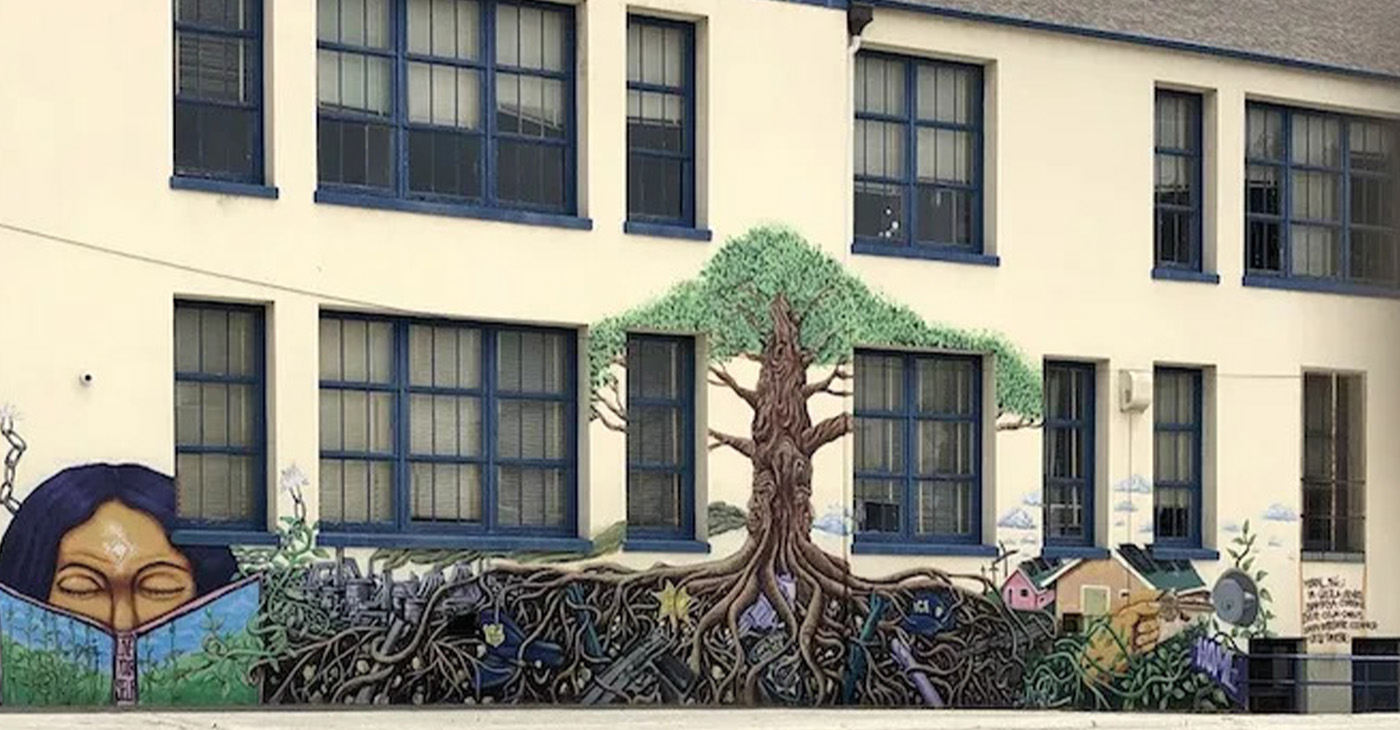
By Ze Segundo, Special to The Post
This is an autobiographical statement by a former Street Academy student who overcame many obstacles in the1970s, attended S.F. State University, and built a successful life for herself.
I was born and raised in Oakland, living in a household with a single mother and eight children. My life was chaotic: I never felt loved, never hearing the words, “I love you.”
I was 4 years old when all of us were sent to foster homes. There, my little sister and I were tortured. I believe we were there a little over a year.
When we finally returned home to our mother, she had a new husband who was very abusive to all of us including my mother.
I and my other sisters were sexually abused by two uncles and my big brother. I remember my uncle choking me and telling me if I told anyone, he would kill me and my little brother – so I didn’t tell. I was terrified of him. I tried to stay away from him as much as possible, but that’s kind of hard to do when a sexual predator lives with you.
My mother would have parties on the weekends where there would be many people drinking and fighting. The police were often at my home. I hated Sunday mornings because my mother would make us kids clean up after the parties. The house had the stench of cigarettes and booze.
Having to clean up other people’s vomit made me sick to my stomach. This is when I started to drink myself. Taking sips of leftover alcohol in glasses and beer cans. That would be the start of my alcoholism.
I started cutting myself when I was 11 years old and didn’t know why. I think it was because it made me feel something different and somehow made whatever I was feeling go away for the moment.
I didn’t have many friends and didn’t have any social skills. I was very shy and withdrawn. In my early teen I couldn’t look people in the eyes. If I was walking down the street and someone was walking towards me, I would purposely cross the street, so I didn’t have to have contact with them.
I was terrified of the world around me. I didn’t even talk to my mother much because I didn’t know what kind of mood she would be in. I learned to stay silent and stay away from her.
My grandmother lived in Hayward; my sister, brother and I took a bus from Oakland to attend junior high school there. Because I didn’t have any social skills, the kids would tease me and bully me. I had to fight a lot, so much that my brother and I were kicked out; they didn’t want any of us in their schools.
After we were kicked out of the school district, I tried to attend a junior high in Oakland, but the noise in the classroom overwhelmed me. The sounds rumbled in my ears.
Again, I was bullied and teased. So, I stopped going to school. I would leave the house with my brothers and sisters but didn’t set foot into any classroom after that. I just wandered the streets until it was time to go home.
It was a very chaotic home life, and I was a severely abused child, overwhelmed with everything around me.
When I was 15, a social worker talked to my mother about sending me to Oakland Street Academy. My mother thought it was a continuation school, where the worst students went.
I didn’t want to go to Street Academy, fearful of being bullied again, but I was tired of hanging out in the street all day. I thought the Street Academy was strange, a school that took over an old furniture store building. It was an open floor plan with partitions that sectioned off classes.
During class, we could hear the buses go by and people talking as they were walking by. I was still painfully shy and withdrawn. I would show up to school early, so I didn’t have to walk past other students in the classroom. I didn’t speak to any students and barely spoke to the teachers. Even when class was going on, I would sit across the room in a small chair and table between two lockers.
I isolated myself from the rest of the class, not really knowing why, but that’s where I sat. I had a third-grade reading level at age 15 and couldn’t spell much at all.
The first time a teacher pulled up a chair to sit next to me to help me out, I panicked because no adult had ever sat so close to me in any kind of a caring or helping way. My English teacher, Kitty (Epstein), would make the biggest impact in my life. I didn’t know then what it meant to have a teacher who would care about me enough to spend her precious time with me even through all of my frustration about learning and thinking the whole time I couldn’t learn anything because I thought I was stupid.
Kitty told me that I could learn, and that there were no stupid students. I remember one time a small group of students walked to fast food restaurants just to read the menu because reading anything is better than reading nothing at all.
Kitty didn’t give up on me – so, I didn’t give up on myself.
School was difficult for me because so many things were going on at home. It was hard for me to focus, but the teachers were really patient with me. Street Academy empowered students by teaching Chicano studies and Black studies. We were learning about our own histories and cultures. Street Academy students participated in demonstrations like the United Farm Workers grape boycott of the mid-1970s. We learned that we could make a difference with our voices. It was a great self-esteem builder.
In many ways, Street Academy saved my life because I was going nowhere.
The minute I set foot into that school I knew it was something special. It took me four years to graduate because I was so far behind in my schooling, and I was dyslexic.
When I left Street Academy, I was reading college material and attended San Francisco State University. I was the first in my family to graduate high school and the first to go to college. As a 15-year-old with CPTSD (Complex Post-Traumatic Stress Disorder), I accomplished what I thought would never happen to me.
I am grateful to the school’s staff and what Street Academy stands for. Schools and teachers should treat students like human beings, care about them, spend a little extra time, believe in them, and they will believe in themselves because you never know what students are going through and what they have experienced in their past that affects their learning.
There are no stupid kids, bad kids, or lazy kids, only kids who need to be understood and loved. Street Academy gave all of that to me.
During the 1970s, Ze Segundo attended the Oakland Street Academy, an Oakland Unified School District school now known as Emiliano Zapata Street Academy located at 417 29th St. in Oakland.
Arts and Culture
Prescott Circus Theatre Presents Free Summer Performance Series
Now in its 41st year, the Prescott Circus Theatre is a nationally recognized performing arts education program for Oakland youth. The circus offers safe environments that challenge Oakland youth, through circus arts training, to develop the skills and confidence to thrive on stage, in school, and in life.

By Post Staff
The Prescott Circus, Oakland’s longest-running youth circus, is returning this summer with its free shows. Join the Prescott Circus’s young stars as they share their joys and talents through stilt-dancing, tumbling, juggling, and more.
At the heart of this one-hour show, which demonstrates teamwork, pride, and joy, are Oakland Unified School District students ages 8 – 17 from more than 10 different schools
Now in its 41st year, the Prescott Circus Theatre is a nationally recognized performing arts education program for Oakland youth. The circus offers safe environments that challenge Oakland youth, through circus arts training, to develop the skills and confidence to thrive on stage, in school, and in life.
This is accomplished through no-cost school and community programs for more than 300 Oakland youth each year. Performing company members from Prescott, where the program began, perform and make appearances at as many as 40 Bay Area events each year.
The summer program is funded in part by Oakland Fund for Children and Youth, California Arts Council, Port of Oakland, and the West Davis & Bergard Foundation.
Performances will be held Tuesday, July 14, 11 a.m. and 1:30 p.m. (ASL interpreted) and Wednesday, July 15, 11 a.m., at the Malonga Casquelourd Center for the Arts, 1428 Alice St., Oakland. For free reservations go to

https://PrescottCircusSummerShows.eventbrite.com
For group reservations for camps, childcare centers, senior centers, go to www.prescottcircus.org
A community show will be held Saturday, July 18, 2 p.m. to 3 p.m., at DeFremery Park,1651 Adeline St., Oakland.

WORK FROM HOME
Home-based business with potential monthly income of $10K+ per month. A proven training system and website provided to maximize business effectiveness. Perfect job to earn side and primary income. Contact Lynne for more details: Lynne4npusa@gmail.com 800-334-0540


Oakland Post: Week of July 22 – 28, 2026

Fed Court to Decide Landmark First Amendment Case

Jordan Walker Leads Call for More Black Youth in Baseball

How Black WNBA Players Became Collateral Damage in the Caitlin Clark Culture War

NAACP Announces $20m Voter Registration Drive at National Convention in Chicago

Starting This Summer, California Car Buyers Can Get an Instant $3500 Off the Cost of Electric Vehicles

Surveillance Pricing Fight: State Senate Debates Bill Banning Retailers from Using AI to Set Prices Based on a Buyer’s Profile

Oakland Children’s Hospital Workers and Patients Rally for Pediatric Medical Care

Opinion: When Politicians Start Sanitizing One Chapter of History, They’re Coming After The Whole Book

Beyond Politics: California Legislators Across Party Lines Celebrate Lori Wilson at 50

NPRC to Meet with California Attorney General’s Office on to Urge Guardianship Reform

Mount Zion MBC, Church of Jesus Christ of Latter-day Saints Partner to Bring 29,000 Meals to Alameda County

Councilmember Houston Helps Deter Trend to Award Contracts to Suburban Companies

Rep. Garamendi, House Democrats Demand Trump Administration Abandon Illegal Plans to Dismantle Civil Rights, Special Ed Offices

Council Gives Approval for $125 Million Oakland Coliseum Sale to AASEG
Mount Zion MBC, Church of Jesus Christ of Latter-day Saints Partner to Bring 29,000 Meals to Alameda County
Oakland Children’s Hospital Workers and Patients Rally for Pediatric Medical Care
Surveillance Pricing Fight: State Senate Debates Bill Banning Retailers from Using AI to Set Prices Based on a Buyer’s Profile

Saving Black Mothers Starts Outside the Hospital

IN MEMORIAM: Oakland Dance Legend Reginald Ray-Savage, 67

Gov. Gavin Newsom Signs Law Streamlining Affordable Housing Rules

Oakland Celebrates $125 Million Coliseum Sale


NPRC Heads to Washington to Elevate Adult Guardianship Reform at National Whistleblower Summit

The Part of Buying a Home That No Real Estate Show Ever Prepares You For

Agricultural Engineer Effie Gant Plans Bay Area Farmers Market Initiative

Oakland Post: Week of June 17 – 23, 2026

Oakland Post: Week of July 1 – 7, 2026

NCBW-OBAC Champions Black Women Entrepreneurs at Business en Blaque Expo

Ferry Fares to Increase July 1 as Ridership Hits Record Highs

The Conversation With Al McFarlane 6/23/26

Media Monday 6/22/26

LIVE! ASK ALMA! — TUES. 6.23.26 7PM EST

Car Buying Secrets: 4 Hidden Checks Before You Sign!

Is This 550 HP Charger Worth YOUR Money? AutoNetwork Review

Celebrating Juneteenth – Frederick Douglass on education and resistance

LIVE! — ASK ALMA! — TUES. 6.19.26 7PM EST

Hyundai Ioniq 5 Parking, Safety, and 360 View #shorts

2025 Ioniq 5 New Wiper & Powerful Performance! #shorts

Electric SUV Range: Is 259 Miles Enough? #shorts

EV Charging: How Fast Can You Charge an Electric Vehicle? #shorts

Biometric Cooling… Messaging Seats…Come on! 2025 Infiniti QX80 Autograph 4WD

Charged Up: Witness the Magic of a Fully Electric Car! #shorts

Range Rover Sport PHEV Included…: See What’s Inside This Luxury SUV! #shorts

Invisible Hood View: Perfect Parking with X-Ray Vision! #shorts
-
 Business22 hours ago
Mount Zion MBC, Church of Jesus Christ of Latter-day Saints Partner to Bring 29,000 Meals to Alameda County
-
 Business22 hours ago
Oakland Children’s Hospital Workers and Patients Rally for Pediatric Medical Care
-
 Business19 hours ago
Surveillance Pricing Fight: State Senate Debates Bill Banning Retailers from Using AI to Set Prices Based on a Buyer’s Profile
-
 Black History5 days ago
Saving Black Mothers Starts Outside the Hospital
-
 Business3 days ago
Gov. Gavin Newsom Signs Law Streamlining Affordable Housing Rules
-
 Black History1 week ago
Oakland Celebrates $125 Million Coliseum Sale
-
 Community1 week ago
NPRC Heads to Washington to Elevate Adult Guardianship Reform at National Whistleblower Summit
-
 Business4 days ago
The Part of Buying a Home That No Real Estate Show Ever Prepares You For
