
Activism
2024 in Review: 7 Questions for the Equal Justice Society
Currently, the Oakland-based nonprofit focuses its advocacy efforts on school discipline, special education, the school-to-prison pipeline, race-conscious remedies, and inequities in the criminal justice system. California Black Media spoke with Keith Kamisugi, Director of Communications at EJS, on the organization’s successes, disappointments and plans moving forward to the new year.


By Edward Henderson, California Black Media
The Equal Justice Society (EJS) aims to transform the nation’s consciousness on race through law, social science, and the arts. Their legal strategy aims to broaden conceptions of present-day discrimination to include unconscious and structural bias by using social science, structural analysis, and real-life experience.
Currently, the Oakland-based nonprofit focuses its advocacy efforts on school discipline, special education, the school-to-prison pipeline, race-conscious remedies, and inequities in the criminal justice system.
California Black Media spoke with Keith Kamisugi, Director of Communications at EJS, on the organization’s successes, disappointments and plans moving forward to the new year.
Looking back at 2024, what stands out to you as your most important achievement and why?
The Equal Justice Society’s most important achievement so far in 2024 is the substantive advancement of reparations in California as one of the leaders of ARRT (the Alliance for Reparations, Reconciliation and Truth) with eight reparations measures passing the State Legislature and signed by the Governor and one ballot measure presented to the voters in the general election, (Prop. 6).
On the international front, EJS President Lisa Holder delivered remarks in April 2024 at the United Nations Permanent Forum on People of African Descent in Geneva, Switzerland.
How did your leadership and investments contribute to improving the lives of Black Californians?

EJS has directly impacted Black school children and Black women through our lawsuits against several California school districts and against manufacturers of hair relaxers, which caused women to develop uterine and ovarian cancers. In September 2024, EJS’s clients, the Black Parallel School Board (BPSB) and individual families, finalized a five-year plan that improves policies to ensure that students with disabilities, and particularly Black students with disabilities, are no longer subjected to unnecessary exclusion from integrated environments.
What frustrated you the most over the last year?
We have been troubled by the misinformation resulting from some media outlets about reparations developments, such as wrongly equating reparations solely with financial compensation and characterizing stalled reparations legislation as structural defeats.
What inspired you the most over the last year?
EJS was inspired by the 630-plus organizations and businesses – majority non-Black – that endorsed the California Reparations Task Force final report. These endorsements exemplify the broad-based support for the reparations movement from entities that recognize the social imperative to repair the harm caused by 400 years of White supremacy and who seek to support reparations in all its forms — compensation, apology, satisfaction, rehabilitation and guarantees of non-repetition.
What is one lesson you learned in 2024 that will inform your decision-making next year?
We re-learned in 2024 the incredible lengths to which the Right Wing will devote resources towards destroying race-conscious remedies and truthful narratives that seek to simply level the playing field, afford equal opportunity, provide a factual historical accounting, and repair the harm of four centuries of terror and oppression.
In a word, what is the biggest challenge Black Californians face?
Racism.
What is the goal you want to achieve most in 2025?
We want to establish reparations and harm repair as the dominant American civil rights issue for the next 25 years. Also, we would like to draw national attention to healthcare inequality, especially for Black women.











Activism
Oakland Post: Week of August 12 – 18, 2026
The printed Weekly Edition of the Oakland Post: Week of August 12 – 18, 2026
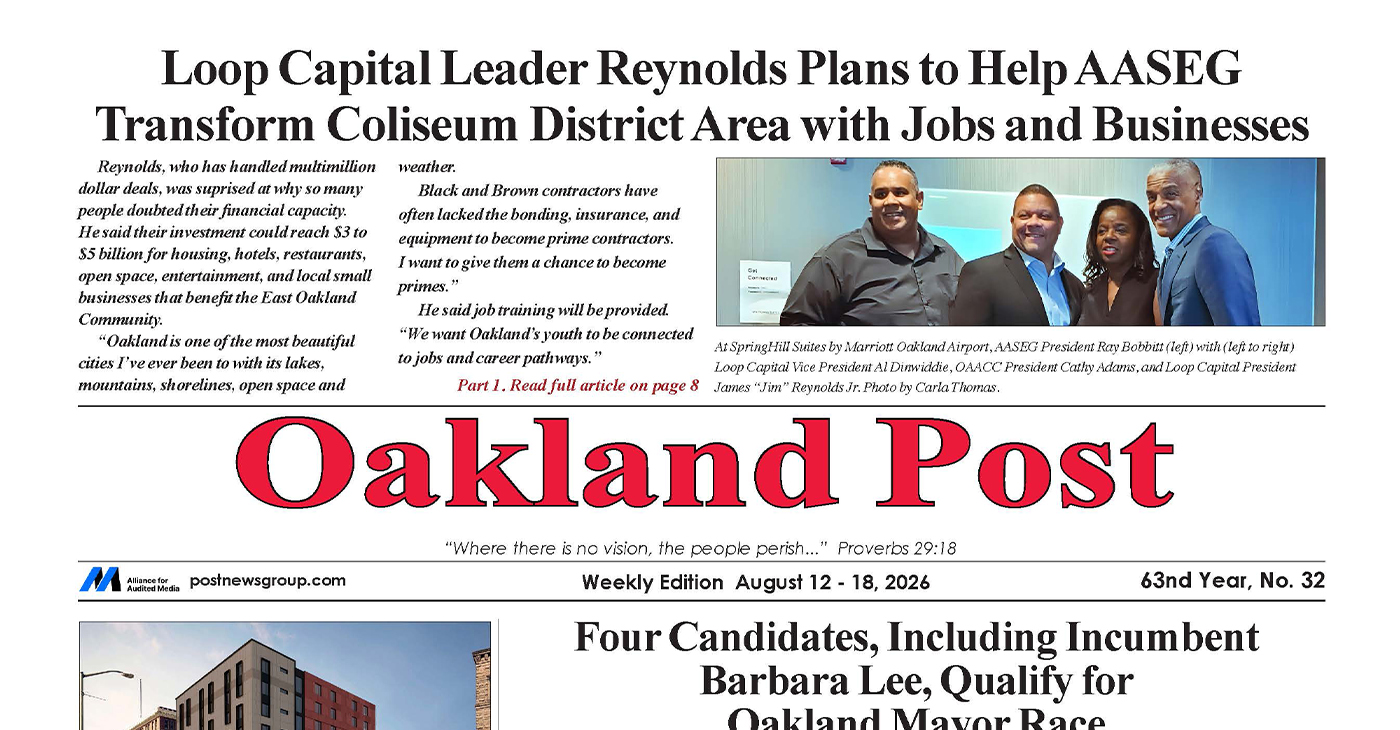
To enlarge your view of this issue, use the slider, magnifying glass icon or full page icon in the lower right corner of the browser window.
Activism
Oakland Post: Week of August 5 – 11, 2026
The printed Weekly Edition of the Oakland Post: Week of August 5 – 11, 2026
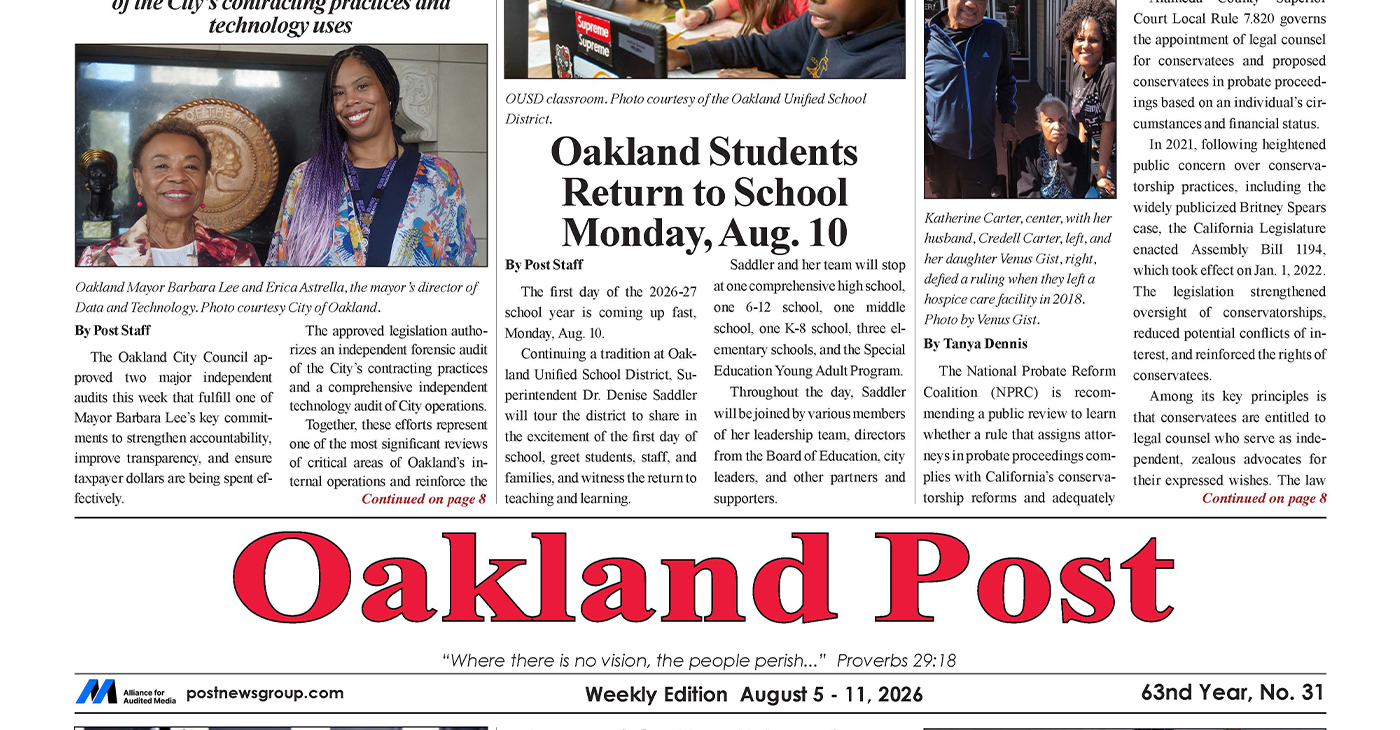
To enlarge your view of this issue, use the slider, magnifying glass icon or full page icon in the lower right corner of the browser window.
Activism
Oakland Post: Week of July 29 – August 4, 2026
The printed Weekly Edition of the Oakland Post: Week of July 29 – August 4, 2026
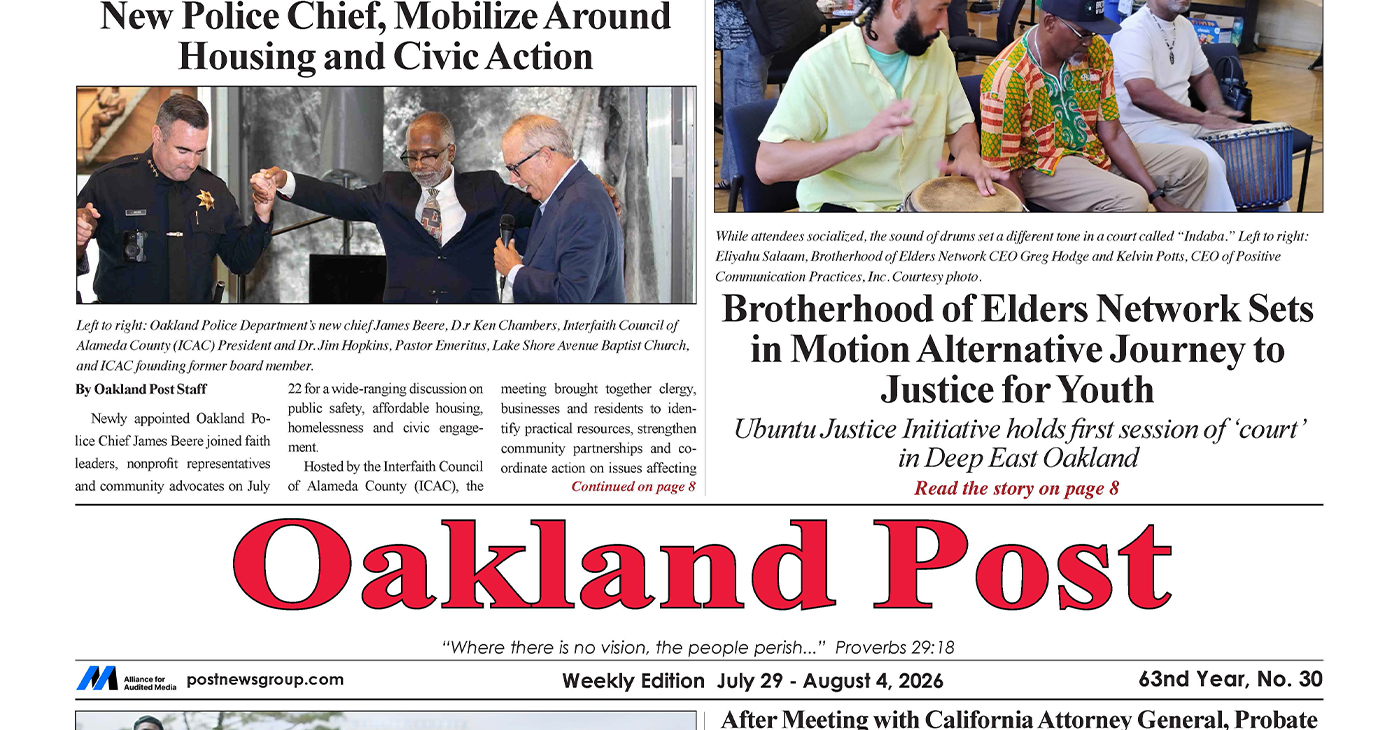
To enlarge your view of this issue, use the slider, magnifying glass icon or full page icon in the lower right corner of the browser window.

WORK FROM HOME
Home-based business with potential monthly income of $10K+ per month. A proven training system and website provided to maximize business effectiveness. Perfect job to earn side and primary income. Contact Lynne for more details: Lynne4npusa@gmail.com 800-334-0540


Four Candidates, Including Incumbent Barbara Lee, Qualify for Oakland Mayor’s Race

Oakland Observes Black August with Block Parties, Film Showings, Workshops

Oakland Post: Week of August 12 – 18, 2026

COMMENTARY: Why Local School Tax Measure G1 Will Not Be on the November Ballot

California Hispanic Chambers of Commerce Unveils: ‘Powering the Future’ Theme for 47th Annual Statewide Convention

Returning to Its Roots, the Oakland Black-Eyed Pea Festival Partners with the Freedom Farmers Market Sept. 12

Less Affluent School Districts, Including Sacramento City, Face Threat of State Takeover

From Blueprint to Breakthrough: Tackling Affordable Housing in Oakland

NPRC Scores First Advocacy Victory: David Shaw Finally Gets His Wish to ‘Go Home’

ESSAY: California Can Close Its Colorectal Cancer Gap

Car Wash Workers Cope with Lingering Impacts of ICE Raids

Misty Copeland Shapes Ballet’s Tomorrow

As Part of Your Back-to- School Checklist, Vaccinate

As Part of Your Back-to- School Checklist, Vaccinate

Congresswoman Simon Demands Investigation into Trump’s Abuse of Emergency Powers for Coal Export Terminal in West Oakland

Department of Homeland Security Demands California Secretary of State Shirley N. Weber Scrub Voter Rolls

Oakland Children’s Hospital Workers and Patients Rally for Pediatric Medical Care

New Judge Could Decide if Karmelo Anthony Gets a New Trial

“The Power to See Threats Sooner”: Gov. Newsom, Safety Officials Showcase California’s Investments in Hi-Tech Wildfire Prevention

Alpha Kappa Alpha Sorority, Inc. Celebrates New North Atlantic Regional Director

Surveillance Pricing Fight: State Senate Debates Bill Banning Retailers from Using AI to Set Prices Based on a Buyer’s Profile

Mount Zion MBC, Church of Jesus Christ of Latter-day Saints Partner to Bring 29,000 Meals to Alameda County

California Sen. Padilla Joins Colleagues to Introduce Bill Imposing Term Limits on Supreme Court Justices

Starting This Summer, California Car Buyers Can Get an Instant $3500 Off the Cost of Electric Vehicles

COMMENTARY: You Are Already Paying for the AI Boom

California Bill Would Let Abuse Victims Use Trauma as Legal Defense for Violent Crime
Less Affluent School Districts, Including Sacramento City, Face Threat of State Takeover
Car Wash Workers Cope with Lingering Impacts of ICE Raids

Fed Court to Decide Landmark First Amendment Case

Gov. Gavin Newsom Signs Law Streamlining Affordable Housing Rules

The Conversation With Al McFarlane 6/23/26

Media Monday 6/22/26

LIVE! ASK ALMA! — TUES. 6.23.26 7PM EST

Car Buying Secrets: 4 Hidden Checks Before You Sign!

Is This 550 HP Charger Worth YOUR Money? AutoNetwork Review

Celebrating Juneteenth – Frederick Douglass on education and resistance

LIVE! — ASK ALMA! — TUES. 6.19.26 7PM EST

Hyundai Ioniq 5 Parking, Safety, and 360 View #shorts

2025 Ioniq 5 New Wiper & Powerful Performance! #shorts

Electric SUV Range: Is 259 Miles Enough? #shorts

EV Charging: How Fast Can You Charge an Electric Vehicle? #shorts

Biometric Cooling… Messaging Seats…Come on! 2025 Infiniti QX80 Autograph 4WD

Charged Up: Witness the Magic of a Fully Electric Car! #shorts

Range Rover Sport PHEV Included…: See What’s Inside This Luxury SUV! #shorts

Invisible Hood View: Perfect Parking with X-Ray Vision! #shorts
-
 Featured7 days ago
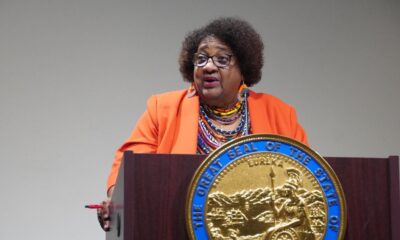
Department of Homeland Security Demands California Secretary of State Shirley N. Weber Scrub Voter Rolls
-
 Business3 weeks ago
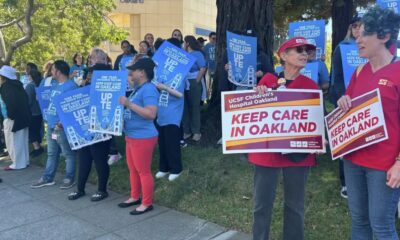
Oakland Children’s Hospital Workers and Patients Rally for Pediatric Medical Care
-
 #NNPA BlackPress2 weeks ago
New Judge Could Decide if Karmelo Anthony Gets a New Trial
-
 Environment7 days ago
“The Power to See Threats Sooner”: Gov. Newsom, Safety Officials Showcase California’s Investments in Hi-Tech Wildfire Prevention
-
 Black History2 weeks ago
Alpha Kappa Alpha Sorority, Inc. Celebrates New North Atlantic Regional Director
-
 Business3 weeks ago
Surveillance Pricing Fight: State Senate Debates Bill Banning Retailers from Using AI to Set Prices Based on a Buyer’s Profile
-
 Business3 weeks ago
Mount Zion MBC, Church of Jesus Christ of Latter-day Saints Partner to Bring 29,000 Meals to Alameda County
-
 Featured7 days ago
California Sen. Padilla Joins Colleagues to Introduce Bill Imposing Term Limits on Supreme Court Justices
