
California Black Media
Your Taxes Raised $83.1 Billion for the State Last Fiscal Year; Schools Received $44.6 Billion
Schools across the Golden State received a windfall of $44.6 billion in local property tax revenue, according to the 2021-22 California Board of Equalization’s (BOE) Annual Report released late last month. The funds collected from property owners for the 2021-22 fiscal year, which ended last June, was an increase of 3.8% from the previous fiscal year. Overall, local property tax revenues increased 4% or $3.2 billion to $83.1 billion total. In addition to schools, the funds were funneled to the coffers of local governments throughout California.


McKenzie Jackson
California Black Media
Schools across the Golden State received a windfall of $44.6 billion in local property tax revenue, according to the 2021-22 California Board of Equalization’s (BOE) Annual Report released late last month.
The funds collected from property owners for the 2021-22 fiscal year, which ended last June, was an increase of 3.8% from the previous fiscal year. Overall, local property tax revenues increased 4% or $3.2 billion to $83.1 billion total. In addition to schools, the funds were funneled to the coffers of local governments throughout California.
BOE Chairman Antonio Vazquez said in an April 18 statement that property taxes are a steady and reliable revenue stream for government services and schools that Californians depend on daily.
“The BOE’s critical role protects these dollars through its oversight of property tax assessments and that they are done fairly, uniformly, and consistently,” he said.
The board released a 26-page report weeks after California Democratic lawmakers proposed Assembly Constitutional Amendment (ACA) 11 to abolish the board and reassign its duties to other state tax agencies effective Jan. 1, 2026.
The board is responsible for overseeing property tax collection in all 58 of California’s counties. It also makes more than 13 million tax assessments every year.
The report, released yearly to provide information on revenue collected by the five-member tax body and detail its accomplishments, made no mention of the amendment.
In addition to Vazquez, who represents the BOE’s Third District, other members are: State Controller Malia M. Cohen; Ted Gaines (First District); Sally J. Lieber (Second District); and Mike Schaefer, Vice Chair (Fourth District). Yvette M. Stowers, who was appointed by the Board, serves as Executive Director.
Cohen, the first African American woman to chair the BOE, was voted State Controller last November. She took office in January this year.
This year’s report found that the total net statewide county-assessed property value increased by 7% to $7.6 trillion in fiscal year 2021-22, up $500 billion from the previous year.
The assessed property value has increased annually for the past 10 years from $4.6 trillion in 2013. For example, it was $5.8 trillion in 2017, $6.9 trillion in 2020 and $7.2 trillion in 2021.
Schools receive a lion’s share of property tax revenues. The 2020-21 fiscal year, $38.5 billion went to counties ($11.7 billion), cities ($10.4 billion) and special districts ($16.3 billion).
Local governments also received $2.2 billion from state-assessed property tax revenues. Last May, the board set the values of 339 state-assessed properties — mainly public utilities and railroads — at $133.9 billion, an increase of $10.8 billion from the previous year. This property tax revenue together with the county-assessed property tax monies will give local municipalities $85.3 billion in property tax funds.
The report also informs Californians of the Taxpayers Rights Advocate (TRA) Office, which is independent of the BOE.
The TRA Office receives contacts from taxpayers and others who are either seeking assistance with a problem or a disagreement they have in the assessment and collection of property taxes or a concern with a program administered by our agency,” the report reads. “Generally, the TRA Office assists taxpayers who have been unable to resolve a matter through normal channels and seek confirmation that they were treated fairly under the law.”
The BOE report found that the state government will receive $3.3 billion in revenue from the Alcoholic Beverage Tax Program, Tax on Insurers Program and Private Railroad Car Tax.
The Alcoholic Beverage Tax Program garnered $429 million. The program is a per-gallon excise tax collected on the sale, distribution, or importation of alcoholic beverages to the state. The monies from this tax are placed into the Alcohol Beverage Control Fund and are withdrawn to be used by the state’s general funds or to pay refunds under the program.
The Tax on Insurers Program, administered by the board, State Controller’s Office, and California Department of Insurance, generated $2.9 billion for the state. Insurance companies conducting business in California are subject to as many as three taxes — a tax on gross premiums, a retaliatory tax, and the ocean marine tax.
The Private Railroad Car Tax, an in-lieu property tax on railroad cars owned by non-railroad companies and operated upon California railroads, generated $9.8 million in funds.
The report also revealed that bills that became effective in the last two years impacted programs run by the Board of Equalization. Assembly Bill 137, for example, extended the assessment appeals decision deadline for qualified applications whose two-year deadline was between March 4, 2020, and March 31, 2021 to Dec. 31, 2021. One bill, AB 1203, expanded the type of work experience an individual must have to be eligible to serve on an assessment appeals board in Los Angeles County to include professional experience in fields such as real estate.
Senate Bill (SB) 825 extended the welfare exemption from property tax for land conservancies and trusts from lien date 2022 to lien date 2027. The legislation also extended the sunset gate for intercounty pipeline right-of-way assessments from 2020-21 to 2025-26.
In a letter at the beginning of the budget report, Board of Equalization Executive Director Yvette Stowers said the board is focused on its mission of tax administration to support California governments.
“We are proud to serve this great State of California and will continue to do our part to provide essential revenues for the state and local governments,” Stowers wrote.










Activism
Oakland Post: Week of April 1 – 7, 2026
The printed Weekly Edition of the Oakland Post: Week of April 1 – 7, 2026
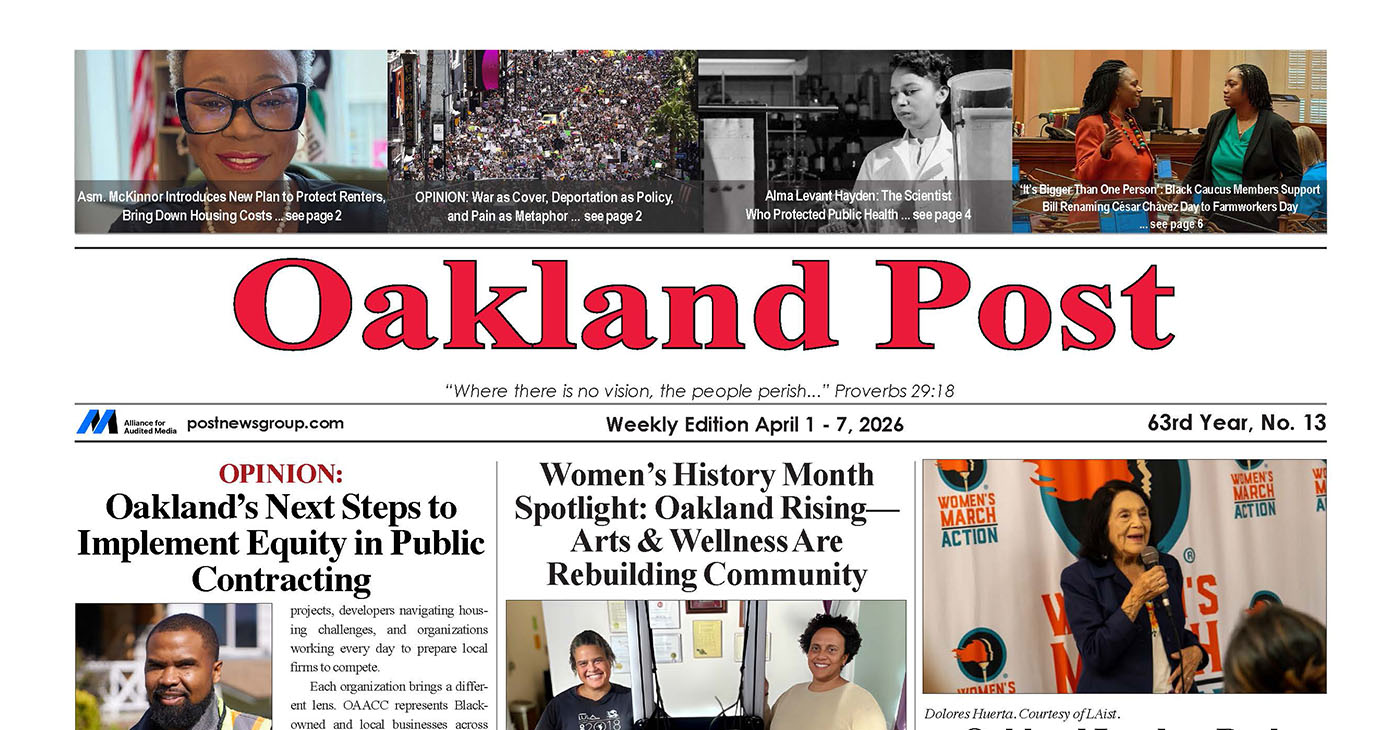
To enlarge your view of this issue, use the slider, magnifying glass icon or full page icon in the lower right corner of the browser window.
Activism
Oakland Post: Week of March 18 – 24, 2026
The printed Weekly Edition of the Oakland Post: Week of March 18 – 24, 2026

To enlarge your view of this issue, use the slider, magnifying glass icon or full page icon in the lower right corner of the browser window.
Activism
Oakland Post: Week of March 11 -17, 2026
The printed Weekly Edition of the Oakland Post: Week of March 11 – 17, 2026
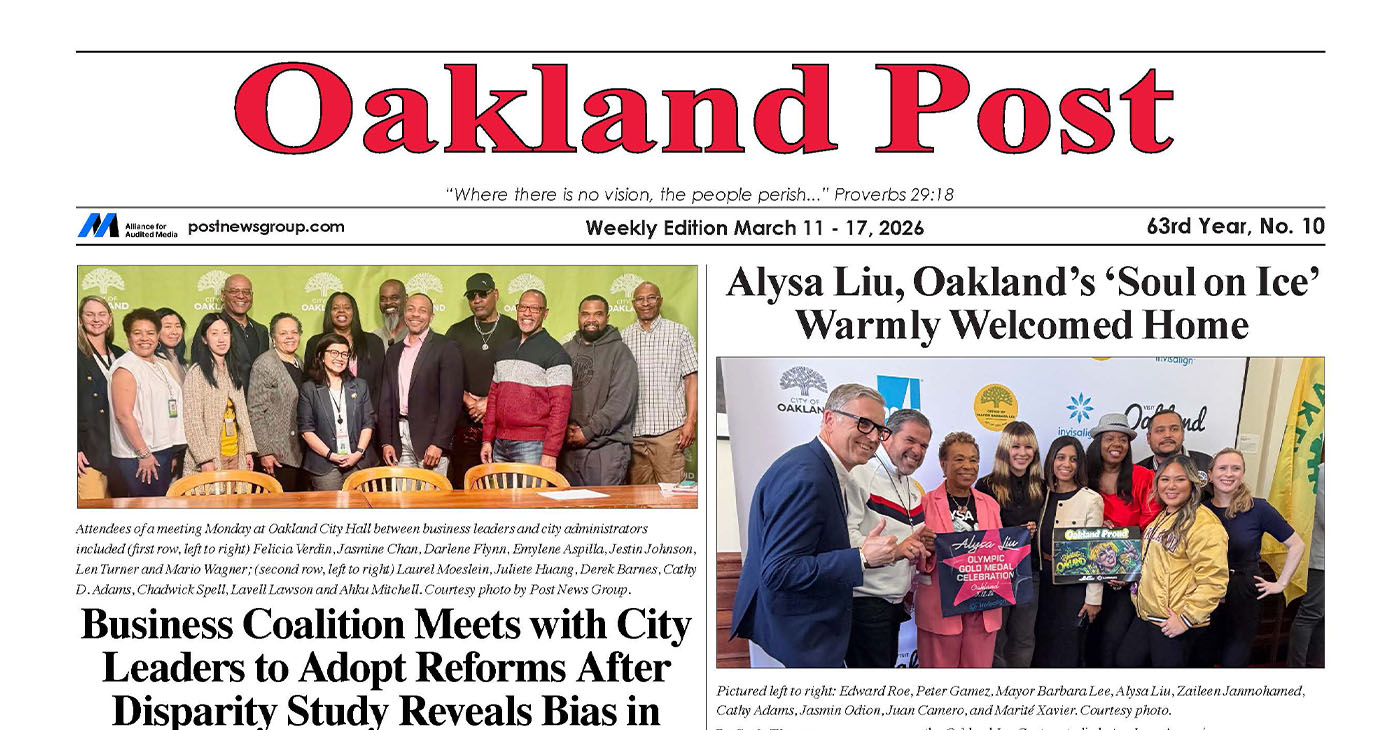
To enlarge your view of this issue, use the slider, magnifying glass icon or full page icon in the lower right corner of the browser window.


WORK FROM HOME
Home-based business with potential monthly income of $10K+ per month. A proven training system and website provided to maximize business effectiveness. Perfect job to earn side and primary income. Contact Lynne for more details: Lynne4npusa@gmail.com 800-334-0540


Oakland Post: Week of April 1 – 7, 2026

Black Artists in America, Installation Three Wraps at the Dixon Gallery and Gardens

Grief, Advocacy, and Education: A Counselor Reflects on Black Maternal Health

Future of Florida’s Black History Museum in Limbo

New Research Shows the Many Benefits of Early Learning

South Hampton K-8 Students Among Top 10 Finalists for Samsung’s ‘Solve for Tomorrow’ Competition

Cuba: No Negotiation with US on the President or Political System

Brooklyn Academy of Music Names Jamaican-Born Tamara McCaw as President

Trinidad & Tobego – U.S. Launches WhatsApp Channel for American Citizens in the Country

Oakland Post: Week of March 18 – 24, 2026

AI Innovation vs. Ethics and Environmental Impact

AI, Web3, and Digital Reparations

What If You Owned Your AI Agent?

Season 7, Episode 3 – January Reporter’s Roundtable 📱

Season 7, Episode 3 – January Reporter’s Roundtable

Reflecting on Black History Milestones in Birmingham AL

CITY OF SAN LEANDRO STATE OF CALIFORNIA PUBLIC WORKS DEPARTMENT ENGINEERING DIVISION NOTICE TO BIDDERS FOR ANNUAL STREET OVERLAY/REHABILITATION 2019-21 – PHASE III

Oakland Post: Week of February 18 – 24, 2026

Oakland Post: Week of February 25 – March 3, 2026

PRESS ROOM: NBA Hall of Fame Nominee Terry Cummings Joins 100 Black Men of DeKalb County to Launch Victory & Values Initiative

Trump’s MAGA Allies are Creating Executive Order Plan to Steal the 2026 Midterms

Oakland Post: Week of March 4 – 10, 2026

Chase Oakland Community Center Hosts Alley-Oop Accelerator Building Community and Opportunity for Bay Area Entrepreneurs

U.S. manufacturing rebounds – how foundry services are adapting to rising demand

Poll Shows Support for Policies That Help Families Afford Child Care

OP-ED: One Hundred Years of Black Workers Telling the Truth

Advancements in solar technology that are changing the way we power the world

Oakland Post: Week of March 11 -17, 2026

Woman’s Search for Family’s Roots Leads to Ancestor John T. Ward – A Successful Entrepreneur and Conductor on the Underground Railroad

COMMENTARY: Women of Color Shape Our Past and Future

Hyundai Ioniq 5 Parking, Safety, and 360 View #shorts

2025 Ioniq 5 New Wiper & Powerful Performance! #shorts

Electric SUV Range: Is 259 Miles Enough? #shorts

EV Charging: How Fast Can You Charge an Electric Vehicle? #shorts

Biometric Cooling… Messaging Seats…Come on! 2025 Infiniti QX80 Autograph 4WD

Charged Up: Witness the Magic of a Fully Electric Car! #shorts

Range Rover Sport PHEV Included…: See What’s Inside This Luxury SUV! #shorts

Invisible Hood View: Perfect Parking with X-Ray Vision! #shorts

AI Is Reshaping Black Healthcare: Promise, Peril, and the Push for Improved Results in California

ESSAY: Technology and Medicine, a Primary Care Point of View

Sanctuary Cities

The RESISTANCE – FREEDOM NOW

STATE OF THE PEOPLE: Freddie

ECONOMIC BOYCOTT DAY!!!!!

I told You So
-
 Activism4 weeks ago
Oakland Post: Week of March 4 – 10, 2026
-
 Activism3 weeks ago
Oakland Post: Week of March 11 -17, 2026
-
 #NNPA BlackPress4 weeks ago
Woman’s Search for Family’s Roots Leads to Ancestor John T. Ward – A Successful Entrepreneur and Conductor on the Underground Railroad
-
 #NNPA BlackPress4 weeks ago
COMMENTARY: Women of Color Shape Our Past and Future
-

 Advice3 weeks ago
Financial Wellness and Mental Health: Managing Money Stress in College
-

 #NNPA BlackPress4 weeks ago
Advocates Raise Alarm Over ICE Operation, MOU and Detention Risks in Baltimore County
-
 Activism2 weeks ago
Oakland Post: Week of March 18 – 24, 2026
-

 #NNPA BlackPress4 weeks ago
Pete Buttigieg to Join Mayor Randall Woodfin for Community Town Hall in Birmingham
