
Bay Area
What Oakland’s Homeless Audit Says About Evictions, Policing, and Fire
Although the audit was vast in its analysis, this guide attempts to outline key points from the audit related only to evictions and hygiene services, police response and costs, and fire department response and costs.

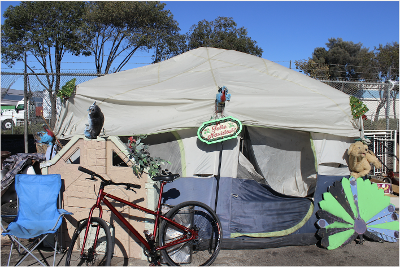
On April 14, Oakland’s City Auditor Courtney Ruby released an audit of the city’s homeless encampment management interventions and activities for the fiscal years 2018-19 and 2019-2020. The 95-page report includes data and estimations about interventions, populations, costs, and availability of services related to homeless people and their communities.
Claiming that the city “lacked an effective strategy…and did not provide sufficient policy direction or adequate funding,” Ruby also included recommendations for better addressing homeless communities. Although the audit was vast in its analysis, this guide attempts to outline key points from the audit related only to evictions and hygiene services, police response and costs, and fire department response and costs.
Evictions and hygiene services
The audit’s data on evictions and hygiene services is limited to the 2018-19 fiscal year and the first eight months of the 2019-20 fiscal year, when the city suspended most homeless evictions and cleaning interventions due to the COVID-19 pandemic in March 2020. During this timeframe, the city evicted 181 homeless communities. Of these evictions, 123, or about two-thirds of the total, were classified as “re-closures,” which the report defined as occurring “when homeless individuals return to a previously closed [homeless community].” In the fiscal year 2018-19, about 60% of evictions were re-closures. From July 2019 through February 2020, this ratio increased, and about 77% of evictions were re-closures.
The audit reports 1,599 interventions classified as “hygiene and garbage services,” and defines such interventions as “providing portable toilets, hand-washing stations, regular garbage service, and/or traffic barriers.” For each of these services performed per homeless community, the audit counts one intervention. These interventions are lumped together and lack individual data, meaning that the audit did not report precise data on how often the city provided trash pick-up to homeless communities.
The audit reports that the city increased its hygiene and garbage interventions. From 2018-19, the city provided 797 such interventions, or about 66 per month. During the first eight months of 2019-2020, the city performed 802 such interventions, or about 100 per month. After March 2020, in response to COVID-19, the audit claims the city increased the number of homeless communities that receive hygiene interventions from 20 to 40, but the vast majority of homeless communities in Oakland still do not get hygiene and/or trash services with any regularity. The audit estimates that there are at least 140 homeless communities in Oakland but acknowledges “that this estimate may be conservative.”
Police response and costs
Data recorded in the audit shows police response to 911 calls in homeless communities was not timely. While over 99% of 911 calls were classified as “Priority 2,” which the audit claims “ideally should be responded to in 10 to 15 minutes,” data provided by OPD showed the median police response time to Priority 2 calls was two hours in 2018-19, while the mean response time was four hours. In 2019-20, response time slowed by about 50%, with the median response time being about three hours, while the mean response time was about six hours. Data OPD listed related to response time range show the department took over two days to respond to at least one 911 call in 2018-19 and over six days to respond to at least one other 911 call in 2019-20. Although OPD recorded 1,458 calls to homeless communities during the two years of the audit, the audit only analyzed 988 of these calls, claiming that “response data was incomplete” for 470 calls.
The audit records OPD using about $3.1 million in costs associated with homeless communities. But that $3.1 million does not include an accurate account of overtime pay. OPD only started recording overtime pay related to homeless communities in February 2020, just before the frequency of interventions, notably evictions, declined dramatically.
About $1.7 million, a slim majority of OPD’s recorded costs related to homeless communities, are recorded as labor costs that went to the three members of The Homeless Outreach Team. The Homeless Outreach Team consists of one sergeant and two officers who dedicate 100% of their time to homeless community work.
The Abandoned Auto Unit incurred over $800,000 in labor costs to provide support at moderate to large homeless community evictions. They were responsible for “traffic control and tagging and towing vehicles at [homeless communities] when necessary.” About $600,000 went to labor costs incurred by Patrol staff responding to 911 calls.
Fire Department response and costs
The audit reports that The Oakland Fire Department responded to 988 fires in homeless communities in 2018-19 and 2019-20, which is more than one a day. The data recorded shows that the OFD response times for such fires were timely, arriving in just over seven minutes and 50 seconds to over 90% of calls. Such responses were slightly faster than responses to non-homeless community related calls, which, in 90% of cases, OFD responded to in about eight minutes and 10 seconds. OFD has recorded no injuries to firefighters fighting fires at homeless communities. One homeless resident died in 2020 as a direct result of a fire. The audit did not record fire-related injuries to homeless people or their lost possessions.
OFD-related costs accounted for an estimated $1.8 million in funds related to homeless communities in 2018-19 and 2019-2020. About $676,000 went to “fire prevention labor,” which includes labor costs associated with fire hazard inspections, investigations related to fires, and removal of hazardous waste. Over $ million went to both labor and equipment costs related to “fire suppression.” Fire suppression costs include costs related to fighting fires and rescue activities. OFD costs related to homeless communities rose over 40% from 2018-19 to 2019-20 while total fires at homeless communities increased about 17% over these years.














Activism
Oakland Post: Week of September 23 – 29, 2026
The printed Weekly Edition of the Oakland Post: Week of September 23 – 29, 2026


To enlarge your view of this issue, use the slider, magnifying glass icon or full page icon in the lower right corner of the browser window.

Activism
Oakland Post: Week of September 16 – 22, 2026
The printed Weekly Edition of the Oakland Post: Week of September 16 – 22, 2026

To enlarge your view of this issue, use the slider, magnifying glass icon or full page icon in the lower right corner of the browser window.
Activism
Oakland Post: Week of September 9 – 15, 2026
The printed Weekly Edition of the Oakland Post: Week of September 9 – 15, 2026

To enlarge your view of this issue, use the slider, magnifying glass icon or full page icon in the lower right corner of the browser window.



Asm. Corey Jackson Announces Launch of 24-Hour Childcare in His District

IN MEMORIAM: The Rev. Leon “Sonny” Clark, Longtime Orange County Pastor and Community Leader, Dies at 72

Poll: Becerra Widens His Lead Over Hilton; Californians Split on Wealth Tax

From Historic Memories to New Possibilities: Oakland Celebrates Coliseum 60

County Office of Education Says OUSD Finances Are Getting Healthier, Materially Stronger

LIVE FREE Sunday Dinner Brings Faith, Fellowship and Civic Conversation to Oakland

Remembering Chauncey Bailey as Student Journalists Face Threats to Truth-Telling

BLACspace Cooperative Invites Bay Area to Experience Oakland’s Black Cultural Ecosystem Through a BLAC Map Tour + Party

In Wake of Death on Doorstep, Williams Chapel Baptist Church Calls for Better Care, Funding for Unhoused

Oakland Centenarian Nuna McKee Honored!

Caribbean Nations Produce Action Plan Calling for UK Reparations Over Slavery

Oakland Post: Week of September 23 – 29, 2026

Doulas Are Helping Black California Moms Navigate Pregnancy–Even as High Mortality Rates Persist

Newsom Signs Addictive Social Media Law to Protect Kids

On Your November Ballot: Prop 38 Would Allocate $8.4 Billion to Immunology and Immunotherapy Funding

Less Affluent School Districts, Including Sacramento City, Face Threat of State Takeover

ESSAY: California Can Close Its Colorectal Cancer Gap

California Hispanic Chambers of Commerce Unveils: ‘Powering the Future’ Theme for 47th Annual Statewide Convention

Four Candidates, Including Incumbent Barbara Lee, Qualify for Oakland Mayor’s Race

Oakland Post: Week of August 12 – 18, 2026

From Blueprint to Breakthrough: Tackling Affordable Housing in Oakland

Oakland Observes Black August with Block Parties, Film Showings, Workshops

COMMENTARY: Why Local School Tax Measure G1 Will Not Be on the November Ballot

Standoff for Justice: Our Homes Are Worth Fighting For

Returning to Its Roots, the Oakland Black-Eyed Pea Festival Partners with the Freedom Farmers Market Sept. 12

Oakland Post: Week of August 26 – September 1, 2026

NPRC Scores First Advocacy Victory: David Shaw Finally Gets His Wish to ‘Go Home’

Frontier Airlines’ Return to Oakland Airport Brings Flights, Jobs and Opportunity

Gubernatorial Candidate Steve Hilton Blasts California New Tire Rules; Newsom Hits Back

Chef Sharon Lee Blends Culinary Excellence, Education and Empowerment

The Conversation With Al McFarlane 6/23/26

Media Monday 6/22/26

LIVE! ASK ALMA! — TUES. 6.23.26 7PM EST

Car Buying Secrets: 4 Hidden Checks Before You Sign!

Is This 550 HP Charger Worth YOUR Money? AutoNetwork Review

Celebrating Juneteenth – Frederick Douglass on education and resistance

LIVE! — ASK ALMA! — TUES. 6.19.26 7PM EST

Hyundai Ioniq 5 Parking, Safety, and 360 View #shorts

2025 Ioniq 5 New Wiper & Powerful Performance! #shorts

Electric SUV Range: Is 259 Miles Enough? #shorts

EV Charging: How Fast Can You Charge an Electric Vehicle? #shorts

Biometric Cooling… Messaging Seats…Come on! 2025 Infiniti QX80 Autograph 4WD

Charged Up: Witness the Magic of a Fully Electric Car! #shorts

Range Rover Sport PHEV Included…: See What’s Inside This Luxury SUV! #shorts

Invisible Hood View: Perfect Parking with X-Ray Vision! #shorts
-
 Business4 weeks ago
Frontier Airlines’ Return to Oakland Airport Brings Flights, Jobs and Opportunity
-
 Business4 weeks ago
Gubernatorial Candidate Steve Hilton Blasts California New Tire Rules; Newsom Hits Back
-
 Business4 weeks ago
Chef Sharon Lee Blends Culinary Excellence, Education and Empowerment
-

 Black History4 weeks ago
Jackie Wright Champions Bay Area Stories, Filmmakers and Cultural Institutions
-

 Community4 weeks ago
Big City Mayors Ask for “Yes” Vote on Housing Bond Measure; Conservatives Say “No”
-

 Education4 weeks ago
Gov. Newsom’s Latest Appointees Include Sacramento Advocate for Formerly Incarcerated Students; State’s New Tech Chief
-

 Business4 weeks ago
Oakland Coliseum Project Opens Door for Small Businesses to Build Bigger
-

 Community2 weeks ago
Misnamed ‘Parent’ PAC Seeks to Influence Oakland School Board Elections
