
Activism
Virtual Murrell, Black Panther Party Member, to Speak at Merritt College on Sept. 16
The Barbara Lee and Elihu Harris Lecture Series presents a conversation with Virtual Murrell on Saturday, Sept. 16, at 7 p.m. in the Huey P. Newton and Bobby Seale Student Lounge at Merritt College in Oakland. Murrell is a former member of the Black Panther Party, a dynamic leader, political figure, advisor and author who has been active for six decades organizing and helping protect and preserve democracy. He has been celebrated by Black Panther Party members and founders for his organizing skills and compelling public speaking talent.


The Activist and Author is part of the Barbara Lee and Elihu Harris lecture series
Special to The Post
The Barbara Lee and Elihu Harris Lecture Series presents a conversation with Virtual Murrell on Saturday, Sept. 16, at 7 p.m. in the Huey P. Newton and Bobby Seale Student Lounge at Merritt College in Oakland.
Murrell is a former member of the Black Panther Party, a dynamic leader, political figure, advisor and author who has been active for six decades organizing and helping protect and preserve democracy. He has been celebrated by Black Panther Party members and founders for his organizing skills and compelling public speaking talent.
Murrell began his life’s work as an organizer while a student at Merritt College in the 1960s and his book, “In Pursuit of America’s Promise: Memoirs of a Black Panther,” has recently been published.
The event is co-produced by the Martin Luther King Jr. Freedom Center and the Peralta Community College District. To reserve free tickets, call the Freedom Center office at (510) 434-3988.
“Virtual Murrell has been a personal friend of me and my family since 1962,” Bobby Seale has written. “He and I were the leaders and founders of one of the first Black student activist organizations in the country. Moreover, we also co-founded one of the first Black history and Black Studies programs. It could not have been done without the leadership abilities and roles of Virtual Murrell.”
Rodney Carlisle, professor emeritus, Rutgers University, wrote in the forward to Murrell’s book, “This memoir is a remarkable achievement for several reasons. It is a fascinating first-person account by an African American leader and political figure whose personal career and observations span the decades from the 1960s to the first decade of the 21st century. As a young student leader at Merritt College in Oakland, California, Virtual Murrell knew and worked with Bobby Seale and Huey Newton, and others associated with the formation of the Black Panther Party.
“Later, as a political adviser and activist, he worked with a wide variety of Black leaders in the Democratic Party, throughout the state of California, and in Washington D.C. with a long career spanning the 20th century and the first years of the 21st century. For readers familiar or unfamiliar with the story of ‘Black Radicalism’ as well as the more centrist positions of Black leadership in those decades, his book provides an intimate first-hand account.
“More broadly, however, Murrell’s comments on the situation of African Americans in the late 20th century and early 21st century will be interesting not only to contemporary readers who seek to understand the interplay of race issues and politics, but as an historical document for later generations. Rather than presenting these complex issues ‘from the outside’ as a sociologist or a historian, the issues and developments are described by an active, perceptive, and interesting participant.’”
About the Barbara Lee and Elihu Harris Lecture Series and the Martin Luther King Jr. Freedom Center
The Barbara Lee and Elihu Harris Lecture Series promotes an ample exchange of ideas to help inspire and move forward new leadership and servantship. The Lecture Series is a longstanding public forum that invites civic leaders from all sectors to respond to Dr. King’s still-pressing question, “Where do we go from here: chaos or community?”
Broad East Bay audiences of all ages are exposed to some of our nation’s most courageous and exemplary civil and human rights figures, engaging in creative solutions and challenges to some of the most perplexing issues facing our communities today: economic inequity, voter disenfranchisement, systemic racism, violence in schools and neighborhoods, police brutality, and the contradictions and ramifications of extreme poverty.
Lectures are organized by the youth and staff at the Freedom Center, with a focus on promoting ideas and actions rooted in principles of nonviolence, and lessons from some of our nation’s most significant civil rights struggles.
Civic engagement at the Martin Luther King Jr Freedom Center brings together individuals and organizations of diverse ages, races and socioeconomic backgrounds, working side-by-side for a healthy democracy.
The Freedom Center brings best practices from the nation’s Civil Rights Movement to the forefront in community education, training, and practice, building strong community partnerships with proven results.





Activism
Oakland Post: Week of April 1 – 7, 2026
The printed Weekly Edition of the Oakland Post: Week of April 1 – 7, 2026
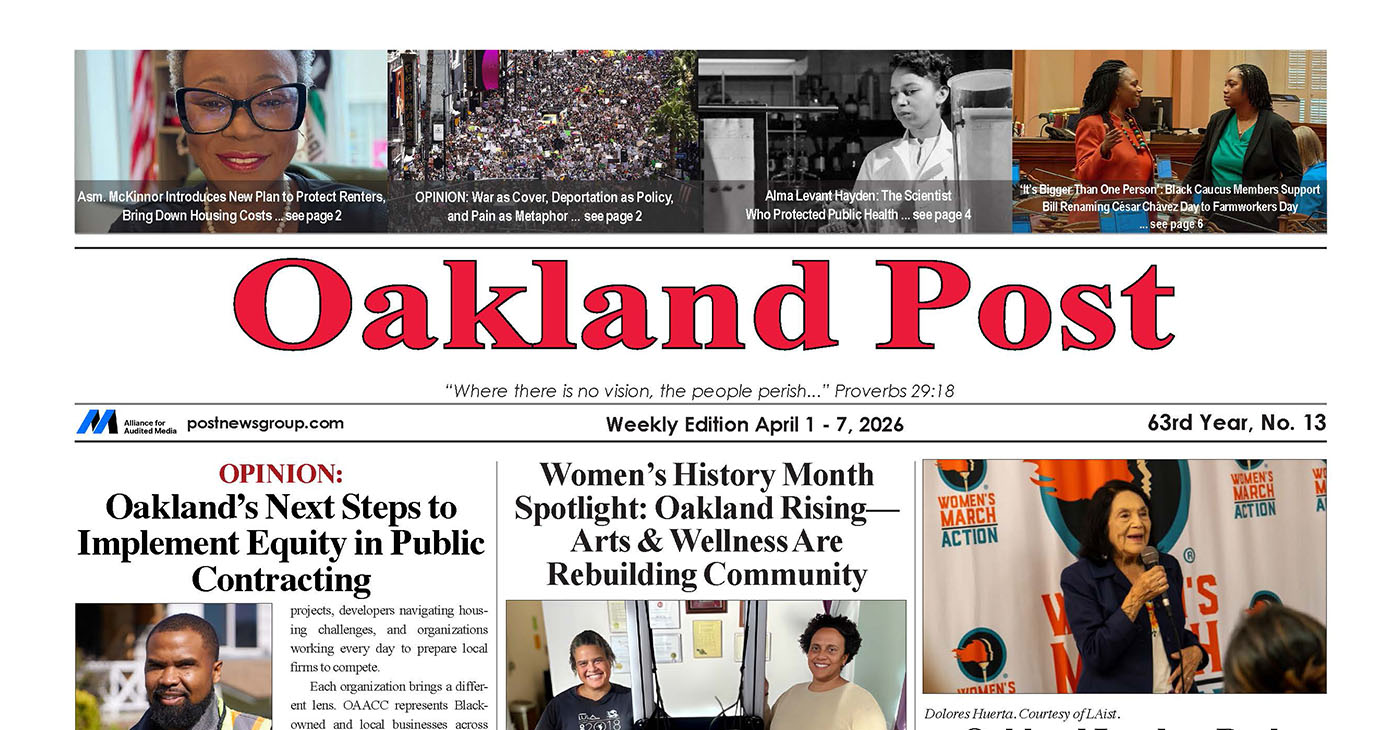
To enlarge your view of this issue, use the slider, magnifying glass icon or full page icon in the lower right corner of the browser window.
Activism
Oakland Post: Week of March 18 – 24, 2026
The printed Weekly Edition of the Oakland Post: Week of March 18 – 24, 2026

To enlarge your view of this issue, use the slider, magnifying glass icon or full page icon in the lower right corner of the browser window.
Activism
Oakland Post: Week of March 11 -17, 2026
The printed Weekly Edition of the Oakland Post: Week of March 11 – 17, 2026
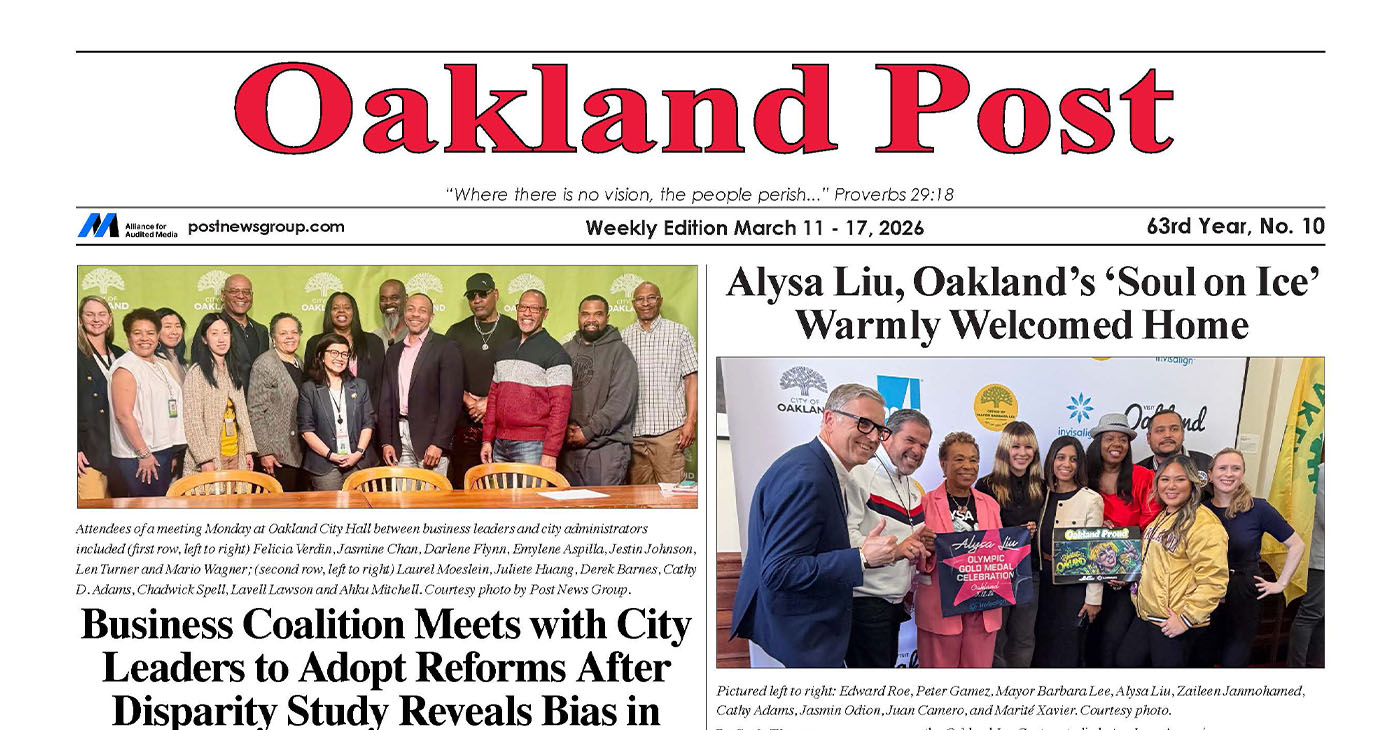
To enlarge your view of this issue, use the slider, magnifying glass icon or full page icon in the lower right corner of the browser window.

WORK FROM HOME
Home-based business with potential monthly income of $10K+ per month. A proven training system and website provided to maximize business effectiveness. Perfect job to earn side and primary income. Contact Lynne for more details: Lynne4npusa@gmail.com 800-334-0540


Oakland Post: Week of April 1 – 7, 2026

Black Artists in America, Installation Three Wraps at the Dixon Gallery and Gardens

Grief, Advocacy, and Education: A Counselor Reflects on Black Maternal Health

Future of Florida’s Black History Museum in Limbo

New Research Shows the Many Benefits of Early Learning

South Hampton K-8 Students Among Top 10 Finalists for Samsung’s ‘Solve for Tomorrow’ Competition

Cuba: No Negotiation with US on the President or Political System

Brooklyn Academy of Music Names Jamaican-Born Tamara McCaw as President

Trinidad & Tobego – U.S. Launches WhatsApp Channel for American Citizens in the Country

Oakland Post: Week of March 18 – 24, 2026

AI Innovation vs. Ethics and Environmental Impact

AI, Web3, and Digital Reparations

What If You Owned Your AI Agent?

Season 7, Episode 3 – January Reporter’s Roundtable 📱

Season 7, Episode 3 – January Reporter’s Roundtable

Reflecting on Black History Milestones in Birmingham AL

Oakland Post: Week of February 25 – March 3, 2026

PRESS ROOM: NBA Hall of Fame Nominee Terry Cummings Joins 100 Black Men of DeKalb County to Launch Victory & Values Initiative

Oakland Post: Week of March 4 – 10, 2026

Trump’s MAGA Allies are Creating Executive Order Plan to Steal the 2026 Midterms

U.S. manufacturing rebounds – how foundry services are adapting to rising demand

Poll Shows Support for Policies That Help Families Afford Child Care

OP-ED: One Hundred Years of Black Workers Telling the Truth

Oakland Post: Week of March 11 -17, 2026

Advancements in solar technology that are changing the way we power the world
Oakland Post: Week of March 18 – 24, 2026

Woman’s Search for Family’s Roots Leads to Ancestor John T. Ward – A Successful Entrepreneur and Conductor on the Underground Railroad

COMMENTARY: Women of Color Shape Our Past and Future

PRESS ROOM: Civil Rights TV Launches in Selma as the World’s First 24/7 Civil Rights Television Network

Financial Wellness and Mental Health: Managing Money Stress in College

Hyundai Ioniq 5 Parking, Safety, and 360 View #shorts

2025 Ioniq 5 New Wiper & Powerful Performance! #shorts

Electric SUV Range: Is 259 Miles Enough? #shorts

EV Charging: How Fast Can You Charge an Electric Vehicle? #shorts

Biometric Cooling… Messaging Seats…Come on! 2025 Infiniti QX80 Autograph 4WD

Charged Up: Witness the Magic of a Fully Electric Car! #shorts

Range Rover Sport PHEV Included…: See What’s Inside This Luxury SUV! #shorts

Invisible Hood View: Perfect Parking with X-Ray Vision! #shorts

AI Is Reshaping Black Healthcare: Promise, Peril, and the Push for Improved Results in California

ESSAY: Technology and Medicine, a Primary Care Point of View

Sanctuary Cities

The RESISTANCE – FREEDOM NOW

STATE OF THE PEOPLE: Freddie

ECONOMIC BOYCOTT DAY!!!!!

I told You So

-
 Activism3 weeks ago
Oakland Post: Week of March 11 -17, 2026
-
 Activism2 weeks ago
Oakland Post: Week of March 18 – 24, 2026
-
 #NNPA BlackPress4 weeks ago
Woman’s Search for Family’s Roots Leads to Ancestor John T. Ward – A Successful Entrepreneur and Conductor on the Underground Railroad
-
 #NNPA BlackPress4 weeks ago
COMMENTARY: Women of Color Shape Our Past and Future
-
 Advice3 weeks ago
Financial Wellness and Mental Health: Managing Money Stress in College
-

 #NNPA BlackPress4 weeks ago
Advocates Raise Alarm Over ICE Operation, MOU and Detention Risks in Baltimore County
-

 #NNPA BlackPress4 weeks ago
Pete Buttigieg to Join Mayor Randall Woodfin for Community Town Hall in Birmingham
-
 #NNPA BlackPress2 weeks ago
Brooklyn Academy of Music Names Jamaican-Born Tamara McCaw as President
