
Economics
United Nations Working Group Says U.S. Should Consider Reparations

By JESSE J. HOLLAND, Associated Press
The United States should consider reparations to African-American descendants of slavery, establish a national human rights commission and publicly acknowledge that the trans-Atlantic slave trade was a crime against humanity, a United Nations working group said Friday.
The U.N. Working Group of Experts on People of African Descent released its preliminary recommendations after more than a week of meetings with black Americans and others from around the country, including Baltimore, Chicago, New York City, the District of Columbia and Jackson, Mississippi.
 After finishing their fact-finding mission, the working group was “extremely concerned about the human rights situation of African-Americans,” chair Mireille Fanon Mendes-France of France said in the report. “The colonial history, the legacy of enslavement, racial subordination and segregation, racial terrorism and racial inequality in the U.S. remains a serious challenge as there has been no real commitment to reparations and to truth and reconciliation for people of African descent.”
For example, Mendes-France compared the recent deaths of unarmed black men like Michael Brown and Eric Garner at the hands of police to the lynchings of black men in the South from the post-Civil War days through the Civil Rights era. Those deaths, and others, have inspired protests around the country under the Black Lives Matter moniker.
“Contemporary police killings and the trauma it creates are reminiscent of the racial terror lynchings in the past,” she told reporters. “Impunity for state violence has resulted in the current human rights crisis and must be addressed as a matter of urgency.”
Some of the working group’s members, none of whom are from the United States, said they were shocked by some of the things they found and were told.
For example, “it’s very easy in the United States for African-Americans to be imprisoned, and that was very concerning,” said Sabelo Gumedze of South Africa.
Federal officials say 37 percent of the state and federal prison populations were black males in 2014. The working group suggests the U.S. implement several reforms, including reducing the use of mandatory minimum laws, ending racial profiling, ending excessive bail and banning solitary confinement.
“What stands out for me is the lack of acknowledgement of the slave trade,” said Ricardo A. Sunga III, who lives in the Philippines.
The working group suggests monuments, markers and memorials be erected in the United States to facilitate dialogue, and “past injustices and crimes against African-Americans need to be addressed with reparatory justice.”
The group will suggest several U.S. changes to improve human rights for African-Americans, which also include establishing a national human rights commission, ratifying international human rights treaties, asking Congress to study slavery and its aftereffects and considering reparations.
The Working Group of Experts on People of African Descent was established in 2002 by the then-Commission on Human Rights, following the World Conference against Racism in 2001.
It also visited the United States in 2010, where its final report found similar problems, including blacks facing disproportionately high unemployment, lower income levels, less access to education, “problematic access to quality health-care services and the high incidence of certain health conditions, electoral disenfranchisement and structural issues in the administration of justice (in particular incarceration rates).”
The current panel will give its final findings to the U.N. Human Rights Council in Geneva in September.


Activism
Oakland Post: Week of July 22 – 28, 2026
The printed Weekly Edition of the Oakland Post: Week of July 22 – 28, 2026
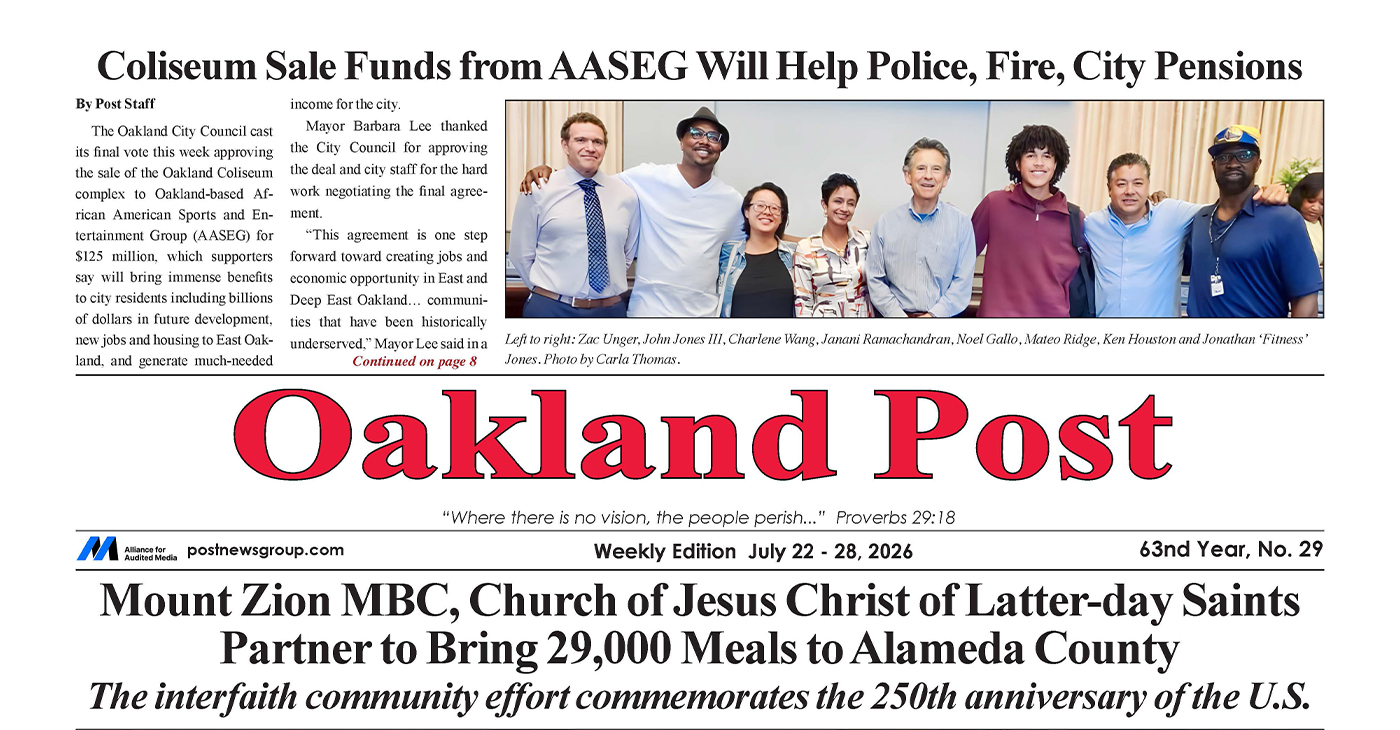
To enlarge your view of this issue, use the slider, magnifying glass icon or full page icon in the lower right corner of the browser window.
Activism
Oakland Post: Week of July 15 – 21, 2026
The printed Weekly Edition of the Oakland Post: Week of July 15 – 21, 2026
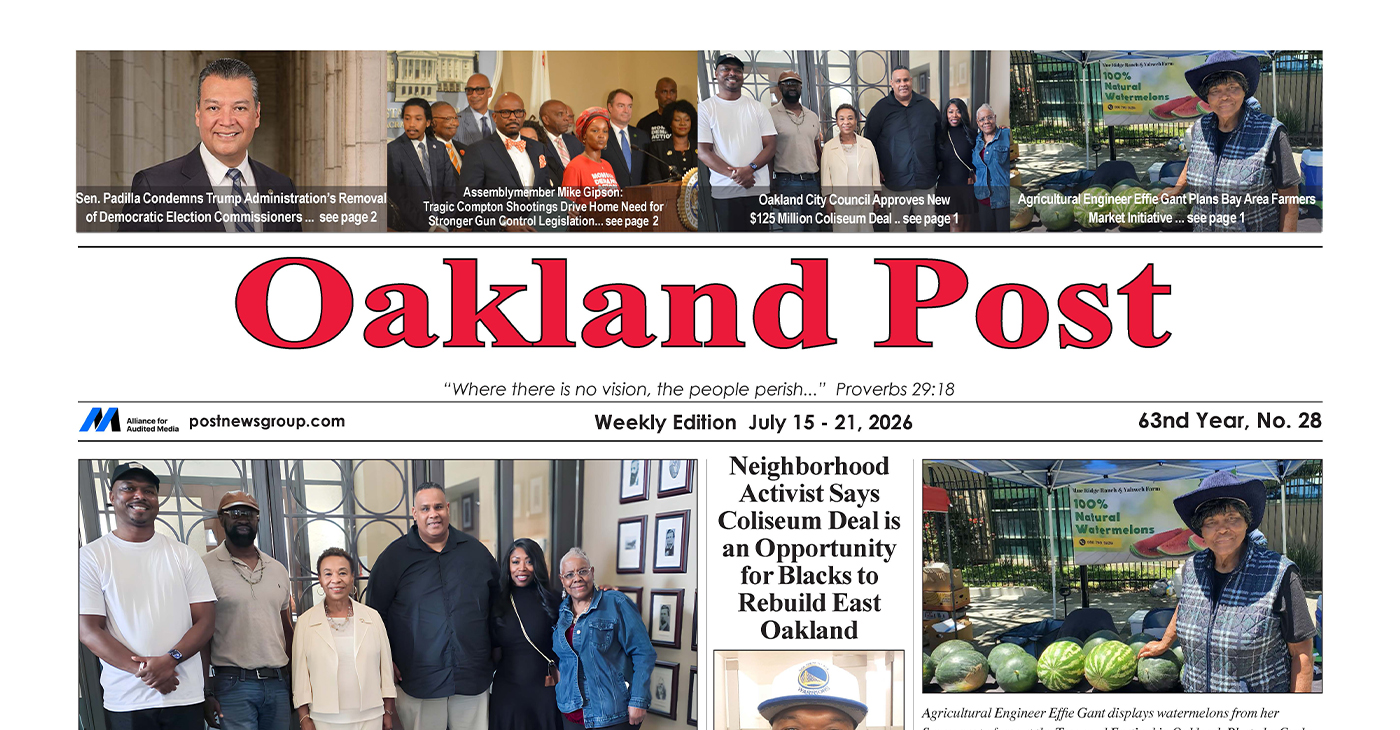
To enlarge your view of this issue, use the slider, magnifying glass icon or full page icon in the lower right corner of the browser window.
Activism
Oakland Post: Week of July 8 – 14, 2026
The printed Weekly Edition of the Oakland Post: Week of July 8 – 14, 2026
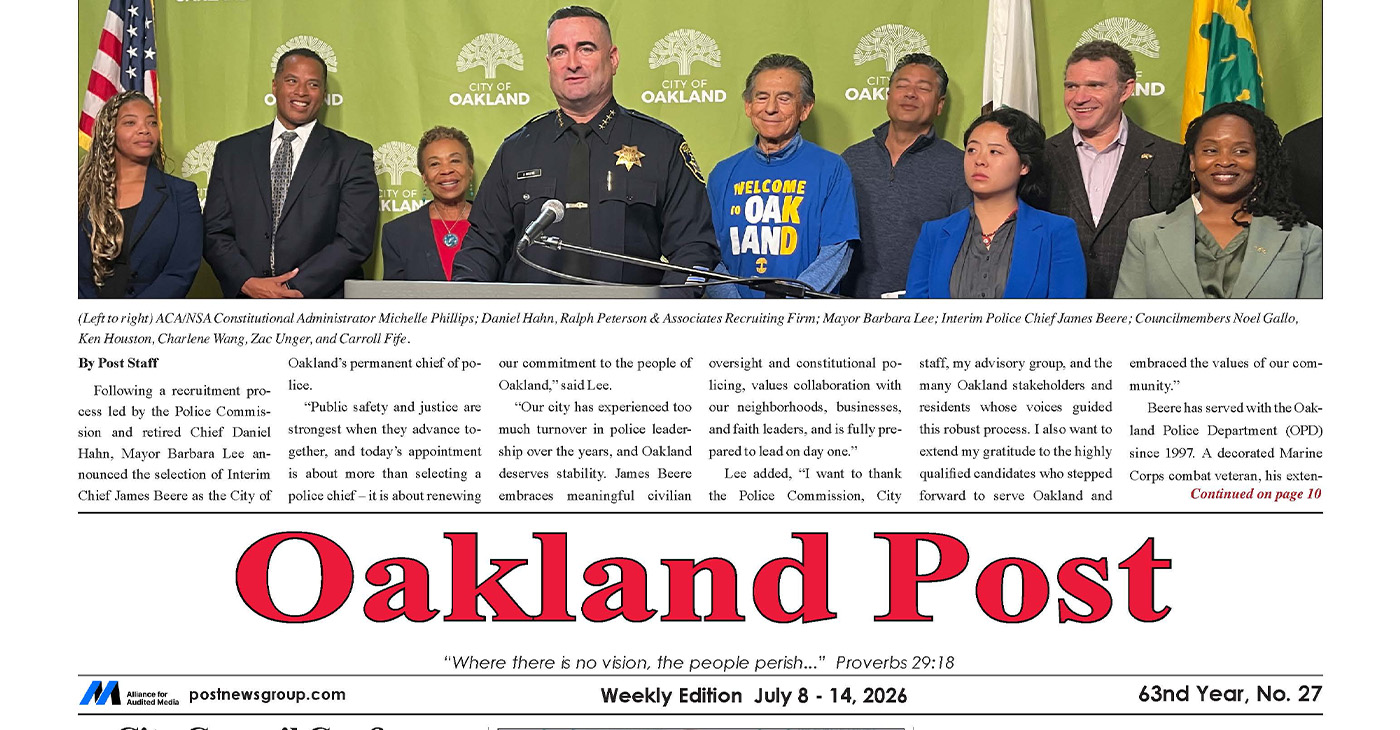
To enlarge your view of this issue, use the slider, magnifying glass icon or full page icon in the lower right corner of the browser window.

WORK FROM HOME
Home-based business with potential monthly income of $10K+ per month. A proven training system and website provided to maximize business effectiveness. Perfect job to earn side and primary income. Contact Lynne for more details: Lynne4npusa@gmail.com 800-334-0540


Oakland Post: Week of July 22 – 28, 2026

Fed Court to Decide Landmark First Amendment Case

Jordan Walker Leads Call for More Black Youth in Baseball

How Black WNBA Players Became Collateral Damage in the Caitlin Clark Culture War

NAACP Announces $20m Voter Registration Drive at National Convention in Chicago

Starting This Summer, California Car Buyers Can Get an Instant $3500 Off the Cost of Electric Vehicles

Surveillance Pricing Fight: State Senate Debates Bill Banning Retailers from Using AI to Set Prices Based on a Buyer’s Profile

Oakland Children’s Hospital Workers and Patients Rally for Pediatric Medical Care

Opinion: When Politicians Start Sanitizing One Chapter of History, They’re Coming After The Whole Book

Beyond Politics: California Legislators Across Party Lines Celebrate Lori Wilson at 50

NPRC to Meet with California Attorney General’s Office on to Urge Guardianship Reform

Mount Zion MBC, Church of Jesus Christ of Latter-day Saints Partner to Bring 29,000 Meals to Alameda County

Councilmember Houston Helps Deter Trend to Award Contracts to Suburban Companies

Rep. Garamendi, House Democrats Demand Trump Administration Abandon Illegal Plans to Dismantle Civil Rights, Special Ed Offices

Council Gives Approval for $125 Million Oakland Coliseum Sale to AASEG
Oakland Children’s Hospital Workers and Patients Rally for Pediatric Medical Care
Mount Zion MBC, Church of Jesus Christ of Latter-day Saints Partner to Bring 29,000 Meals to Alameda County
Surveillance Pricing Fight: State Senate Debates Bill Banning Retailers from Using AI to Set Prices Based on a Buyer’s Profile

Saving Black Mothers Starts Outside the Hospital

IN MEMORIAM: Oakland Dance Legend Reginald Ray-Savage, 67

Gov. Gavin Newsom Signs Law Streamlining Affordable Housing Rules

Oakland Celebrates $125 Million Coliseum Sale
Starting This Summer, California Car Buyers Can Get an Instant $3500 Off the Cost of Electric Vehicles

NPRC Heads to Washington to Elevate Adult Guardianship Reform at National Whistleblower Summit


Agricultural Engineer Effie Gant Plans Bay Area Farmers Market Initiative

The Part of Buying a Home That No Real Estate Show Ever Prepares You For

Oakland Post: Week of June 17 – 23, 2026

Oakland Post: Week of July 1 – 7, 2026

NCBW-OBAC Champions Black Women Entrepreneurs at Business en Blaque Expo

The Conversation With Al McFarlane 6/23/26

Media Monday 6/22/26

LIVE! ASK ALMA! — TUES. 6.23.26 7PM EST

Car Buying Secrets: 4 Hidden Checks Before You Sign!

Is This 550 HP Charger Worth YOUR Money? AutoNetwork Review

Celebrating Juneteenth – Frederick Douglass on education and resistance

LIVE! — ASK ALMA! — TUES. 6.19.26 7PM EST

Hyundai Ioniq 5 Parking, Safety, and 360 View #shorts

2025 Ioniq 5 New Wiper & Powerful Performance! #shorts

Electric SUV Range: Is 259 Miles Enough? #shorts

EV Charging: How Fast Can You Charge an Electric Vehicle? #shorts

Biometric Cooling… Messaging Seats…Come on! 2025 Infiniti QX80 Autograph 4WD

Charged Up: Witness the Magic of a Fully Electric Car! #shorts

Range Rover Sport PHEV Included…: See What’s Inside This Luxury SUV! #shorts

Invisible Hood View: Perfect Parking with X-Ray Vision! #shorts
-
 Business2 days ago
Oakland Children’s Hospital Workers and Patients Rally for Pediatric Medical Care
-
 Business2 days ago
Mount Zion MBC, Church of Jesus Christ of Latter-day Saints Partner to Bring 29,000 Meals to Alameda County
-
 Business2 days ago
Surveillance Pricing Fight: State Senate Debates Bill Banning Retailers from Using AI to Set Prices Based on a Buyer’s Profile
-
 Black History6 days ago
Saving Black Mothers Starts Outside the Hospital
-
 Business4 days ago
Gov. Gavin Newsom Signs Law Streamlining Affordable Housing Rules
-
 Black History1 week ago
Oakland Celebrates $125 Million Coliseum Sale
-
 Business2 days ago
Starting This Summer, California Car Buyers Can Get an Instant $3500 Off the Cost of Electric Vehicles
-
 Community1 week ago
NPRC Heads to Washington to Elevate Adult Guardianship Reform at National Whistleblower Summit
