
Bay Area
To Boot Out Prop 209: Black Lawmakers Make Case for Affirmative Action in California


Does California have a “legacy of unequal treatment” of minorities and women? That’s language from Assembly Constitutional Amendment 5 (ACA-5) introduced by Assemblymember Dr. Shirley Weber (D-San Diego) and Assemblymember Mike Gipson (D-Carson). Members of the California Legislative Black Caucus (CLBC) want their colleagues in the legislature to consider that question and examine whether affirmative action is the right response for redressing that history of inequality.
The Opportunity for All Coalition is a group that has formed in support of ACA-5, which would repeal Proposition 209.
In 1996 voters passed the controversial amendment to the state constitution. It banned discrimination or preferential treatment based on race or gender in public education, employment, and contracting.
“It’s been 24 years — 24 long years — since Prop. 209 was promoted as a civil rights initiative,” said Weber.
On May 1, the Opportunity for All Coalition held a virtual seminar. More than 100 people logged on to take part in a discussion about the ethnic disparities of the COVID-19 crisis. Coalition member and the Chair of the California State Board of Equalization, Malia Cohen, said data revealing that communities of color are disproportionately impacted by the coronavirus crisis highlights inequities in society and the need for affirmative action. A recent Centers for Disease Control and Prevention (CDC) report confirmed that death rates for African Americans and Latinos, “were substantially higher than that of white” people.
Coalition member Vincent Pan is the Co-Executive Director of Chinese for Affirmative Action (CAA). During the discussion he referenced recently-released California Department of Public Health (CDPH) data that showed Pacific Islanders and Native Hawaiians are also dying at a higher rate than their representation in the population. CDPH numbers show, as of April 30, 2,073 people have died in California from COVID-19.
Coalition members said Proposition 209 exacerbated disparities. While people from communities of color are more likely to be hospitalized for the virus, they’re less likely to have healthcare coverage and more likely to work essential service jobs. ACA-5 supporters also said this population is less likely to have access to public job opportunities, and women and small business owners who are Black or from other minority groups are less likely to earn government contracts. “Proposition 209 cost women- and minority-owned businesses $1.1 billion each year,” Weber said in a written statement.
Prop. 209’s impact on admission at California’s most competitive public universities has remained a flashpoint in public debate about the policy. Ethnic minority groups have mobilized on both sides “… with the intent to divide the various ethnic communities to fight over the scraps at the University of California,” said Weber at the March 10 press conference announcing ACA-5.
The movement against reestablishing affirmative action in the state is also virtual. “No On ACA-5″ is the name of a Change.org petition being circulated by a Silicon Valley-based Asian American group that campaigned to block past repeal efforts in 2014. As of May 2, more than 22,000 people have signed the petition. One supporter wrote that “race-based” policies are “unconstitutional” and are not fair to Asians.
The Asian American Coalition for Education (AACE) used similar language in a press release encouraging Californians to join the fight. The national organization known for accusing Harvard University of discriminating against Asians wrote: “ACA-5 will surely result in racial discrimination against Asian Americans in California.”
Groups opposed to ACA-5 argue that race-conscious policies favoring other groups take opportunities away from qualified Asian American students. In a written statement, the Opportunity for All Coalition said the state’s ban on affirmative action hurts everyone, citing a decrease in college-educated workers and lost wages.
“We can’t have shared success without shared opportunities to get ahead,” The Opportunity for All statement read. “We refuse to let the rich and powerful use race and lies to divide us when so much is at stake. We’re not going to rebuild a stronger California unless we come together to end discrimination and ensure real equal opportunity for all.”
The number of Asian students enrolled in the University of California (UC) system increased in the absence of affirmative action. While post Prop 209, Black, Latino, and Native American enrollment at UCLA and UC Berkeley dropped by 60 percent. The same UC Institutional Research and Academic Planning report found an overall decline in diversity.
Race-neutral programs targeting students from disadvantaged communities have helped to increase enrollment for some minority groups. The number of Latino students also increased as the population grew statewide. Still, African American enrollment at the UCs hasn’t rebounded. In the fall of 2019, Black students made up 3.8% of the student body system wide. Asian students made up 36% while accounting for about 15% of the state population.
UC research also finds a denial letter can derail a student’s life trajectory. Applicants shut out of UCs are less likely to earn a degree or high wages. This might help to explain some of the emotion driving the dispute that has gone before the nation’s highest court. The U.S. Supreme Court has upheld the use of affirmative action in college admissions only to achieve diversity. The Court also ruled that race cannot be the deciding factor in admission. California is one of eight states that has barred affirmative action altogether.
Opponents of the ban argue affirmative action is not preferential treatment. Instead, they say, it removes barriers. Supporters of ACA-5 say, in the absence of affirmative action, historically excluded groups are denied opportunities for upward mobility. They argue public organizations should reflect the communities they serve — and point to data that shows that diverse environments foster understanding and respect for others.
Though less often discussed, Prop. 209 has impacted public contracts and hiring for nearly a quarter of a century. “This law served as an impediment to state contracting, hiring and legislative policies addressing economic and social disparities experienced by women and people of color,” said Weber. One example is the state’s efforts to increase the number of Black and Latino teachers to address the achievement gap between Black and Latino students and their white and Asian peers.
In a statement appealing to Asian American business owners, CAA wrote, “repealing Proposition 209 would unlock billions of dollars in economic opportunities for Asian Americans and Pacific Islanders (AAPI) small business owners. In cities where affirmative action is legal, like Chicago or Atlanta, AAPI-owned businesses earn much more in public contracts than in San Francisco or Los Angeles.”
In addition to virtual meetings, the Opportunity for All Coalition is encouraging supporters to tweet Assemblymembers Ken Cooley (D-Rancho Cordova), Freddie Rodriguez (D-Pomona) and Patrick O’Donnell (D-Long Beach) to encourage the Democratic lawmakers to vote for ACA-5. It would take a two-thirds majority vote to repeal Proposition 209.
Opponents are working to stop the bill in its tracks. The campaign against affirmative action includes drumming up support mostly online and encouraging people to contact their state representatives.
Organizers on both sides say they’re fighting for equality. ACA-5 is set to be discussed Tuesday May 5 in committee when the state Assembly reopens for sessions this week. If the constitution amendment passes and meets all requirements by June 25, voters could once again have a chance to weigh in on a ballot measure in November that decides whether affirmative action is the right answer for California.
Due to the statewide stay-at-home order and guidance on physical distancing, seating for this hearing will be very limited for press and for the public. All are encouraged to watch the hearing from its live stream on the Assembly’s website at 10:00 a.m. https://www.assembly.ca.gov/todaysevents.




Activism
Oakland Post: Week of March 18 – 24, 2026
The printed Weekly Edition of the Oakland Post: Week of March 18 – 24, 2026


To enlarge your view of this issue, use the slider, magnifying glass icon or full page icon in the lower right corner of the browser window.

Activism
Oakland Post: Week of March 11 -17, 2026
The printed Weekly Edition of the Oakland Post: Week of March 11 – 17, 2026
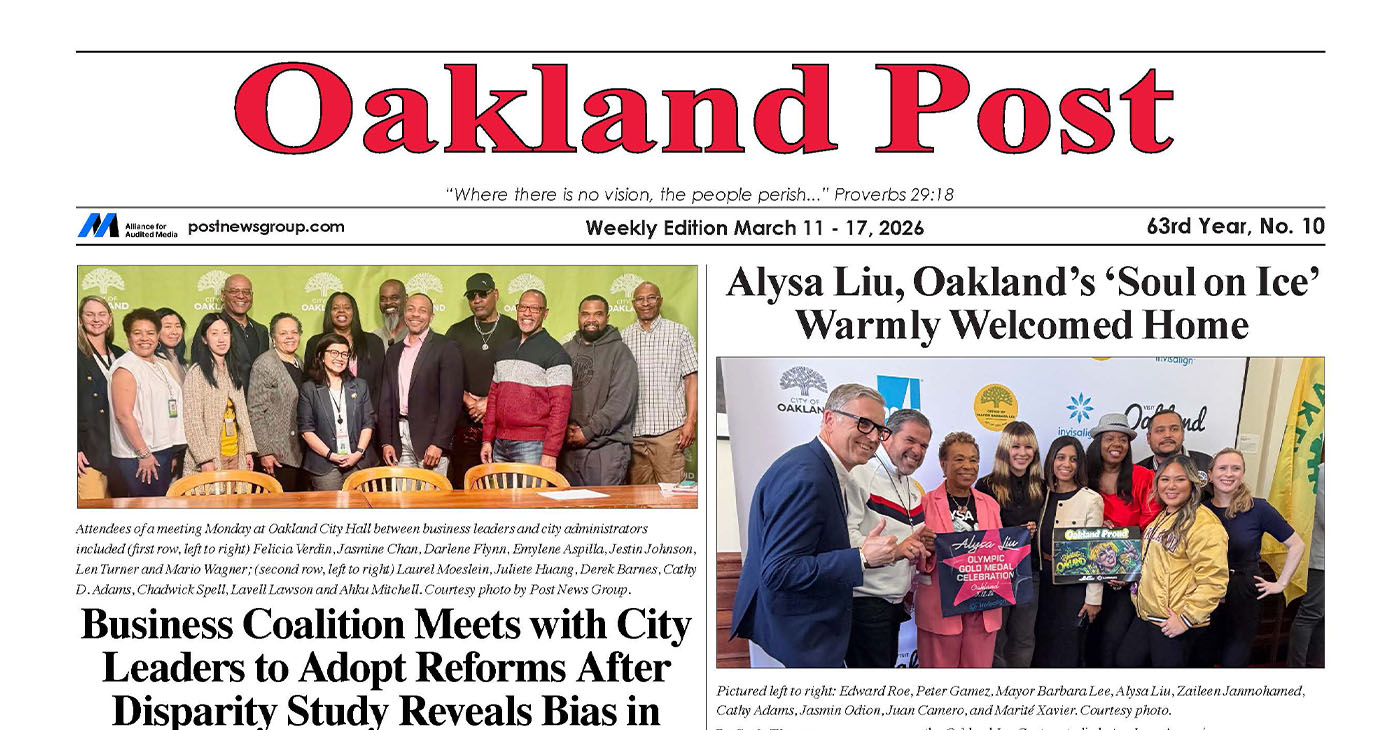
To enlarge your view of this issue, use the slider, magnifying glass icon or full page icon in the lower right corner of the browser window.
Activism
Oakland Post: Week of March 4 – 10, 2026
The printed Weekly Edition of the Oakland Post: Week of March 4 – 10, 2026

To enlarge your view of this issue, use the slider, magnifying glass icon or full page icon in the lower right corner of the browser window.

WORK FROM HOME
Home-based business with potential monthly income of $10K+ per month. A proven training system and website provided to maximize business effectiveness. Perfect job to earn side and primary income. Contact Lynne for more details: Lynne4npusa@gmail.com 800-334-0540


Black Artists in America, Installation Three Wraps at the Dixon Gallery and Gardens

Grief, Advocacy, and Education: A Counselor Reflects on Black Maternal Health

Future of Florida’s Black History Museum in Limbo

New Research Shows the Many Benefits of Early Learning

South Hampton K-8 Students Among Top 10 Finalists for Samsung’s ‘Solve for Tomorrow’ Competition

Cuba: No Negotiation with US on the President or Political System

Brooklyn Academy of Music Names Jamaican-Born Tamara McCaw as President

Trinidad & Tobego – U.S. Launches WhatsApp Channel for American Citizens in the Country

Oakland Post: Week of March 18 – 24, 2026

AI Innovation vs. Ethics and Environmental Impact

AI, Web3, and Digital Reparations

What If You Owned Your AI Agent?

Season 7, Episode 3 – January Reporter’s Roundtable 📱

Season 7, Episode 3 – January Reporter’s Roundtable

AI, Media, and Power | Part 2, Real-World Impacts and Tradeoffs

Discrimination in City Contracts

Oakland Post: Week of February 11 – 17, 2026

Reflecting on Black History Milestones in Birmingham AL

Rising Optimism Among Small And Middle Market Business Leaders Suggests Growth for California

CITY OF SAN LEANDRO STATE OF CALIFORNIA PUBLIC WORKS DEPARTMENT ENGINEERING DIVISION NOTICE TO BIDDERS FOR ANNUAL STREET OVERLAY/REHABILITATION 2019-21 – PHASE III

Oakland Post: Week of February 18 – 24, 2026

PRESS ROOM: NBA Hall of Fame Nominee Terry Cummings Joins 100 Black Men of DeKalb County to Launch Victory & Values Initiative

Oakland Post: Week of February 25 – March 3, 2026

U.S. manufacturing rebounds – how foundry services are adapting to rising demand

Trump’s MAGA Allies are Creating Executive Order Plan to Steal the 2026 Midterms

OP-ED: One Hundred Years of Black Workers Telling the Truth

Advancements in solar technology that are changing the way we power the world

Chase Oakland Community Center Hosts Alley-Oop Accelerator Building Community and Opportunity for Bay Area Entrepreneurs

PRESS ROOM: Civil Rights TV Launches in Selma as the World’s First 24/7 Civil Rights Television Network

Poll Shows Support for Policies That Help Families Afford Child Care

Hyundai Ioniq 5 Parking, Safety, and 360 View #shorts

2025 Ioniq 5 New Wiper & Powerful Performance! #shorts

Electric SUV Range: Is 259 Miles Enough? #shorts

EV Charging: How Fast Can You Charge an Electric Vehicle? #shorts

Biometric Cooling… Messaging Seats…Come on! 2025 Infiniti QX80 Autograph 4WD

Charged Up: Witness the Magic of a Fully Electric Car! #shorts

Range Rover Sport PHEV Included…: See What’s Inside This Luxury SUV! #shorts

Invisible Hood View: Perfect Parking with X-Ray Vision! #shorts

AI Is Reshaping Black Healthcare: Promise, Peril, and the Push for Improved Results in California

ESSAY: Technology and Medicine, a Primary Care Point of View

Sanctuary Cities

The RESISTANCE – FREEDOM NOW

STATE OF THE PEOPLE: Freddie

ECONOMIC BOYCOTT DAY!!!!!

I told You So

-
 #NNPA BlackPress4 weeks ago
Reflecting on Black History Milestones in Birmingham AL
-
 #NNPA BlackPress4 weeks ago
PRESS ROOM: NBA Hall of Fame Nominee Terry Cummings Joins 100 Black Men of DeKalb County to Launch Victory & Values Initiative
-
 Activism4 weeks ago
Oakland Post: Week of February 25 – March 3, 2026
-
 #NNPA BlackPress4 weeks ago
Trump’s MAGA Allies are Creating Executive Order Plan to Steal the 2026 Midterms
-
 #NNPA BlackPress4 weeks ago
OP-ED: One Hundred Years of Black Workers Telling the Truth
-
 #NNPA BlackPress4 weeks ago
Poll Shows Support for Policies That Help Families Afford Child Care
-

 Activism3 weeks ago
Oakland Post: Week of March 4 – 10, 2026
-

 #NNPA BlackPress3 weeks ago
Woman’s Search for Family’s Roots Leads to Ancestor John T. Ward – A Successful Entrepreneur and Conductor on the Underground Railroad
