
Activism
Third Opinion: How My Dad’s Terminal Diagnosis Taught Me the Importance of Self Advocacy
…there I was, sitting in the living room where I was raised, learning from my father that a CAT scan had revealed that the basilar artery that carried blood from his heart to his brain was completely blocked. The diagnosis was that he had mere weeks left to live. The timetable, he confided, seemed inaccurate. “I don’t feel like I’m dying,” he said, hefting my suitcase over his shoulder and walking it upstairs, an exertion that was absolutely against doctor’s orders.


By Keenan Norris, Special to California Black Media Partners
One moment, I was decompressing after my day at work in Oakland, the next I was being called home to Southern California to learn something too serious for telephone conversation. I remember playing the same song for the entire six-hour drive down south.
Then, there I was, sitting in the living room where I was raised, learning from my father that a CAT scan had revealed that the basilar artery that carried blood from his heart to his brain was completely blocked. The diagnosis was that he had mere weeks left to live. The timetable, he confided, seemed inaccurate. “I don’t feel like I’m dying,” he said, hefting my suitcase over his shoulder and walking it upstairs, an exertion that was absolutely against doctor’s orders.
The disconnect between my father’s lived experience and his diagnosis was just one rift that would arise between my family and the medical system. In the weeks that followed, he suffered a series of small strokes, obvious symptoms of occlusion. At the local hospitals we took him to, the staff all but told us he was a dead man.
Unwilling to accept this premature conclusion, my family took it upon ourselves to do what the medical establishment seemed unwilling to do. We fought for my father, pushing for referrals and further tests. And it was because of our family’s advocacy that the terminal diagnosis given to my father was not, in fact, the last word on his life.
Debra Law is a lecturer at The Valley Foundation School of Nursing at San Jose State. Formerly a medical-surgical nurse and adult kidney transplant coordinator at Stanford University Medical Center, Law, who is African American, explains that “Patient advocacy can come in many different forms, and it does not require medical knowledge, per se.”
“As a nurse, when we know that a patient has someone in the room that sends the message, ‘My loved one is important.’ If they put the call light on for their loved one, then they are the voice for their loved one,” she added.
Nurses, Law notes, can serve as a vitally important “last line of defense” for patients.
For my family, there was no such defense. Upon disclosing his condition to medical personnel, we were consistently told that the situation was hopeless. My mother, however, would not accept the resignation of the medical establishment and instead talked her way into a referral to a large public research and teaching hospital in the Los Angeles Area.
At that hospital, respected for its leading-edge research, we were informed that only four people on record had survived a complete occlusion of their basilar artery for any significant period. But there might be cause for hope: A subsequent CAT scan revealed that new blood vessels had emerged and were beginning to substitute for the blocked artery. We would have to monitor my father’s blood pressure all day and all night, the world-class neurologist told us, making sure it did not drop so low that blood flow to the brain would ebb irrecoverably, causing a deadly stroke. The home remedies to increase blood pressure suggested to us were primitive: Salt tablets, hot water, beer. If we could keep his blood pressure high enough for long enough, the new vessels might grow large enough to save his life.
We did our best, monitoring my father’s blood pressure 24/7, rejecting sleep and sanity. The constant care schedule exhausted us. The experience of those days and nights was so far beyond rationality, that it feels like another human body than my own lived through it. I am a writer, but I have no words for what we went through.
After days of that madness, somehow, he was still alive. The strokes began to dissipate.
We returned to the local hospital. The doctor who had originally diagnosed him with the death sentence ordered another CAT scan: The new blood vessels had long since grown strong enough to sustain my father’s brain, he determined.
Why hadn’t the world-class neurologist at the large research and teaching hospital seen what this local physician could see so clearly? Why had my father been dispatched to us in what amounted to a nightmarish outpatient procedure? It might be, the local physician told us, that his counterpart at the research hospital was more concerned with studying my father’s rare condition than with him as a patient. The obscene history of medical experimentation on Black people — from the Tuskegee syphilis experiment to the commandeering of Henrietta Lacks’s cells — was not as well known then as it is now.
The reality of poorer health outcomes for Black people across so many indices is proof of the persistence of racialized maltreatment in our healthcare system to this day.
We need to advocate for ourselves and our loved ones in the medical system. Law cites the Black Infant Health Program and the increase in doulas to address the disturbingly high rates both of Black infant and maternal mortality as examples of Black healthcare advocacy.
Hearing the doctor out, my dad just shrugged. Hadn’t we heard him when he said he didn’t feel like he was dying? He’d been advocating for himself all along.
We went home; my dad weeded the garden under the sweltering sun that afternoon and would go on to live for five more years. I let myself sleep, finally, for the first time in what felt like forever.
About the Author
Keenan Norris’s books include Chi Boy: Native Sons and Chicago Reckonings and The Confession of Copeland Cane. He had been the recipient of the Northern California Book Award and National Arts & Entertainment Journalism Award. He teaches at San Jose State University.
Third Opinion is a California Black Media (CBM) series of personal essays written by Black patients, advocates and medical providers in California that provide experience-based cues for health and wellbeing as well as insights into understanding and navigating the state’s health care delivery system. The articles produced are resources of CBM’s California Black Health Journalism Project.
This article is supported by the California Black Health Journalism Project, a program created by California Black Media, that addresses the top health challenges African Americans in California face. It relies on the input of community and practitioners; an awareness of historical factors, social contexts and root causes; and a strong focus on solutions as determined by policymakers, advocates and patients.








Activism
Oakland Post: Week of September 23 – 29, 2026
The printed Weekly Edition of the Oakland Post: Week of September 23 – 29, 2026

To enlarge your view of this issue, use the slider, magnifying glass icon or full page icon in the lower right corner of the browser window.
Activism
Oakland Post: Week of September 16 – 22, 2026
The printed Weekly Edition of the Oakland Post: Week of September 16 – 22, 2026

To enlarge your view of this issue, use the slider, magnifying glass icon or full page icon in the lower right corner of the browser window.
Activism
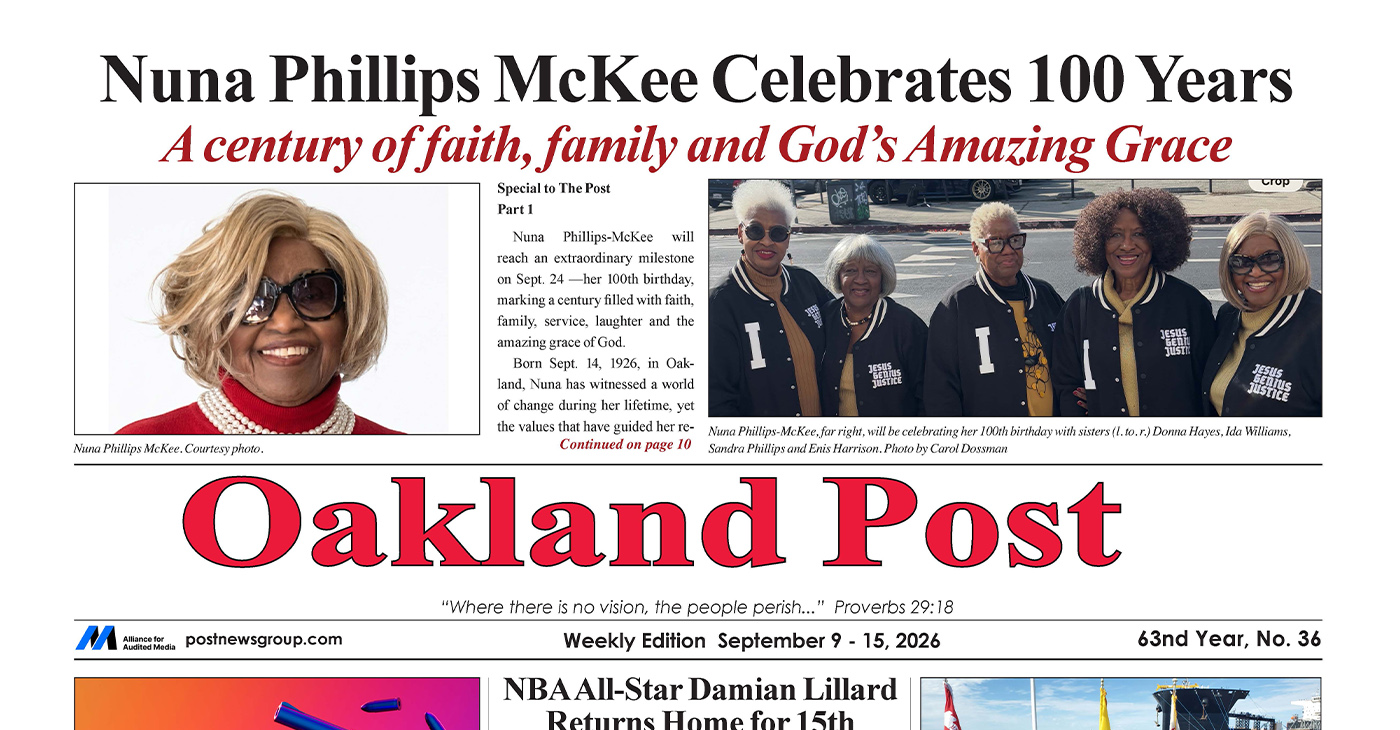
Oakland Post: Week of September 9 – 15, 2026
The printed Weekly Edition of the Oakland Post: Week of September 9 – 15, 2026
To enlarge your view of this issue, use the slider, magnifying glass icon or full page icon in the lower right corner of the browser window.



Asm. Corey Jackson Announces Launch of 24-Hour Childcare in His District

IN MEMORIAM: The Rev. Leon “Sonny” Clark, Longtime Orange County Pastor and Community Leader, Dies at 72

Poll: Becerra Widens His Lead Over Hilton; Californians Split on Wealth Tax

From Historic Memories to New Possibilities: Oakland Celebrates Coliseum 60

County Office of Education Says OUSD Finances Are Getting Healthier, Materially Stronger

LIVE FREE Sunday Dinner Brings Faith, Fellowship and Civic Conversation to Oakland

Remembering Chauncey Bailey as Student Journalists Face Threats to Truth-Telling

BLACspace Cooperative Invites Bay Area to Experience Oakland’s Black Cultural Ecosystem Through a BLAC Map Tour + Party

In Wake of Death on Doorstep, Williams Chapel Baptist Church Calls for Better Care, Funding for Unhoused

Oakland Centenarian Nuna McKee Honored!

Caribbean Nations Produce Action Plan Calling for UK Reparations Over Slavery

Oakland Post: Week of September 23 – 29, 2026

Doulas Are Helping Black California Moms Navigate Pregnancy–Even as High Mortality Rates Persist

Newsom Signs Addictive Social Media Law to Protect Kids

On Your November Ballot: Prop 38 Would Allocate $8.4 Billion to Immunology and Immunotherapy Funding

Standoff for Justice: Our Homes Are Worth Fighting For

Oakland Post: Week of August 26 – September 1, 2026

Frontier Airlines’ Return to Oakland Airport Brings Flights, Jobs and Opportunity

Gubernatorial Candidate Steve Hilton Blasts California New Tire Rules; Newsom Hits Back

Chef Sharon Lee Blends Culinary Excellence, Education and Empowerment

Jackie Wright Champions Bay Area Stories, Filmmakers and Cultural Institutions

Big City Mayors Ask for “Yes” Vote on Housing Bond Measure; Conservatives Say “No”

Oakland Coliseum Project Opens Door for Small Businesses to Build Bigger

Gov. Newsom’s Latest Appointees Include Sacramento Advocate for Formerly Incarcerated Students; State’s New Tech Chief

Misnamed ‘Parent’ PAC Seeks to Influence Oakland School Board Elections

Longtime BWOPA Member Brendalyn Goodall Appointed to California Workforce Development Board

Gov. Newsom Signs Law Shielding Immigration Aid Workers From Doxing Threats

Secretary of State Shirley N. Weber Urges Californians to Vote Early as Voter ID Battle Intensifies

From Palestine to Oakland: Seeds for Liberation Examines Shared Struggles for Freedom

IN MEMORIAM: Dolly Parton Dead at 80 — How She Built a Legacy of Love and Earned Her Place in Black Culture

The Conversation With Al McFarlane 6/23/26

Media Monday 6/22/26

LIVE! ASK ALMA! — TUES. 6.23.26 7PM EST

Car Buying Secrets: 4 Hidden Checks Before You Sign!

Is This 550 HP Charger Worth YOUR Money? AutoNetwork Review

Celebrating Juneteenth – Frederick Douglass on education and resistance

LIVE! — ASK ALMA! — TUES. 6.19.26 7PM EST

Hyundai Ioniq 5 Parking, Safety, and 360 View #shorts

2025 Ioniq 5 New Wiper & Powerful Performance! #shorts

Electric SUV Range: Is 259 Miles Enough? #shorts

EV Charging: How Fast Can You Charge an Electric Vehicle? #shorts

Biometric Cooling… Messaging Seats…Come on! 2025 Infiniti QX80 Autograph 4WD

Charged Up: Witness the Magic of a Fully Electric Car! #shorts

Range Rover Sport PHEV Included…: See What’s Inside This Luxury SUV! #shorts

Invisible Hood View: Perfect Parking with X-Ray Vision! #shorts
-
 Community2 weeks ago
Misnamed ‘Parent’ PAC Seeks to Influence Oakland School Board Elections
-

 Activism3 weeks ago
Oakland Post: Week of September 2 – 8, 2026
-

 Community2 weeks ago
Richmond Tiny House Village Farm & Garden Set to Open Gates on Sept. 26
-

 Black History2 weeks ago
Latest Massacre in Haiti Reveals Cruelty U.S. Deportations
-

 Activism2 weeks ago
Oakland Post: Week of September 9 – 15, 2026
-

 Black History2 weeks ago
OPINION: Nolan Wells’ Death One of Several Signifying Racial Terror Lives on in U.S. South
-

 Community2 weeks ago
Democratic Clubs Interview Candidates for Oakland School Board
-
 Featured2 weeks ago
‘Ready to See These Bills Become Law’: Sen. Weber’s Package of 15 Bills Advance to Gov. Newsom’s Desk
