
Activism
Statewide “Listening Sessions” Allow Reparations Task Force to hear Black Californians Stories
The community listening sessions are being conducted across the state by the Reparations Task Force’s seven “anchor organizations.” The seven, Afrikan Black Coalition, Black Equity Collective, Black Equity Initiative, California Black Power Network, Coalition for a Just and Equitable California, Othering and Belonging Institute (University of California Berkeley) and Repaired Nations began conducting community gatherings in March.

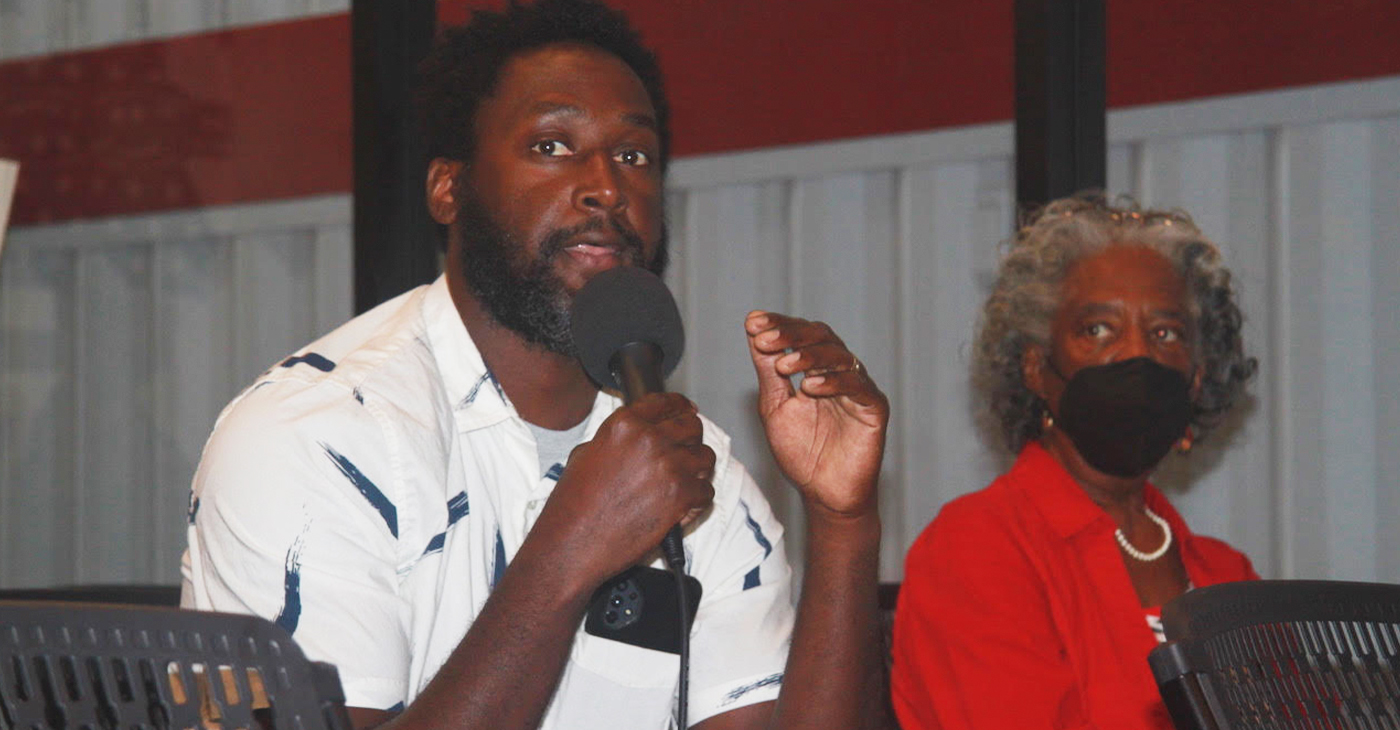
Antonio Ray Harvey | California Black Media
A series of community Listening Sessions are being held statewide to help the nine members of the California Task Force to Study and Develop Reparations Proposals for African Americans better understand how laws and policies that contribute to perpetuating the effects of slavery have negatively impacted Black Californians.
The most recent three gatherings authorized by the Task Force took place last month.
An online community session was conducted featuring panelists Friday Jones, Los Angeles Reparations Commission Vice Chair; Jan Williams, Downtown Crenshaw Board member; and University of California at Berkeley professor Dr. Jovan Scott Lewis.
“What (Reparations) must do is bring about this sense of recognition,” said Lewis, who is a member of the California Reparations Task Force.
“One of the things that the [Task Force] has accomplished so far over the past year is to bring about a sense of recognition for the Black American community in California and the country overall,” Lewis told the online audience.
The virtual webinar and Community Listening session was hosted by the Coalition for a Just and Equitable California (CJEC), the American Redress Coalition of California (ARCC), and Community Health Councils (CHC).
CJEC is a state-wide coalition of organizations, associations, and community members that support reparations for Black Californians who are descendants of enslaved Black American men and women. CHC is a Los Angeles-based nonprofit committed to practices advancing justice, equity, diversity, and inclusion to achieve sustainable policy and systemic change.
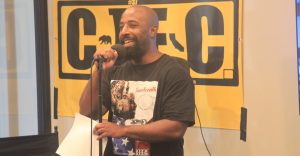
A sanctioned in-person community listening session was held in the city of Vallejo. It was hosted by CJEC with the support of the state’s Department of Justice (DOJ) and the Black Women Organized for Political Action (BWOPA).
The event was held at Black-owned LaDells Shoes in downtown Vallejo. Personal testimony of adversity and success rooted in the Black experience in and around Vallejo were shared during this session. Struggles with employment, decent housing, racism in public schools, homelessness, police brutality, and the challenges of maintaining a business were covered.
“In May we had our first community conversation about reparations [in Oakland, Calif.] and it was an overall history of reparations in the United States,” said Dr. Kerby Lynch, who recently received a doctorate in geography from the University of California Berkeley. “This session is about what reparations look like for Vallejo. We are here to listen to one another’s stories and record these testimonies.”
Vallejo is one of the cities in the state with a modest population of Black people who are fighting for recognition during the reparations proceeding. It does have an abundance of Black history to be shared.
Home of the former Mare Island Naval Shipyard, Vallejo is 32 miles north of San Francisco. The 2020 United States Census says the East Bay Area city had a population of 22,416 Black people (18.48%) out of a total of 121,275. Statewide Blacks are 5.4% of the population.
The third listening session hosted by CJEC was held in Sacramento. Task Force member and Bay Area attorney Don T. Tamaki participated virtually in the session that was held in Sacramento’s Oak Park neighborhood.
At the Sacramento listening session, the community testified about how to build small businesses, Black people’s “Great Migration” from the deep south to the west coast, how the Freedman’s Bureau model can be used to determine reparations, and Black pioneer’s presence during the Gold Rush.
The community listening sessions are being conducted across the state by the Reparations Task Force’s seven “anchor organizations.”
The seven, Afrikan Black Coalition, Black Equity Collective, Black Equity Initiative, California Black Power Network, Coalition for a Just and Equitable California, Othering and Belonging Institute (University of California Berkeley) and Repaired Nations began conducting community gatherings in March.
The listening sessions are designed to ensure certain communities around the state have the opportunity to provide their thoughts and concerns about the work the task force is doing.
On June 1, 2022, the Task Force issued a 483-page interim report to the California legislature. The report surveys the ongoing and compounding harms experienced by African Americans as a result of slavery and its lingering effects on American society today.
“It’s a sweeping indictment,” Tamaki said of the report during the Sacramento community listening session. “It connects the harms of the past and follows the consequences that we face today. There have to be legislative remedies.”
The interim report also includes a set of preliminary recommendations for policies that the California Legislature could adopt to remedy those harms. A final report will be issued before July 1, 2023.
The Task Force in-person meetings will reconvene in Los Angeles at the Paradise Baptist Church on Friday, Sept. 23, at 9:00 a.m. and Saturday, Sept. 24, 2022, at 9:00 a.m. The church is located at 5100 S. Broadway.
For updates and additional information visit Reparations Task Force Meetings.











Activism
Oakland Post: Week of September 23 – 29, 2026
The printed Weekly Edition of the Oakland Post: Week of September 23 – 29, 2026

To enlarge your view of this issue, use the slider, magnifying glass icon or full page icon in the lower right corner of the browser window.
Activism
Oakland Post: Week of September 16 – 22, 2026
The printed Weekly Edition of the Oakland Post: Week of September 16 – 22, 2026

To enlarge your view of this issue, use the slider, magnifying glass icon or full page icon in the lower right corner of the browser window.
Activism
Oakland Post: Week of September 9 – 15, 2026
The printed Weekly Edition of the Oakland Post: Week of September 9 – 15, 2026

To enlarge your view of this issue, use the slider, magnifying glass icon or full page icon in the lower right corner of the browser window.



From Historic Memories to New Possibilities: Oakland Celebrates Coliseum 60

County Office of Education Says OUSD Finances Are Getting Healthier, Materially Stronger

LIVE FREE Sunday Dinner Brings Faith, Fellowship and Civic Conversation to Oakland

Remembering Chauncey Bailey as Student Journalists Face Threats to Truth-Telling

BLACspace Cooperative Invites Bay Area to Experience Oakland’s Black Cultural Ecosystem Through a BLAC Map Tour + Party

In Wake of Death on Doorstep, Williams Chapel Baptist Church Calls for Better Care, Funding for Unhoused

Oakland Centenarian Nuna McKee Honored!

Caribbean Nations Produce Action Plan Calling for UK Reparations Over Slavery

Oakland Post: Week of September 23 – 29, 2026

Doulas Are Helping Black California Moms Navigate Pregnancy–Even as High Mortality Rates Persist

Newsom Signs Addictive Social Media Law to Protect Kids

On Your November Ballot: Prop 38 Would Allocate $8.4 Billion to Immunology and Immunotherapy Funding

Ask California: Golden State Releases New AI Chatbot

Asm. Isaac Bryan’s Bill Banning California Police From ICE Side Jobs Reaches Newsom’s Desk

Assemblymember LaShae Sharp-Collins’s Bill Would Pause Law Enforcement’s Use of Shock Gloves Pending Study

Less Affluent School Districts, Including Sacramento City, Face Threat of State Takeover

ESSAY: California Can Close Its Colorectal Cancer Gap

California Hispanic Chambers of Commerce Unveils: ‘Powering the Future’ Theme for 47th Annual Statewide Convention

Four Candidates, Including Incumbent Barbara Lee, Qualify for Oakland Mayor’s Race

Oakland Post: Week of August 12 – 18, 2026

From Blueprint to Breakthrough: Tackling Affordable Housing in Oakland

Oakland Observes Black August with Block Parties, Film Showings, Workshops

COMMENTARY: Why Local School Tax Measure G1 Will Not Be on the November Ballot

Standoff for Justice: Our Homes Are Worth Fighting For

Returning to Its Roots, the Oakland Black-Eyed Pea Festival Partners with the Freedom Farmers Market Sept. 12

Oakland Post: Week of August 26 – September 1, 2026

NPRC Scores First Advocacy Victory: David Shaw Finally Gets His Wish to ‘Go Home’

Frontier Airlines’ Return to Oakland Airport Brings Flights, Jobs and Opportunity

Gubernatorial Candidate Steve Hilton Blasts California New Tire Rules; Newsom Hits Back

Chef Sharon Lee Blends Culinary Excellence, Education and Empowerment

The Conversation With Al McFarlane 6/23/26

Media Monday 6/22/26

LIVE! ASK ALMA! — TUES. 6.23.26 7PM EST

Car Buying Secrets: 4 Hidden Checks Before You Sign!

Is This 550 HP Charger Worth YOUR Money? AutoNetwork Review

Celebrating Juneteenth – Frederick Douglass on education and resistance

LIVE! — ASK ALMA! — TUES. 6.19.26 7PM EST

Hyundai Ioniq 5 Parking, Safety, and 360 View #shorts

2025 Ioniq 5 New Wiper & Powerful Performance! #shorts

Electric SUV Range: Is 259 Miles Enough? #shorts

EV Charging: How Fast Can You Charge an Electric Vehicle? #shorts

Biometric Cooling… Messaging Seats…Come on! 2025 Infiniti QX80 Autograph 4WD

Charged Up: Witness the Magic of a Fully Electric Car! #shorts

Range Rover Sport PHEV Included…: See What’s Inside This Luxury SUV! #shorts

Invisible Hood View: Perfect Parking with X-Ray Vision! #shorts
-
 Commentary4 weeks ago
Standoff for Justice: Our Homes Are Worth Fighting For
-
 Activism4 weeks ago
Oakland Post: Week of August 26 – September 1, 2026
-
 Business4 weeks ago
Frontier Airlines’ Return to Oakland Airport Brings Flights, Jobs and Opportunity
-
 Business4 weeks ago
Gubernatorial Candidate Steve Hilton Blasts California New Tire Rules; Newsom Hits Back
-
 Business4 weeks ago
Chef Sharon Lee Blends Culinary Excellence, Education and Empowerment
-

 Community4 weeks ago
Big City Mayors Ask for “Yes” Vote on Housing Bond Measure; Conservatives Say “No”
-
 Black History4 weeks ago
Jackie Wright Champions Bay Area Stories, Filmmakers and Cultural Institutions
-

 Education4 weeks ago
Gov. Newsom’s Latest Appointees Include Sacramento Advocate for Formerly Incarcerated Students; State’s New Tech Chief
