
Politics
Some Examples of Confederate Tributes Around the South


The Mississippi flag hangs, with the other state flags, in the subway between the U.S. Capitol and Dirksen Senate Office Building in Washington, Tuesday, June 23, 2015. In the wake of a massacre at a black church in Charleston, S.C., a bipartisan mix of officials across the country is calling for the removal of Confederate flags and other symbols of the Confederacy. (AP Photo/Cliff Owen)
The Associated Press
ATLANTA (AP) — Tributes to the Confederacy and the Jim Crow era that have existed still abound in the Deep South and beyond more than a century after the end of the Civil War.

Here are some of the most high-profile displays, including several that are being criticized anew following the fatal shooting of nine parishioners at a historic black church in Charleston, South Carolina:
— ALABAMA: An 88 -foot-tall Confederate memorial sits at the Capitol entrance nearest the governor’s office. It features four different Confederate banners, including the battle flag. Jefferson Davis, the lone president of the Confederacy, is said to have laid the cornerstone at a ceremony in 1886. Two nearby public high schools, now with nearly all-black student bodies, are named for Davis and Robert E. Lee, commander of the Confederate forces.
— ARKANSAS: There are two Confederate monuments on the Capitol grounds, one honoring Confederate women, the other soldiers.
— FLORIDA: No confederate flag flies at the Florida Capitol, but the state flag, whose main design was adopted in 1900, features a St. Andrew’s Cross — an ‘X’ emblazoned across the banner. The imagery is similar to the Battle Flag, though it also reflects a flag of the Spanish empire when it ruled Florida from the early 16th century until 1763. Several county courthouses and local public squares or parks feature Confederate veterans monuments.
— GEORGIA: The Capitol and surrounding grounds feature multiple statues, busts and portraits of Confederate war heroes and segregationist politicians. In the Capitol rotunda is a portrait of Alexander H. Stephens, vice president of the Confederacy. A bust of Stephens sits just outside the rotunda. The Georgia state flag, a compromise version that replaced a design with the battle flag, is modeled after the “Stars and Bars,” the first national flag of the Confederacy. Twenty miles from the Capitol is Stone Mountain, which features a massive carving of Jefferson Davis, Stonewall Jackson and Robert E. Lee, all on horseback.
— KENTUCKY: Jefferson Davis is among the statues included in the Capitol rotunda. The Davis statue is situated behind the Abraham Lincoln statute that sits in the rotunda’s center, so that the president of the Confederacy appears to be looking over the shoulder of the 16th U.S. president who governed during the Civil War.
— LOUISIANA: A statue of Robert E. Lee sits at the center of Lee Circle, a major traffic circle connecting downtown New Orleans to the Garden District neighborhood. Another city thoroughfare is named for Jefferson Davis and includes a statue of the Confederate president.
— MISSISSIPPI: The state flag is the last U.S. state banner to include an explicit image of the Confederate battle flag. At one Capitol entrance sits a monument to the women of the Confederacy. The University of Mississippi’s athletics teams are knowns as the “Ole Miss Rebels,” and the school’s band often plays “Dixie” at sporting events.
— NORTH CAROLINA: An obelisk memorial to the state’s Confederate war dead and a monument to the “North Carolina Women of the Confederacy” are located on the old Capitol grounds in Raleigh. The Capitol square also includes statues of Civil War-era Gov. Zebulon Vance and Gov. Charles Aycock, known partly for his anti-black rhetoric at the end of the 19th century.
— SOUTH CAROLINA: The Confederate battle flag flies at the base of a Confederate monument in front of the Capitol. It flies between a Confederate monument and a statue of Benjamin Tillman, a noted white supremacist who spent three decades — from 1890 to 1918 — as governor and U.S. senator. Behind the Capitol is a statue of Strom Thurmond, a long-serving U.S. senator who ran for president in 1948 as a “Dixiecrat” to protest the national Democratic Party’s softening stance on segregation.
— TENNESSEE: A bust of Nathan Bedford Forrest, an early Grand Wizard of the Ku Klux Klan, is inside the Capitol.
— VIRGINIA: Arlington National Cemetery, formerly the plantation of Robert E. Lee, includes a Confederate section with almost 500 graves surrounding a memorial. Future President William Howard Taft authorized the memorial in 1906, when he served as secretary of war for President Theodore Roosevelt.
___
Compiled by Bill Barrow in Atlanta; Kim Chandler in Montgomery, Alabama; Andrew DeMillo in Little Rock, Arkansas; Emily Wagster Pettus in Jackson, Mississippi; and Gary Robertson in Raleigh, North Carolina.
Copyright 2015 The Associated Press. All rights reserved. This material may not be published, broadcast, rewritten or redistributed.









Business
OP-ED: Proposition 44 Would Put a Price on Trust
The danger in Proposition 44 is not only its 90 percent figure. It is that the meaning of “qualifying” spending will be worked out later. A clinic preparing a budget today may not know whether a navigator, health educator, transportation program, outreach worker, technology upgrade, or other patient-support service will be counted the way it expects. Yet the financial consequence of getting it wrong could be immediate.





Business
OP-ED: Proposition 40: It’s Time to Play Chess, Not Checkers
Proposition 40 would impose a one-time 5 percent tax on the wealth of Californians with more than $1 billion in assets. Most of that money would go toward health care, with the remainder supporting food assistance and education-related programs.

Activism
Oakland Post: Week of September 30 – October 6, 2026
The printed Weekly Edition of the Oakland Post: Week of September 30 – October 6, 2026
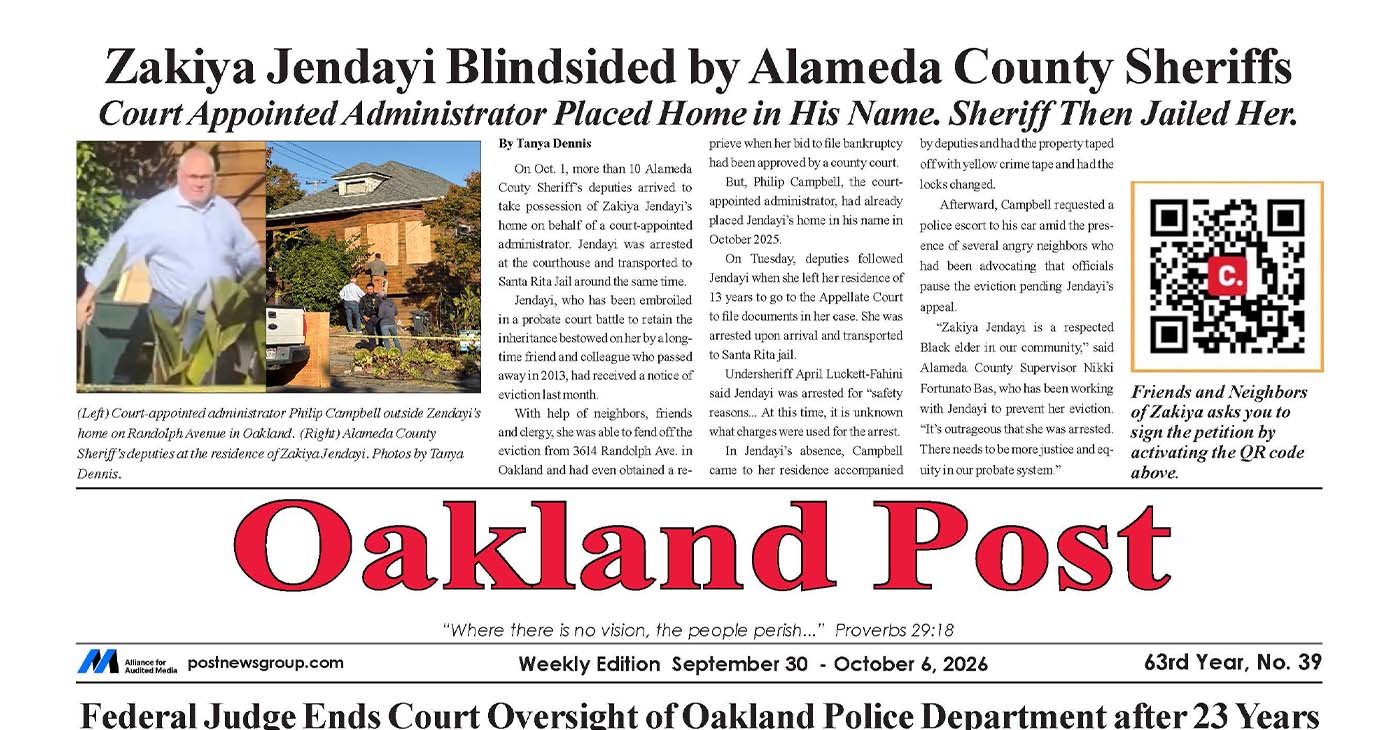
To enlarge your view of this issue, use the slider, magnifying glass icon or full page icon in the lower right corner of the browser window.


OP-ED: Proposition 44 Would Put a Price on Trust

OP-ED: Proposition 40: It’s Time to Play Chess, Not Checkers

Listening as a Lifeline: A Doula’s Witness to Black Maternal Health

New Protections for Ticket Buyers: Gov. Newsom Signs Assemblymember Isaac Bryan’s Bill

‘We Don’t Talk Trash — We Pick Up Trash!’

Zakiya Jendayi Arrested, Locked Out of Home by Sheriff’s Deputies

Oakland Post: Week of September 30 – October 6, 2026

Asm. Corey Jackson Announces Launch of 24-Hour Childcare in His District

IN MEMORIAM: The Rev. Leon “Sonny” Clark, Longtime Orange County Pastor and Community Leader, Dies at 72

Poll: Becerra Widens His Lead Over Hilton; Californians Split on Wealth Tax

From Historic Memories to New Possibilities: Oakland Celebrates Coliseum 60

County Office of Education Says OUSD Finances Are Getting Healthier, Materially Stronger

LIVE FREE Sunday Dinner Brings Faith, Fellowship and Civic Conversation to Oakland

Remembering Chauncey Bailey as Student Journalists Face Threats to Truth-Telling

BLACspace Cooperative Invites Bay Area to Experience Oakland’s Black Cultural Ecosystem Through a BLAC Map Tour + Party

Standoff for Justice: Our Homes Are Worth Fighting For

Oakland Post: Week of August 26 – September 1, 2026

Frontier Airlines’ Return to Oakland Airport Brings Flights, Jobs and Opportunity

Gubernatorial Candidate Steve Hilton Blasts California New Tire Rules; Newsom Hits Back

Chef Sharon Lee Blends Culinary Excellence, Education and Empowerment

Jackie Wright Champions Bay Area Stories, Filmmakers and Cultural Institutions

Misnamed ‘Parent’ PAC Seeks to Influence Oakland School Board Elections

Oakland Coliseum Project Opens Door for Small Businesses to Build Bigger

Big City Mayors Ask for “Yes” Vote on Housing Bond Measure; Conservatives Say “No”

Gov. Newsom’s Latest Appointees Include Sacramento Advocate for Formerly Incarcerated Students; State’s New Tech Chief

Longtime BWOPA Member Brendalyn Goodall Appointed to California Workforce Development Board

Gov. Newsom Signs Law Shielding Immigration Aid Workers From Doxing Threats

Secretary of State Shirley N. Weber Urges Californians to Vote Early as Voter ID Battle Intensifies

Oakland Post: Week of September 2 – 8, 2026

IN MEMORIAM: Dolly Parton Dead at 80 — How She Built a Legacy of Love and Earned Her Place in Black Culture

The Conversation With Al McFarlane 6/23/26

Media Monday 6/22/26

LIVE! ASK ALMA! — TUES. 6.23.26 7PM EST

Car Buying Secrets: 4 Hidden Checks Before You Sign!

Is This 550 HP Charger Worth YOUR Money? AutoNetwork Review

Celebrating Juneteenth – Frederick Douglass on education and resistance

LIVE! — ASK ALMA! — TUES. 6.19.26 7PM EST

Hyundai Ioniq 5 Parking, Safety, and 360 View #shorts

2025 Ioniq 5 New Wiper & Powerful Performance! #shorts

Electric SUV Range: Is 259 Miles Enough? #shorts

EV Charging: How Fast Can You Charge an Electric Vehicle? #shorts

Biometric Cooling… Messaging Seats…Come on! 2025 Infiniti QX80 Autograph 4WD

Charged Up: Witness the Magic of a Fully Electric Car! #shorts

Range Rover Sport PHEV Included…: See What’s Inside This Luxury SUV! #shorts

Invisible Hood View: Perfect Parking with X-Ray Vision! #shorts
-
 Community3 weeks ago
Misnamed ‘Parent’ PAC Seeks to Influence Oakland School Board Elections
-
 Activism4 weeks ago
Oakland Post: Week of September 2 – 8, 2026
-

 Activism3 weeks ago
Oakland Post: Week of September 9 – 15, 2026
-

 Community3 weeks ago
Richmond Tiny House Village Farm & Garden Set to Open Gates on Sept. 26
-

 Black History3 weeks ago
Latest Massacre in Haiti Reveals Cruelty U.S. Deportations
-

 Black History3 weeks ago
OPINION: Nolan Wells’ Death One of Several Signifying Racial Terror Lives on in U.S. South
-

 Business2 weeks ago
Mayor Lee Announces $1 Million Kaiser Permanente Grant for Pilot Program to Address Homelessness, Clean Up Public Spaces throughout Oakland
-

 Community3 weeks ago
Democratic Clubs Interview Candidates for Oakland School Board
