
City Government
Schaaf: “We will not have coal shipped through our city.”

In a sharp email exchange, Oakland Mayor Libby Schaaf has blasted local developer Phil Tagami for moving ahead with a deal to export coal out of the former Oakland Army Base.
The digital dispute was documented in emails that the Sierra Club obtained through a Public Records Act request.
In 2013, Tagami had said use of the Army Base to bring coal to Oakland by rail and ship it abroad was the farthest thing from his mind. He said that his company, California Capital and Investment Group (CCIG), had “no interest or involvement in the pursuit of coal-related operations at the former Oakland Army Base.”
But that was then.

Mayor Libby Schaaf.
Schaaf wrote in an email to Tagami, dated May 11, that she was “extremely disappointed to once again hear” mention of the “possibility of shipping coal into Oakland” during a community breakfast.
“Stop it immediately,” Schaaf wrote. “You have been awarded the privilege and opportunity of a lifetime to develop this unique piece of land. You must respect the owner and public’s decree that we will not have coal shipped through our city.”
In response to the mayor’s email, Tagami explained that by entering into a binding contract with Terminal and Logistics Solutions (TLS), he and the city had agreed to “a complete transfer of our rights and obligations with respect to the terminal operations under the ground lease.”
Additionally, he states the scope of the binding deal “is not driven or defined by any single commodity, product, or good in transit,” claiming that the city cannot legally restrict what products flow through the rail terminal development.
What is essential to the new facility’s financial and legal viability, said Tagami, is “the ability to accommodate the full universe of bulk goods,” which includes coal.
Tagami claims that the binding legal contract signed by the city gives it no control over what commodities can be shipped. But according to a number of community members, under the contract’s “Regulation for Health and Safety” clause, the city can apply regulations for health-related reasons.
The clause states that the city has the right to apply regulations at any time after the agreement’s adoption if failure to do so “would place existing or future occupants or users of the project, adjacent neighbors, or any portion thereof, or all of them, in a condition substantially dangerous to their health or safety.”
According to Brian Beveridge, co-director of the West Oakland Environment Indicators Project (WOEIP) and West Oakland resident, there is ample evidence that shipping coal through Oakland would be detrimental to residents’ health.
“Coal dust is related to diesel pollution and the burning of fossil fuels,” said Beveridge. “It contains carcinogens and is likely the cause of black lung disease and asthma.”
“The whole community’s health is at stake. Our advances in cleaning air in West Oakland are at stake. The city’s pride in calling itself a green city is at stake.”
Community observers have also criticized the city’s lack of transparency in negotiations with developers of city land. The examples, they say, include the Oakland Army Base and sale of the parcel at Lake Merritt and East 12th Street.
“It’s completely in line with all these other development deals happening behind closed doors where the public is being cut out of the conversation,” said Jess Dervin-Ackerman of the Sierra Club’s San Francisco Bay Area chapter.
“All these proposals are on city-owned land and should be used for community benefits. What City Council is doing is just letting developers have at it.”
“We’re ready to back Mayor Schaaf if she’s ready to stand up and say ‘no’ to coal,” said Beveridge. “Oakland is unanimously opposed to shipping coal into or out of our city.”












Activism
Oakland Post: Week of September 23 – 29, 2026
The printed Weekly Edition of the Oakland Post: Week of September 23 – 29, 2026

To enlarge your view of this issue, use the slider, magnifying glass icon or full page icon in the lower right corner of the browser window.
Activism
Oakland Post: Week of September 16 – 22, 2026
The printed Weekly Edition of the Oakland Post: Week of September 16 – 22, 2026
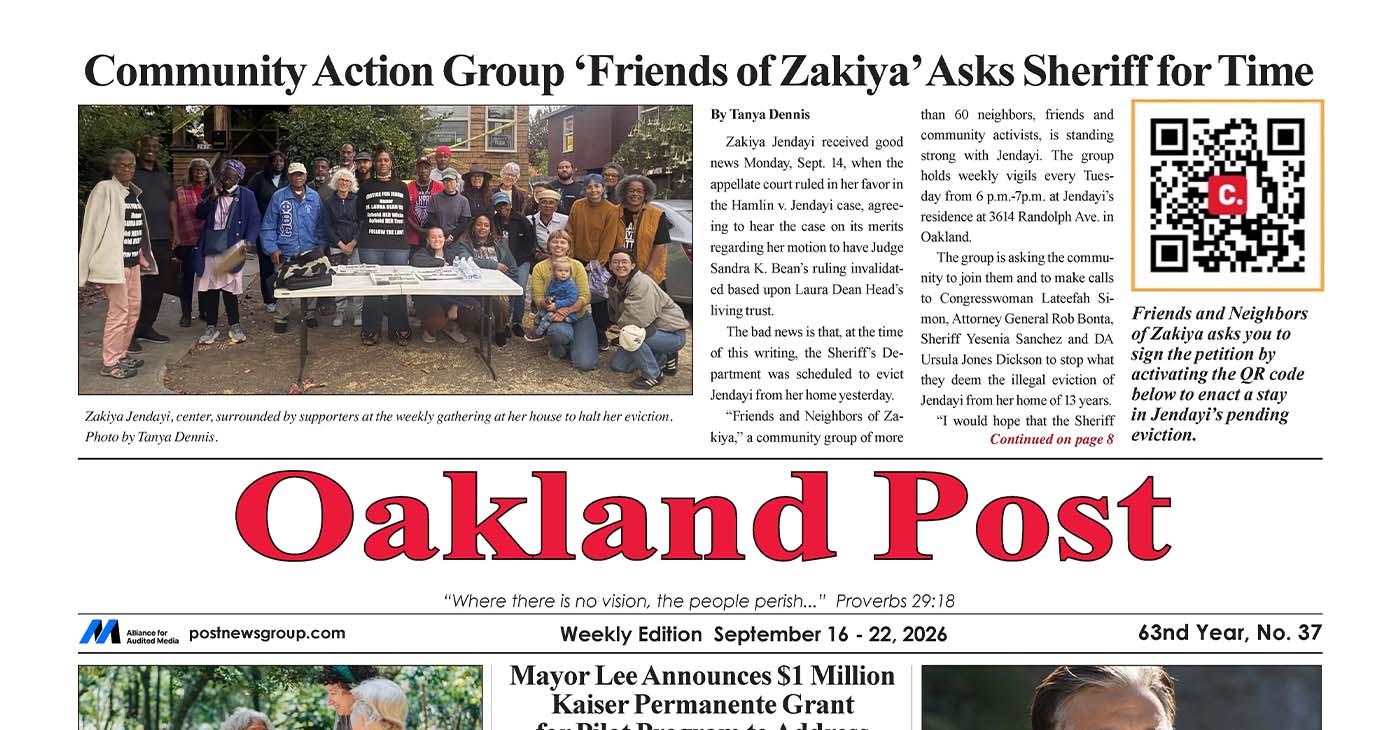
To enlarge your view of this issue, use the slider, magnifying glass icon or full page icon in the lower right corner of the browser window.
Activism
Oakland Post: Week of September 9 – 15, 2026
The printed Weekly Edition of the Oakland Post: Week of September 9 – 15, 2026

To enlarge your view of this issue, use the slider, magnifying glass icon or full page icon in the lower right corner of the browser window.


IN MEMORIAM: The Rev. Leon “Sonny” Clark, Longtime Orange County Pastor and Community Leader, Dies at 72

Poll: Becerra Widens His Lead Over Hilton; Californians Split on Wealth Tax

From Historic Memories to New Possibilities: Oakland Celebrates Coliseum 60

County Office of Education Says OUSD Finances Are Getting Healthier, Materially Stronger

LIVE FREE Sunday Dinner Brings Faith, Fellowship and Civic Conversation to Oakland

Remembering Chauncey Bailey as Student Journalists Face Threats to Truth-Telling

BLACspace Cooperative Invites Bay Area to Experience Oakland’s Black Cultural Ecosystem Through a BLAC Map Tour + Party

In Wake of Death on Doorstep, Williams Chapel Baptist Church Calls for Better Care, Funding for Unhoused

Oakland Centenarian Nuna McKee Honored!

Caribbean Nations Produce Action Plan Calling for UK Reparations Over Slavery

Oakland Post: Week of September 23 – 29, 2026

Doulas Are Helping Black California Moms Navigate Pregnancy–Even as High Mortality Rates Persist

Newsom Signs Addictive Social Media Law to Protect Kids

On Your November Ballot: Prop 38 Would Allocate $8.4 Billion to Immunology and Immunotherapy Funding

Ask California: Golden State Releases New AI Chatbot

Less Affluent School Districts, Including Sacramento City, Face Threat of State Takeover

ESSAY: California Can Close Its Colorectal Cancer Gap

California Hispanic Chambers of Commerce Unveils: ‘Powering the Future’ Theme for 47th Annual Statewide Convention

Four Candidates, Including Incumbent Barbara Lee, Qualify for Oakland Mayor’s Race

Oakland Post: Week of August 12 – 18, 2026

From Blueprint to Breakthrough: Tackling Affordable Housing in Oakland

Oakland Observes Black August with Block Parties, Film Showings, Workshops

COMMENTARY: Why Local School Tax Measure G1 Will Not Be on the November Ballot

Standoff for Justice: Our Homes Are Worth Fighting For

Returning to Its Roots, the Oakland Black-Eyed Pea Festival Partners with the Freedom Farmers Market Sept. 12

Oakland Post: Week of August 26 – September 1, 2026

NPRC Scores First Advocacy Victory: David Shaw Finally Gets His Wish to ‘Go Home’

Frontier Airlines’ Return to Oakland Airport Brings Flights, Jobs and Opportunity

Gubernatorial Candidate Steve Hilton Blasts California New Tire Rules; Newsom Hits Back

Chef Sharon Lee Blends Culinary Excellence, Education and Empowerment

The Conversation With Al McFarlane 6/23/26

Media Monday 6/22/26

LIVE! ASK ALMA! — TUES. 6.23.26 7PM EST

Car Buying Secrets: 4 Hidden Checks Before You Sign!

Is This 550 HP Charger Worth YOUR Money? AutoNetwork Review

Celebrating Juneteenth – Frederick Douglass on education and resistance

LIVE! — ASK ALMA! — TUES. 6.19.26 7PM EST

Hyundai Ioniq 5 Parking, Safety, and 360 View #shorts

2025 Ioniq 5 New Wiper & Powerful Performance! #shorts

Electric SUV Range: Is 259 Miles Enough? #shorts

EV Charging: How Fast Can You Charge an Electric Vehicle? #shorts

Biometric Cooling… Messaging Seats…Come on! 2025 Infiniti QX80 Autograph 4WD

Charged Up: Witness the Magic of a Fully Electric Car! #shorts

Range Rover Sport PHEV Included…: See What’s Inside This Luxury SUV! #shorts

Invisible Hood View: Perfect Parking with X-Ray Vision! #shorts
-
 Commentary4 weeks ago
Standoff for Justice: Our Homes Are Worth Fighting For
-
 Activism4 weeks ago
Oakland Post: Week of August 26 – September 1, 2026
-
 Business4 weeks ago
Frontier Airlines’ Return to Oakland Airport Brings Flights, Jobs and Opportunity
-
 Business4 weeks ago
Gubernatorial Candidate Steve Hilton Blasts California New Tire Rules; Newsom Hits Back
-
 Business4 weeks ago
Chef Sharon Lee Blends Culinary Excellence, Education and Empowerment
-

 Community4 weeks ago
Big City Mayors Ask for “Yes” Vote on Housing Bond Measure; Conservatives Say “No”
-

 Black History4 weeks ago
Jackie Wright Champions Bay Area Stories, Filmmakers and Cultural Institutions
-

 Education4 weeks ago
Gov. Newsom’s Latest Appointees Include Sacramento Advocate for Formerly Incarcerated Students; State’s New Tech Chief
