
Activism
S.F. Mayor Advances Historic Homelessness Recovery Plan with 4 New Innovative Projects
“These four innovative new and exciting projects demonstrate and help fulfill the vision of Mayor Breed’s Homelessness Recovery Plan,” said San Francisco Department of Homelessness and Supportive Housing, executive director, Shireen McSpadden. “We know that housing is the solution to homelessness. By continuing to expand access to housing, and new shelter models we can stabilize more homeless residents in our community.”


New projects will add shelter for up to 430 people and nearly 200 units of permanent supportive housing
By S.F. Mayor’s Office of Communications
Mayor London N. Breed announced on December 10 the City is moving forward with four new projects that will provide shelter for up to 430 individuals and permanent housing for 194 residents who are currently experiencing homelessness.
As part of Breed’s bold Homelessness Recovery Plan, the City has committed to acquiring or leasing 1,500 new units of Permanent Supportive Housing (PSH) and expanding shelter options for people living outdoors. There is an unprecedented confluence of local, state, and federal funding sources that provide the unique opportunity for significant investments in new permanent housing and shelter options.
This strategy brought in over 360 units of supportive housing through the 2020 Homekey Grant Program, and this fall, the Board of Supervisors authorized the Department of Homelessness and Supportive Housing (HSH) to acquire and convert three more existing properties into supportive housing in Districts 11, 9, and 6, which will add an additional 237 units.
To continue to build toward these goals, the City is announcing the following proposed four new projects:
- In partnership with the non-profit provider Urban Alchemy, master lease the property located at 711 Post St. to operate a new semi-congregate shelter for adults
- In partnership with Tenderloin Housing Clinic, fund a master lease and operations of the Garland Hotel located at 505 O’Farrell St. to add 80 units of affordable housing with onsite social services
- Convert the Baldwin Hotel, located at 74 6th St., from its current use as supportive housing to approximately 180 units of non-congregate shelter for adults
- Proposed acquisition of the property located at 835 Turk St. to add up to 114 units of Permanent Supportive Housing in District 5
“We’re continuing to push forward in implementing our ambitious Homelessness Recovery Plan, which is the largest expansion of new Permanent Supportive Housing in over 20 years. These new projects will allow us to provide shelter for up to 430 individuals and permanent housing for 194 residents who are homeless in San Francisco,” said Breed. “We’re creating the places we need for people to get the housing and care they need so we can address the challenges we see on our streets and make a difference in the lives of people facing homelessness.”

“These four innovative new and exciting projects demonstrate and help fulfill the vision of Mayor Breed’s Homelessness Recovery Plan,” said San Francisco Department of Homelessness and Supportive Housing, executive director, Shireen McSpadden. “We know that housing is the solution to homelessness. By continuing to expand access to housing, and new shelter models we can stabilize more homeless residents in our community.”
The proposed master lease of 711 Post Street would provide temporary, semi-congregate shelter for adults experiencing homelessness through 123 units that include single, double, and quad units. The property is ideal for this new shelter model as it provides many amenities, including small sleeping rooms, bathrooms and showers on each floor, community lounges, lobby and front desk, commercial kitchen and dining space, and ADA chair lift at the entrance.
The semi-congregate shelter program that HSH is proposing would be operated by Urban Alchemy and would include meals for guests as well as dedicated Urban Alchemy staff practitioners supporting street activation along Post Street.
“The Urban Alchemy approach works because it is holistic. We embrace our unhoused neighbors who need safe spaces, and we embrace the neighborhood, so the quality of life improves for everyone,” said Lena Miller, CEO of Urban Alchemy that runs shelters throughout California. “The 711 Post model is exciting, and we’re committed to delivering our trademark success – a stable shelter with resources for those in need and a neighborhood of cleaner, safer streets.”
Additionally, in partnership with Tenderloin Housing Clinic (THC), the City is proposing to lease the Garland Hotel at 505 O’Farrell for use as permanent housing. The property has 80 units, an elevator, private bathrooms, private kitchenettes, is in close proximity to public transportation, and has been recently renovated.
Tenderloin Housing Clinic has extensive experience operating PSH and will be the leaseholder, operator, and service provider.
A third proposed project will convert the Baldwin Hotel from Permanent Supportive Housing to a non-congregate shelter. The Baldwin Hotel is currently a PSH Program, but the small rooms and lack of private bathrooms have been challenging to operate. The approximately 100 existing tenants at the Baldwin will have an opportunity to move with their current service provider (THC) to the Garland Hotel or another comparable PSH site.
Once tenants are relocated from the Baldwin, the Site would be re-opened as a non-congregate shelter as part of HSH’s temporary shelter portfolio, supporting the expansion of non-congregate shelter models that have been successful during the COVID-19 pandemic through the Shelter-in-Place (SIP) hotel program.
“It’s a huge improvement for the Baldwin residents,” said Tenderloin Housing Clinic executive director, Randy Shaw. “We thank Mayor Breed and HSH for seizing the opportunity to lease one of San Francisco’s finest SRO hotels into the permanent supportive housing program.”
The service provider of this non-congregate shelter has not yet been identified, and the shelter program is anticipated to open in the Spring/Summer of 2022.
The final proposed project is to purchase the property at 835 Turk St. in District 5 and convert it to Permanent Supportive Housing with up to 114 units with private bathrooms. The building will provide affordable homes with onsite social services to help tenants gain and maintain housing and stability.
The site will have staff, professional property management, and support services. The property is currently a residential hotel with high vacancy and includes generously sized rooms with private bathrooms, a lobby, dining room, and parking garage.
Through these four exciting, proposed projects, the City will add semi-congregate shelter for up to 200-250 guests, 194 new units of supportive housing, and approximately 180 new units of non-congregate shelter.


Activism
Oakland Post: Week of March 18 – 24, 2026
The printed Weekly Edition of the Oakland Post: Week of March 18 – 24, 2026

To enlarge your view of this issue, use the slider, magnifying glass icon or full page icon in the lower right corner of the browser window.
Activism
Oakland Post: Week of March 11 -17, 2026
The printed Weekly Edition of the Oakland Post: Week of March 11 – 17, 2026
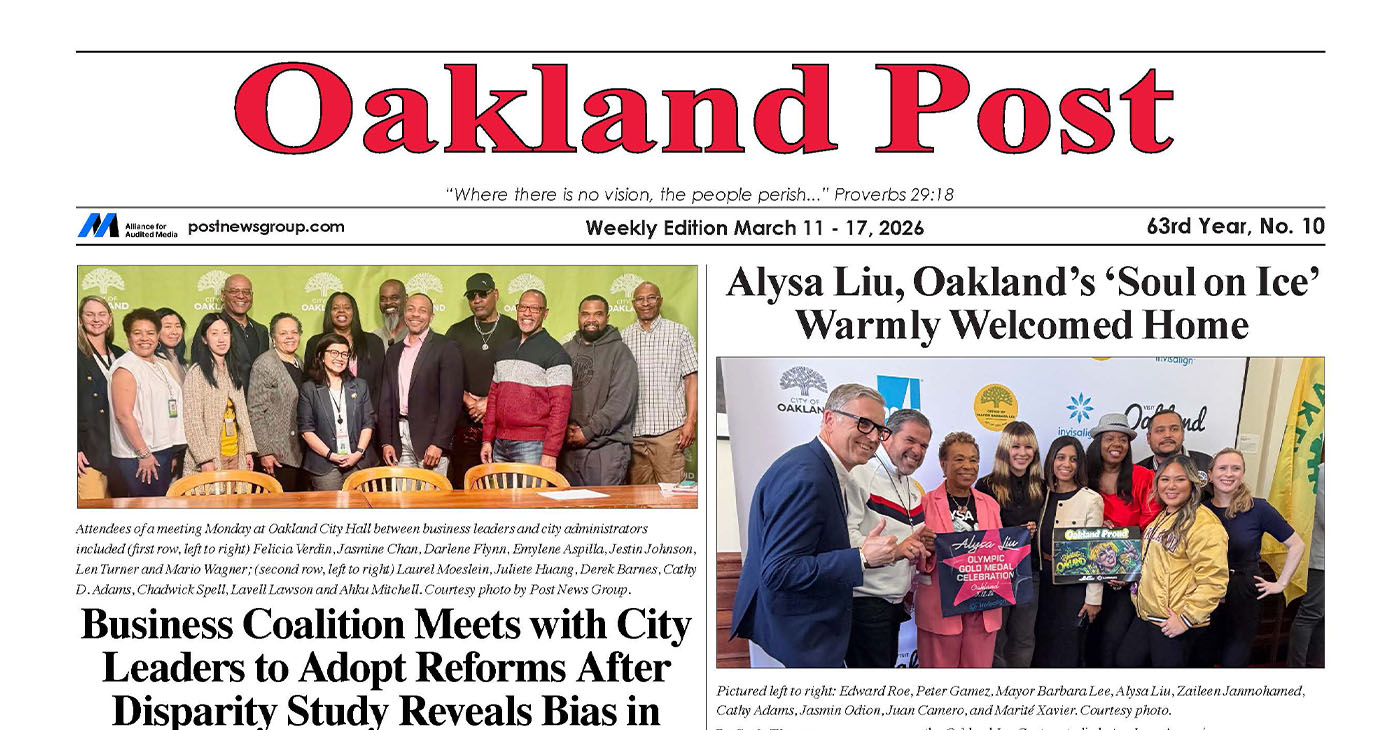
To enlarge your view of this issue, use the slider, magnifying glass icon or full page icon in the lower right corner of the browser window.
Activism
Oakland Post: Week of March 4 – 10, 2026
The printed Weekly Edition of the Oakland Post: Week of March 4 – 10, 2026

To enlarge your view of this issue, use the slider, magnifying glass icon or full page icon in the lower right corner of the browser window.

WORK FROM HOME
Home-based business with potential monthly income of $10K+ per month. A proven training system and website provided to maximize business effectiveness. Perfect job to earn side and primary income. Contact Lynne for more details: Lynne4npusa@gmail.com 800-334-0540


Black Artists in America, Installation Three Wraps at the Dixon Gallery and Gardens

Grief, Advocacy, and Education: A Counselor Reflects on Black Maternal Health

Future of Florida’s Black History Museum in Limbo

New Research Shows the Many Benefits of Early Learning

South Hampton K-8 Students Among Top 10 Finalists for Samsung’s ‘Solve for Tomorrow’ Competition

Cuba: No Negotiation with US on the President or Political System

Brooklyn Academy of Music Names Jamaican-Born Tamara McCaw as President

Trinidad & Tobego – U.S. Launches WhatsApp Channel for American Citizens in the Country

Oakland Post: Week of March 18 – 24, 2026

AI Innovation vs. Ethics and Environmental Impact

AI, Web3, and Digital Reparations

What If You Owned Your AI Agent?

Season 7, Episode 3 – January Reporter’s Roundtable 📱

Season 7, Episode 3 – January Reporter’s Roundtable

AI, Media, and Power | Part 2, Real-World Impacts and Tradeoffs

Discrimination in City Contracts

Oakland Post: Week of February 11 – 17, 2026

Reflecting on Black History Milestones in Birmingham AL

Rising Optimism Among Small And Middle Market Business Leaders Suggests Growth for California

CITY OF SAN LEANDRO STATE OF CALIFORNIA PUBLIC WORKS DEPARTMENT ENGINEERING DIVISION NOTICE TO BIDDERS FOR ANNUAL STREET OVERLAY/REHABILITATION 2019-21 – PHASE III

Oakland Post: Week of February 18 – 24, 2026

PRESS ROOM: NBA Hall of Fame Nominee Terry Cummings Joins 100 Black Men of DeKalb County to Launch Victory & Values Initiative

Oakland Post: Week of February 25 – March 3, 2026

U.S. manufacturing rebounds – how foundry services are adapting to rising demand

Trump’s MAGA Allies are Creating Executive Order Plan to Steal the 2026 Midterms

OP-ED: One Hundred Years of Black Workers Telling the Truth

Advancements in solar technology that are changing the way we power the world

Chase Oakland Community Center Hosts Alley-Oop Accelerator Building Community and Opportunity for Bay Area Entrepreneurs

PRESS ROOM: Civil Rights TV Launches in Selma as the World’s First 24/7 Civil Rights Television Network

Poll Shows Support for Policies That Help Families Afford Child Care

Hyundai Ioniq 5 Parking, Safety, and 360 View #shorts

2025 Ioniq 5 New Wiper & Powerful Performance! #shorts

Electric SUV Range: Is 259 Miles Enough? #shorts

EV Charging: How Fast Can You Charge an Electric Vehicle? #shorts

Biometric Cooling… Messaging Seats…Come on! 2025 Infiniti QX80 Autograph 4WD

Charged Up: Witness the Magic of a Fully Electric Car! #shorts

Range Rover Sport PHEV Included…: See What’s Inside This Luxury SUV! #shorts

Invisible Hood View: Perfect Parking with X-Ray Vision! #shorts

AI Is Reshaping Black Healthcare: Promise, Peril, and the Push for Improved Results in California

ESSAY: Technology and Medicine, a Primary Care Point of View

Sanctuary Cities

The RESISTANCE – FREEDOM NOW

STATE OF THE PEOPLE: Freddie

ECONOMIC BOYCOTT DAY!!!!!

I told You So

-
 #NNPA BlackPress4 weeks ago
Reflecting on Black History Milestones in Birmingham AL
-
 #NNPA BlackPress4 weeks ago
PRESS ROOM: NBA Hall of Fame Nominee Terry Cummings Joins 100 Black Men of DeKalb County to Launch Victory & Values Initiative
-
 Activism4 weeks ago
Oakland Post: Week of February 25 – March 3, 2026
-
 #NNPA BlackPress4 weeks ago
Trump’s MAGA Allies are Creating Executive Order Plan to Steal the 2026 Midterms
-
 #NNPA BlackPress4 weeks ago
OP-ED: One Hundred Years of Black Workers Telling the Truth
-
 #NNPA BlackPress4 weeks ago
Poll Shows Support for Policies That Help Families Afford Child Care
-

 Activism3 weeks ago
Oakland Post: Week of March 4 – 10, 2026
-

 #NNPA BlackPress3 weeks ago
Woman’s Search for Family’s Roots Leads to Ancestor John T. Ward – A Successful Entrepreneur and Conductor on the Underground Railroad
